Snapshot của cesanta/elk: 1.9k★ · C · Frontend. A low footprint JavaScript engine for embedded systems
Tóm tắt dựng từ metadata GitHub của chính dự án — chưa có bài review TopGit. Trang sẽ tự động cập nhật khi bài review đầy đủ được xuất bản.
VÌ SAO CHƯA CÓ REVIEW
TopGit viết bài đầy đủ cho repo có nhiều sao nhất và được yêu cầu nhiều nhất. Trang này là snapshot trong thời gian chờ — xem README gốc ở tab READ ME.
Elk is a tiny embeddable JavaScript engine that implements a small but usable
subset of ES6. It is designed for microcontroller development. Instead of
writing firmware code entirely in C/C++, Elk allows to add JavaScript
customisations to the firmware developed in C - which is a great way to let
customers to extend/customise device functionality.
Elk features include:
Cross platform. Works anywhere from 8-bit microcontrollers to 64-bit servers
Zero dependencies. Builds cleanly by ISO C or ISO C++ compilers
Easy to embed: just copy elk.c and elk.h to your source tree
Small and simple embedding API
Does not use malloc. Operates with a given memory buffer only
Small footprint: about 20KB on flash/disk, about 100 bytes RAM for core VM
No bytecode. Interprets JS code directly
Elk approach is different from other scripting environments like micropython,
which provide a complete JS API for everything. Elk is completely bare, it
does not even have a standard library. All required functionality is supposed
to be imported from C/C++ firmware, and JS code simply orchestrates things.
That leaves Elk very minimal and tunable.
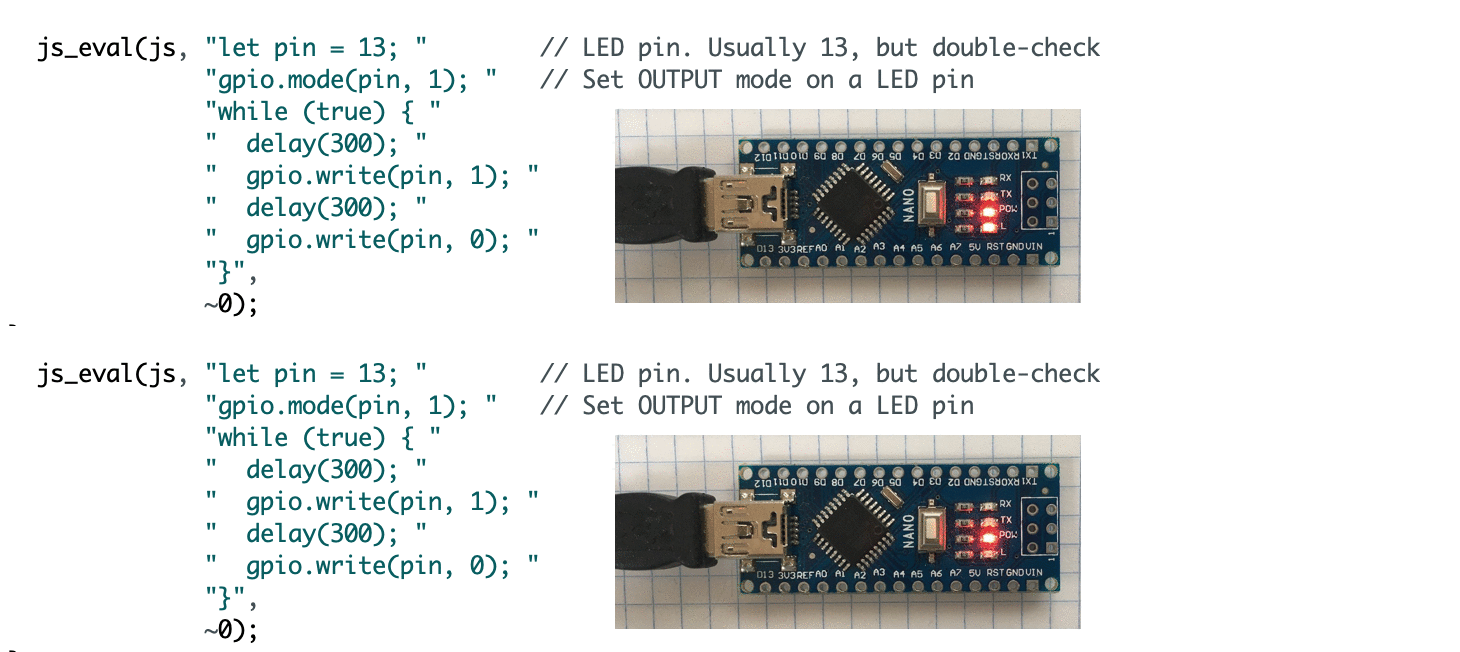
Below is a blinky demonstration on a classic Arduino Nano board which has
2K RAM and 30K flash (see full sketch):
JavaScript on ESP32
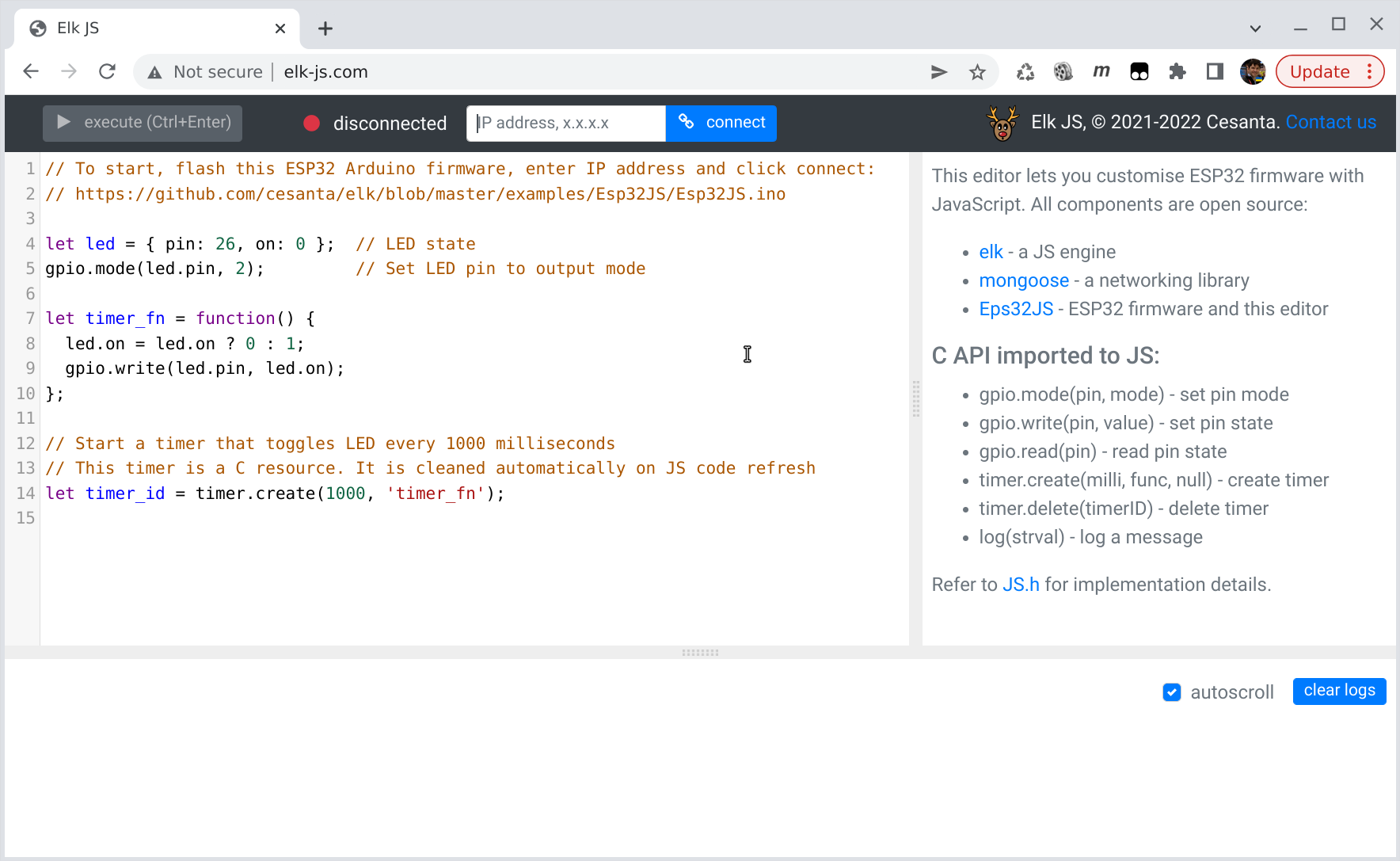
The Esp32JS Arduino sketch is an example of Elk integration
with ESP32. Flash this sketch on your ESP32 board, go to
https://cesanta.com/elk, and get a JavaScript development environment
instantly! All components, including ESP32 firmware and Web editor, are open.
Here how it looks like:
The example JS firmware implements a classic blinky that uses timers imported
from C.
This demonstrates how JS code can import and call existing C functions:
#include <stdio.h>
#include "elk.h"

// C function that adds two numbers. Will be called from JS
jsval_t sum(struct js *js, jsval_t *args, int nargs) {
  if (nargs != 2) return js_err(js, "2 args expected");
  double a = js_getnum(args[0]);  // Fetch 1st arg
  double b = js_getnum(args[1]);  // Fetch 2nd arg
  return js_mknum(a + b);
}

int main(void) {
  char mem[200];
  struct js *js = js_create(mem, sizeof(mem));      // Create JS instance
  js_set(js, js_glob(js), "sum", js_mkfun(sum)));   // Import sum()
  jsval_t result = js_eval(js, "sum(3, 4);", ~0U);  // Call sum
  printf("result: %s\n", js_str(js, result));       // result: 7
  return 0;
}
Supported features
Operations: all standard JS operations except:
!=, ==. Use strict comparison !==, ===
No computed member access a[b]
No exponentiation operation a ** b
Typeof: typeof('a') === 'string'
For loop: for (...;...;...) ...
Conditional: if (...) ... else ...
Ternary operator a ? b : c
Simple types: let a, b, c = 12.3, d = 'a', e = null, f = true, g = false;
Functions: let f = function(x, y) { return x + y; };
Objects: let obj = {f: function(x) { return x * 2}}; obj.f(3);
Every statement must end with a semicolon ;
Strings are binary data chunks, not Unicode strings: 'Київ'.length === 8
Not supported features
No var, no const. Use let (strict mode only)
No do, switch, while. Use for
No => functions. Use let f = function(...) {...};
No arrays, closures, prototypes, this, new, delete
No standard library: no Date, Regexp, Function, String, Number
Performance
Since Elk parses and interprets JS code on the fly, it is not meant to be
used in a performance-critical scenarios. For example, below are the numbers
for a simple loop code on a different architectures.
for (let i = 0; i < 100; i++) true;
// 97 milliseconds on a 16Mhz 8-bit Atmega328P (Arduino Uno and alike)
// 16 milliseconds on a 48Mhz SAMD21
//  5 milliseconds on a 133Mhz Raspberry RP2040
//  2 milliseconds on a 240Mhz ESP32
Build options
Available preprocessor definitions:
Name
Default
Description
JS_EXPR_MAX
20
Maximum tokens in expression. Expression evaluation function declares an on-stack array jsval_t stk[JS_EXPR_MAX];. Increase to allow very long expressions. Reduce to save C stack space.
JS_DUMP
undefined
Define to enable js_dump(struct js *) function which prints JS memory internals to stdout
Note: on ESP32 or ESP8266, compiled functions go into the .text ELF
section and subsequently into the IRAM MCU memory. It is possible to save
IRAM space by copying Elk code into the irom section before linking.
First, compile the object file, then rename .text section, e.g. for ESP32:
Note: Elk uses snprintf() standard function to format numbers (double).
On some architectures, for example AVR Arduino, that standard function does
not support float formatting - therefore printing numbers may output nothing
or ? symbols.
API reference
js_create()
struct js *js_create(void *buf, size_t len);
Initialize JS engine in a given memory block. Elk will only use that memory
block to hold its runtime, and never use any extra memory.
Return: a non-NULL opaque pointer on success, or NULL when
len is too small. The minimum len is about 100 bytes.
The given memory buffer is laid out in the following way:
  | <-------------------------------- len ------------------------------> |
  | struct js, ~100 bytes  |   runtime vars    |    free memory           |
Evaluate JS code in buf, len and return result of the evaluation. During
the evaluation, Elk stores variables in the "runtime" memory section. When
js_eval() returns, Elk does not keep any reference to the evaluated code: all
strings, functions, etc, are copied to the runtime.
Important note: the returned result is valid only before the next call to
js_eval(). The reason is that js_eval() triggers a garbage collection.
A garbage collection is mark-and-sweep, run before every top-level statement
gets executed.
The runtime footprint is as follows:
An empty object is 8 bytes
Each object property is 16 bytes
A string is 4 bytes + string length, aligned to 4 byte boundary
A C stack usage is ~200 bytes per nested expression evaluation
js_str()
const char *js_str(struct js *, jsval_t val);
Stringify JS value val and return a pointer to a 0-terminated result.
The string is allocated in the "free" memory section. If there is no
enough space there, an empty string is returned. The returned pointer
is valid until the next js_eval() call.
enum { JS_UNDEF, JS_NULL, JS_TRUE, JS_FALSE, JS_STR, JS_NUM, JS_ERR, JS_PRIV };
int js_type(jsval_t val);       // Return JS value type
double js_getnum(jsval_t val);  // Get number
int js_getbool(jsval_t val);    // Get boolean, 0 or 1
char *js_getstr(struct js *js, jsval_t val, size_t *len);  // Get string
Extract C values from JS values
js_chkargs()
bool js_chkargs(jsval_t *args, int nargs, const char *spec);
A helper function that checks a validity of the arguments passed to a function.
A spec is a 0-terminated string where each character represents a type of
the expected argument: b for bool, d for number, s for string, j
for any other JS value.
Usage example - a C function that implements a JS function
greater_than(number1, number2):
Return resource usage statistics: total for total usable JS memory, min
for the lowest free JS memory observed (low watermark), and cstacksize for
the largest C stack usage observed.
js_dump()
void js_dump(struct js *);
Print debug info about the current JS state to stdout. Requires -DJS_DUMP
LICENSE
Dual license: AGPLv3 or commercial. For commercial licensing, technical support
and integration help, please contact us at https://cesanta.com/contact.html
See also
Mongoose Web Server Library - a robust, open-source solution licensed under GPLv2, designed to seamlessly integrate web server functionality into your embedded devices.
With complementary Mongoose Wizard - a no-code visual tool that enables rapid WebUI creation without the need for frontend expertise.
cesanta/elk có 1.9k sao GitHub — tải lại trang để xem số mới nhất, hoặc xem trực tiếp github.com/cesanta/elk. TopGit phản chiếu số sao của GitHub nhưng không cam kết đến từng phút.
cesanta/elk có phải mã nguồn mở không?
TopGit chưa ghi nhận license cho cesanta/elk. Phần lớn repo public trên GitHub là mã nguồn mở, nhưng điều khoản khác nhau từng repo — mở file LICENSE để xác nhận.
cesanta/elk có website riêng không?
TopGit chưa ghi nhận URL trang chủ cho cesanta/elk. Phần README ở tab phía trên thường có link demo, hoặc xem mô tả GitHub của repo.
cesanta/elk là gì?
cesanta/elk (cesanta/elk) là dự án C trên GitHub. Theo mô tả gốc: A low footprint JavaScript engine for embedded systems
cesanta/elk so với các dự án Frontend khác thế nào?
cesanta/elk được TopGit xếp vào nhóm Frontend, với 1.9k sao GitHub và viết bằng C. Xem trang chủ đề Frontend trên TopGit để so sánh với các dự án tương tự theo số sao và mức độ hoạt động.
Cùng nhóm Frontend còn repo nào?
cesanta/elk thuộc nhóm Frontend trên TopGit, cùng 7 topic GitHub. Trang Trending và Topics liệt kê các repo cùng số sao và cùng ngôn ngữ để so sánh.
Đọc thêm về cesanta/elk ở đâu?
Trang TopGit này là một snapshot — tab "Readme" hiển thị nguyên văn README của repo (đã bỏ link, giữ ảnh). Repo GitHub ở github.com/cesanta/elk là nguồn chính thức.
Đọc đầy đủ README ở tab phía trên.
Vẫn đang phân vân về elk?
Một cú bấm sẽ gửi câu hỏi kèm trang này cho AI — xem AI nói gì về elk.
 /elk
/elk