TopGit theo dõi changkun/wallfacer trên GitHub trong nhóm Backend, đã đạt 78 sao. Chat, specs, tasks, and code. An autonomous engineering platform. Full autonomy when you trust it. Full control when you don't.
Tóm tắt dựng từ metadata GitHub của chính dự án — chưa có bài review TopGit. Trang sẽ tự động cập nhật khi bài review đầy đủ được xuất bản.
VÌ SAO CHƯA CÓ REVIEW
TopGit viết bài đầy đủ cho repo có nhiều sao nhất và được yêu cầu nhiều nhất. Trang này là snapshot trong thời gian chờ — xem README gốc ở tab READ ME.
Full autonomy when you trust it. Full control when you don't.
Wallfacer is an autonomous engineering platform that works across multiple levels of abstraction. Start with a conversation when you're exploring an idea. Move to specs when the shape becomes clear. Track tasks when it's time to execute. Drop into code when you need precision. Agents operate at every level, and you decide how much freedom they get.
Open source. Runs locally. No IDE lock-in. No cloud dependency. Bring your own LLM provider.
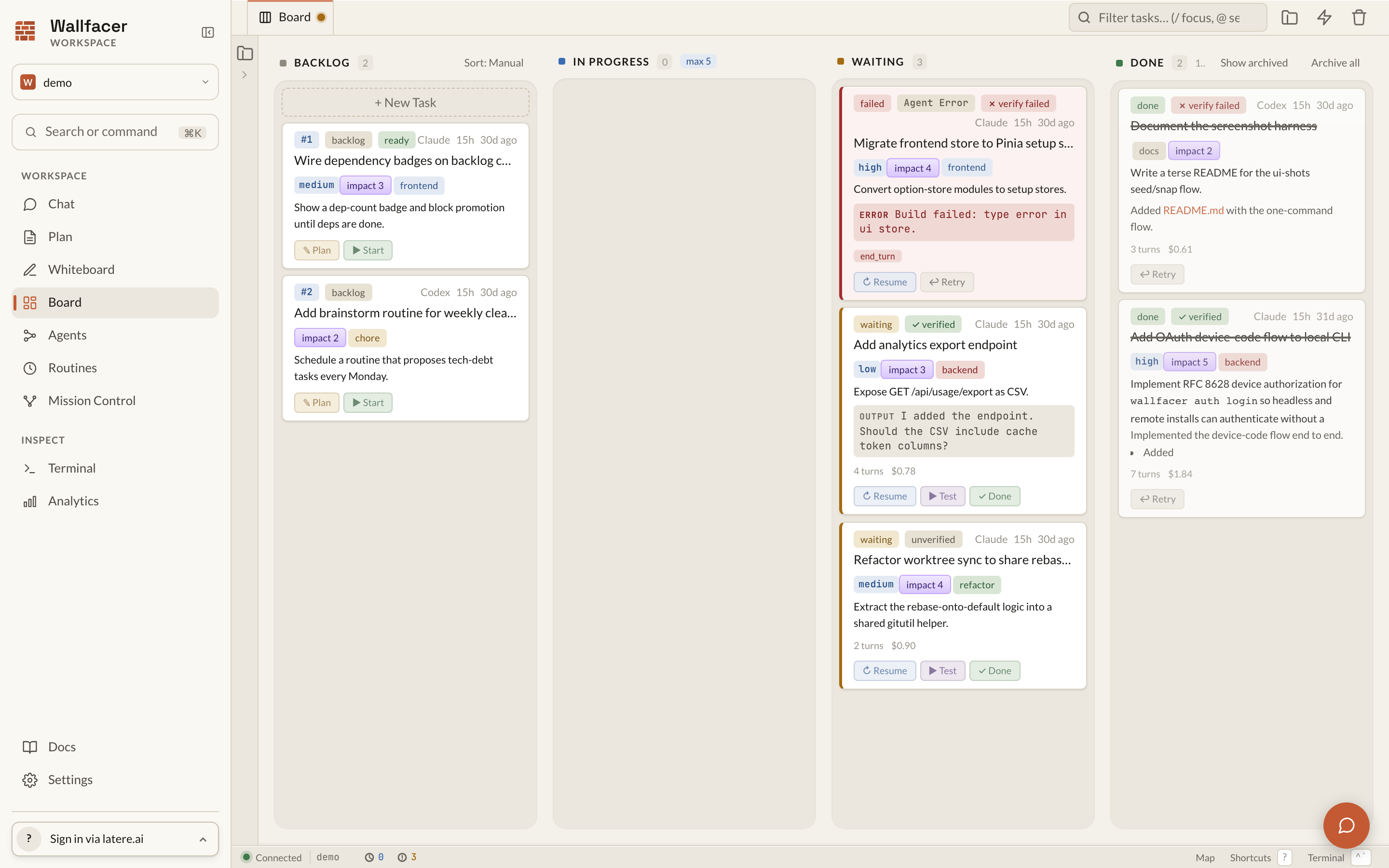
Task board: coordinate parallel agent execution
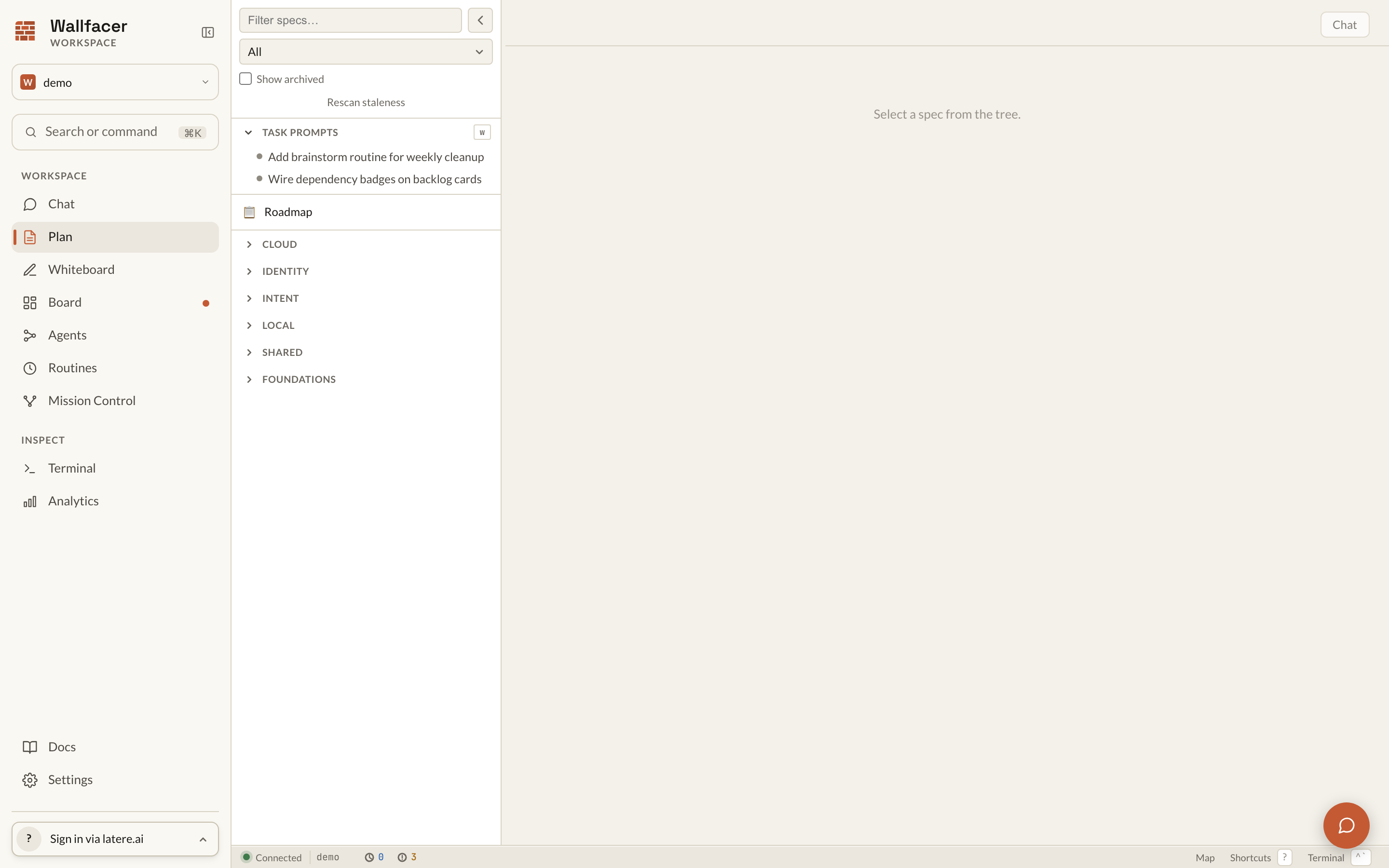
Plan mode: design before you build
Why Wallfacer
Every AI coding tool today pins you to one interaction mode. Chat-based tools are fast but lose structure at scale. Spec-driven tools add discipline but slow you down on day one. Task boards help you coordinate but don't understand your architecture. Wallfacer connects all of these into a continuous workflow.
Adaptive abstraction. Chat for greenfield exploration, specs for complex systems (a recursive tree of markdown specs that agents read, iterate on, break down, and dispatch as tasks), tasks for parallel execution, code for surgical edits. Move between levels as your project evolves.
Autonomy spectrum. Run the full loop autonomously (implement, test, commit, push) or step in at any point. Dial autonomy up or down per task, per spec, per project.
Spec as intermediate representation. Ideas don't go straight to code. They become structured specs that agents can reason about, iterate on, and implement against. Specs are versioned and reviewable.
Per-task git worktrees. Each task works in its own git worktree for safe parallel execution. Multiple agents work simultaneously without stepping on each other.
Operator visibility. Live logs, traces, timelines, diff review, and usage and cost tracking. A full audit trail from idea to merged code.
Self-development. Wallfacer builds Wallfacer. Most recent capabilities were developed by the system itself.
Harness flexibility. Works with Claude Code, Codex, Cursor, OpenCode, and Pi through a pluggable harness layer. Pick one per task or per agent role; not locked to any single provider.
Quick Start
Install:
curl -fsSL https://raw.githubusercontent.com/changkun/wallfacer/main/install.sh | sh
Check prerequisites:
wallfacer doctor
Start the server:
wallfacer run # execs your chosen harness CLI directly as a host process
A browser window opens automatically. Add your Claude credential (OAuth token via claude setup-token, or API key from console.anthropic.com) in Settings. See Getting Started for the full walkthrough.
Other commands: wallfacer status (print or watch board state), wallfacer spec (validate or scaffold specs), and wallfacer auth (cloud sign-in). Run wallfacer <command> -help for flags.
How It Works
Explore. Describe what you want to build in chat. Wallfacer helps you shape the idea.
Specify. The idea becomes a structured spec. Iterate on it until the design is right.
Execute. Specs break into tasks on a board. Agents implement, test, and commit in isolated git worktrees.
Ship. Reviewed changes merge automatically. Auto-commit, auto-push, and auto-build when you're ready.
Move left for more freedom and lower commitment; move right for more precision and higher commitment. Agents operate at every level, and autonomy dials up or down independently at each one. Specs move through a seven-state lifecycle (vague to drafted to validated to testing to complete, with stale and archived off to the side), and the planning chat exposes slash commands like /create, /validate, /break-down, and /dispatch to drive them.
Read more: Concepts, Plan, and Chat.
How execution is structured
Wallfacer runs every task through a small, composable set of primitives:
Agents are sub-roles (impl, test, commit-msg, title, oversight), each with a harness pin (Claude, Codex, Cursor, OpenCode, or Pi), capabilities, and an optional system prompt.
Flows compose agents into an ordered pipeline. The built-in is implement.
Tasks pick a flow; the runner walks the flow's step chain.
Routines spawn tasks against a flow on a schedule. A scheduled routine running an ordinary prompt covers recurring idea generation.
User-authored agents and fleets live as YAML under ~/.wallfacer/{agents,flows}/ and are edited on the unified Agent Graph surface (the old Agents and Flows pages merged into it). Clone a built-in to pin it to a harness, override its system prompt, or insert a review step, without restarting the server. Task prompts are refined in place from Plan mode.
Read more: Agent Graph.
Product Tour
Task board: managed execution
The board (shown above) coordinates many agent tasks at once. Drag cards across the lifecycle, batch-create with dependency wiring, refine prompts before execution, and let autoimplement promote backlog items as capacity opens. Each task runs as a host process in its own git worktree.
Plan mode: structured design
Design before you build (shown above). The three-pane plan view gives you an explorer tree (left), a focused markdown view (center), and the planning chat (right). Break large ideas into structured specs, validate dependencies, and dispatch leaf specs to the board when the design is right.
Oversight: an actionable audit trail
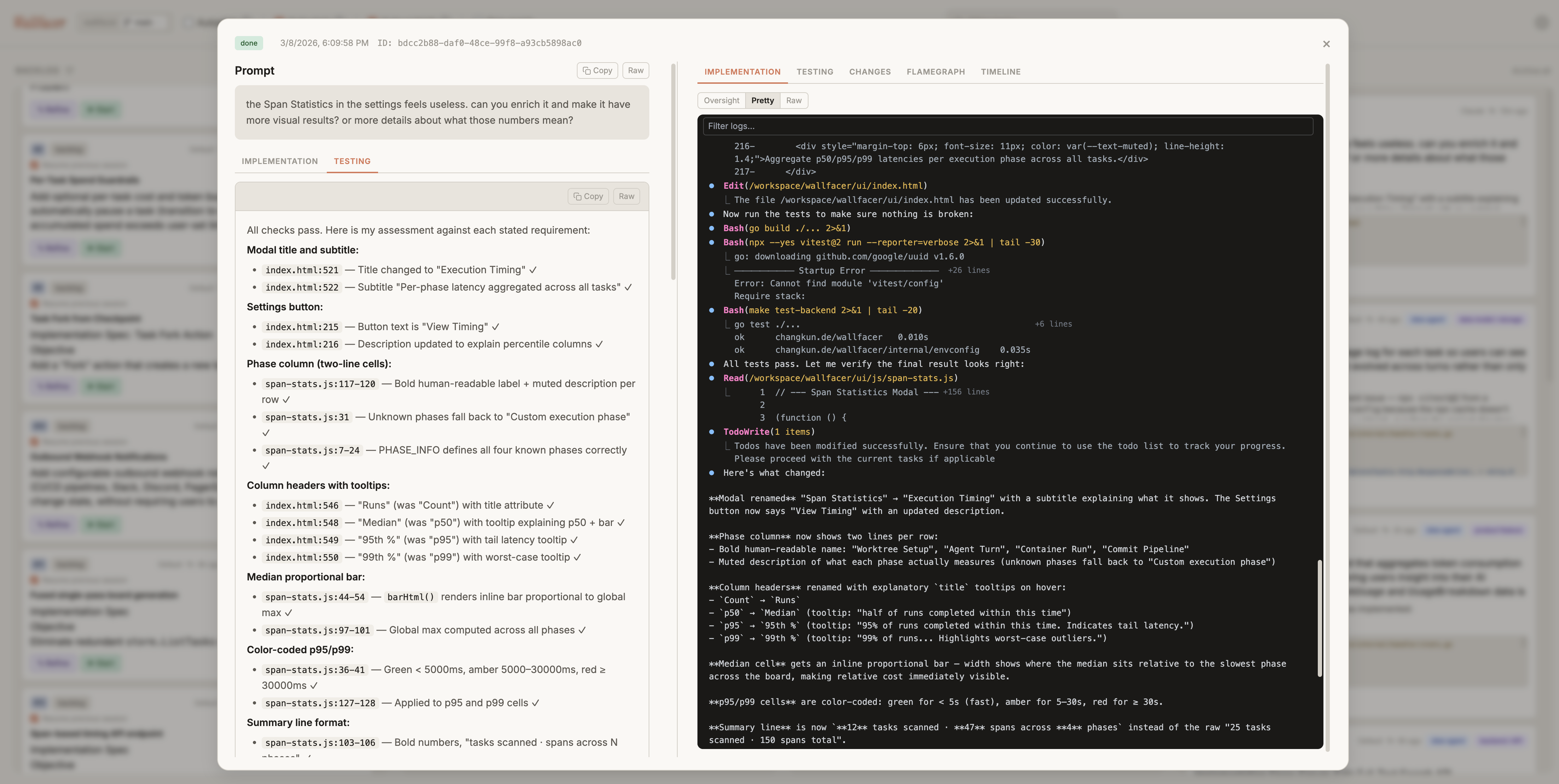
Inspect what happened, when, and why before you accept any automated output. Every task produces a structured event timeline, a diff against the default branch, and an AI-generated oversight summary.
Cost and usage visibility
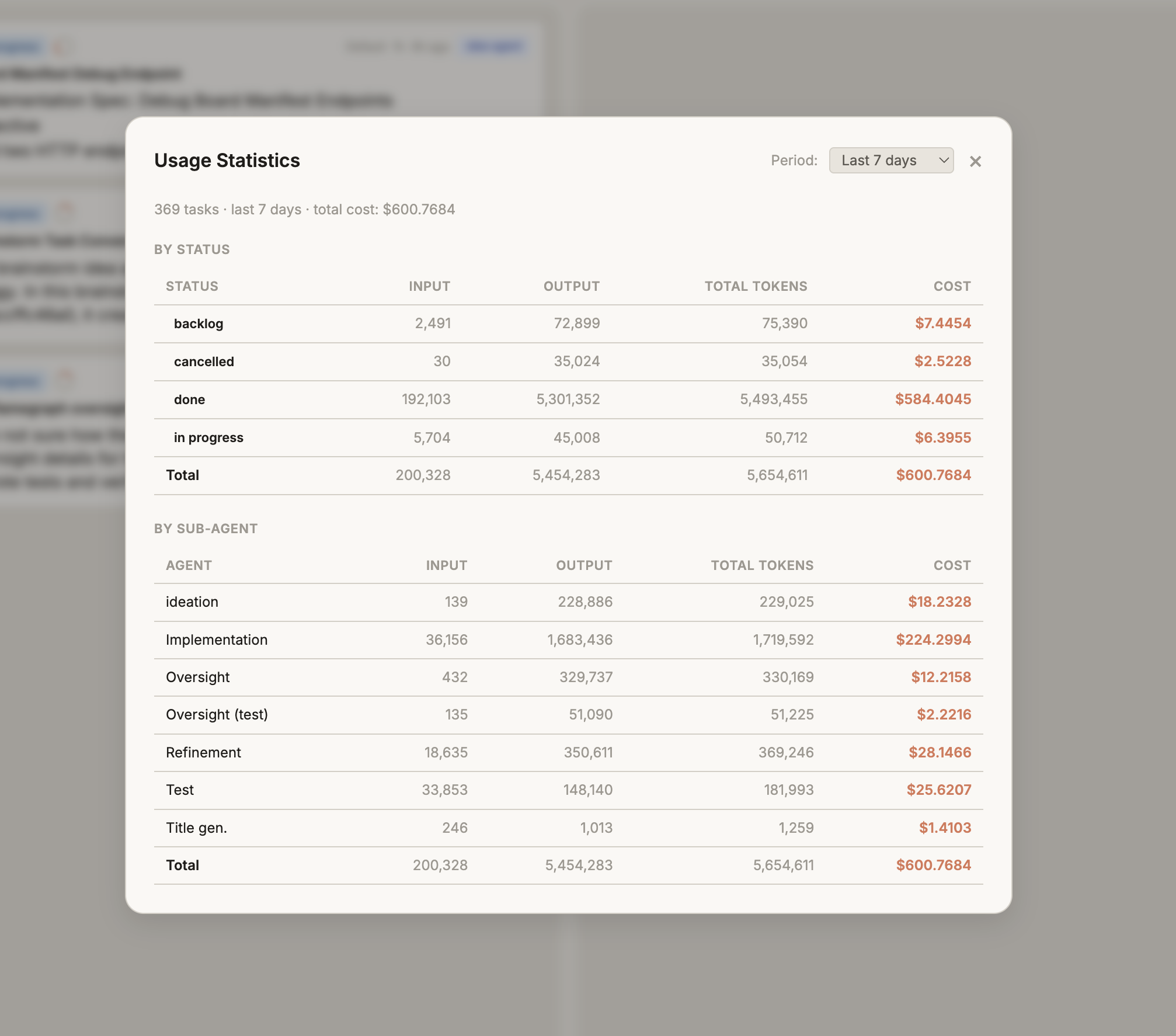
Track token usage and cost by task, activity, and turn, so operations stay measurable as automation scales. The per-activity breakdown (implementation, testing, refinement, oversight) shows exactly where budget goes.
Capability Stack
Chat. Planning chat with slash commands and file-explorer context, conversational drift away from or back into specs.
Code. File explorer with editor, integrated terminal, live logs and diff review, per-turn usage and timeline, native per-repo AGENTS.md/CLAUDE.md discovery.
Five composable sub-agent roles (each pinned to any installed harness) arrange into flows (implement, plus user-authored clones) that can be inspected or rewritten from the sidebar.
Roadmap
Development is organized into three parallel tracks with shared foundations. See specs/README.md for the full dependency graph and spec index.
Local Product: Developer workflow. Spec coordination (document model, planning UX, drift detection), agents and flows (composable sub-agent pipelines), routine tasks (scheduled spawns), file and image attachments, host mounts, oversight risk scoring, visual verification, live serve.
Cloud Platform: Two axes that consume Latere services rather than absorb them. Axis A, the coordination plane (signed-in local instances connect over one outbound connection for presence, spec comments, and metadata projection; local stays the source of truth). Axis B, demand-gated remote execution that dispatches task runtimes to Cella and stages workspace files through FS via the executor seam.
Contributing? See CONTRIBUTING.md for the developer orientation, build commands, and conventions.
Origin
Wallfacer started as a task board for coordinating concurrent agent runs and grew from there: spec coordination, oversight, refinement, an integrated IDE. Most recent capabilities were developed by Wallfacer itself. See docs/origin.md for the long version.
changkun/wallfacer có 78 sao GitHub — tải lại trang để xem số mới nhất, hoặc xem trực tiếp github.com/changkun/wallfacer. TopGit phản chiếu số sao của GitHub nhưng không cam kết đến từng phút.
Dự án có trang chủ ở https://wf.latere.ai/. Tab "Readme" ở trang này thường có ảnh chụp và hướng dẫn bắt đầu nhanh.
changkun/wallfacer còn đang phát triển không?
Commit gần nhất trên changkun/wallfacer là 21 ngày trước (theo timestamp GitHub). Repo có 9 fork — một chỉ báo về mức độ quan tâm của cộng đồng.
changkun/wallfacer dùng license gì?
changkun/wallfacer phát hành theo license MIT. Nên mở file LICENSE trên GitHub để xác nhận — license metadata đôi khi lệch với thực tế dự án.
changkun/wallfacer viết bằng ngôn ngữ gì?
changkun/wallfacer chủ yếu viết bằng Go. Trường "language" của GitHub dựa trên phần lớn byte ở nhánh mặc định.
Đọc thêm về changkun/wallfacer ở đâu?
Trang TopGit này là một snapshot — tab "Readme" hiển thị nguyên văn README của repo (đã bỏ link, giữ ảnh). Repo GitHub ở github.com/changkun/wallfacer là nguồn chính thức.
Đọc đầy đủ README ở tab phía trên.
wallfacer có đáng để bạn bỏ thời gian?
ChatGPT, Claude và Perplexity đều đọc được trang này. Hỏi thử xem họ nghĩ gì về wallfacer.
 /wallfacer