
crossoverJie/gscript

crossoverJie/gscript được TopGit xếp vào nhóm dự án backend, với 222 sao trên GitHub, viết chủ yếu bằng Go. 💪🏻This is a statically and strongly typed language written in Go.|GScript 是用 Go 编写的静态、强类型的脚本语言。
Tóm tắt dựng từ metadata GitHub của chính dự án — chưa có bài review TopGit. Trang sẽ tự động cập nhật khi bài review đầy đủ được xuất bản.
TopGit viết bài đầy đủ cho repo có nhiều sao nhất và được yêu cầu nhiều nhất. Trang này là snapshot trong thời gian chờ — xem README gốc ở tab READ ME.
Snapshot
Cộng tác viên hàng đầu
Xem cộng tác viên hàng đầu
 _     _
 ___ ___ ___ ___|_|___| |_
| . |_ -|  _|  _| | . |  _|
|_  |___|___|_| |_|  _|_|
|___|             |_|
🎮Play | 📘Features | 🌰Demo | 🔧Install | 👾REPL | 🎉Syntax | 🎁Standard library | 💡Contact Author | 🇨🇳中文
Introduction
This is a statically and strongly typed language written in Go, the syntax of Java and Go is referenced.
Target
Provides the ability to write Go language in script form, retains the advantages of Go language (goroutine, etc.), and adds more syntactic sugar for ease of use.
The current Alpha version is for study and experimentation only.
hello_world.gs:
println("hello world");
❯ gscript hello_world.gs
hello world
Playground
Online address: https://gscript.crossoverjie.top/
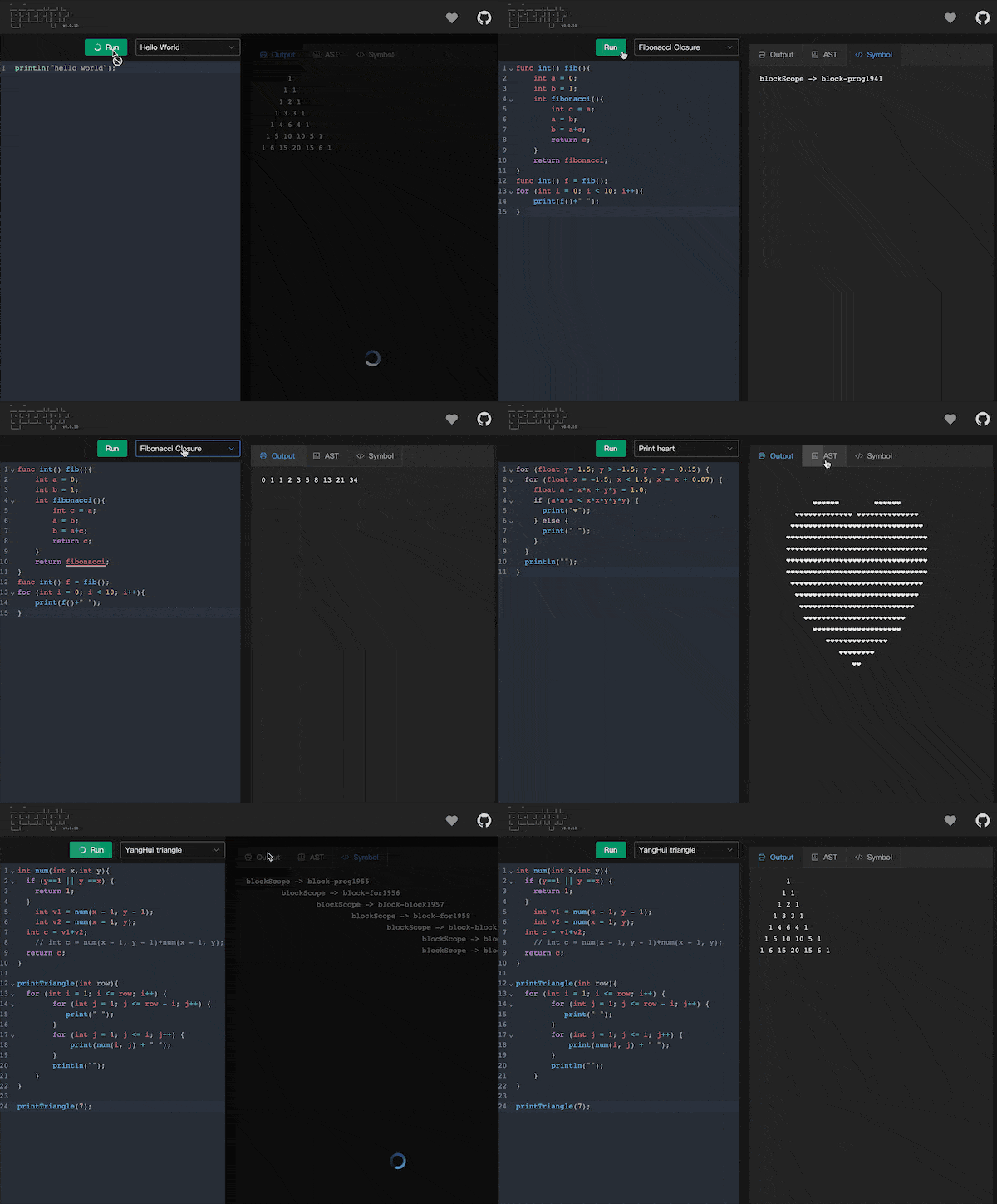
Source code:https://github.com/crossoverJie/gscript-homepage
Features
- Class declaration
- Function declaration and call
- Primitive type:
int/string/float/bool/byte - Array type
-
niltype -
anytype - Function type
- Closure:Functions as First-Class Objects
- Native function
- Standard library
- Map
- Variable arguments
- Operator overloading
- Native support
json - Native support
http - Example
- LeetCode
- LeetCode: Linked list cycle
- LeetCode: Two sum
- Print fibonacci
- Print YangHui triangle
- HTTP Service
- LeetCode
- PKG manager
- Unit Test command line
Demo
Hello world
println("hello world");
Print fibonacci
func int() fib(){
    int a = 0;
    int b = 1;
    int fibonacci(){
        int c = a;
        a = b;
        b = a+c;
        return c;
    }
    return fibonacci;
}

func int() f = fib();

for (int i = 0; i < 10; i++){
    println(f());
}
Webapp
This is a dynamic web application written in GScript.
https://gscript.crossoverjie.top/api/index
Source code: https://github.com/crossoverjie/gscript-homepage
YangHui triangle
int num(int x,int y){
	if (y==1 || y ==x) {
		return 1;
	}
    int v1 = num(x - 1, y - 1);
    int v2 = num(x - 1, y);
	int c = v1+v2;
    // int c = num(x - 1, y - 1)+num(x - 1, y);
	return c;
}

printTriangle(int row){
	for (int i = 1; i <= row; i++) {
        for (int j = 1; j <= row - i; j++) {
           print(" ");
        }
        for (int j = 1; j <= i; j++) {
            print(num(i, j) + " ");
        }
        println("");
    }
}

printTriangle(7);

// output:
      1
     1 1
    1 2 1
   1 3 3 1
  1 4 6 4 1
 1 5 10 10 5 1
1 6 15 20 15 6 1
More examples:https://github.com/crossoverJie/gscript/tree/main/example
Install
Binary
Download the latest binaries here
🐳Docker
docker pull crossoverjie/gscript
REPL
docker run --rm -it crossoverjie/gscript:latest gscript
Run script
docker run --rm -v $PWD:/usr/src/gscript -w /usr/src/gscript crossoverjie/gscript gscript {yourpath}/temp.gs
Build from Source Code
git clone https://github.com/crossoverJie/gscript.git
cd gscript
make build-code
./gscript
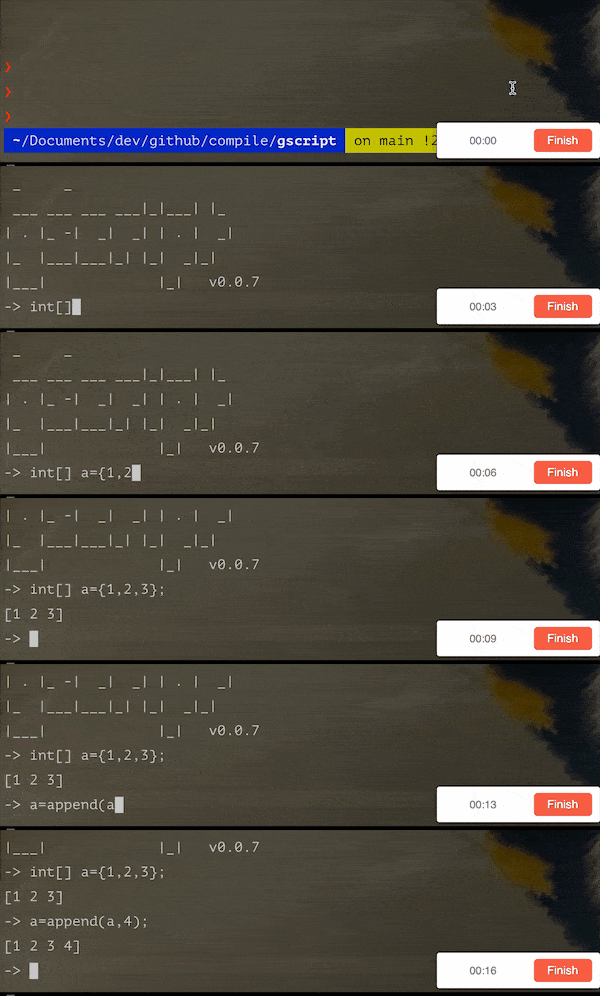
REPL
> ./gscript
Syntax
Primitive
The current version supports four primitive type: int/string/float/bool and nil type.
Variable declaration syntax: type identifier (= expr)?.
int a=10;
string b,c;
float e = 10.1;
bool f = false;
byte by = 1;
string x = ^
{
    "name": "bob",
    "age": 20,
    "skill": {
        "lang": [
            {
                "go": {
                    "feature": [
                        "goroutine",
                        true
                    ]
                }
            }
        ]
    }
}^
Array
Array declaration syntax: ('[' DECIMAL_LITERAL ']')? '{' (variableInitializer (',' variableInitializer)* (',')? )? '}'
// Declare and initialize
int[] a={1,2,3};
println(a);

// Declare an empty array and specify the length
int[] table = [4]{};

println("");
// Append data to array.
append(a,4);
println(a);
for(int i=0;i<len(a);i++){
	println(a[i]);
}

// Access to data by index.
int b=a[2];
println(b);

// byte array
string s = "10";
byte[] a= toByteArray(s);
printf("a=%v ",a);
string s1 = toString(a);
printf("s1=%s",s1);
assertEqual(s1,s);

// slice an array into a new array.
int[] a = {1,2,3};
int s=1;
int[] b = a[s:len(a)];
println(b);
// output: [2 3]
any type
An any type may hold values of all type.
any a =10;
println(a);

int fun1(any a,int b){
	return a+b;
}
int v =fun1(1,2);
println(v);
assertEqual(v,3);

any v2 = fun1(1,2);
println(v2);
assertEqual(v2,3);

int fun2(int a, any b){
	return a+b;
}
int v3 =fun2(1,2);
println(v3);
assertEqual(v3,3);

int fun3(any a, any b){
	return a+b;
}
int v4 =fun3(1,2);
println(v4);
assertEqual(v4,3);

int fun4(any a, any b){
	return a+b;
}
string v5 =fun4("10", "20");
println(v5);
assertEqual(v5,"1020");
Example: Standard library
Class
class ListNode{
    int value;
    ListNode next;
    ListNode(int v, ListNode n){
        value =v;
        next = n;
    }
}

// The new keyword is not required to call the constructor.
ListNode l1 = ListNode(1, nil);

// Using . to access object property or method.
println(l1.value);
The default comes with a parameterless constructor
class Person{
	int age=10;
	string name="abc";
	int getAge(){
		return 100+age;
	}
}

// parameterless constructor
Person xx= Person();
println(xx.age);
assertEqual(xx.age, 10);
println(xx.getAge());
assertEqual(xx.getAge(), 110);
function
// cycle linked list
bool hasCycle(ListNode head){
    if (head == nil){
        return false;
    }
    if (head.next == nil){
        return false;
    }

    ListNode fast = head.next;
    ListNode slow = head;
    bool ret = false;
    for (fast.next != nil){
        if (fast.next == nil){
            return false;
        }
        if (fast.next.next == nil){
            return false;
        }
        if (slow.next == nil){
            return false;
        }
        if (fast == slow){
            ret = true;
            return true;
        }

        fast = fast.next.next;
        slow = slow.next;
    }
    return ret;
}

ListNode l1 = ListNode(1, nil);
bool b1 =hasCycle(l1);
println(b1);
assertEqual(b1, false);

ListNode l4 = ListNode(4, nil);
ListNode l3 = ListNode(3, l4);
ListNode l2 = ListNode(2, l3);
bool b2 = hasCycle(l2);
println(b2);
assertEqual(b2, false);

l4.next = l2;
bool b3 = hasCycle(l2);
println(b3);
assertEqual(b3, true);
Function declaration syntax: typeTypeOrVoid? IDENTIFIER formalParameters ('[' ']')*
add(int a){}
When there is no return value, the return type can also be ignored.
Closure
Function type syntax: func typeTypeOrVoid '(' typeList? ')'
// External variable, global shared.
int varExternal =10;
func int(int) f1(){
	// Closure variable.
	int varInner = 20;
	int innerFun(int a){
		println(a);
		int c=100;
		varExternal++;
		varInner++;
		return varInner;
	}
	return innerFun;
}

// f2 is a function type, the return type and parameter are both int.
func int(int) f2 = f1();
for(int i=0;i<2;i++){
	println("varInner=" + f2(i) + ", varExternal=" + varExternal);
}
println("=======");
func int(int) f3 = f1();
for(int i=0;i<2;i++){
	println("varInner=" + f3(i) + ", varExternal=" + varExternal);
}
Output:
0
varInner=21, varExternal=11
1
varInner=22, varExternal=12
=======
0
varInner=21, varExternal=13
1
varInner=22, varExternal=14
Variable arguments
GScript also support variable arguments:
int add(string s, int ...num){
	println(s);
	int sum = 0;
	for(int i=0;i<len(num);i++){
		int v = num[i];
		sum = sum+v;
	}
	return sum;
}
int x = add("abc", 1,2,3,4);
println(x);
assertEqual(x, 10);
Operator overloading
Operator that Gscript support:
+-*/== != < <= > >=
Overloading function must be operator, and append operator.
class Person{
	int age;
	Person(int a){
		age = a;
	}
}
Person operator + (Person p1, Person p2){
	Person pp = Person(p1.age+p2.age);
	return pp;
}
Person operator - (Person p1, Person p2){
	Person pp = Person(p1.age-p2.age);
	return pp;
}
Person operator * (Person p1, Person p2){
	Person pp = Person(p1.age * p2.age);
	return pp;
}
Person operator / (Person p1, Person p2){
	Person pp = Person(p1.age / p2.age);
	return pp;
}
bool operator == (Person p1, Person p2){
	return p1.age==p2.age;
}
bool operator != (Person p1, Person p2){
	return p1.age!=p2.age;
}
bool operator > (Person p1, Person p2){
	return p1.age>p2.age;
}
bool operator >= (Person p1, Person p2){
	return p1.age>=p2.age;
}
bool operator < (Person p1, Person p2){
	return p1.age<p2.age;
}
bool operator <= (Person p1, Person p2){
	return p1.age<=p2.age;
}
Person p1 = Person(10);
Person p2 = Person(20);
//Person p3 =  operator(p1,p2);
Person p3 = p1+p2;
println("p3.age="+p3.age);
assertEqual(p3.age, 30);

Person p4 = p1-p2;
println("p4.age="+p4.age);
println(100-10);

Person p5 = p1*p2;
println("p5.age="+p5.age);
assertEqual(p5.age, 200);

Person p6 = p2/p1;
println("p6.age="+p6.age);
assertEqual(p6.age, 2);

bool b1 = p1 == p2;
println("b1=="+b1);
assertEqual(b1,false);

bool b2 = p1 != p2;
println("b2=="+b2);
assertEqual(b2,true);

bool b3 = p1 > p2;
println("b3=="+b3);
assertEqual(b3,false);

bool b4 = p1 >= p2;
println("b4=="+b4);
assertEqual(b4,false);

bool b5 = p1 < p2;
println("b5=="+b5);
assertEqual(b5,true);

bool b6 = p1 <= p2;
println("b6=="+b6);
assertEqual(b6,true);
More examples: https://github.com/crossoverJie/gscript/tree/main/example
Standard library
Standard library source code: https://github.com/crossoverJie/gscript/tree/main/internal
Native function
printf("hello %s ","123");
printf("hello-%s-%s ","123","abc");
printf("hello-%s-%d ","123",123);

string s = sprintf("nice to meet %s", "you");
println(s);
assertEqual(s,"nice to meet you");

int[] a={1,2,3};
// len return array length.
println(len(a));

// Append data to array.
append(a,4);
println(a);
// output: [1,2,3,4]

// Assert function
assertEqual(len(a),4);

// Return hashcode
int hashcode = hash(key);


// Serialize to JSON string.
class P{
	string name;
	P(string n){
		name = n;
	}
}
class Object{
	P p;
	int x;
	Object(P pp, int xx){
		p = pp;
		x = xx;
	}
}
P p1 = P("abc");
Object o1 = Object(p1, 100);
string json = JSON(o1);
println(json); //{"p":{"name":"abc"},"x":100}

// Query json with path
int x = JSONGet(json,"x");
println(x);
assertEqual(x,100);

string name = JSONGet(json,"p.name");
println(name);
assertEqual(name,"abc");

// Get command-line arguments.
System s = System();
string[] args = s.getOSArgs();
Reference JSON query syntax: xjson
Map
Function Definition
class Map{
	put(any key, any value){}
	any get(any key){}
}
Usage
int count =100;
Map m1 = Map();
for (int i=0;i<count;i++){
	string key = i+"";
	string value = key;
	m1.put(key,value);
}
println(m1.getSize());
assertEqual(m1.getSize(),count);

for (int i=0;i<count;i++){
	string key = i+"";
	string value = m1.get(key);
	println("key="+key+ ":"+ value);
	assertEqual(key,value);
}
StringBuilder
Function Definition
class StringBuilder{
	byte[] buf = [0]{};

	// append contents to buf, it returns the length of s
	int writeString(string s){}

	// append b to buf, it returns the length of b.
	int WriteBytes(byte[] b){}

	// copies the buffer to a new.
	grow(int n){}

	string String(){}
}
Usage
StringBuilder b = StringBuilder();
b.writeString("10");
b.writeString("20");
int l = b.writeString("30");
string s = b.String();
printf("s:%s, len=%d ",s,l);
assertEqual(s,"102030");
byte[] b2 = toByteArray("40");
b.WriteBytes(b2);
s = b.String();
assertEqual(s,"10203040");
println(s);
Strings
Function Definition
class Strings{
	// concatenates the elements of its first argument to create a single string. The separator
	// string sep is placed between elements in the resulting string.
	string join(string[] elems, string sep){}

	// tests whether the string s begins with prefix.
	bool hasPrefix(string s, string prefix){}
}
Usage
Strings s = Strings();
string[] elems = {"name=xxx","age=xx"};
string ret = s.join(elems, "&");
println(ret);
assertEqual(ret, "name=xxx&age=xx");

bool b = s.hasPrefix("http://www.xx.com", "http");
println(b);
assertEqual(b,true);
b = s.hasPrefix("http://www.xx.com", "https");
println(b);
assertEqual(b,false);
http
Standard library:
// http lib
// Response json
FprintfJSON(int code, string path, string json){}
// Resonse html
FprintfHTML(int code, string path, string html){}

// path (relative paths may omit leading slash)
string QueryPath(string path){}

string FormValue(string path, string key){}
class HttpContext{
    string path;
    JSON(int code, any v){
        string json = JSON(v);
        FprintfJSON(code, path, json);
    }
    HTML(int code, any v) {
        string html = v;
        FprintfHTML(code, path, html);
    }
    string queryPath() {
        string p = QueryPath(path);
        return p;
    }

    string formValue(string key){
        string v = FormValue(path, key);
        return v;
    }
}
// Bind route
httpHandle(string method, string path, func (HttpContext) handle){
    // println("path="+path);
    HttpContext ctx = HttpContext();
    handle(ctx);
}
// Run http server.
httpRun(string addr){}
Start http service:
class Person{
    string name;
}
func (HttpContext) handle (HttpContext ctx){
    Person p = Person();
    p.name = "abc";
    println("p.name=" + p.name);
    println("ctx=" + ctx);
    ctx.JSON(200, p);
}

func (HttpContext) handle1 (HttpContext ctx){
    Person p = Person();
    p.name = "def";
    println("p.name=" + p.name);
    println("ctx=" + ctx);
    ctx.JSON(200, p);
}
func (HttpContext) handle2 (HttpContext ctx){
    DateTime d = DateTime();
    string local = d.getCurrentTime("Asia/Shanghai","2006-01-02 15:04:05");
    println(local);
    string html =^
    <html>
    <title>hello</title>
    <h1>current ^+ local +^</h1>
    <p>hahaha</p>
    </html>
    ^;
    string queryPath = ctx.queryPath();
    println("queryPath = " + queryPath);

    // http://127.0.0.1:8000/p/2?id=100
    string id = ctx.formValue("id");
    println("id="+id);
    ctx.HTML(200, html);
}
httpHandle("get", "/p", handle);
httpHandle("get", "/p/1", handle1);
httpHandle("get", "/p/2", handle2);
httpRun(":8000");
Contact author
crossoverJie#gmail.com

Repo liên quan
golang/go is the open source repository behind The Go Programming Language, holding the compiler, runtime, and standard library source that Go's official binaries are built from. The README frames Go's purpose as building software that is simple, reliable, and efficient, credits the project to thousands of contributors, and notes that this GitHub repo mirrors the canonical Git repository at go.googlesource.com/go.
Awesome Go, maintained at avelino/awesome-go, groups Go frameworks, libraries, and software into topic categories including Actor Model, Artificial Intelligence, Audio and Music, Authentication and Authorization, Blockchain, Bot Building, and Build Automation. Every linked entry gets a short description instead of a bare URL. The repository carries an MIT license and takes new entries through pull requests reviewed against its own contribution guidelines, which makes it a common bookmark for day-to-day Go development.
Caddy's README promises automatic HTTPS, clustering and scale. Four Hacker News users say what held up and what did not.
Moby has 72,361 stars, but first-hand accounts are scarce: old GitHub issues, new networking complaints and a 2017 Hacker News launch thread.
Trả lời nhanh
crossoverJie/gscript có những chủ đề gì?
GitHub topics của crossoverJie/gscript: "antlr4", "compile", "go", "golang", "language", "programming-language". TopGit xếp repo vào nhóm Backend.
crossoverJie/gscript có phải mã nguồn mở không?
Có — crossoverJie/gscript phát hành theo license BSD-3-Clause, nghĩa là mã nguồn mở để đọc, fork và (tùy license) tái sử dụng. Mã: github.com/crossoverJie/gscript.
crossoverJie/gscript có trang demo không?
Dự án có trang chủ ở https://gscript.crossoverjie.top/. Tab "Readme" ở trang này thường có ảnh chụp và hướng dẫn bắt đầu nhanh.
crossoverJie/gscript còn đang phát triển không?
Commit gần nhất trên crossoverJie/gscript là 4.0 năm trước (theo timestamp GitHub). Repo có 25 fork — một chỉ báo về mức độ quan tâm của cộng đồng.
crossoverJie/gscript dùng license gì?
crossoverJie/gscript phát hành theo license BSD-3-Clause. Nên mở file LICENSE trên GitHub để xác nhận — license metadata đôi khi lệch với thực tế dự án.
Đọc thêm về crossoverJie/gscript ở đâu?
Trang TopGit này là một snapshot — tab "Readme" hiển thị nguyên văn README của repo (đã bỏ link, giữ ảnh). Repo GitHub ở github.com/crossoverJie/gscript là nguồn chính thức.
Đọc đầy đủ README ở tab phía trên.
gscript có đáng để bạn bỏ thời gian?
ChatGPT, Claude và Perplexity đều đọc được trang này. Hỏi thử xem họ nghĩ gì về gscript.