cvg/depthsplat

Snapshot của cvg/depthsplat: 1.2k★ · Python. [CVPR'25] DepthSplat: Connecting Gaussian Splatting and Depth
Tóm tắt dựng từ metadata GitHub của chính dự án — chưa có bài review TopGit. Trang sẽ tự động cập nhật khi bài review đầy đủ được xuất bản.
TopGit viết bài đầy đủ cho repo có nhiều sao nhất và được yêu cầu nhiều nhất. Trang này là snapshot trong thời gian chờ — xem README gốc ở tab READ ME.
Snapshot
Cộng tác viên hàng đầu
Xem cộng tác viên hàng đầu
DepthSplat: Connecting Gaussian Splatting and Depth
Haofei Xu · Songyou Peng · Fangjinhua Wang · Hermann Blum · Daniel Barath · Andreas Geiger · Marc Pollefeys
CVPR 2025
Paper | Project Page | Models
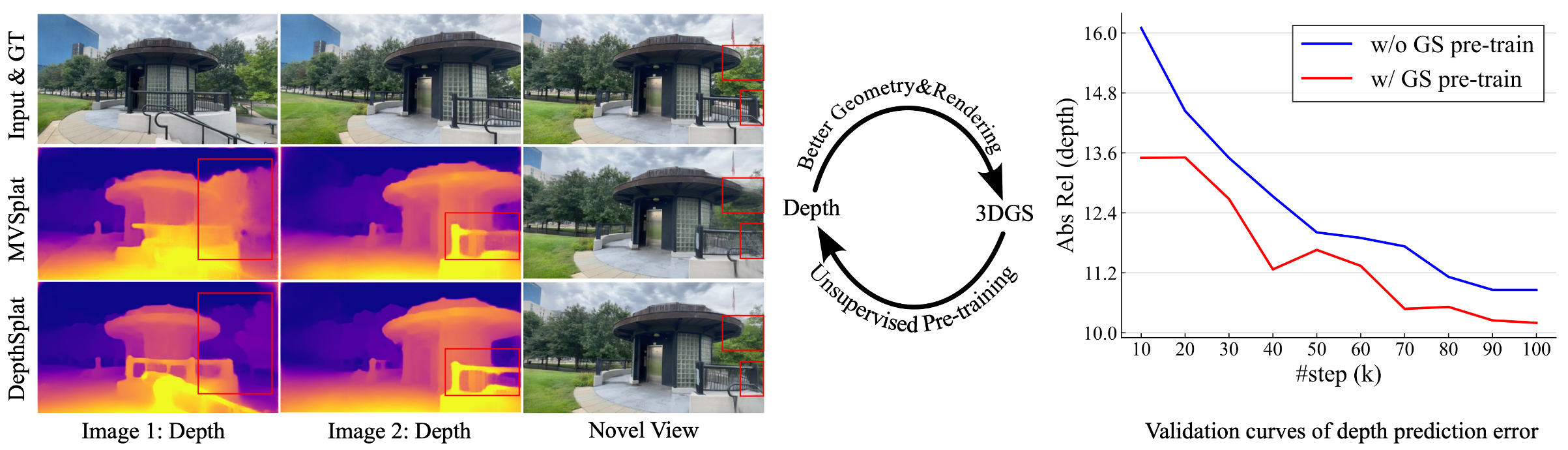
DepthSplat enables cross-task interactions between Gaussian splatting and depth estimation.
Left: Better depth leads to improved novel view synthesis with Gaussian splatting.
Right: Unsupervised depth pre-training with Gaussian splatting leads to reduced depth prediction error.
Updates
-
2026-03-31: Check out ReSplat for more compact and robust feed-forward Gaussian splatting models!
-
2025-03-27: We simplified our model architecture while preparing the CVPR camera-ready version. The models have been re-trained, and the paper has been updated accordingly. The new models are now simpler, faster, and perform as well as or better than the previous version.
Installation
Our code is developed using PyTorch 2.4.0, CUDA 12.4, and Python 3.10.
We recommend setting up a virtual environment using either conda or venv before installation:
# conda
conda create -y -n depthsplat python=3.10
conda activate depthsplat

# or venv
# python -m venv /path/to/venv/depthsplat
# source /path/to/venv/depthsplat/bin/activate

# installation
pip install torch==2.4.0 torchvision==0.19.0 --index-url https://download.pytorch.org/whl/cu124
pip install -r requirements.txt
Model Zoo
Our pre-trained models are hosted on Hugging Face 🤗.
Model details can be found at MODEL_ZOO.md.
Camera Conventions
The camera intrinsic matrices are normalized, with the first row divided by the image width and the second row divided by the image height.
The camera extrinsic matrices follow the OpenCV convention for camera-to-world transformation (+X right, +Y down, +Z pointing into the screen).
Datasets
For dataset preparation, please refer to DATASETS.md.
Gaussian Splatting
Useful configs
dataset.test_chunk_interval=1: Running on the full test set can be time-consuming due to the large number of scenes. You can run on a fraction of the test set for debugging or validation purposes. For example, settingdataset.test_chunk_interval=10will evaluate on 1/10 of the full test set.output_dir=outputs/depthsplat: Directory to save the results.test.save_image=true: Save the rendered images.test.save_gt_image=true: Save the ground truth (GT) images.test.save_input_images=true: Save the input images.test.save_depth=true: Save the predicted depths.test.save_depth_concat_img=true: Save the concatenated images and depths.test.save_depth_npy=true: Save the raw depth predictions in.npy.test.save_gaussian=true: Save the reconstructed Gaussians in.plyfiles, which can be viewed using online viewers like SuperSplat, Antimatter15, etc.
Rendering Video
DepthSplat enables feed-forward reconstruction from 12 input views (512x960 resolutions) in 0.6 seconds on a single A100 GPU.
RealEstate10K
6 input views at 512x960 resolutions: click to expand the script
- A preprocessed subset is provided to quickly run inference with our model, please refer to the details in DATASETS.md.
# render video on re10k (need to have ffmpeg installed)
CUDA_VISIBLE_DEVICES=0 python -m src.main +experiment=dl3dv \
dataset.test_chunk_interval=1 \
dataset.roots=[datasets/re10k_720p] \
dataset.image_shape=[512,960] \
dataset.ori_image_shape=[720,1280] \
model.encoder.num_scales=2 \
model.encoder.upsample_factor=4 \
model.encoder.lowest_feature_resolution=8 \
model.encoder.monodepth_vit_type=vitb \
model.encoder.gaussian_adapter.gaussian_scale_max=0.1 \
checkpointing.pretrained_model=pretrained/depthsplat-gs-base-re10kdl3dv-448x768-randview2-6-f8ddd845.pth \
mode=test \
dataset/view_sampler=evaluation \
dataset.view_sampler.num_context_views=6 \
dataset.view_sampler.index_path=assets/re10k_ctx_6v_video.json \
test.save_video=true \
test.compute_scores=false \
test.render_chunk_size=10 \
output_dir=outputs/depthsplat-re10k-512x960
https://github.com/user-attachments/assets/3f228a3f-8d54-4a90-9db4-ff0874150883
2 input views at 256x256 resolutions:
# render video on re10k (need to have ffmpeg installed)
CUDA_VISIBLE_DEVICES=0 python -m src.main +experiment=re10k \
dataset.test_chunk_interval=100 \
model.encoder.num_scales=2 \
model.encoder.upsample_factor=2 \
model.encoder.lowest_feature_resolution=4 \
model.encoder.monodepth_vit_type=vitl \
checkpointing.pretrained_model=pretrained/depthsplat-gs-large-re10k-256x256-view2-e0f0f27a.pth \
mode=test \
dataset/view_sampler=evaluation \
dataset.view_sampler.index_path=assets/evaluation_index_re10k_video.json \
test.save_video=true \
test.compute_scores=false
output_dir=outputs/depthsplat-re10k
DL3DV
12 input views at 512x960 resolutions:
-
A preprocessed subset is provided to quickly run inference with our model, please refer to the details in DATASETS.md.
-
Tip: use
test.stablize_camera=trueto stablize the camera trajectory.
# render video on dl3dv (need to have ffmpeg installed)
CUDA_VISIBLE_DEVICES=0 python -m src.main +experiment=dl3dv \
dataset.test_chunk_interval=1 \
dataset.roots=[datasets/dl3dv_960p] \
dataset.image_shape=[512,960] \
dataset.ori_image_shape=[540,960] \
model.encoder.upsample_factor=8 \
model.encoder.lowest_feature_resolution=8 \
model.encoder.gaussian_adapter.gaussian_scale_max=0.1 \
checkpointing.pretrained_model=pretrained/depthsplat-gs-small-re10kdl3dv-448x768-randview4-10-c08188db.pth \
mode=test \
dataset/view_sampler=evaluation \
dataset.view_sampler.num_context_views=12 \
dataset.view_sampler.index_path=assets/dl3dv_start_0_distance_100_ctx_12v_video.json \
test.save_video=true \
test.stablize_camera=true \
test.compute_scores=false \
test.render_chunk_size=10 \
output_dir=outputs/depthsplat-dl3dv-512x960
https://github.com/user-attachments/assets/ea6d3b9c-af80-43e6-9a12-36c67e874366
Evaluation
RealEstate10K
Evaluation scripts (small, base, and large models)
Please note that the numbers may differ slightly from those reported in the paper, as the models have been re-trained.
- To evalute the large model:
# Table 1 of depthsplat paper
CUDA_VISIBLE_DEVICES=0 python -m src.main +experiment=re10k \
dataset.test_chunk_interval=1 \
model.encoder.num_scales=2 \
model.encoder.upsample_factor=2 \
model.encoder.lowest_feature_resolution=4 \
model.encoder.monodepth_vit_type=vitl \
checkpointing.pretrained_model=pretrained/depthsplat-gs-large-re10k-256x256-view2-e0f0f27a.pth \
mode=test \
dataset/view_sampler=evaluation
- To evaluate the base model:
# Table 1 of depthsplat paper
CUDA_VISIBLE_DEVICES=0 python -m src.main +experiment=re10k \
dataset.test_chunk_interval=1 \
model.encoder.num_scales=2 \
model.encoder.upsample_factor=2 \
model.encoder.lowest_feature_resolution=4 \
model.encoder.monodepth_vit_type=vitb \
checkpointing.pretrained_model=pretrained/depthsplat-gs-base-re10k-256x256-view2-ca7b6795.pth \
mode=test \
dataset/view_sampler=evaluation
- To evaluate the small model:
# Table 1 of depthsplat paper
CUDA_VISIBLE_DEVICES=0 python -m src.main +experiment=re10k \
dataset.test_chunk_interval=1 \
model.encoder.upsample_factor=4 \
model.encoder.lowest_feature_resolution=4 \
checkpointing.pretrained_model=pretrained/depthsplat-gs-small-re10k-256x256-view2-cfeab6b1.pth \
mode=test \
dataset/view_sampler=evaluation
DL3DV
Evaluation scripts (6, 4, 2 input views, and zero-shot generalization)
- 6 input views:
# Table 7 of depthsplat paper
CUDA_VISIBLE_DEVICES=0 python -m src.main +experiment=dl3dv \
mode=test \
dataset/view_sampler=evaluation \
dataset.view_sampler.num_context_views=6 \
dataset.view_sampler.index_path=assets/dl3dv_start_0_distance_50_ctx_6v_video_0_50.json \
model.encoder.num_scales=2 \
model.encoder.upsample_factor=4 \
model.encoder.lowest_feature_resolution=8 \
model.encoder.monodepth_vit_type=vitb \
checkpointing.pretrained_model=pretrained/depthsplat-gs-base-dl3dv-256x448-randview2-6-02c7b19d.pth
- 4 input views:
# Table 7 of depthsplat paper
CUDA_VISIBLE_DEVICES=0 python -m src.main +experiment=dl3dv \
mode=test \
dataset/view_sampler=evaluation \
dataset.view_sampler.num_context_views=4 \
dataset.view_sampler.index_path=assets/dl3dv_start_0_distance_50_ctx_4v_video_0_50.json \
model.encoder.num_scales=2 \
model.encoder.upsample_factor=4 \
model.encoder.lowest_feature_resolution=8 \
model.encoder.monodepth_vit_type=vitb \
checkpointing.pretrained_model=pretrained/depthsplat-gs-base-dl3dv-256x448-randview2-6-02c7b19d.pth
- 2 input views:
# Table 7 of depthsplat paper
CUDA_VISIBLE_DEVICES=0 python -m src.main +experiment=dl3dv \
mode=test \
dataset/view_sampler=evaluation \
dataset.view_sampler.num_context_views=2 \
dataset.view_sampler.index_path=assets/dl3dv_start_0_distance_50_ctx_2v_video_0_50.json \
model.encoder.num_scales=2 \
model.encoder.upsample_factor=4 \
model.encoder.lowest_feature_resolution=8 \
model.encoder.monodepth_vit_type=vitb \
checkpointing.pretrained_model=pretrained/depthsplat-gs-base-dl3dv-256x448-randview2-6-02c7b19d.pth
- Zero-shot generalization from RealEstate10K to DL3DV:
# Table 8 of depthsplat paper
CUDA_VISIBLE_DEVICES=0 python -m src.main +experiment=dl3dv \
mode=test \
dataset/view_sampler=evaluation \
dataset.view_sampler.num_context_views=2 \
dataset.view_sampler.index_path=assets/dl3dv_start_0_distance_10_ctx_2v_tgt_4v.json \
model.encoder.num_scales=2 \
model.encoder.upsample_factor=2 \
model.encoder.lowest_feature_resolution=4 \
model.encoder.monodepth_vit_type=vitl \
checkpointing.pretrained_model=pretrained/depthsplat-gs-large-re10k-256x256-view2-e0f0f27a.pth
ACID
Evaluation scripts (zero-shot generalization)
- Zero-shot generalization from RealEstate10K to ACID:
# Table 8 of depthsplat paper
CUDA_VISIBLE_DEVICES=0 python -m src.main +experiment=re10k \
mode=test \
dataset.roots=[datasets/acid] \
dataset.view_sampler.index_path=assets/evaluation_index_acid.json \
dataset/view_sampler=evaluation \
dataset.view_sampler.num_context_views=2 \
model.encoder.num_scales=2 \
model.encoder.upsample_factor=2 \
model.encoder.lowest_feature_resolution=4 \
model.encoder.monodepth_vit_type=vitl \
checkpointing.pretrained_model=pretrained/depthsplat-gs-large-re10k-256x256-view2-e0f0f27a.pth
Training
- Before training, you need to download the pre-trained UniMatch and Depth Anything V2 weights, and set up your wandb account (in particular, by setting
wandb.entity=YOUR_ACCOUNT) for logging.
wget https://s3.eu-central-1.amazonaws.com/avg-projects/unimatch/pretrained/gmflow-scale1-things-e9887eda.pth -P pretrained
wget https://huggingface.co/depth-anything/Depth-Anything-V2-Small/resolve/main/depth_anything_v2_vits.pth -P pretrained
- By default, we train our models using four GH200 GPUs (96GB VRAM each). However, this is not a strict requirement—our model can be trained on different GPUs as well. For example, we have verified that configurations such as four RTX 4090 GPUs (24GB VRAM each) or a single A100 GPU (80GB VRAM) can achieve very similar results, with a PSNR difference of at most 0.1 dB. Just ensure that the total number of training samples, calculated as (number of GPUs ×
data_loader.train.batch_size×trainer.max_steps), remains the same. Check out the scripts scripts/re10k_depthsplat_train.sh and scripts/dl3dv_depthsplat_train.sh for details.
Depth Prediction
We fine-tune our Gaussian Splatting pre-trained depth model using ground-truth depth supervision. The depth models are trained with a randomly selected number of input images (ranging from 2 to 8) and can be used for depth prediction from multi-view posed images. For more details, please refer to scripts/inference_depth.sh.

Citation
@inproceedings{xu2024depthsplat,
      title   = {DepthSplat: Connecting Gaussian Splatting and Depth},
      author  = {Xu, Haofei and Peng, Songyou and Wang, Fangjinhua and Blum, Hermann and Barath, Daniel and Geiger, Andreas and Pollefeys, Marc},
      booktitle={CVPR},
      year={2025}
    }
Acknowledgements
This project is developed with several fantastic repos: pixelSplat, MVSplat, MVSplat360, UniMatch, Depth Anything V2 and DL3DV. We thank the original authors for their excellent work.
Repo liên quan
Master programming by recreating your favorite technologies from scratch.
A curated meta-list of curated lists organized by technology domain. The repository acts as a directory pointing to hundreds of specialized awesome lists covering programming languages, platforms, frameworks, and tooling. All content is community-contributed under the CC0 public domain dedication.
Public APIs is a community-curated GitHub repository listing free, publicly accessible APIs across a wide range of categories, with auth type, HTTPS, and CORS noted for each entry. It's a browsable reference, not a library to install.
freeCodeCamp is a free, self-paced curriculum for learning to code, published as open source at freeCodeCamp/freeCodeCamp. It's a 501(c)(3) nonprofit funded by donor support, structured around six certifications in its Full-Stack Developer Curriculum, each gated by required projects instead of open-book quizzes. The repository also carries beta language certifications for developers, interview-prep resources, and the code that runs the live freecodecamp.org platform.
Trả lời nhanh
cvg/depthsplat có bao nhiêu sao?
cvg/depthsplat có 1.2k sao GitHub — tải lại trang để xem số mới nhất, hoặc xem trực tiếp github.com/cvg/depthsplat. TopGit phản chiếu số sao của GitHub nhưng không cam kết đến từng phút.
cvg/depthsplat có phải mã nguồn mở không?
Có — cvg/depthsplat phát hành theo license MIT, nghĩa là mã nguồn mở để đọc, fork và (tùy license) tái sử dụng. Mã: github.com/cvg/depthsplat.
cvg/depthsplat có trang demo không?
Dự án có trang chủ ở https://haofeixu.github.io/depthsplat/. Tab "Readme" ở trang này thường có ảnh chụp và hướng dẫn bắt đầu nhanh.
cvg/depthsplat là gì?
cvg/depthsplat (cvg/depthsplat) là dự án Python trên GitHub. Theo mô tả gốc: [CVPR'25] DepthSplat: Connecting Gaussian Splatting and Depth
Đọc thêm về cvg/depthsplat ở đâu?
Trang TopGit này là một snapshot — tab "Readme" hiển thị nguyên văn README của repo (đã bỏ link, giữ ảnh). Repo GitHub ở github.com/cvg/depthsplat là nguồn chính thức.
Đọc đầy đủ README ở tab phía trên.
depthsplat có đáng để bạn bỏ thời gian?
ChatGPT, Claude và Perplexity đều đọc được trang này. Hỏi thử xem họ nghĩ gì về depthsplat.