136 sao GitHub và vẫn tăng — deezer/linear_graph_autoencoders là dự án Python mà TopGit đang theo dõi trên nền tảng. Source code from the NeurIPS 2019 workshop article "Keep It Simple: Graph Autoencoders Without Graph Convolutional Networks" (G. Salha, R. Hennequin, M. Vazirgiannis) + k-core framework implementation from IJCAI 2019 article "A Degeneracy Framework for Scalable Graph Autoencoders" (G. Salha, R. Hennequin, V.A. Tran, M. Vazirgiannis)
Tóm tắt dựng từ metadata GitHub của chính dự án — chưa có bài review TopGit. Trang sẽ tự động cập nhật khi bài review đầy đủ được xuất bản.
VÌ SAO CHƯA CÓ REVIEW
TopGit viết bài đầy đủ cho repo có nhiều sao nhất và được yêu cầu nhiều nhất. Trang này là snapshot trong thời gian chờ — xem README gốc ở tab READ ME.
This repository provides Python (Tensorflow) code to reproduce experiments from the article Keep It Simple: Graph Autoencoders Without Graph Convolutional Networks presented at the NeurIPS 2019 Workshop on Graph Representation Learning.
Update: an extended conference version of this article is now available here: Simple and Effective Graph Autoencoders with One-Hop Linear Models (accepted at ECML-PKDD 2020).
Update 2: do you prefer PyTorch? An implementation of Linear Graph AE and VAE is now available in the pytorch_geometric project! See the example here.
Introduction
We release Tensorflow implementations of the following two graph embedding models from the paper:
Linear Graph Autoencoders
Linear Graph Variational Autoencoders
together with standard Graph Autoencoders (AE) and Graph Variational Autoencoders (VAE) models (with 2-layer or 3-layer Graph Convolutional Networks encoders) from Kipf and Welling (2016).
We evaluate all models on the link prediction and node clustering tasks introduced in the paper. We provide the Cora, Citeseer and Pubmed datasets in the data folder, and refer to section 4 of the paper for direct link to the additional datasets used in our experiments.
Our code builds upon Thomas Kipf's original Tensorflow implementation of standard Graph AE/VAE.
Scaling-Up Graph AE and VAE
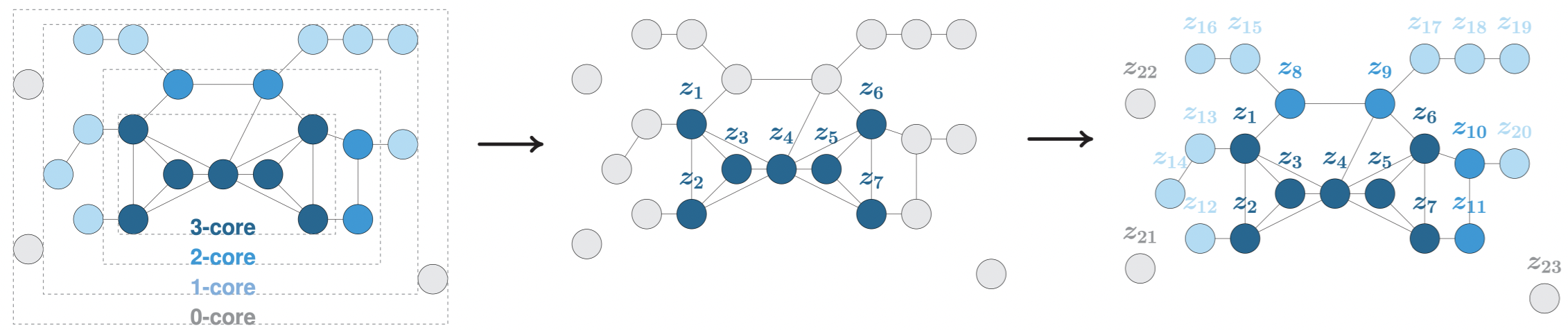
Standard Graph AE and VAE models suffer from scalability issues. In order to scale them to large graphs with millions of nodes and egdes, we also provide an implementation of our framework from the article A Degeneracy Framework for Scalable Graph Autoencoders (IJCAI 2019). In this paper, we propose to train the graph AE/VAE only from a dense subset of nodes, namely the k-core or k-degenerate subgraph. Then, we propagate embedding representations to the remaining nodes using faster heuristics.
Update: in this other repository, we provide an implementation of FastGAE, a new (and more effective) method from our group to scale Graph AE and VAE.
The above commands will train a standard Graph VAE with 2-layer GCN encoders (line 2) and a Linear Graph VAE (line 3) on Cora dataset and will evaluate embeddings on the Link Prediction task, with all parameters set to default values.
By adding --kcore=True, the model will only be trained on the k-core subgraph instead of using the entire graph. Here, k is a parameter (from 0 to the maximal core number of the graph) to specify using the --k flag.
Complete list of parameters
Parameter
Type
Description
Default Value
model
string
Name of the model, among: - gcn_ae: Graph AE from Kipf and Welling (2016), with 2-layer GCN encoder and inner product decoder - gcn_vae: Graph VAE from Kipf and Welling (2016), with Gaussian distributions, 2-layer GCN encoders for mu and sigma, and inner product decoder - linear_ae: Linear Graph AE, as introduced in section 3 of NeurIPS workshop paper, with linear encoder, and inner product decoder - linear_vae: Linear Graph VAE, as introduced in section 3 of NeurIPS workshop paper, with Gaussian distributions, linear encoders for mu and sigma, and inner product decoder - deep_gcn_ae: Deeper version of Graph AE, with 3-layer GCN encoder, and inner product decoder - deep_gcn_vae: Deeper version of Graph VAE, with Gaussian distributions, 3-layer GCN encoders for mu and sigma, and inner product decoder
gcn_ae
dataset
string
Name of the dataset, among: - cora: scientific publications citation network - citeseer: scientific publications citation network - pubmed: scientific publications citation network
We provide the preprocessed versions, coming from the tkipf/gae repository. Please check the LINQS website for raw data
You can specify any additional graph dataset, in edgelist format, by editing input_data.py
cora
task
string
Name of the Machine Learning evaluation task, among: - link_prediction: Link Prediction - node_clustering: Node Clustering
See section 4 and supplementary material of NeurIPS 2019 workshop paper for details about tasks
link_prediction
dropout
float
Dropout rate
0.
epoch
int
Number of epochs in model training
200
features
boolean
Whether to include node features in encoder
False
learning_rate
float
Initial learning rate (with Adam optimizer)
0.01
hidden
int
Number of units in GCN encoder hidden layer(s)
32
dimension
int
Dimension of encoder output, i.e. embedding dimension
16
kcore
boolean
Whether to run k-core decomposition and use the degeneracy framework from IJCAI paper. If False, the AE/VAE will be trained on the entire graph
False
k
int
Which k-core to use. Higher k => smaller graphs and faster (but maybe less accurate) training
2
nb_run
integer
Number of model runs + tests
1
prop_val
float
Proportion of edges in validation set (for Link Prediction)
5.
prop_test
float
Proportion of edges in test set (for Link Prediction)
10.
validation
boolean
Whether to report validation results at each epoch (for Link Prediction)
Set --task=node_clustering with same hyperparameters to evaluate models on node clustering (as in Table 4) instead of link prediction
Set --nb_run=100 to report mean AUC and AP along with standard errors over 100 runs, as in the paper
We recommend GPU usage for faster learning
Cite
1 - Please cite the following paper(s) if you use linear graph AE/VAE code in your own work.
NeurIPS 2019 workshop version:
@misc{salha2019keep,
  title={Keep It Simple: Graph Autoencoders Without Graph Convolutional Networks},
  author={Salha, Guillaume and Hennequin, Romain and Vazirgiannis, Michalis},
  howpublished={Workshop on Graph Representation Learning, 33rd Conference on Neural Information Processing Systems (NeurIPS)},
  year={2019}
}
and/or the extended conference version:
@inproceedings{salha2020simple,
  title={Simple and Effective Graph Autoencoders with One-Hop Linear Models},
  author={Salha, Guillaume and Hennequin, Romain and Vazirgiannis, Michalis},
  booktitle={European Conference on Machine Learning and Principles and Practice of Knowledge Discovery in Databases (ECML-PKDD)},
  year={2020}
}
2 - Please cite the following paper if you use the k-core framework for scalability in your own work.
@inproceedings{salha2019degeneracy,
  title={A Degeneracy Framework for Scalable Graph Autoencoders},
  author={Salha, Guillaume and Hennequin, Romain and Tran, Viet Anh and Vazirgiannis, Michalis},
  booktitle={28th International Joint Conference on Artificial Intelligence (IJCAI)},
  year={2019}
}
deezer/linear_graph_autoencoders có bao nhiêu sao?
deezer/linear_graph_autoencoders có 136 sao GitHub — tải lại trang để xem số mới nhất, hoặc xem trực tiếp github.com/deezer/linear_graph_autoencoders. TopGit phản chiếu số sao của GitHub nhưng không cam kết đến từng phút.
deezer/linear_graph_autoencoders có tag gì không?
Bản đồng bộ chưa ghi nhận topic GitHub nào cho deezer/linear_graph_autoencoders. GitHub topics hiển thị ở thanh bên phải trang repo — đó là nơi đáng kiểm tra nhất.
deezer/linear_graph_autoencoders còn đang phát triển không?
Commit gần nhất trên deezer/linear_graph_autoencoders là 5.8 năm trước (theo timestamp GitHub). Repo có 16 fork — một chỉ báo về mức độ quan tâm của cộng đồng.
deezer/linear_graph_autoencoders viết bằng ngôn ngữ gì?
deezer/linear_graph_autoencoders chủ yếu viết bằng Python. Trường "language" của GitHub dựa trên phần lớn byte ở nhánh mặc định.
Đọc thêm về deezer/linear_graph_autoencoders ở đâu?
Trang TopGit này là một snapshot — tab "Readme" hiển thị nguyên văn README của repo (đã bỏ link, giữ ảnh). Repo GitHub ở github.com/deezer/linear_graph_autoencoders là nguồn chính thức.
Đọc đầy đủ README ở tab phía trên.
Vẫn đang phân vân về linear_graph_autoencoders?
Một cú bấm sẽ gửi câu hỏi kèm trang này cho AI — xem AI nói gì về linear_graph_autoencoders.
 /linear_graph_autoencoders