29.4k sao GitHub và vẫn tăng — donnemartin/data-science-ipython-notebooks là dự án Python mà TopGit đang theo dõi trên nền tảng. Data science Python notebooks: Deep learning (TensorFlow, Theano, Caffe, Keras), scikit-learn, Kaggle, big data (Spark, Hadoop MapReduce, HDFS), matplotlib, pandas, NumPy, SciPy, Python essentials, AWS, and various command lines.
Tóm tắt dựng từ metadata GitHub của chính dự án — chưa có bài review TopGit. Trang sẽ tự động cập nhật khi bài review đầy đủ được xuất bản.
VÌ SAO CHƯA CÓ REVIEW
TopGit viết bài đầy đủ cho repo có nhiều sao nhất và được yêu cầu nhiều nhất. Trang này là snapshot trong thời gian chờ — xem README gốc ở tab READ ME.
IPython Notebook(s) demonstrating deep learning functionality.
tensor-flow-tutorials
Additional TensorFlow tutorials:
pkmital/tensorflow_tutorials
nlintz/TensorFlow-Tutorials
alrojo/tensorflow-tutorial
BinRoot/TensorFlow-Book
tuanavu/tensorflow-basic-tutorials
Notebook
Description
tsf-basics
Learn basic operations in TensorFlow, a library for various kinds of perceptual and language understanding tasks from Google.
tsf-linear
Implement linear regression in TensorFlow.
tsf-logistic
Implement logistic regression in TensorFlow.
tsf-nn
Implement nearest neighboars in TensorFlow.
tsf-alex
Implement AlexNet in TensorFlow.
tsf-cnn
Implement convolutional neural networks in TensorFlow.
tsf-mlp
Implement multilayer perceptrons in TensorFlow.
tsf-rnn
Implement recurrent neural networks in TensorFlow.
tsf-gpu
Learn about basic multi-GPU computation in TensorFlow.
tsf-gviz
Learn about graph visualization in TensorFlow.
tsf-lviz
Learn about loss visualization in TensorFlow.
tensor-flow-exercises
Notebook
Description
tsf-not-mnist
Learn simple data curation by creating a pickle with formatted datasets for training, development and testing in TensorFlow.
tsf-fully-connected
Progressively train deeper and more accurate models using logistic regression and neural networks in TensorFlow.
tsf-regularization
Explore regularization techniques by training fully connected networks to classify notMNIST characters in TensorFlow.
tsf-convolutions
Create convolutional neural networks in TensorFlow.
tsf-word2vec
Train a skip-gram model over Text8 data in TensorFlow.
tsf-lstm
Train a LSTM character model over Text8 data in TensorFlow.
theano-tutorials
Notebook
Description
theano-intro
Intro to Theano, which allows you to define, optimize, and evaluate mathematical expressions involving multi-dimensional arrays efficiently. It can use GPUs and perform efficient symbolic differentiation.
theano-scan
Learn scans, a mechanism to perform loops in a Theano graph.
theano-logistic
Implement logistic regression in Theano.
theano-rnn
Implement recurrent neural networks in Theano.
theano-mlp
Implement multilayer perceptrons in Theano.
keras-tutorials
Notebook
Description
keras
Keras is an open source neural network library written in Python. It is capable of running on top of either Tensorflow or Theano.
setup
Learn about the tutorial goals and how to set up your Keras environment.
intro-deep-learning-ann
Get an intro to deep learning with Keras and Artificial Neural Networks (ANN).
theano
Learn about Theano by working with weights matrices and gradients.
keras-otto
Learn about Keras by looking at the Kaggle Otto challenge.
ann-mnist
Review a simple implementation of ANN for MNIST using Keras.
conv-nets
Learn about Convolutional Neural Networks (CNNs) with Keras.
conv-net-1
Recognize handwritten digits from MNIST using Keras - Part 1.
conv-net-2
Recognize handwritten digits from MNIST using Keras - Part 2.
keras-models
Use pre-trained models such as VGG16, VGG19, ResNet50, and Inception v3 with Keras.
auto-encoders
Learn about Autoencoders with Keras.
rnn-lstm
Learn about Recurrent Neural Networks (RNNs) with Keras.
lstm-sentence-gen
Learn about RNNs using Long Short Term Memory (LSTM) networks with Keras.
deep-learning-misc
Notebook
Description
deep-dream
Caffe-based computer vision program which uses a convolutional neural network to find and enhance patterns in images.
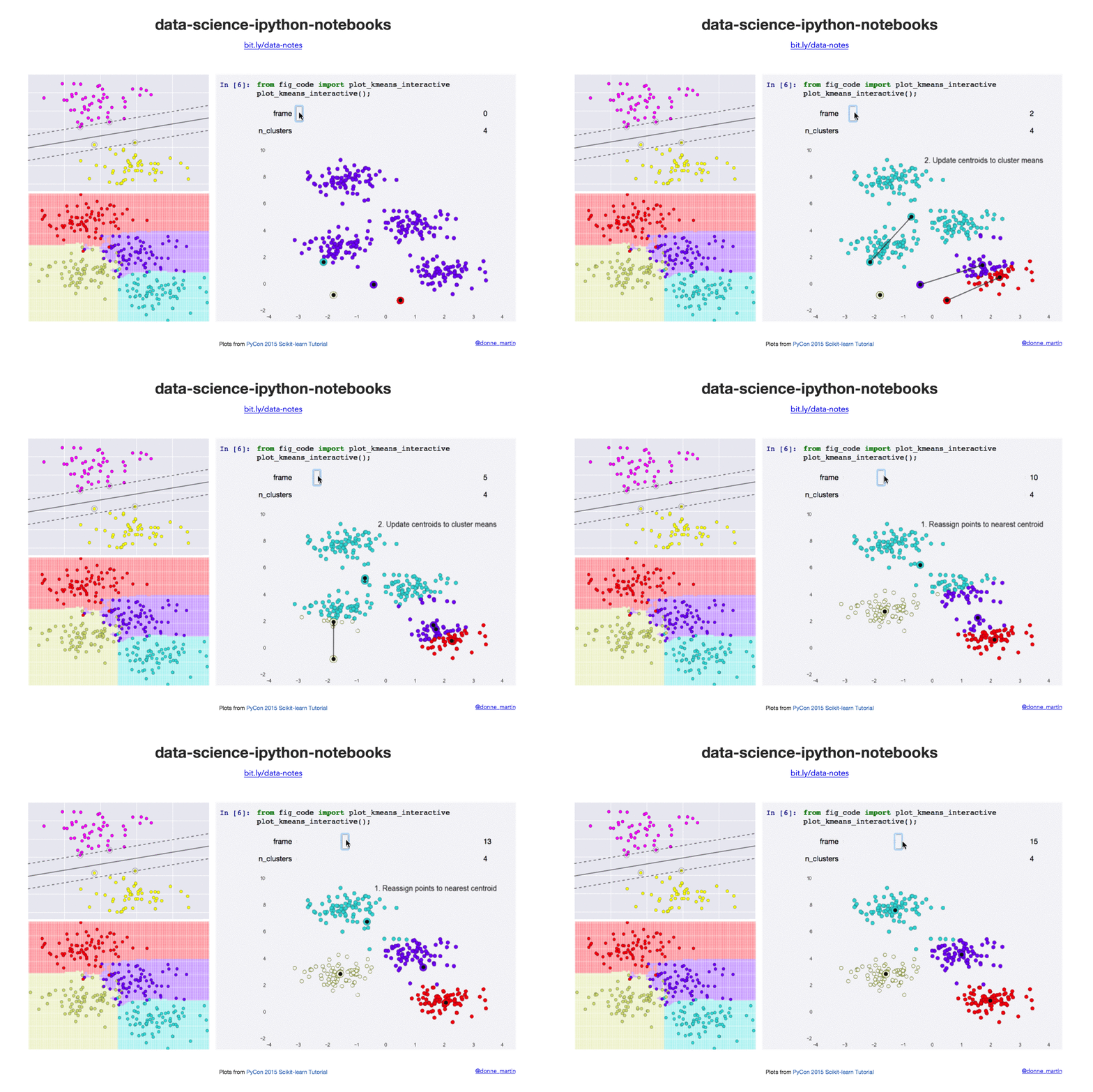
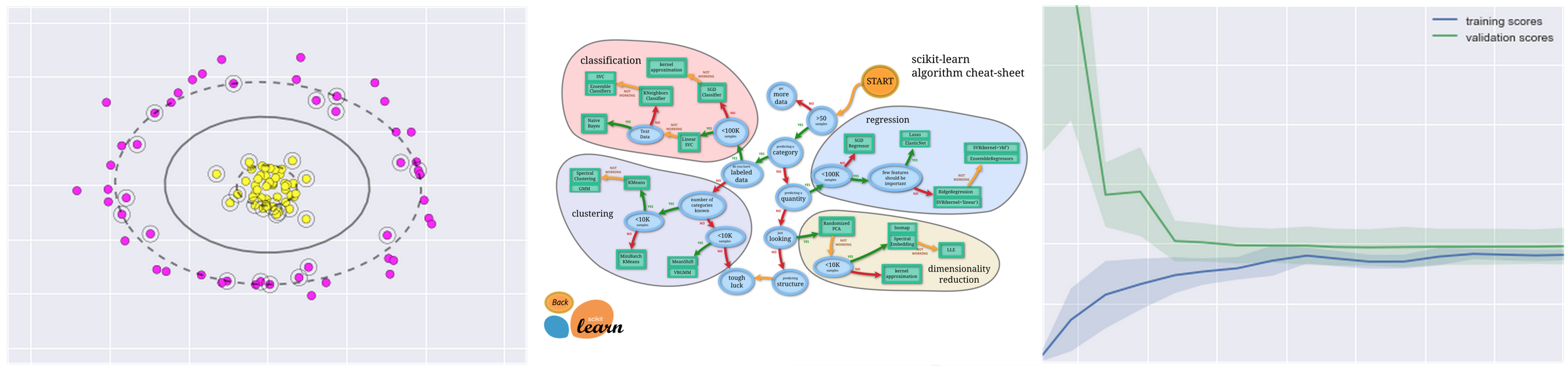
Intro notebook to scikit-learn. Scikit-learn adds Python support for large, multi-dimensional arrays and matrices, along with a large library of high-level mathematical functions to operate on these arrays.
knn
Implement k-nearest neighbors in scikit-learn.
linear-reg
Implement linear regression in scikit-learn.
svm
Implement support vector machine classifiers with and without kernels in scikit-learn.
random-forest
Implement random forest classifiers and regressors in scikit-learn.
k-means
Implement k-means clustering in scikit-learn.
pca
Implement principal component analysis in scikit-learn.
gmm
Implement Gaussian mixture models in scikit-learn.
validation
Implement validation and model selection in scikit-learn.
statistical-inference-scipy
IPython Notebook(s) demonstrating statistical inference with SciPy functionality.
Notebook
Description
scipy
SciPy is a collection of mathematical algorithms and convenience functions built on the Numpy extension of Python. It adds significant power to the interactive Python session by providing the user with high-level commands and classes for manipulating and visualizing data.
effect-size
Explore statistics that quantify effect size by analyzing the difference in height between men and women. Uses data from the Behavioral Risk Factor Surveillance System (BRFSS) to estimate the mean and standard deviation of height for adult women and men in the United States.
sampling
Explore random sampling by analyzing the average weight of men and women in the United States using BRFSS data.
hypothesis
Explore hypothesis testing by analyzing the difference of first-born babies compared with others.
Software library written for data manipulation and analysis in Python. Offers data structures and operations for manipulating numerical tables and time series.
github-data-wrangling
Learn how to load, clean, merge, and feature engineer by analyzing GitHub data from the Viz repo.
Introduction-to-Pandas
Introduction to Pandas.
Introducing-Pandas-Objects
Learn about Pandas objects.
Data Indexing and Selection
Learn about data indexing and selection in Pandas.
Operations-in-Pandas
Learn about operating on data in Pandas.
Missing-Values
Learn about handling missing data in Pandas.
Hierarchical-Indexing
Learn about hierarchical indexing in Pandas.
Concat-And-Append
Learn about combining datasets: concat and append in Pandas.
Merge-and-Join
Learn about combining datasets: merge and join in Pandas.
Aggregation-and-Grouping
Learn about aggregation and grouping in Pandas.
Pivot-Tables
Learn about pivot tables in Pandas.
Working-With-Strings
Learn about vectorized string operations in Pandas.
Working-with-Time-Series
Learn about working with time series in pandas.
Performance-Eval-and-Query
Learn about high-performance Pandas: eval() and query() in Pandas.
Python 2D plotting library which produces publication quality figures in a variety of hardcopy formats and interactive environments across platforms.
matplotlib-applied
Apply matplotlib visualizations to Kaggle competitions for exploratory data analysis. Learn how to create bar plots, histograms, subplot2grid, normalized plots, scatter plots, subplots, and kernel density estimation plots.
Introduction-To-Matplotlib
Introduction to Matplotlib.
Simple-Line-Plots
Learn about simple line plots in Matplotlib.
Simple-Scatter-Plots
Learn about simple scatter plots in Matplotlib.
Errorbars.ipynb
Learn about visualizing errors in Matplotlib.
Density-and-Contour-Plots
Learn about density and contour plots in Matplotlib.
Histograms-and-Binnings
Learn about histograms, binnings, and density in Matplotlib.
Customizing-Legends
Learn about customizing plot legends in Matplotlib.
Customizing-Colorbars
Learn about customizing colorbars in Matplotlib.
Multiple-Subplots
Learn about multiple subplots in Matplotlib.
Text-and-Annotation
Learn about text and annotation in Matplotlib.
Customizing-Ticks
Learn about customizing ticks in Matplotlib.
Settings-and-Stylesheets
Learn about customizing Matplotlib: configurations and stylesheets.
Three-Dimensional-Plotting
Learn about three-dimensional plotting in Matplotlib.
Geographic-Data-With-Basemap
Learn about geographic data with basemap in Matplotlib.
Adds Python support for large, multi-dimensional arrays and matrices, along with a large library of high-level mathematical functions to operate on these arrays.
Introduction-to-NumPy
Introduction to NumPy.
Understanding-Data-Types
Learn about data types in Python.
The-Basics-Of-NumPy-Arrays
Learn about the basics of NumPy arrays.
Computation-on-arrays-ufuncs
Learn about computations on NumPy arrays: universal functions.
Computation-on-arrays-aggregates
Learn about aggregations: min, max, and everything in between in NumPy.
Computation-on-arrays-broadcasting
Learn about computation on arrays: broadcasting in NumPy.
Boolean-Arrays-and-Masks
Learn about comparisons, masks, and boolean logic in NumPy.
Fancy-Indexing
Learn about fancy indexing in NumPy.
Sorting
Learn about sorting arrays in NumPy.
Structured-Data-NumPy
Learn about structured data: NumPy's structured arrays.
python-data
IPython Notebook(s) demonstrating Python functionality geared towards data analysis.
Notebook
Description
data structures
Learn Python basics with tuples, lists, dicts, sets.
data structure utilities
Learn Python operations such as slice, range, xrange, bisect, sort, sorted, reversed, enumerate, zip, list comprehensions.
functions
Learn about more advanced Python features: Functions as objects, lambda functions, closures, *args, **kwargs currying, generators, generator expressions, itertools.
datetime
Learn how to work with Python dates and times: datetime, strftime, strptime, timedelta.
logging
Learn about Python logging with RotatingFileHandler and TimedRotatingFileHandler.
pdb
Learn how to debug in Python with the interactive source code debugger.
unit tests
Learn how to test in Python with Nose unit tests.
kaggle-and-business-analyses
IPython Notebook(s) used in kaggle competitions and business analyses.
Notebook
Description
titanic
Predict survival on the Titanic. Learn data cleaning, exploratory data analysis, and machine learning.
churn-analysis
Predict customer churn. Exercise logistic regression, gradient boosting classifers, support vector machines, random forests, and k-nearest-neighbors. Includes discussions of confusion matrices, ROC plots, feature importances, prediction probabilities, and calibration/descrimination.
spark
IPython Notebook(s) demonstrating spark and HDFS functionality.
Notebook
Description
spark
In-memory cluster computing framework, up to 100 times faster for certain applications and is well suited for machine learning algorithms.
hdfs
Reliably stores very large files across machines in a large cluster.
mapreduce-python
IPython Notebook(s) demonstrating Hadoop MapReduce with mrjob functionality.
Notebook
Description
mapreduce-python
Runs MapReduce jobs in Python, executing jobs locally or on Hadoop clusters. Demonstrates Hadoop Streaming in Python code with unit test and mrjob config file to analyze Amazon S3 bucket logs on Elastic MapReduce. Disco is another python-based alternative.
aws
IPython Notebook(s) demonstrating Amazon Web Services (AWS) and AWS tools functionality.
Also check out:
SAWS: A Supercharged AWS command line interface (CLI).
Awesome AWS: A curated list of libraries, open source repos, guides, blogs, and other resources.
Notebook
Description
boto
Official AWS SDK for Python.
s3cmd
Interacts with S3 through the command line.
s3distcp
Combines smaller files and aggregates them together by taking in a pattern and target file. S3DistCp can also be used to transfer large volumes of data from S3 to your Hadoop cluster.
s3-parallel-put
Uploads multiple files to S3 in parallel.
redshift
Acts as a fast data warehouse built on top of technology from massive parallel processing (MPP).
kinesis
Streams data in real time with the ability to process thousands of data streams per second.
lambda
Runs code in response to events, automatically managing compute resources.
commands
IPython Notebook(s) demonstrating various command lines for Linux, Git, etc.
Notebook
Description
linux
Unix-like and mostly POSIX-compliant computer operating system. Disk usage, splitting files, grep, sed, curl, viewing running processes, terminal syntax highlighting, and Vim.
anaconda
Distribution of the Python programming language for large-scale data processing, predictive analytics, and scientific computing, that aims to simplify package management and deployment.
ipython notebook
Web-based interactive computational environment where you can combine code execution, text, mathematics, plots and rich media into a single document.
git
Distributed revision control system with an emphasis on speed, data integrity, and support for distributed, non-linear workflows.
ruby
Used to interact with the AWS command line and for Jekyll, a blog framework that can be hosted on GitHub Pages.
jekyll
Simple, blog-aware, static site generator for personal, project, or organization sites. Renders Markdown or Textile and Liquid templates, and produces a complete, static website ready to be served by Apache HTTP Server, Nginx or another web server.
pelican
Python-based alternative to Jekyll.
django
High-level Python Web framework that encourages rapid development and clean, pragmatic design. It can be useful to share reports/analyses and for blogging. Lighter-weight alternatives include Pyramid, Flask, Tornado, and Bottle.
Regular expression cheat sheet useful in data wrangling.
algorithmia
Algorithmia is a marketplace for algorithms. This notebook showcases 4 different algorithms: Face Detection, Content Summarizer, Latent Dirichlet Allocation and Optical Character Recognition.
notebook-installation
anaconda
Anaconda is a free distribution of the Python programming language for large-scale data processing, predictive analytics, and scientific computing that aims to simplify package management and deployment.
Follow instructions to install Anaconda or the more lightweight miniconda.
dev-setup
For detailed instructions, scripts, and tools to set up your development environment for data analysis, check out the dev-setup repo.
running-notebooks
To view interactive content or to modify elements within the IPython notebooks, you must first clone or download the repository then run the notebook. More information on IPython Notebooks can be found here.
$ git clone https://github.com/donnemartin/data-science-ipython-notebooks.git
$ cd data-science-ipython-notebooks
$ jupyter notebook
Notebooks tested with Python 2.7.x.
credits
Python for Data Analysis: Data Wrangling with Pandas, NumPy, and IPython by Wes McKinney
PyCon 2015 Scikit-learn Tutorial by Jake VanderPlas
Python Data Science Handbook by Jake VanderPlas
Parallel Machine Learning with scikit-learn and IPython by Olivier Grisel
Statistical Interference Using Computational Methods in Python by Allen Downey
TensorFlow Examples by Aymeric Damien
TensorFlow Tutorials by Parag K Mital
TensorFlow Tutorials by Nathan Lintz
TensorFlow Tutorials by Alexander R Johansen
TensorFlow Book by Nishant Shukla
Summer School 2015 by mila-udem
Keras tutorials by Valerio Maggio
Kaggle
Yhat Blog
contributing
Contributions are welcome! For bug reports or requests please submit an issue.
contact-info
Feel free to contact me to discuss any issues, questions, or comments.
This repository contains a variety of content; some developed by Donne Martin, and some from third-parties. The third-party content is distributed under the license provided by those parties.
The content developed by Donne Martin is distributed under the following license:
I am providing code and resources in this repository to you under an open source license. Because this is my personal repository, the license you receive to my code and resources is from me and not my employer (Facebook).
Copyright 2015 Donne Martin

Licensed under the Apache License, Version 2.0 (the "License");
you may not use this file except in compliance with the License.
You may obtain a copy of the License at

   http://www.apache.org/licenses/LICENSE-2.0

Unless required by applicable law or agreed to in writing, software
distributed under the License is distributed on an "AS IS" BASIS,
WITHOUT WARRANTIES OR CONDITIONS OF ANY KIND, either express or implied.
See the License for the specific language governing permissions and
limitations under the License.
donnemartin/data-science-ipython-notebooks có bao nhiêu sao?
donnemartin/data-science-ipython-notebooks có 29.4k sao GitHub — tải lại trang để xem số mới nhất, hoặc xem trực tiếp github.com/donnemartin/data-science-ipython-notebooks. TopGit phản chiếu số sao của GitHub nhưng không cam kết đến từng phút.
donnemartin/data-science-ipython-notebooks có những chủ đề gì?
GitHub topics của donnemartin/data-science-ipython-notebooks: "aws", "big-data", "caffe", "data-science", "deep-learning", "hadoop", "kaggle", "keras", "machine-learning", "mapreduce", "matplotlib", "numpy", "pandas", "python", "scikit-learn", "scipy", "spark", "tensorflow", "theano". TopGit xếp repo vào nhóm AI Tools.
donnemartin/data-science-ipython-notebooks còn đang phát triển không?
Commit gần nhất trên donnemartin/data-science-ipython-notebooks là 2.6 năm trước (theo timestamp GitHub). Repo có 8.0k fork — một chỉ báo về mức độ quan tâm của cộng đồng.
donnemartin/data-science-ipython-notebooks là gì?
donnemartin/data-science-ipython-notebooks (donnemartin/data-science-ipython-notebooks) là dự án Python trên GitHub. Theo mô tả gốc: Data science Python notebooks: Deep learning (TensorFlow, Theano, Caffe, Keras), scikit-learn, Kaggle, big data (Spark, Hadoop MapReduce, HDFS), matplotlib, pandas, NumPy, SciPy, Python essentials, AWS, and various command lines.
donnemartin/data-science-ipython-notebooks so với các dự án AI Tools khác thế nào?
donnemartin/data-science-ipython-notebooks được TopGit xếp vào nhóm AI Tools, với 29.4k sao GitHub và viết bằng Python. Xem trang chủ đề AI Tools trên TopGit để so sánh với các dự án tương tự theo số sao và mức độ hoạt động.
donnemartin/data-science-ipython-notebooks viết bằng ngôn ngữ gì?
donnemartin/data-science-ipython-notebooks chủ yếu viết bằng Python. Trường "language" của GitHub dựa trên phần lớn byte ở nhánh mặc định.
Vì sao donnemartin/data-science-ipython-notebooks được xếp vào nhóm AI Tools?
TopGit xếp donnemartin/data-science-ipython-notebooks vào nhóm AI Tools dựa trên GitHub topics và mô tả của repo (gắn thẻ: "aws", "big-data", "caffe"). Việc phân loại dựa trên metadata thật của repo, không phải đoán theo cảm tính biên tập.
Đọc đầy đủ README ở tab phía trên.
Muốn nghe thêm một ý kiến về data-science-ipython-notebooks?
Hỏi một AI đọc được trang này — một cú bấm là có ngay nhận định về data-science-ipython-notebooks.
 /data-science-ipython-notebooks