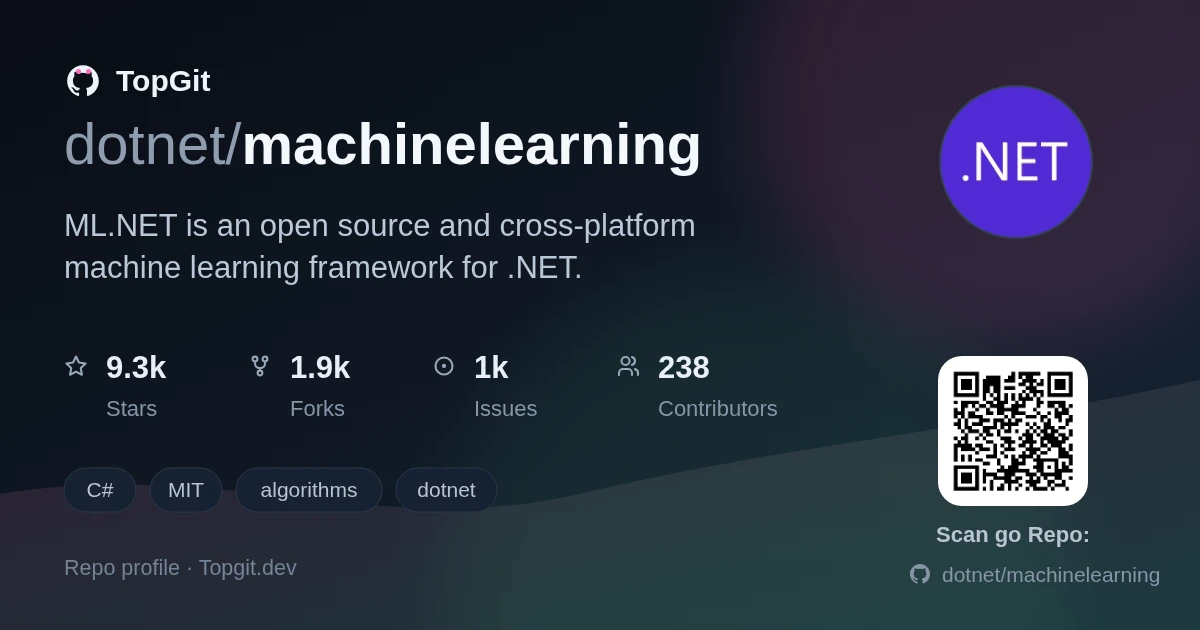
Là một dự án backend, dotnet/machinelearning đã đạt 9.4k sao trên GitHub, ngôn ngữ C#. ML.NET is an open source and cross-platform machine learning framework for .NET.
Tóm tắt dựng từ metadata GitHub của chính dự án — chưa có bài review TopGit. Trang sẽ tự động cập nhật khi bài review đầy đủ được xuất bản.
VÌ SAO CHƯA CÓ REVIEW
TopGit viết bài đầy đủ cho repo có nhiều sao nhất và được yêu cầu nhiều nhất. Trang này là snapshot trong thời gian chờ — xem README gốc ở tab READ ME.
ML.NET is a cross-platform open-source machine learning (ML) framework for .NET.
ML.NET allows developers to easily build, train, deploy, and consume custom models in their .NET applications without requiring prior expertise in developing machine learning models or experience with other programming languages like Python or R. The framework provides data loading from files and databases, enables data transformations, and includes many ML algorithms.
With ML.NET, you can train models for a variety of scenarios, like classification, forecasting, and anomaly detection.
You can also consume both TensorFlow and ONNX models within ML.NET which makes the framework more extensible and expands the number of supported scenarios.
Getting started with machine learning and ML.NET
Learn more about the basics of ML.NET.
Build your first ML.NET model by following our ML.NET Getting Started tutorial.
Check out our documentation and tutorials.
See the API Reference documentation.
Clone our ML.NET Samples GitHub repo and run some sample apps.
Take a look at some ML.NET Community Samples.
Watch some videos on the ML.NET videos YouTube playlist.
Roadmap
Take a look at ML.NET's Roadmap to see what the team plans to work on in the next year.
Operating systems and processor architectures supported by ML.NET
ML.NET runs on Windows, Linux, and macOS using .NET, or Windows using .NET Framework.
ML.NET also runs on ARM64, Apple silicon, and Blazor WebAssembly. However, there are some limitations.
64-bit is supported on all platforms. 32-bit is supported on Windows, except for TensorFlow and LightGBM related functionality.
ML.NET NuGet packages status
Release notes
Check out the release notes to see what's new. You can also read the blog posts for more details about each release.
Using ML.NET packages
The main Microsoft.ML package targets .NET Standard 2.0, so it can be used by compatible .NET implementations. Some optional ML.NET packages target newer frameworks; check the target frameworks listed on the package before adding it to your application.
Once you have an app, you can install the ML.NET NuGet package using the .NET CLI:
dotnet add package Microsoft.ML
Alternatively, you can add the Microsoft.ML package from within Visual Studio's NuGet package manager or via Paket.
Daily NuGet builds of the project are also available in our Azure DevOps feed:
Building ML.NET (For contributors building ML.NET open source code)
To build ML.NET from source please visit our developer guide.
Release process and versioning
Major releases of ML.NET are shipped once a year with the major .NET releases, starting with ML.NET 1.7 in November 2021 with .NET 6, then ML.NET 2.0 with .NET 7, etc. We will maintain release branches to optionally service ML.NET with bug fixes and/or minor features on the same cadence as .NET servicing.
Check out the Release Notes to see all of the past ML.NET releases.
Contributing
We welcome contributions! Please review our contribution guide.
This project has adopted the code of conduct defined by the Contributor Covenant to clarify expected behavior in our community.
For more information, see the .NET Foundation Code of Conduct.
Code examples
Here is a code snippet for training a model to predict sentiment from text samples. You can find complete samples in the samples repo.
var dataPath = "sentiment.csv";
var mlContext = new MLContext();
var loader = mlContext.Data.CreateTextLoader(new[]
    {
        new TextLoader.Column("SentimentText", DataKind.String, 1),
        new TextLoader.Column("Label", DataKind.Boolean, 0),
    },
    hasHeader: true,
    separatorChar: ',');
var data = loader.Load(dataPath);
var learningPipeline = mlContext.Transforms.Text.FeaturizeText("Features", "SentimentText")
        .Append(mlContext.BinaryClassification.Trainers.FastTree());
var model = learningPipeline.Fit(data);
Now from the model we can make inferences (predictions):
var predictionEngine = mlContext.Model.CreatePredictionEngine<SentimentData, SentimentPrediction>(model);
var prediction = predictionEngine.Predict(new SentimentData
{
    SentimentText = "Today is a great day!"
});
Console.WriteLine("prediction: " + prediction.Prediction);
License
ML.NET is licensed under the MIT license, and it is free to use commercially.
Trang TopGit này là một snapshot — tab "Readme" hiển thị nguyên văn README của repo (đã bỏ link, giữ ảnh). Repo GitHub ở github.com/dotnet/machinelearning là nguồn chính thức.
dotnet/machinelearning có bao nhiêu sao?
dotnet/machinelearning có 9.4k sao GitHub — tải lại trang để xem số mới nhất, hoặc xem trực tiếp github.com/dotnet/machinelearning. TopGit phản chiếu số sao của GitHub nhưng không cam kết đến từng phút.
dotnet/machinelearning có phải mã nguồn mở không?
Có — dotnet/machinelearning phát hành theo license MIT, nghĩa là mã nguồn mở để đọc, fork và (tùy license) tái sử dụng. Mã: github.com/dotnet/machinelearning.
dotnet/machinelearning còn đang phát triển không?
Commit gần nhất trên dotnet/machinelearning là 3 tháng trước (theo timestamp GitHub). Repo có 2.0k fork — một chỉ báo về mức độ quan tâm của cộng đồng.
dotnet/machinelearning là gì?
dotnet/machinelearning (dotnet/machinelearning) là dự án C# trên GitHub. Theo mô tả gốc: ML.NET is an open source and cross-platform machine learning framework for .NET.
dotnet/machinelearning so với các dự án Backend khác thế nào?
dotnet/machinelearning được TopGit xếp vào nhóm Backend, với 9.4k sao GitHub và viết bằng C#. Xem trang chủ đề Backend trên TopGit để so sánh với các dự án tương tự theo số sao và mức độ hoạt động.
Đọc đầy đủ README ở tab phía trên.
Chưa chắc machinelearning có hợp với bạn?
Để ChatGPT, Claude hoặc Perplexity tìm hiểu giúp — bấm bên dưới và xem AI nói gì về machinelearning.

 /machinelearning