heroiclabs/nakama — dự án backend — đang có 13.7k sao GitHub trong nhóm Backend. Scalable open-source game backend server: multiplayer, matchmaking, leaderboards, chat, and social features for games.
Tóm tắt dựng từ metadata GitHub của chính dự án — chưa có bài review TopGit. Trang sẽ tự động cập nhật khi bài review đầy đủ được xuất bản.
VÌ SAO CHƯA CÓ REVIEW
TopGit viết bài đầy đủ cho repo có nhiều sao nhất và được yêu cầu nhiều nhất. Trang này là snapshot trong thời gian chờ — xem README gốc ở tab READ ME.
Users - Register/login new users via social networks, email, or device ID.
Storage - Store user records, settings, and other objects in collections.
Social - Users can connect with friends, and join groups. Builtin social graph to see how users can be connected.
Chat - 1-on-1, group, and global chat between users. Persist messages for chat history.
Multiplayer - Realtime, or turn-based active and passive multiplayer.
Leaderboards - Dynamic, seasonal, get top members, or members around a user. Have as many as you need.
Tournaments - Invite players to compete together over prizes. Link many together to create leagues.
Parties - Add team play to a game. Users can form a party and communicate with party members.
Purchase Validation - Validate in-app purchases and subscriptions.
In-App Notifications - Send messages and notifications to connected client sockets.
Runtime code - Extend the server with custom logic written in Lua, TypeScript/JavaScript, or native Go code.
Matchmaker, dashboard, metrics, and more.
Build scalable games and apps with a production ready server used by ambitious game studios and app developers all around the world. Have a look at the documentation and join the developer community for more info.
Getting Started
The server is simple to setup and run for local development and can be deployed to any cloud provider. See the deployment notes for recommendations on how to deploy the project for production. Nakama server requires CockroachDB or another Postgres wire-compatible server as it's database.
Docker
The fastest way to run the server and the database is with Docker. Setup Docker and start the daemon.
Set up a docker-compose file and place it in a folder for your project.
Run docker-compose -f ./docker-compose.yml up to download container images and run the servers.
For more detailed instructions have a look at our Docker quickstart guide.
Nakama Docker images are maintained on Docker Hub and prerelease images are occasionally published for cutting edge features of the server.
Binaries
You can run the servers with native binaries for your platform.
Download the server from our releases page and the database.
Follow the database instructions to start it.
Run a migration which will setup or upgrade the database schema:
Nakama supports a variety of protocols optimized for various gameplay or app use cases. For request/response it can use GRPC or the HTTP1.1+JSON fallback (REST). For realtime communication you can use WebSockets or rUDP.
For example with the REST API to authenticate a user account with a device identifier.
There's a number of official client libraries available on GitHub with documentation. The current platform/language support includes: .NET (in C#), Unity engine, JavaScript, Java (with Android), Unreal engine, Godot, Defold, and Swift (with iOS). If you'd like to contribute a client or request one let us know.
Nakama Console
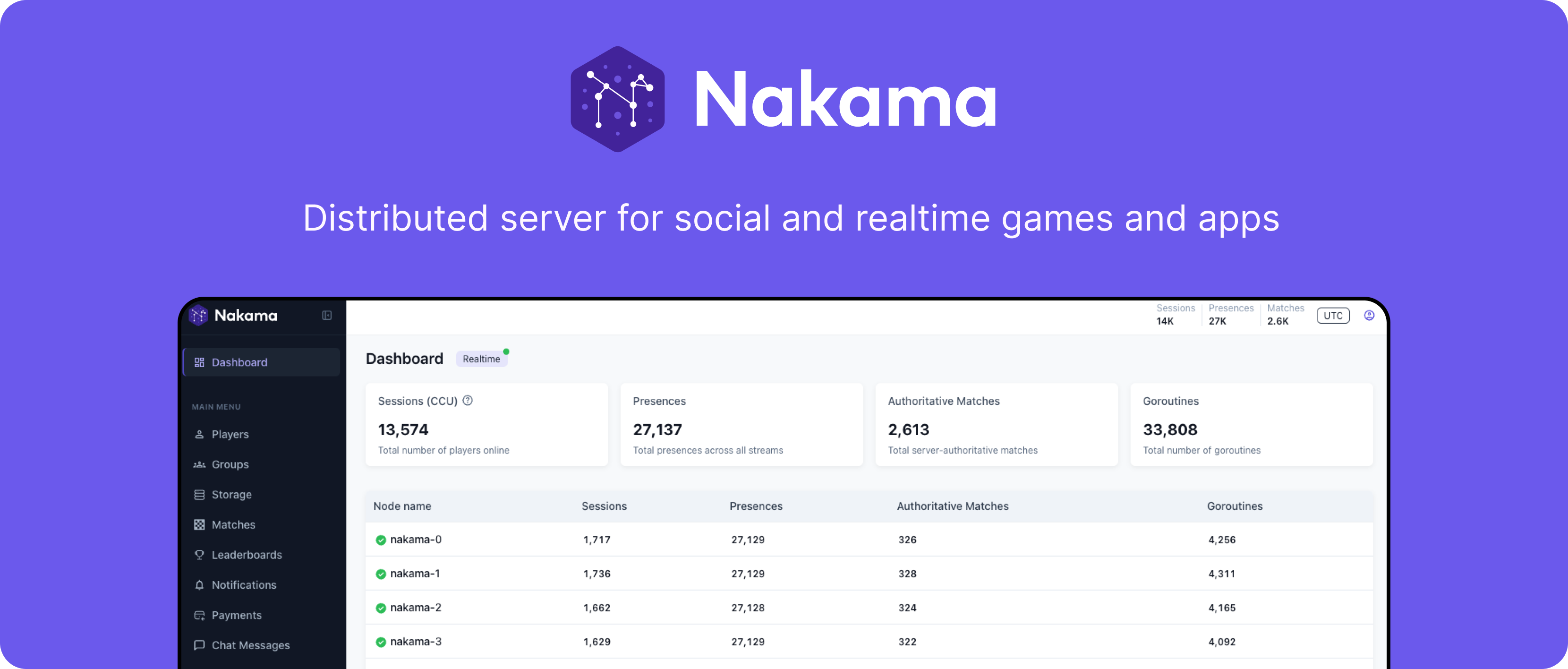
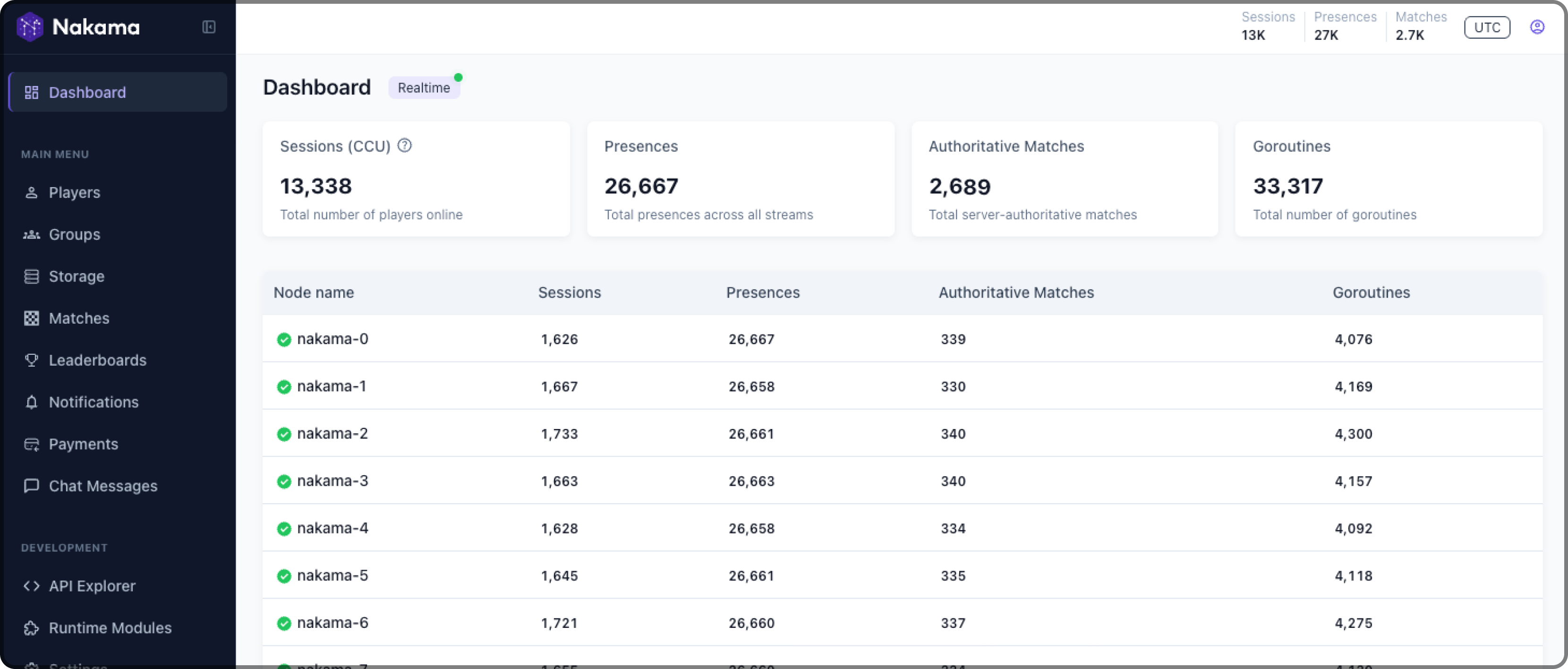
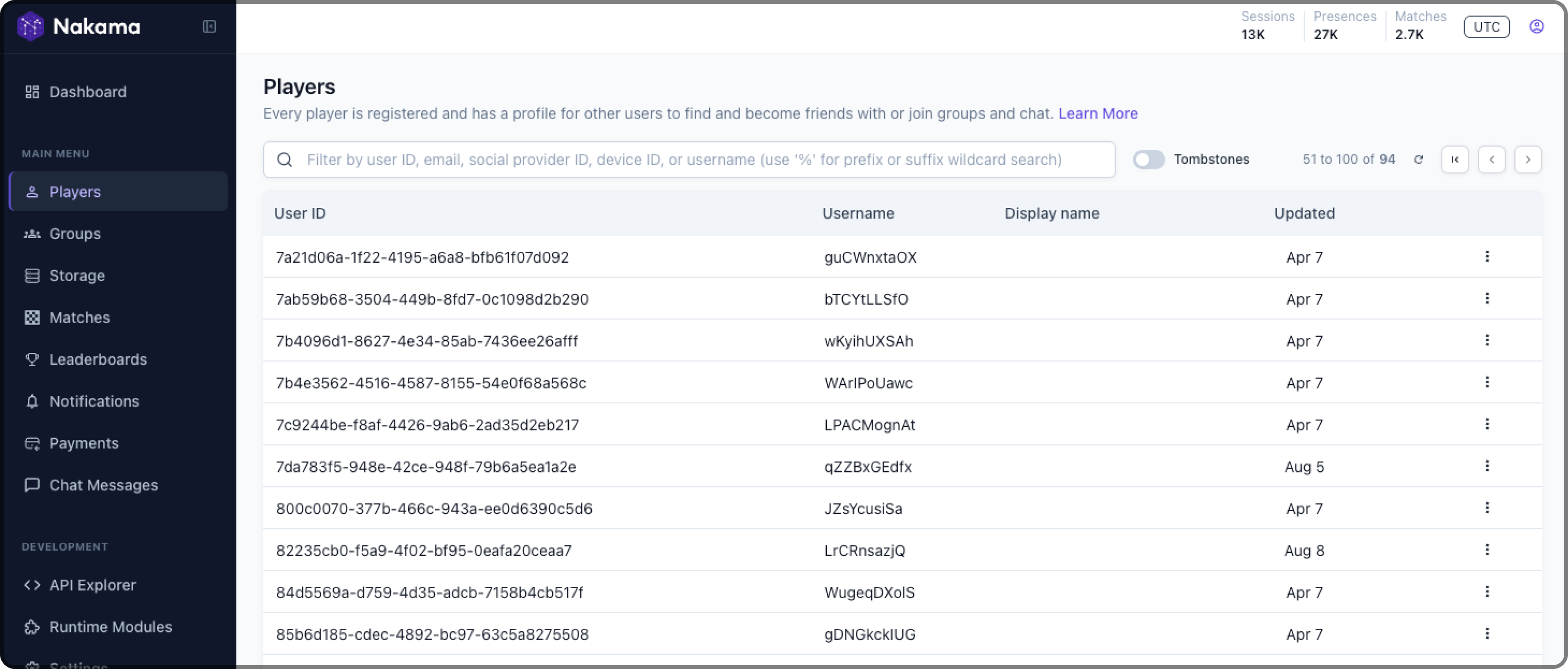
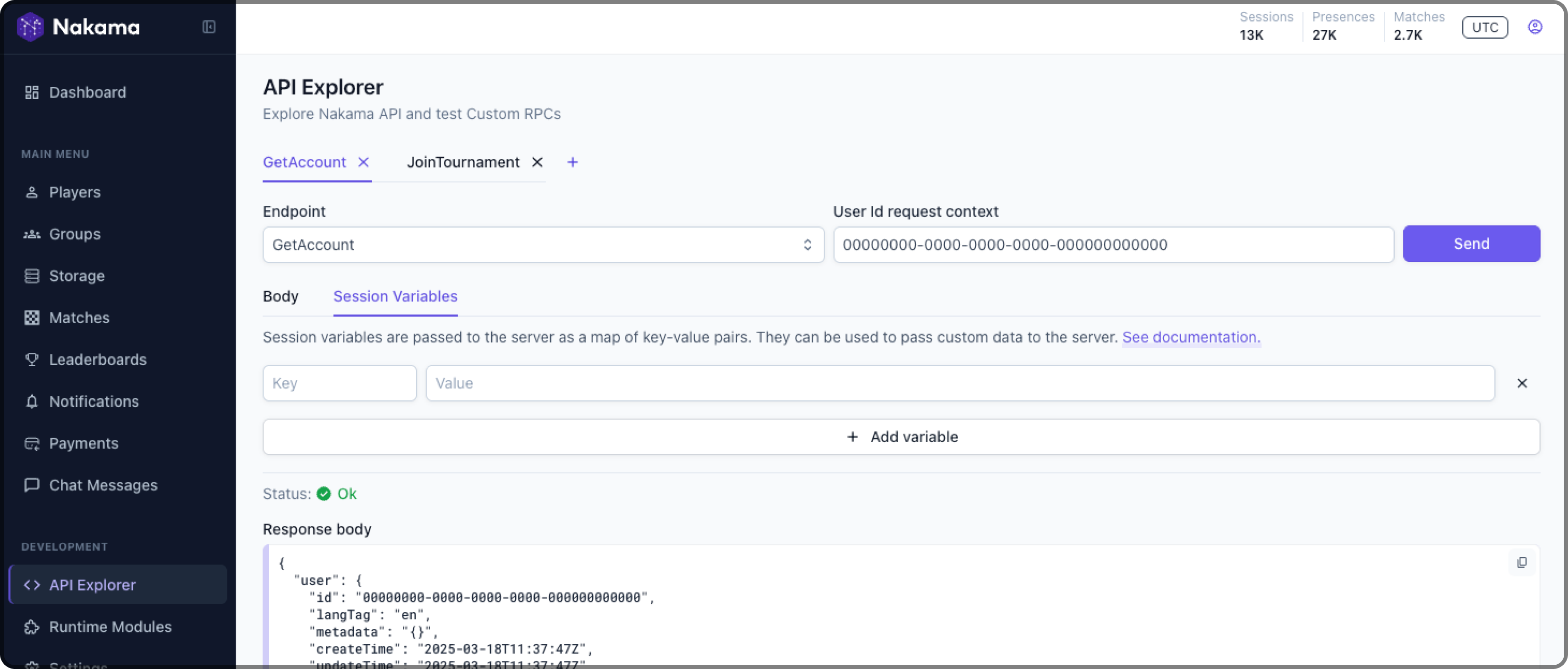
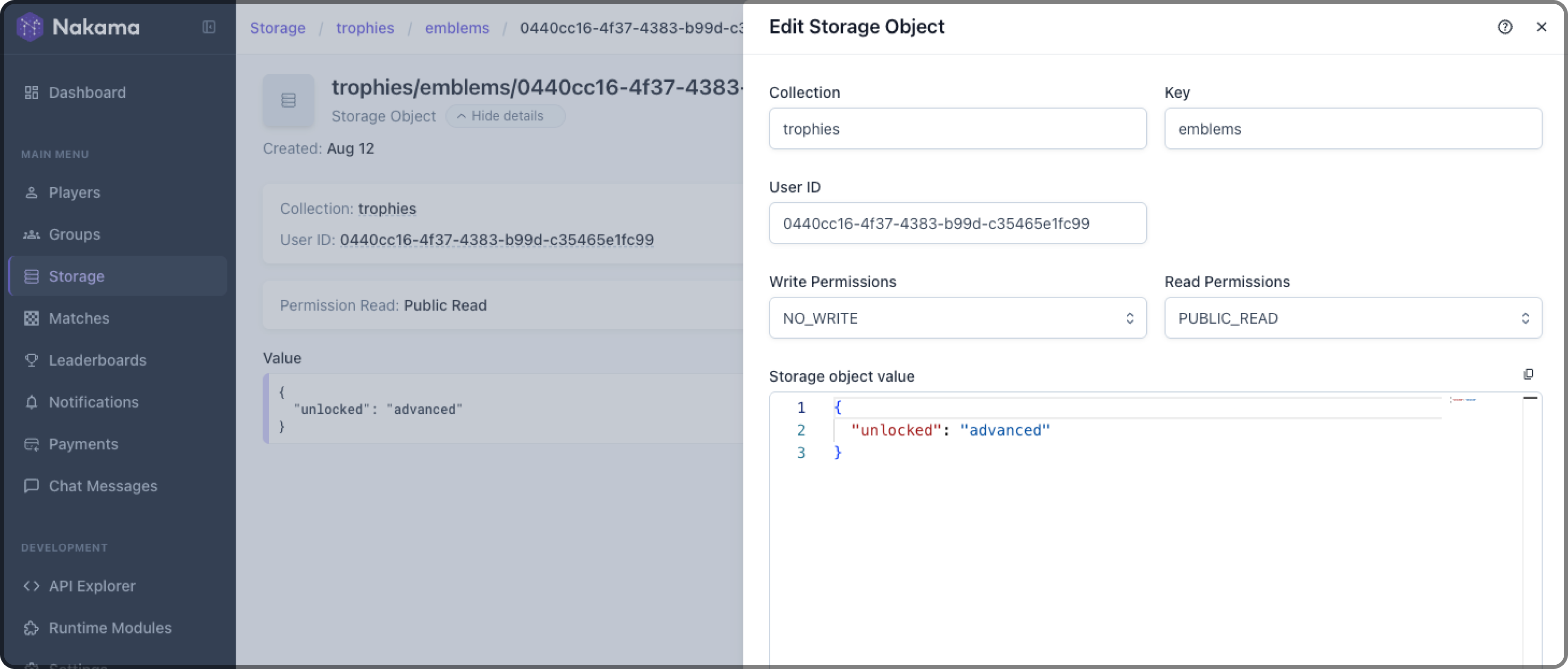
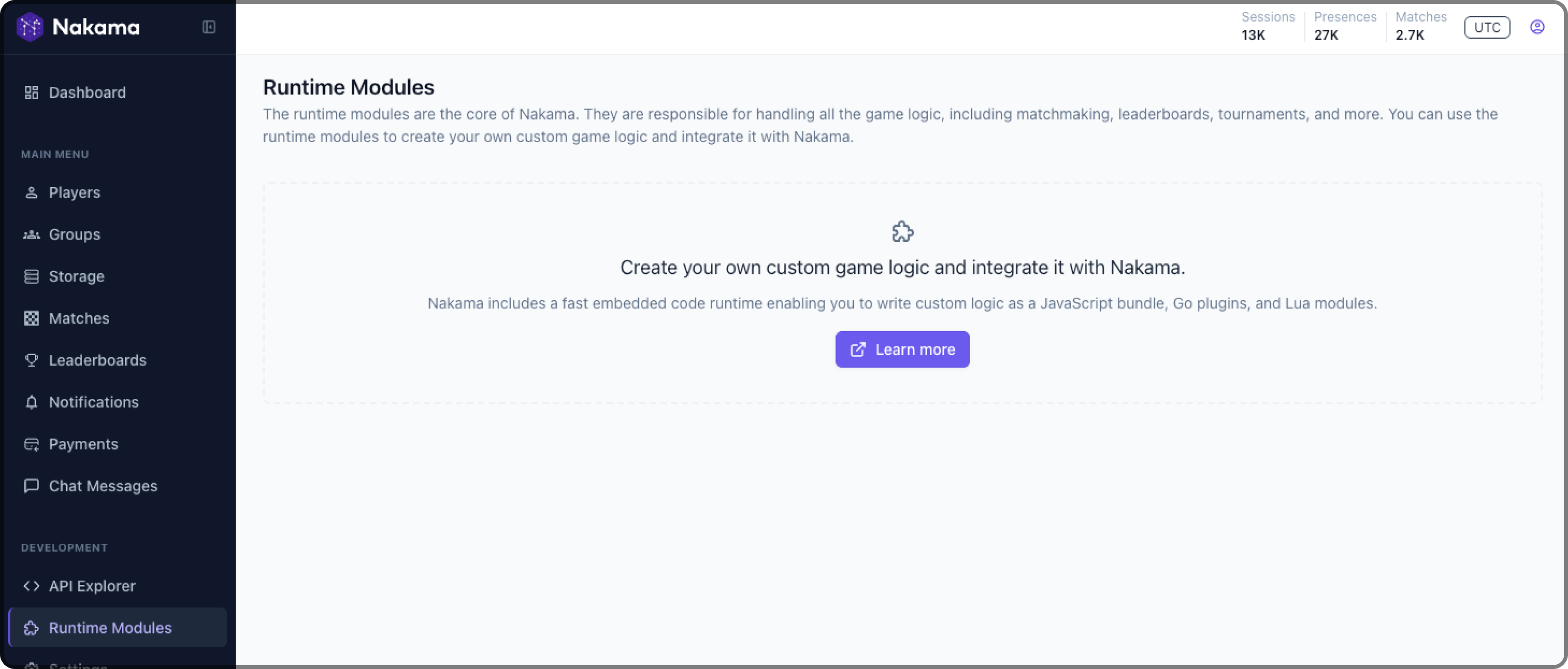
The server provides a web UI which teams can use to inspect various data stored through the server APIs, view lightweight service metrics, manage player data, update storage objects, restrict access to production with permission profiles, and gain visibility into realtime features like active multiplayer matches. There is no separate installation required as it is embedded as part of the single server binary.
You can navigate to it on your browser on http://127.0.0.1:7351.
View Screenshots
Deployment
Nakama can be deployed to any cloud provider such as Google Cloud, Azure, AWS, Digital Ocean, Heroku, or your own private cloud. You should setup and provision separate nodes for Nakama and CockroachDB.
The recommended minimum production infrastructure for CockroachDB is outlined in these docs and Nakama can be run on instance types as small as "g1-small" on Google Cloud although we recommend a minimum of "n1-standard-1" in production. The specific hardware requirements will depend on what features of the server are used. Reach out to us for help and advice on what servers to run.
Heroic Cloud
You can support development, new features, and maintainance of the server by using the Heroic Labs' Heroic Cloud for deployment. This service handles the uptime, replication, backups, logs, data upgrades, and all other tasks involved with production server environments.
Have a look at our Heroic Cloud service for more details.
Contribute
The development roadmap is managed as GitHub issues and pull requests are welcome. If you're interested to add a feature which is not mentioned on the issue tracker please open one to create a discussion or drop in and discuss it in the community forum.
Simple Builds
All dependencies required for a build are vendored as part of the Go project. We recommend a modern release of the Go toolchain and do not store the codebase in the old GOPATH.
Download the source tree.
git clone "https://github.com/heroiclabs/nakama" nakama
cd nakama
Build the project from source.
go build -trimpath -mod=vendor
./nakama --version
Full Source Builds
The codebase uses Protocol Buffers, GRPC, GRPC-Gateway, buf, and the OpenAPI spec as part of the project. These dependencies are generated as sources and committed to the repository to simplify builds for contributors.
To build the codebase and generate all sources follow these steps.
Install buf. The protoc plugins run as remote plugins at the versions pinned in apigrpc/apigrpc.gen.yaml and console/console.gen.yaml.
Re-generate the protocol buffers and gateway code.
# Run the shell script:
./buf.sh
Build the codebase.
go build -trimpath -mod=vendor
Testing
In order to run all the unit and integration tests run:
docker-compose -f ./docker-compose-tests.yml up --build --abort-on-container-exit; docker-compose -f ./docker-compose-tests.yml down -v
This will create an isolated environment with Nakama and database instances, run
all the tests, and drop the environment afterwards.
License
This project is licensed under the Apache-2 License.
heroiclabs/nakama có 13.7k sao GitHub — tải lại trang để xem số mới nhất, hoặc xem trực tiếp github.com/heroiclabs/nakama. TopGit phản chiếu số sao của GitHub nhưng không cam kết đến từng phút.
Commit gần nhất trên heroiclabs/nakama là 3 tháng trước (theo timestamp GitHub). Repo có 1.5k fork — một chỉ báo về mức độ quan tâm của cộng đồng.
heroiclabs/nakama là gì?
heroiclabs/nakama (heroiclabs/nakama) là dự án Go trên GitHub. Theo mô tả gốc: Scalable open-source game backend server: multiplayer, matchmaking, leaderboards, chat, and social features for games.
heroiclabs/nakama so với các dự án Backend khác thế nào?
heroiclabs/nakama được TopGit xếp vào nhóm Backend, với 13.7k sao GitHub và viết bằng Go. Xem trang chủ đề Backend trên TopGit để so sánh với các dự án tương tự theo số sao và mức độ hoạt động.
heroiclabs/nakama viết bằng ngôn ngữ gì?
heroiclabs/nakama chủ yếu viết bằng Go. Trường "language" của GitHub dựa trên phần lớn byte ở nhánh mặc định.
Vì sao heroiclabs/nakama được xếp vào nhóm Backend?
TopGit xếp heroiclabs/nakama vào nhóm Backend dựa trên GitHub topics và mô tả của repo (gắn thẻ: "backend", "cpp", "csharp"). Việc phân loại dựa trên metadata thật của repo, không phải đoán theo cảm tính biên tập.
Đọc đầy đủ README ở tab phía trên.
Chưa chắc nakama có hợp với bạn?
Để ChatGPT, Claude hoặc Perplexity tìm hiểu giúp — bấm bên dưới và xem AI nói gì về nakama.

 /nakama