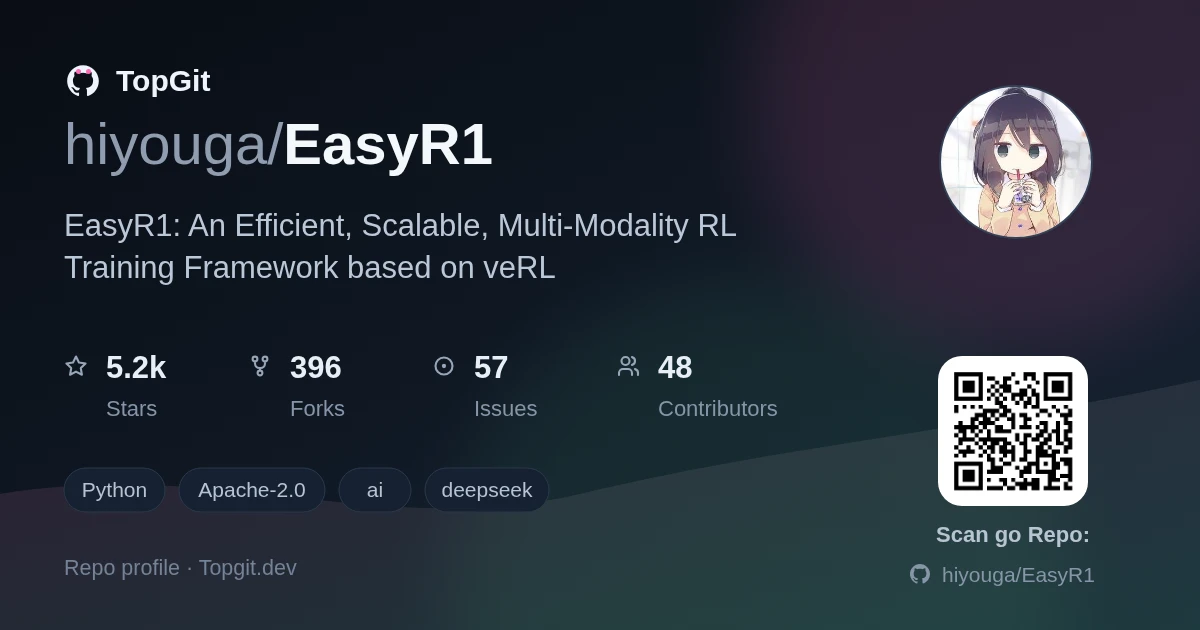
Điểm qua hiyouga/EasyR1: 5.2k sao trên GitHub, viết chủ yếu bằng Python, thuộc nhóm AI Tools. EasyR1: An Efficient, Scalable, Multi-Modality RL Training Framework based on veRL
Tóm tắt dựng từ metadata GitHub của chính dự án — chưa có bài review TopGit. Trang sẽ tự động cập nhật khi bài review đầy đủ được xuất bản.
VÌ SAO CHƯA CÓ REVIEW
TopGit viết bài đầy đủ cho repo có nhiều sao nhất và được yêu cầu nhiều nhất. Trang này là snapshot trong thời gian chờ — xem README gốc ở tab READ ME.
This project is a clean fork of the original veRL project to support vision language models, we thank all the authors for providing such a high-performance RL training framework.
EasyR1 is efficient and scalable due to the design of HybirdEngine and the latest release of vLLM's SPMD mode.
Features
Supported models
Llama3/Qwen2/Qwen2.5/Qwen3 language models
Qwen2-VL/Qwen2.5-VL/Qwen3-VL vision language models
DeepSeek-R1 distill models
Supported algorithms
GRPO
DAPO
Reinforce++
ReMax
RLOO
GSPO
CISPO
Supported datasets
Any text, vision-text dataset in a specific format
Supported tricks
Padding-free training
LoRA training
Resuming from the latest/best checkpoint
Wandb & SwanLab & Mlflow & Tensorboard tracking
Requirements
Software Requirements
Python 3.9+
transformers>=4.54.0
flash-attn>=2.4.3
vllm>=0.8.3
We provide a Dockerfile to easily build environments.
We recommend using the pre-built docker image in EasyR1.
docker pull hiyouga/verl:ngc-th2.8.0-cu12.9-vllm0.11.0
docker run -it --ipc=host --gpus=all hiyouga/verl:ngc-th2.8.0-cu12.9-vllm0.11.0
If your environment does not support Docker, you can consider using Apptainer:
To learn about the GRPO algorithm, you can refer to Hugging Face's blog.
How to Run 70B+ Model in Multi-node Environment
Start the Ray head node.
ray start --head --port=6379 --dashboard-host=0.0.0.0
Start the Ray worker node and connect to the head node.
ray start --address=<head_node_ip>:6379
Check the Ray resource pool.
ray status
Run training script on the Ray head node only.
bash examples/qwen2_5_vl_7b_geo3k_grpo.sh
See the veRL's official doc for more details about multi-node training and Ray debugger.
Other Baselines
We also reproduced the following two baselines of the R1-V project.
CLEVR-70k-Counting: Train the Qwen2.5-VL-3B-Instruct model on counting problem.
GeoQA-8k: Train the Qwen2.5-VL-3B-Instruct model on GeoQA problem.
Performance Baselines
See baselines.md.
Awesome Work using EasyR1
MMR1: Enhancing Multimodal Reasoning with Variance-Aware Sampling and Open Resources.
Vision-R1: Incentivizing Reasoning Capability in Multimodal Large Language Models.
Seg-Zero: Reasoning-Chain Guided Segmentation via Cognitive Reinforcement.
MetaSpatial: Reinforcing 3D Spatial Reasoning in VLMs for the Metaverse.
Temporal-R1: Envolving Temporal Reasoning Capability into LMMs via Temporal Consistent Reward.
NoisyRollout: Reinforcing Visual Reasoning with Data Augmentation.
GUI-R1: A Generalist R1-Style Vision-Language Action Model For GUI Agents.
FAST-GRPO: Fast-Slow Thinking framework that dynamically adapts reasoning depth based on question characteristics.
R1-Track: Direct Application of MLLMs to Visual Object Tracking via Reinforcement Learning.
VisionReasoner: Unified Visual Perception and Reasoning via Reinforcement Learning.
MM-UPT: Unsupervised Post-Training for Multi-Modal LLM Reasoning via GRPO.
RL-with-Cold-Start: Advancing Multimodal Reasoning via Reinforcement Learning with Cold Start.
ViGoRL: Grounded Reinforcement Learning for Visual Reasoning.
Revisual-R1: Advancing Multimodal Reasoning: From Optimized Cold Start to Staged Reinforcement Learning.
SophiaVL-R1: Reinforcing MLLMs Reasoning with Thinking Reward.
Vision-Matters: Simple Visual Perturbations Can Boost Multimodal Math Reasoning.
VTool-R1: VLMs Learn to Think with Images via Reinforcement Learning on Multimodal Tool Use.
Long-RL: Scaling RL to Long Sequences.
EditGRPO: Reinforcement Learning with Post-Rollout Edits for Clinically Accurate Chest X-Ray Report Generation.
ARES: Multimodal Adaptive Reasoning via Difficulty-Aware Token-Level Entropy Shaping.
VPPO: Spotlight on Token Perception for Multimodal Reinforcement Learning.
IE-Critic-R1: Advancing the Explanatory Measurement of Text-Driven Image Editing for Human Perception Alignment.
OneThinker: All-in-one Reasoning Model for Image and Video.
MetaphorStar: Image Metaphor Understanding and Reasoning with End-to-End Visual Reinforcement Learning.
CARDEA: Auditable Reasoning Grounded in Spatial Evidence for End-to-End Coronary Angiography Interpretation.
TODO
Support ulysses parallelism for VLMs (middle priority).
Support more VLM architectures.
[!NOTE]
We will not provide scripts for supervised fine-tuning and inference in this project. If you have such requirements, we recommend using LlamaFactory.
Known bugs
These features are temporarily disabled for now, we plan to fix them one-by-one in the future updates.
Vision language models are not compatible with ulysses parallelism yet.
Discussion Group
👋 Join our WeChat group.
FAQs
ValueError: Image features and image tokens do not match: tokens: 8192, features 9800
Increase the data.max_prompt_length or reduce the data.max_pixels.
RuntimeError: CUDA Error: out of memory at /workspace/csrc/cumem_allocator.cpp:62
Reduce the worker.rollout.gpu_memory_utilization and enable worker.actor.offload.offload_params.
RuntimeError: 0 active drivers ([]). There should only be one.
Uninstall deepspeed from the current python environment.
We also thank Guangming Sheng and Chi Zhang for helpful discussions.
@misc{zheng2025easyr1,
  title        = {EasyR1: An Efficient, Scalable, Multi-Modality RL Training Framework},
  author       = {Yaowei Zheng, Junting Lu, Shenzhi Wang, Zhangchi Feng, Dongdong Kuang, Yuwen Xiong, Richong Zhang},
  howpublished = {\url{https://github.com/hiyouga/EasyR1}},
  year         = {2025}
}
We recommend to also cite the original work.
@article{sheng2024hybridflow,
  title   = {HybridFlow: A Flexible and Efficient RLHF Framework},
  author  = {Guangming Sheng and Chi Zhang and Zilingfeng Ye and Xibin Wu and Wang Zhang and Ru Zhang and Yanghua Peng and Haibin Lin and Chuan Wu},
  year    = {2024},
  journal = {arXiv preprint arXiv: 2409.19256}
}
Trang TopGit này là một snapshot — tab "Readme" hiển thị nguyên văn README của repo (đã bỏ link, giữ ảnh). Repo GitHub ở github.com/hiyouga/EasyR1 là nguồn chính thức.
hiyouga/EasyR1 có bao nhiêu sao?
hiyouga/EasyR1 có 5.2k sao GitHub — tải lại trang để xem số mới nhất, hoặc xem trực tiếp github.com/hiyouga/EasyR1. TopGit phản chiếu số sao của GitHub nhưng không cam kết đến từng phút.
hiyouga/EasyR1 có phải mã nguồn mở không?
Có — hiyouga/EasyR1 phát hành theo license Apache-2.0, nghĩa là mã nguồn mở để đọc, fork và (tùy license) tái sử dụng. Mã: github.com/hiyouga/EasyR1.
hiyouga/EasyR1 còn đang phát triển không?
Commit gần nhất trên hiyouga/EasyR1 là 2 tháng trước (theo timestamp GitHub). Repo có 402 fork — một chỉ báo về mức độ quan tâm của cộng đồng.
hiyouga/EasyR1 là gì?
hiyouga/EasyR1 (hiyouga/EasyR1) là dự án Python trên GitHub. Theo mô tả gốc: EasyR1: An Efficient, Scalable, Multi-Modality RL Training Framework based on veRL
hiyouga/EasyR1 so với các dự án AI Tools khác thế nào?
hiyouga/EasyR1 được TopGit xếp vào nhóm AI Tools, với 5.2k sao GitHub và viết bằng Python. Xem trang chủ đề AI Tools trên TopGit để so sánh với các dự án tương tự theo số sao và mức độ hoạt động.
Đọc đầy đủ README ở tab phía trên.
Chưa chắc EasyR1 có hợp với bạn?
Để ChatGPT, Claude hoặc Perplexity tìm hiểu giúp — bấm bên dưới và xem AI nói gì về EasyR1.
 /EasyR1