Điểm qua huggingface/text-generation-inference: 10.9k sao trên GitHub, viết chủ yếu bằng Python, thuộc nhóm AI Tools. Large Language Model Text Generation Inference
Tóm tắt dựng từ metadata GitHub của chính dự án — chưa có bài review TopGit. Trang sẽ tự động cập nhật khi bài review đầy đủ được xuất bản.
VÌ SAO CHƯA CÓ REVIEW
TopGit viết bài đầy đủ cho repo có nhiều sao nhất và được yêu cầu nhiều nhất. Trang này là snapshot trong thời gian chờ — xem README gốc ở tab READ ME.
[!CAUTION]
text-generation-inference is now in maintenance mode. Going forward, we will accept pull requests for minor bug fixes, documentation improvements and lightweight maintenance tasks.
TGI has initiated the movement for optimized inference engines to rely on a transformers model architectures. This approach is now adopted by downstream inference engines, which we contribute to and recommend using going forward: vllm, SGLang, as well as local engines with inter-compatibility such as llama.cpp or MLX.
Text Generation Inference
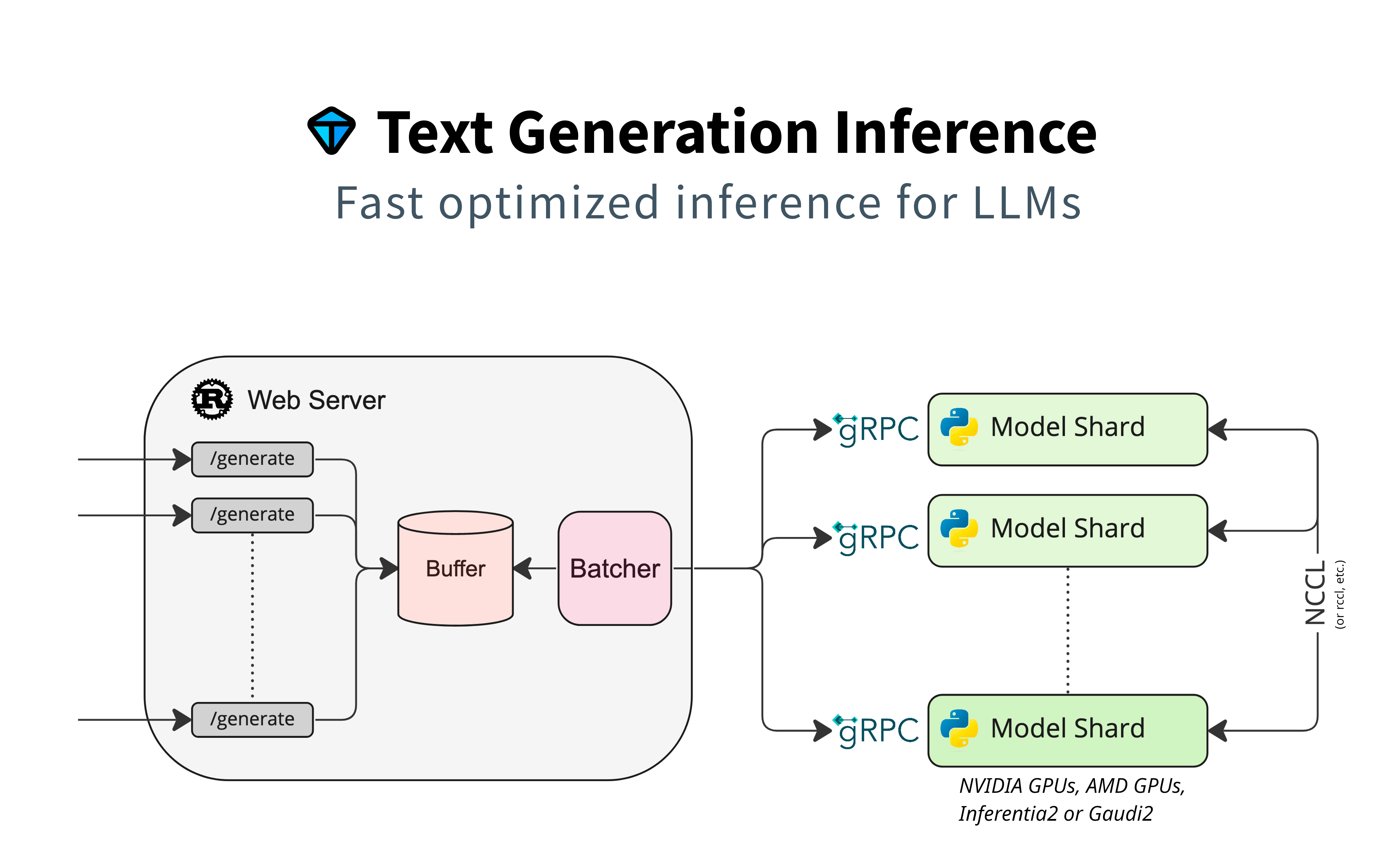
A Rust, Python and gRPC server for text generation inference. Used in production at Hugging Face
to power Hugging Chat, the Inference API and Inference Endpoints.
Table of contents
Get Started
Docker
API documentation
Using a private or gated model
A note on Shared Memory (shm)
Distributed Tracing
Architecture
Local install
Local install (Nix)
Optimized architectures
Run locally
Run
Quantization
Develop
Testing
Text Generation Inference (TGI) is a toolkit for deploying and serving Large Language Models (LLMs). TGI enables high-performance text generation for the most popular open-source LLMs, including Llama, Falcon, StarCoder, BLOOM, GPT-NeoX, and more. TGI implements many features, such as:
Simple launcher to serve most popular LLMs
Production ready (distributed tracing with Open Telemetry, Prometheus metrics)
Tensor Parallelism for faster inference on multiple GPUs
Token streaming using Server-Sent Events (SSE)
Continuous batching of incoming requests for increased total throughput
Messages API compatible with Open AI Chat Completion API
Optimized transformers code for inference using Flash Attention and Paged Attention on the most popular architectures
Quantization with :
bitsandbytes
GPT-Q
EETQ
AWQ
Marlin
fp8
Safetensors weight loading
Watermarking with A Watermark for Large Language Models
Logits warper (temperature scaling, top-p, top-k, repetition penalty, more details see transformers.LogitsProcessor)
Stop sequences
Log probabilities
Speculation ~2x latency
Guidance/JSON. Specify output format to speed up inference and make sure the output is valid according to some specs..
Custom Prompt Generation: Easily generate text by providing custom prompts to guide the model's output
Fine-tuning Support: Utilize fine-tuned models for specific tasks to achieve higher accuracy and performance
Hardware support
Nvidia
AMD (-rocm)
Inferentia
Intel GPU
Gaudi
Google TPU
Get Started
Docker
For a detailed starting guide, please see the Quick Tour. The easiest way of getting started is using the official Docker container:
model=HuggingFaceH4/zephyr-7b-beta
# share a volume with the Docker container to avoid downloading weights every run
volume=$PWD/data

docker run --gpus all --shm-size 1g -p 8080:80 -v $volume:/data \
    ghcr.io/huggingface/text-generation-inference:3.3.5 --model-id $model
And then you can make requests like
curl 127.0.0.1:8080/generate_stream \
    -X POST \
    -d '{"inputs":"What is Deep Learning?","parameters":{"max_new_tokens":20}}' \
    -H 'Content-Type: application/json'
You can also use TGI's Messages API to obtain Open AI Chat Completion API compatible responses.
curl localhost:8080/v1/chat/completions \
    -X POST \
    -d '{
  "model": "tgi",
  "messages": [
    {
      "role": "system",
      "content": "You are a helpful assistant."
    },
    {
      "role": "user",
      "content": "What is deep learning?"
    }
  ],
  "stream": true,
  "max_tokens": 20
}' \
    -H 'Content-Type: application/json'
Note: To use NVIDIA GPUs, you need to install the NVIDIA Container Toolkit. We also recommend using NVIDIA drivers with CUDA version 12.2 or higher. For running the Docker container on a machine with no GPUs or CUDA support, it is enough to remove the --gpus all flag and add --disable-custom-kernels, please note CPU is not the intended platform for this project, so performance might be subpar.
Note: TGI supports AMD Instinct MI210 and MI250 GPUs. Details can be found in the Supported Hardware documentation. To use AMD GPUs, please use docker run --device /dev/kfd --device /dev/dri --shm-size 1g -p 8080:80 -v $volume:/data ghcr.io/huggingface/text-generation-inference:3.3.5-rocm --model-id $model instead of the command above.
To see all options to serve your models (in the code or in the cli):
text-generation-launcher --help
API documentation
You can consult the OpenAPI documentation of the text-generation-inference REST API using the /docs route.
The Swagger UI is also available at: https://huggingface.github.io/text-generation-inference.
Using a private or gated model
You have the option to utilize the HF_TOKEN environment variable for configuring the token employed by
text-generation-inference. This allows you to gain access to protected resources.
For example, if you want to serve the gated Llama V2 model variants:
Go to https://huggingface.co/settings/tokens
Copy your CLI READ token
Export HF_TOKEN=<your CLI READ token>
or with Docker:
model=meta-llama/Meta-Llama-3.1-8B-Instruct
volume=$PWD/data # share a volume with the Docker container to avoid downloading weights every run
token=<your cli READ token>

docker run --gpus all --shm-size 1g -e HF_TOKEN=$token -p 8080:80 -v $volume:/data \
    ghcr.io/huggingface/text-generation-inference:3.3.5 --model-id $model
A note on Shared Memory (shm)
NCCL is a communication framework used by
PyTorch to do distributed training/inference. text-generation-inference makes
use of NCCL to enable Tensor Parallelism to dramatically speed up inference for large language models.
In order to share data between the different devices of a NCCL group, NCCL might fall back to using the host memory if
peer-to-peer using NVLink or PCI is not possible.
To allow the container to use 1G of Shared Memory and support SHM sharing, we add --shm-size 1g on the above command.
If you are running text-generation-inference inside Kubernetes. You can also add Shared Memory to the container by
creating a volume with:
Finally, you can also disable SHM sharing by using the NCCL_SHM_DISABLE=1 environment variable. However, note that
this will impact performance.
Distributed Tracing
text-generation-inference is instrumented with distributed tracing using OpenTelemetry. You can use this feature
by setting the address to an OTLP collector with the --otlp-endpoint argument. The default service name can be
overridden with the --otlp-service-name argument
Architecture
Detailed blogpost by Adyen on TGI inner workings: LLM inference at scale with TGI (Martin Iglesias Goyanes - Adyen, 2024)
Local install
You can also opt to install text-generation-inference locally.
First clone the repository and change directory into it:
git clone https://github.com/huggingface/text-generation-inference
cd text-generation-inference
Then install Rust and create a Python virtual environment with at least
Python 3.9, e.g. using conda or python venv:
BUILD_EXTENSIONS=True make install # Install repository and HF/transformer fork with CUDA kernels
text-generation-launcher --model-id mistralai/Mistral-7B-Instruct-v0.2
Note: on some machines, you may also need the OpenSSL libraries and gcc. On Linux machines, run:
sudo apt-get install libssl-dev gcc -y
Local install (Nix)
Another option is to install text-generation-inference locally using Nix. Currently,
we only support Nix on x86_64 Linux with CUDA GPUs. When using Nix, all dependencies can
be pulled from a binary cache, removing the need to build them locally.
First follow the instructions to install Cachix and enable the Hugging Face cache.
Setting up the cache is important, otherwise Nix will build many of the dependencies
locally, which can take hours.
After that you can run TGI with nix run:
cd text-generation-inference
nix run --extra-experimental-features nix-command --extra-experimental-features flakes . -- --model-id meta-llama/Llama-3.1-8B-Instruct
Note: when you are using Nix on a non-NixOS system, you have to make some symlinks
to make the CUDA driver libraries visible to Nix packages.
For TGI development, you can use the impure dev shell:
nix develop .#impure

# Only needed the first time the devshell is started or after updating the protobuf.
(
cd server
mkdir text_generation_server/pb || true
python -m grpc_tools.protoc -I../proto/v3 --python_out=text_generation_server/pb \
       --grpc_python_out=text_generation_server/pb --mypy_out=text_generation_server/pb ../proto/v3/generate.proto
find text_generation_server/pb/ -type f -name "*.py" -print0 -exec sed -i -e 's/^\(import.*pb2\)/from . \1/g' {} \;
touch text_generation_server/pb/__init__.py
)
All development dependencies (cargo, Python, Torch), etc. are available in this
dev shell.
Optimized architectures
TGI works out of the box to serve optimized models for all modern models. They can be found in this list.
Other architectures are supported on a best-effort basis using:
You can also run pre-quantized weights (AWQ, GPTQ, Marlin) or on-the-fly quantize weights with bitsandbytes, EETQ, fp8, to reduce the VRAM requirement:
4bit quantization is available using the NF4 and FP4 data types from bitsandbytes. It can be enabled by providing --quantize bitsandbytes-nf4 or --quantize bitsandbytes-fp4 as a command line argument to text-generation-launcher.
Read more about quantization in the Quantization documentation.
Develop
make server-dev
make router-dev
Testing
# python
make python-server-tests
make python-client-tests
# or both server and client tests
make python-tests
# rust cargo tests
make rust-tests
# integration tests
make integration-tests
Đọc thêm về huggingface/text-generation-inference ở đâu?
Trang TopGit này là một snapshot — tab "Readme" hiển thị nguyên văn README của repo (đã bỏ link, giữ ảnh). Repo GitHub ở github.com/huggingface/text-generation-inference là nguồn chính thức.
huggingface/text-generation-inference có bao nhiêu sao?
huggingface/text-generation-inference có 10.9k sao GitHub — tải lại trang để xem số mới nhất, hoặc xem trực tiếp github.com/huggingface/text-generation-inference. TopGit phản chiếu số sao của GitHub nhưng không cam kết đến từng phút.
huggingface/text-generation-inference có những chủ đề gì?
GitHub topics của huggingface/text-generation-inference: "bloom", "deep-learning", "falcon", "gpt", "inference", "nlp", "pytorch", "starcoder", "transformer". TopGit xếp repo vào nhóm AI Tools.
huggingface/text-generation-inference có trang demo không?
Dự án có trang chủ ở http://hf.co/docs/text-generation-inference. Tab "Readme" ở trang này thường có ảnh chụp và hướng dẫn bắt đầu nhanh.
huggingface/text-generation-inference còn đang phát triển không?
Commit gần nhất trên huggingface/text-generation-inference là 8 tháng trước (theo timestamp GitHub). Repo có 1.3k fork — một chỉ báo về mức độ quan tâm của cộng đồng.
huggingface/text-generation-inference dùng license gì?
huggingface/text-generation-inference phát hành theo license Apache-2.0. Nên mở file LICENSE trên GitHub để xác nhận — license metadata đôi khi lệch với thực tế dự án.
huggingface/text-generation-inference viết bằng ngôn ngữ gì?
huggingface/text-generation-inference chủ yếu viết bằng Python. Trường "language" của GitHub dựa trên phần lớn byte ở nhánh mặc định.
Đọc đầy đủ README ở tab phía trên.
text-generation-inference có đáng để bạn bỏ thời gian?
ChatGPT, Claude và Perplexity đều đọc được trang này. Hỏi thử xem họ nghĩ gì về text-generation-inference.

 /text-generation-inference