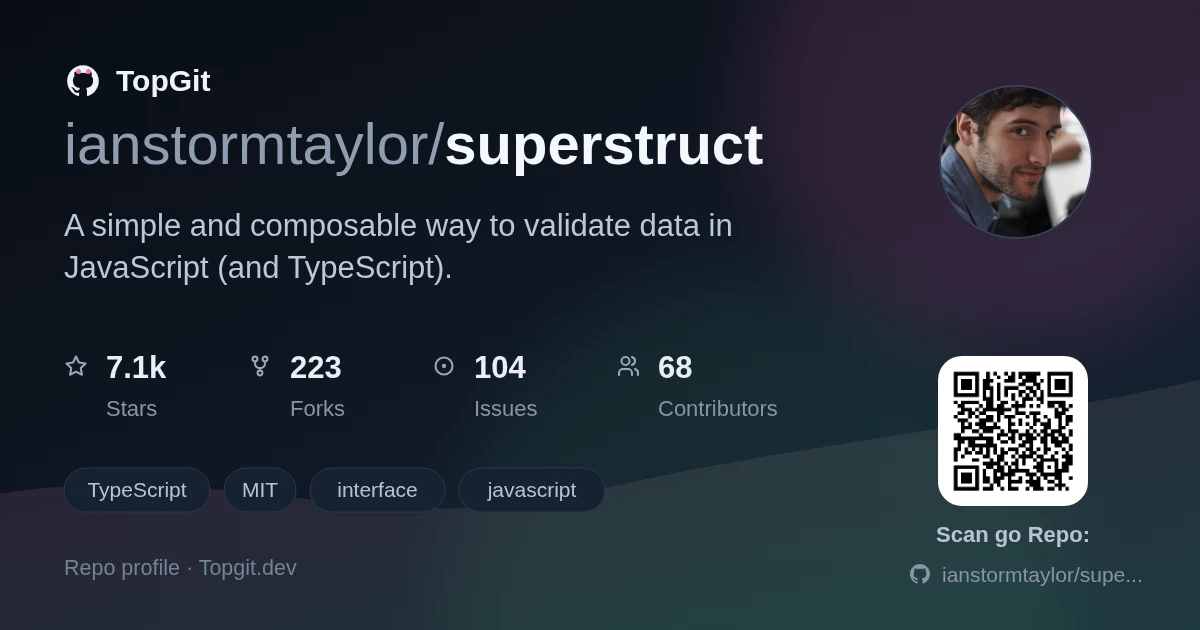
Một mục tập trung giao diện trong kho dữ liệu GitHub của TopGit: ianstormtaylor/superstruct, 7.1k sao, nhóm Frontend, TypeScript. A simple and composable way to validate data in JavaScript (and TypeScript).
Tóm tắt dựng từ metadata GitHub của chính dự án — chưa có bài review TopGit. Trang sẽ tự động cập nhật khi bài review đầy đủ được xuất bản.
VÌ SAO CHƯA CÓ REVIEW
TopGit viết bài đầy đủ cho repo có nhiều sao nhất và được yêu cầu nhiều nhất. Trang này là snapshot trong thời gian chờ — xem README gốc ở tab READ ME.
Superstruct makes it easy to define interfaces and then validate JavaScript data against them. Its type annotation API was inspired by Typescript, Flow, Go, and GraphQL, giving it a familiar and easy to understand API.
But Superstruct is designed for validating data at runtime, so it throws (or returns) detailed runtime errors for you or your end users. This is especially useful in situations like accepting arbitrary input in a REST or GraphQL API. But it can even be used to validate internal data structures at runtime when needed.
Usage
Superstruct allows you to define the shape of data you want to validate:
import { assert, object, number, string, array } from 'superstruct'

const Article = object({
  id: number(),
  title: string(),
  tags: array(string()),
  author: object({
    id: number(),
  }),
})

const data = {
  id: 34,
  title: 'Hello World',
  tags: ['news', 'features'],
  author: {
    id: 1,
  },
}

assert(data, Article)
// This will throw an error when the data is invalid.
// If you'd rather not throw, you can use `is()` or `validate()`.
Superstruct ships with validators for all the common JavaScript data types, and you can define custom ones too:
import { is, define, object, string } from 'superstruct'
import isUuid from 'is-uuid'
import isEmail from 'is-email'

const Email = define('Email', isEmail)
const Uuid = define('Uuid', isUuid.v4)

const User = object({
  id: Uuid,
  email: Email,
  name: string(),
})

const data = {
  id: 'c8d63140-a1f7-45e0-bfc6-df72973fea86',
  email: '[email protected]',
  name: 'Jane',
}

if (is(data, User)) {
  // Your data is guaranteed to be valid in this block.
}
Superstruct can also handle coercion of your data before validating it, for example to mix in default values:
import { create, object, number, string, defaulted } from 'superstruct'

let i = 0

const User = object({
  id: defaulted(number(), () => i++),
  name: string(),
})

const data = {
  name: 'Jane',
}

// You can apply the defaults to your data while validating.
const user = create(data, User)
// {
//   id: 0,
//   name: 'Jane',
// }
And if you use TypeScript, Superstruct automatically ensures that your data has proper typings whenever you validate it:
import { is, object, number, string } from 'superstruct'

const User = object({
  id: number(),
  name: string()
})

const data: unknown = { ... }

if (is(data, User)) {
  // TypeScript knows the shape of `data` here, so it is safe to access
  // properties like `data.id` and `data.name`.
}
Superstruct supports more complex use cases too like defining arrays or nested objects, composing structs inside each other, returning errors instead of throwing them, and more! For more information read the full Documentation.
Why?
There are lots of existing validation libraries—joi, express-validator, validator.js, yup, ajv, is-my-json-valid... But they exhibit many issues that lead to your codebase becoming hard to maintain...
They don't expose detailed errors. Many validators simply return string-only errors or booleans without any details as to why, making it difficult to customize the errors to be helpful for end-users.
They make custom types hard. Many validators ship with built-in types like emails, URLs, UUIDs, etc. with no way to know what they check for, and complicated APIs for defining new types.
They don't encourage single sources of truth. Many existing APIs encourage re-defining custom data types over and over, with the source of truth being spread out across your entire code base.
They don't throw errors. Many don't actually throw the errors, forcing you to wrap everywhere. Although helpful in the days of callbacks, not using throw in modern JavaScript makes code much more complex.
They're tightly coupled to other concerns. Many validators are tightly coupled to Express or other frameworks, which results in one-off, confusing code that isn't reusable across your code base.
They use JSON Schema. Don't get me wrong, JSON Schema can be useful. But it's kind of like HATEOAS—it's usually way more complexity than you need and you aren't using any of its benefits. (Sorry, I said it.)
Of course, not every validation library suffers from all of these issues, but most of them exhibit at least one. If you've run into this problem before, you might like Superstruct.
Which brings me to how Superstruct solves these issues...
Principles
Customizable types. Superstruct's power is in making it easy to define an entire set of custom data types that are specific to your application, and defined in a single place, so you have full control over your requirements.
Unopinionated defaults. Superstruct ships with native JavaScript types, and everything else is customizable, so you never have to fight to override decisions made by "core" that differ from your application's needs.
Composable interfaces. Superstruct interfaces are composable, so you can break down commonly-repeated pieces of data into components, and compose them to build up the more complex objects.
Useful errors. The errors that Superstruct throws contain all the information you need to convert them into your own application-specific errors easy, which means more helpful errors for your end users!
Familiar API. The Superstruct API was heavily inspired by Typescript, Flow, Go, and GraphQL. If you're familiar with any of those, then its schema definition API will feel very natural to use, so you can get started quickly.
Demo
Try out the live demo on CodeSandbox to get an idea for how the API works, or to quickly verify your use case:
Examples
Superstruct's API is very flexible, allowing it to be used for a variety of use cases on your servers and in the browser. Here are a few examples of common patterns...
Basic Validation
Custom Types
Default Values
Optional Values
Composing Structs
Throwing Errors
Returning Errors
Testing Values
Custom Errors
Documentation
Read the getting started guide to familiarize yourself with how Superstruct works. After that, check out the full API reference for more detailed information about structs, types and errors...
ianstormtaylor/superstruct thuộc nhóm Frontend trên TopGit, cùng 7 topic GitHub. Trang Trending và Topics liệt kê các repo cùng số sao và cùng ngôn ngữ để so sánh.
Đọc thêm về ianstormtaylor/superstruct ở đâu?
Trang TopGit này là một snapshot — tab "Readme" hiển thị nguyên văn README của repo (đã bỏ link, giữ ảnh). Repo GitHub ở github.com/ianstormtaylor/superstruct là nguồn chính thức.
ianstormtaylor/superstruct có bao nhiêu sao?
ianstormtaylor/superstruct có 7.1k sao GitHub — tải lại trang để xem số mới nhất, hoặc xem trực tiếp github.com/ianstormtaylor/superstruct. TopGit phản chiếu số sao của GitHub nhưng không cam kết đến từng phút.
ianstormtaylor/superstruct có phải mã nguồn mở không?
Có — ianstormtaylor/superstruct phát hành theo license MIT, nghĩa là mã nguồn mở để đọc, fork và (tùy license) tái sử dụng. Mã: github.com/ianstormtaylor/superstruct.
ianstormtaylor/superstruct còn đang phát triển không?
Commit gần nhất trên ianstormtaylor/superstruct là 2.1 năm trước (theo timestamp GitHub). Repo có 224 fork — một chỉ báo về mức độ quan tâm của cộng đồng.
ianstormtaylor/superstruct dùng license gì?
ianstormtaylor/superstruct phát hành theo license MIT. Nên mở file LICENSE trên GitHub để xác nhận — license metadata đôi khi lệch với thực tế dự án.
ianstormtaylor/superstruct là gì?
ianstormtaylor/superstruct (ianstormtaylor/superstruct) là dự án TypeScript trên GitHub. Theo mô tả gốc: A simple and composable way to validate data in JavaScript (and TypeScript).
ianstormtaylor/superstruct viết bằng ngôn ngữ gì?
ianstormtaylor/superstruct chủ yếu viết bằng TypeScript. Trường "language" của GitHub dựa trên phần lớn byte ở nhánh mặc định.
Đọc đầy đủ README ở tab phía trên.
Muốn nghe thêm một ý kiến về superstruct?
Hỏi một AI đọc được trang này — một cú bấm là có ngay nhận định về superstruct.
 /superstruct