Là một dự án mã nguồn mở, jakevdp/nfft đã đạt 212 sao trên GitHub, ngôn ngữ Jupyter Notebook. Lightweight non-uniform Fast Fourier Transform in Python
Tóm tắt dựng từ metadata GitHub của chính dự án — chưa có bài review TopGit. Trang sẽ tự động cập nhật khi bài review đầy đủ được xuất bản.
VÌ SAO CHƯA CÓ REVIEW
TopGit viết bài đầy đủ cho repo có nhiều sao nhất và được yêu cầu nhiều nhất. Trang này là snapshot trong thời gian chờ — xem README gốc ở tab READ ME.
The nfft package is a lightweight implementation of the non-equispaced
fast Fourier transform (NFFT), implemented via numpy and scipy and released
under the MIT license.
For information about the NFFT algorithm, see the paper
Using NFFT 3 – a software library for various nonequispaced fast Fourier transforms.
The nfft package achieves comparable performance to the C package
described in that paper, without any customized compiled code. Rather, it
makes use of the computational building blocks available in NumPy and SciPy.
For a discussion of the algorithm and this implementation, see the
Implementation Walkthrough
notebook.
About
The nfft package implements one-dimensional versions of the forward and
adjoint non-equispaced fast Fourier transforms;
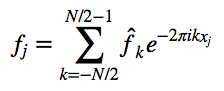
The forward transform:
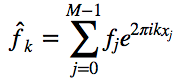
And the adjoint transform:
In both cases, the wavenumbers k are on a regular grid from -N/2 to N/2,
while the data values x_j are irregularly spaced between -1/2 and 1/2.
The direct and fast version of these algorithms are implemented in the following
functions:
nfft.ndft: direct forward non-equispaced Fourier transform
nfft.nfft: fast forward non-equispaced Fourier transform
nfft.ndft_adjoint: direct adjoint non-equispaced Fourier transform
nfft.nfft_adjoint: fast adjoint non-equispaced Fourier transform
Computational complexity
The direct version of each transform has a computational complexity of
approximately O[NM], while the NFFT has a computational complexity of
approximately O[N log(N) + M log(1/ϵ)], where ϵ is the desired precision
of the result. In the current implementation, memory requirements scale as
approximately O[N + M log(1/ϵ)].
Comparison to pynfft
Another option for computing the NFFT in Python is to use the
pynfft package, which provides a
Python wrapper to the C library referenced in the above paper.
The advantage of pynfft is that, compared to nfft, it provides a more
complete set of routines, including multi-dimensional NFFTs, several related
extensions, and a range of computing strategies.
The disadvantage is that pynfft is GPL-licensed (and thus can't be used
in much of the more permissively licensed Python scientific world), and has
a much more complicated set of dependencies.
Performance-wise, nfft and pynfft are comparable, with the
implementation within nfft package being up to a factor of 2 faster
in most cases of interest (see Benchmarks.ipynb
for some simple benchmarks).
If you're curious about the implementation and how nfft attains such
performance without a custom compiled extension, see the Implementation
Walkthrough notebook.
Basic Usage
import numpy as np
from nfft import nfft

# define evaluation points
x = -0.5 + np.random.rand(1000)

# define Fourier coefficients
N = 10000
k = - N // 2 + np.arange(N)
f_k = np.random.randn(N)

# non-equispaced fast Fourier transform
f = nfft(x, f_k)
For some more examples, see the notebooks in the notebooks
directory.
Installation
The nfft package can be installed directly from the Python Package Index:
$ pip install nfft
Dependencies are numpy, scipy,
and pytest, and the package is tested in Python
versions 2.7. 3.5, and 3.6.
Testing
Unit tests can be run using pytest:
$ pytest --pyargs nfft
License
This code is released under the MIT License. For more information,
see the Open Source Initiative
Support
Development of this package is supported by the
UW eScience Institute,
with funding from
the Gordon & Betty Moore Foundation,
the Alfred P. Sloan Foundation,
and the Washington Research Foundation
Trang TopGit này là một snapshot — tab "Readme" hiển thị nguyên văn README của repo (đã bỏ link, giữ ảnh). Repo GitHub ở github.com/jakevdp/nfft là nguồn chính thức.
jakevdp/nfft có bao nhiêu sao?
jakevdp/nfft có 212 sao GitHub — tải lại trang để xem số mới nhất, hoặc xem trực tiếp github.com/jakevdp/nfft. TopGit phản chiếu số sao của GitHub nhưng không cam kết đến từng phút.
jakevdp/nfft có phải mã nguồn mở không?
Có — jakevdp/nfft phát hành theo license MIT, nghĩa là mã nguồn mở để đọc, fork và (tùy license) tái sử dụng. Mã: github.com/jakevdp/nfft.
jakevdp/nfft có website riêng không?
TopGit chưa ghi nhận URL trang chủ cho jakevdp/nfft. Phần README ở tab phía trên thường có link demo, hoặc xem mô tả GitHub của repo.
jakevdp/nfft là gì?
jakevdp/nfft (jakevdp/nfft) là dự án Jupyter Notebook trên GitHub. Theo mô tả gốc: Lightweight non-uniform Fast Fourier Transform in Python
Đọc đầy đủ README ở tab phía trên.
nfft có đáng để bạn bỏ thời gian?
ChatGPT, Claude và Perplexity đều đọc được trang này. Hỏi thử xem họ nghĩ gì về nfft.
 /nfft