junyanz/BicycleGAN — 1.5k★ trên GitHub (Python). Toward Multimodal Image-to-Image Translation
Tóm tắt dựng từ metadata GitHub của chính dự án — chưa có bài review TopGit. Trang sẽ tự động cập nhật khi bài review đầy đủ được xuất bản.
VÌ SAO CHƯA CÓ REVIEW
TopGit viết bài đầy đủ cho repo có nhiều sao nhất và được yêu cầu nhiều nhất. Trang này là snapshot trong thời gian chờ — xem README gốc ở tab READ ME.
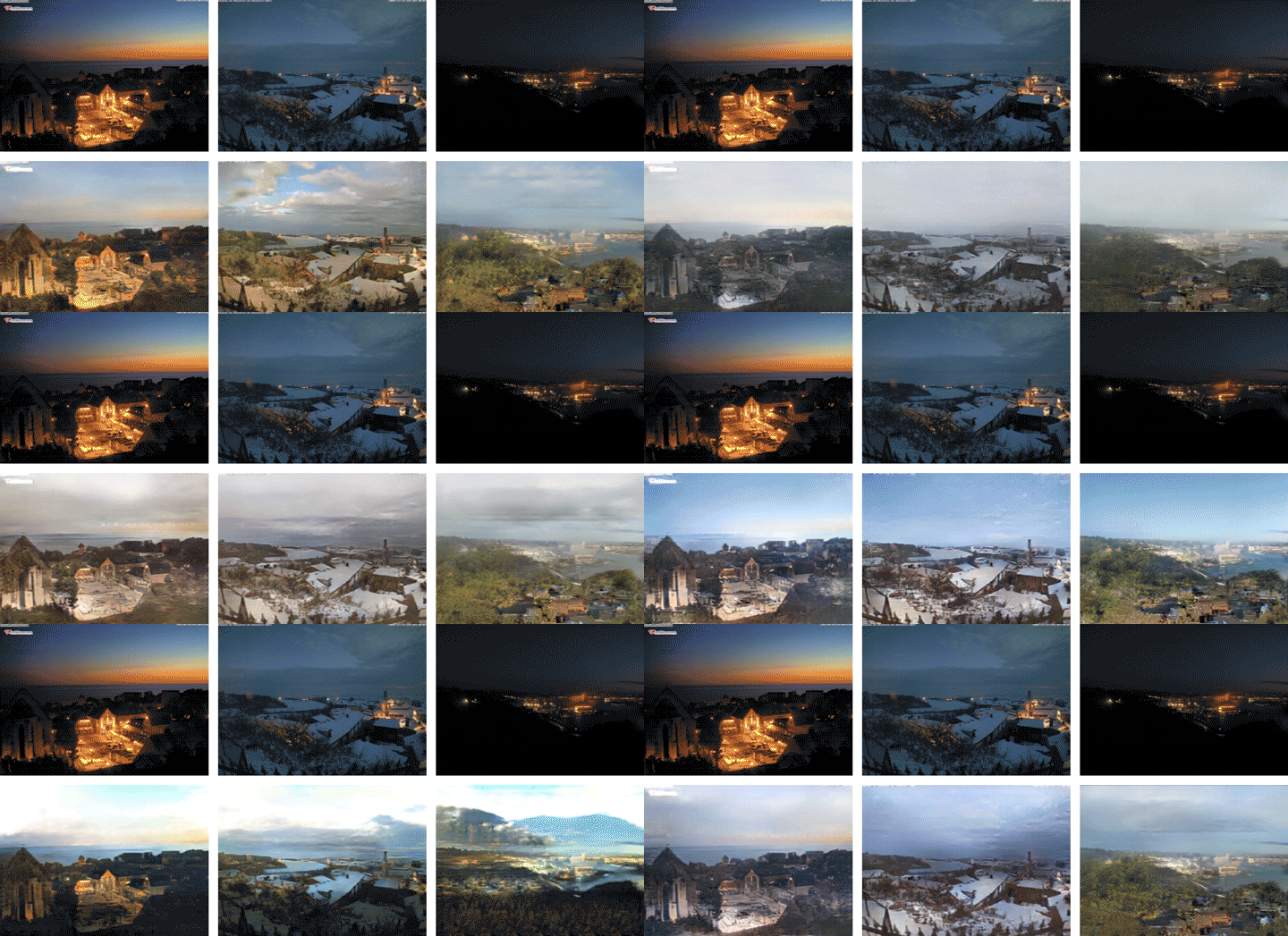
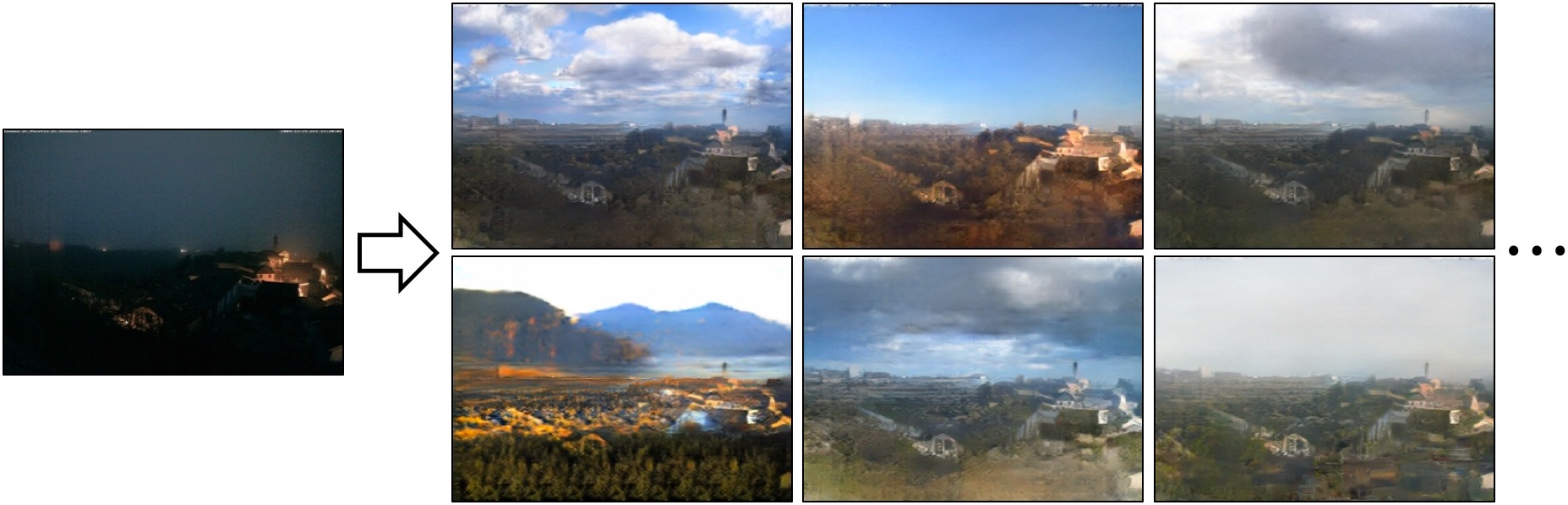
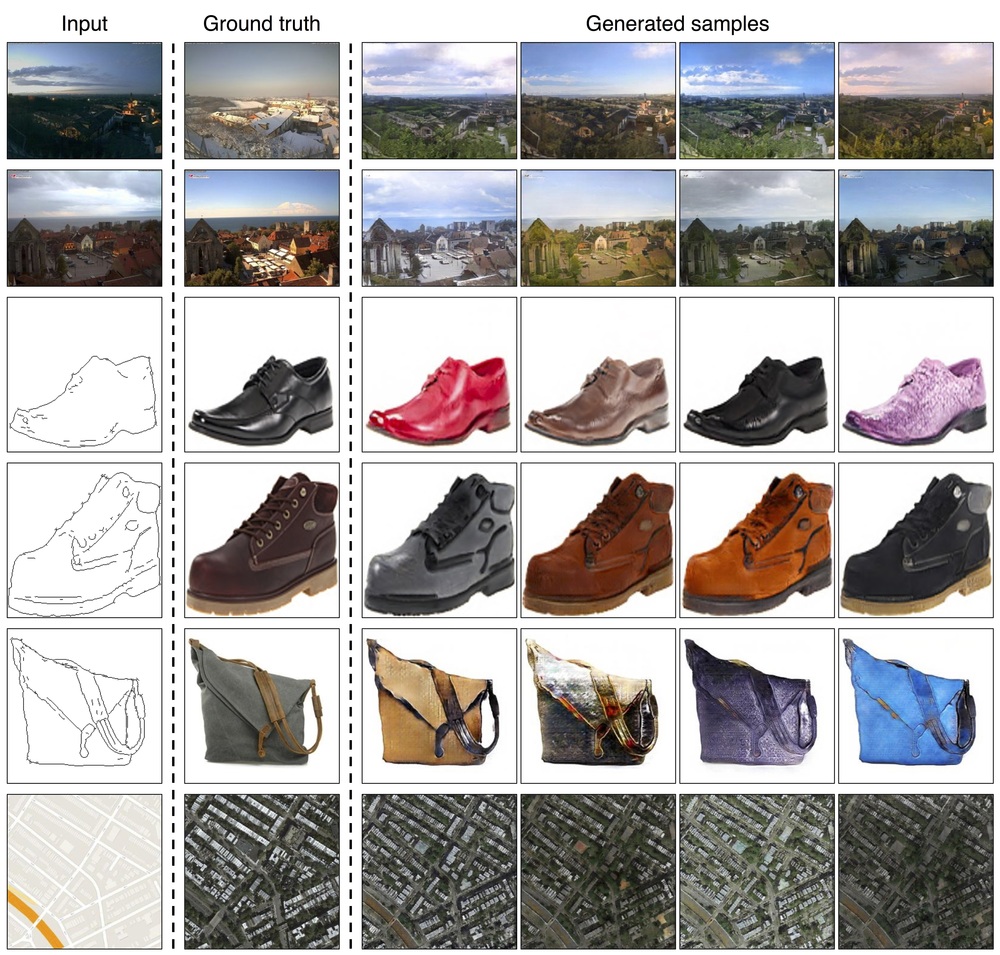
Pytorch implementation for multimodal image-to-image translation. For example, given the same night image, our model is able to synthesize possible day images with different types of lighting, sky and clouds. The training requires paired data.
Note: The current software works well with PyTorch 0.41+. Check out the older branch that supports PyTorch 0.1-0.3.
Toward Multimodal Image-to-Image Translation.
Jun-Yan Zhu,
Richard Zhang, Deepak Pathak, Trevor Darrell, Alexei A. Efros, Oliver Wang, Eli Shechtman.
UC Berkeley and Adobe Research
In Neural Information Processing Systems, 2017.
Example results
Other Implementations
[Tensorflow] by Youngwoon Lee (USC CLVR Lab).
[Tensorflow] by Kv Manohar.
Prerequisites
Linux or macOS
Python 3
CPU or NVIDIA GPU + CUDA CuDNN
Getting Started
Installation
Clone this repo:
git clone -b master --single-branch https://github.com/junyanz/BicycleGAN.git
cd BicycleGAN
Install PyTorch and dependencies from http://pytorch.org
Install python libraries visdom, dominate, and moviepy.
The test results will be saved to a html file here: ./results/edges2shoes/val/index.html.
Generate results with synchronized latent vectors
bash ./scripts/test_edges2shoes.sh --sync
Results can be found at ./results/edges2shoes/val_sync/index.html.
Generate Morphing Videos
We can also produce a morphing video similar to this GIF and Youtube video.
bash ./scripts/video_edges2shoes.sh
Results can be found at ./videos/edges2shoes/.
Model Training
To train a model, download the training images (e.g., edges2shoes).
bash ./datasets/download_dataset.sh edges2shoes
Train a model:
bash ./scripts/train_edges2shoes.sh
To view training results and loss plots, run python -m visdom.server and click the URL http://localhost:8097. To see more intermediate results, check out ./checkpoints/edges2shoes_bicycle_gan/web/index.html
See more training details for other datasets in ./scripts/train.sh.
Datasets (from pix2pix)
Download the datasets using the following script. Many of the datasets are collected by other researchers. Please cite their papers if you use the data.
Download the testset.
bash ./datasets/download_testset.sh dataset_name
Download the training and testset.
bash ./datasets/download_dataset.sh dataset_name
facades: 400 images from CMP Facades dataset. [Citation]
maps: 1096 training images scraped from Google Maps
edges2shoes: 50k training images from UT Zappos50K dataset. Edges are computed by HED edge detector + post-processing. [Citation]
edges2handbags: 137K Amazon Handbag images from iGAN project. Edges are computed by HED edge detector + post-processing. [Citation]
night2day: around 20K natural scene images from Transient Attributes dataset [Citation]
Models
Download the pre-trained models with the following script.
Figure 6 shows realism vs diversity of our method.
Realism We use the Amazon Mechanical Turk (AMT) Real vs Fake test from this repository, first introduced in this work.
Diversity For each input image, we produce 20 translations by randomly sampling 20 z vectors. We compute LPIPS distance between consecutive pairs to get 19 paired distances. You can compute this by putting the 20 images into a directory and using this script (note that we used version 0.0 rather than default 0.1, so use flag -v 0.0). This is done for 100 input images. This results in 1900 total distances (100 images X 19 paired distances each), which are averaged together. A larger number means higher diversity.
Citation
If you find this useful for your research, please use the following.
@inproceedings{zhu2017toward,
  title={Toward multimodal image-to-image translation},
  author={Zhu, Jun-Yan and Zhang, Richard and Pathak, Deepak and Darrell, Trevor and Efros, Alexei A and Wang, Oliver and Shechtman, Eli},
  booktitle={Advances in Neural Information Processing Systems},
  year={2017}
}
If you use modules from CycleGAN or pix2pix paper, please use the following:
@inproceedings{CycleGAN2017,
  title={Unpaired Image-to-Image Translation using Cycle-Consistent Adversarial Networkss},
  author={Zhu, Jun-Yan and Park, Taesung and Isola, Phillip and Efros, Alexei A},
  booktitle={Computer Vision (ICCV), 2017 IEEE International Conference on},
  year={2017}
}


@inproceedings{isola2017image,
  title={Image-to-Image Translation with Conditional Adversarial Networks},
  author={Isola, Phillip and Zhu, Jun-Yan and Zhou, Tinghui and Efros, Alexei A},
  booktitle={Computer Vision and Pattern Recognition (CVPR), 2017 IEEE Conference on},
  year={2017}
}
Acknowledgements
This code borrows heavily from the pytorch-CycleGAN-and-pix2pix repository.
Trang TopGit này là một snapshot — tab "Readme" hiển thị nguyên văn README của repo (đã bỏ link, giữ ảnh). Repo GitHub ở github.com/junyanz/BicycleGAN là nguồn chính thức.
junyanz/BicycleGAN có những chủ đề gì?
GitHub topics của junyanz/BicycleGAN: "deep-learning", "gans", "generative-adversarial-network", "pix2pix", "pytorch". TopGit xếp repo vào nhóm AI Tools.
junyanz/BicycleGAN có phải mã nguồn mở không?
TopGit chưa ghi nhận license cho junyanz/BicycleGAN. Phần lớn repo public trên GitHub là mã nguồn mở, nhưng điều khoản khác nhau từng repo — mở file LICENSE để xác nhận.
junyanz/BicycleGAN có trang demo không?
Dự án có trang chủ ở https://junyanz.github.io/BicycleGAN/. Tab "Readme" ở trang này thường có ảnh chụp và hướng dẫn bắt đầu nhanh.
junyanz/BicycleGAN còn đang phát triển không?
Commit gần nhất trên junyanz/BicycleGAN là 6.0 năm trước (theo timestamp GitHub). Repo có 252 fork — một chỉ báo về mức độ quan tâm của cộng đồng.
Đọc đầy đủ README ở tab phía trên.
BicycleGAN có đáng để bạn bỏ thời gian?
ChatGPT, Claude và Perplexity đều đọc được trang này. Hỏi thử xem họ nghĩ gì về BicycleGAN.