juspay/hyperswitch-prism là dự án Backend trên GitHub, viết chủ yếu bằng Rust, với 1.4k sao. One library | Many payment processors | Scale to multiple processors with few lines of code.
Tóm tắt dựng từ metadata GitHub của chính dự án — chưa có bài review TopGit. Trang sẽ tự động cập nhật khi bài review đầy đủ được xuất bản.
VÌ SAO CHƯA CÓ REVIEW
TopGit viết bài đầy đủ cho repo có nhiều sao nhất và được yêu cầu nhiều nhất. Trang này là snapshot trong thời gian chờ — xem README gốc ở tab READ ME.
One integration. Any payment processor.Switch processors with few lines of code.
Website · Documentation · Slack Community
What is Prism?
Prism is a stateless, unified connector library to connect with any payment processor. It is extracted out of the hardened integrations through continuous testing & iterative bug fixing over years of usage within Juspay Hyperswitch.
Why are payment processor integrations such a big deal?
Every payment processor has diverse APIs, error codes, authentication methods, pdf documents to read, and behavioural differences between the actual environment and documented specs.
A small mistake or oversight can create a huge financial impact for businesses accepting payments. Thousands of enterprises around the world have gone through this learning curve and iterated and fixed payment systems over many years. All such fixes/improvements/iterations are locked-in as tribal knowledge into Enterprise Payment Platforms and SaaS Payment Orchestration solutions.
Hence, Prism - to open up payment diversity to the entire world as a simple, lightweight, zero lock-in, developer friendly payments library.
Prism is extracted, built and maintained by the team behind Juspay Hyperswitch - the open-source payments platform with 40K+ Github stars and used by leading enterprise merchants around the world.
Note: In all honesty, payments are not more complicated than database drivers. It is simply just that the industry has not arrived at a standard (and it never will!!).
What does Prism do well?
One request schema for every payment. The same authorize call works against Stripe, Adyen and many more without additional lines of code.
Stateless. No database, no stored PII. Credentials are not stored/ logged by the library. It lives only up to the lifetime of your HTTP client.
PCI scope reduction. The card data flowing/ not flowing into the library is your choice. You can choose to leverage any payment processor vault or your own PCI certified vault. Nothing is logged or stored by the library.
Integrations - Status
Prism supports multiple connectors with varying levels of payment method and flow coverage. Each connector is continuously tested against real sandbox/ production environments.
Legend: ✓ Supported | x Not Supported | ⚠ In Progress | ? Needs Validation
Status
Description
✓
Fully implemented and tested
x
Not applicable or unsupported by processor
⚠
Implementation in progress or partial
?
Implementation needs validation against live environment
View Complete Connector Coverage →
What Prism does not do (yet)?
Built-in vault or tokenization service. This is a design choice. You may bring your own vault, or use the payment processor's vault.
Retry or routing logic. It lives in Juspay Hyperswitch. Prism is only the transformation layer.
Beyond payments. The diversity exists beyond payments - in subscriptions, fraud, tax, payouts. And it is our aspiration, to evolve Prism into a stateless commerce library.
Architecture
A very high level overview of the Prism architecture and components. To understand more refer docs
Before integrating, read the SDK guide for your language — it covers connector authentication configs, required fields per connector, sandbox test cards, status codes, and common runtime pitfalls.
Language
SDK Integration Guide
Python
sdk/python/README.md
Node.js
sdk/javascript/README.md
Java
sdk/java/README.md
Rust
sdk/rust
Demo Application: Checkout the E-Commerce Demo for a complete working example with Stripe and Adyen integration.
Install the Prism Library
Start by installing the library in the language of your choice.
This file contains complete SDK documentation including installation, payment operations, error handling, connector configuration, field probe data, and examples for all payment processors.
🔄 Routing between Payment Providers
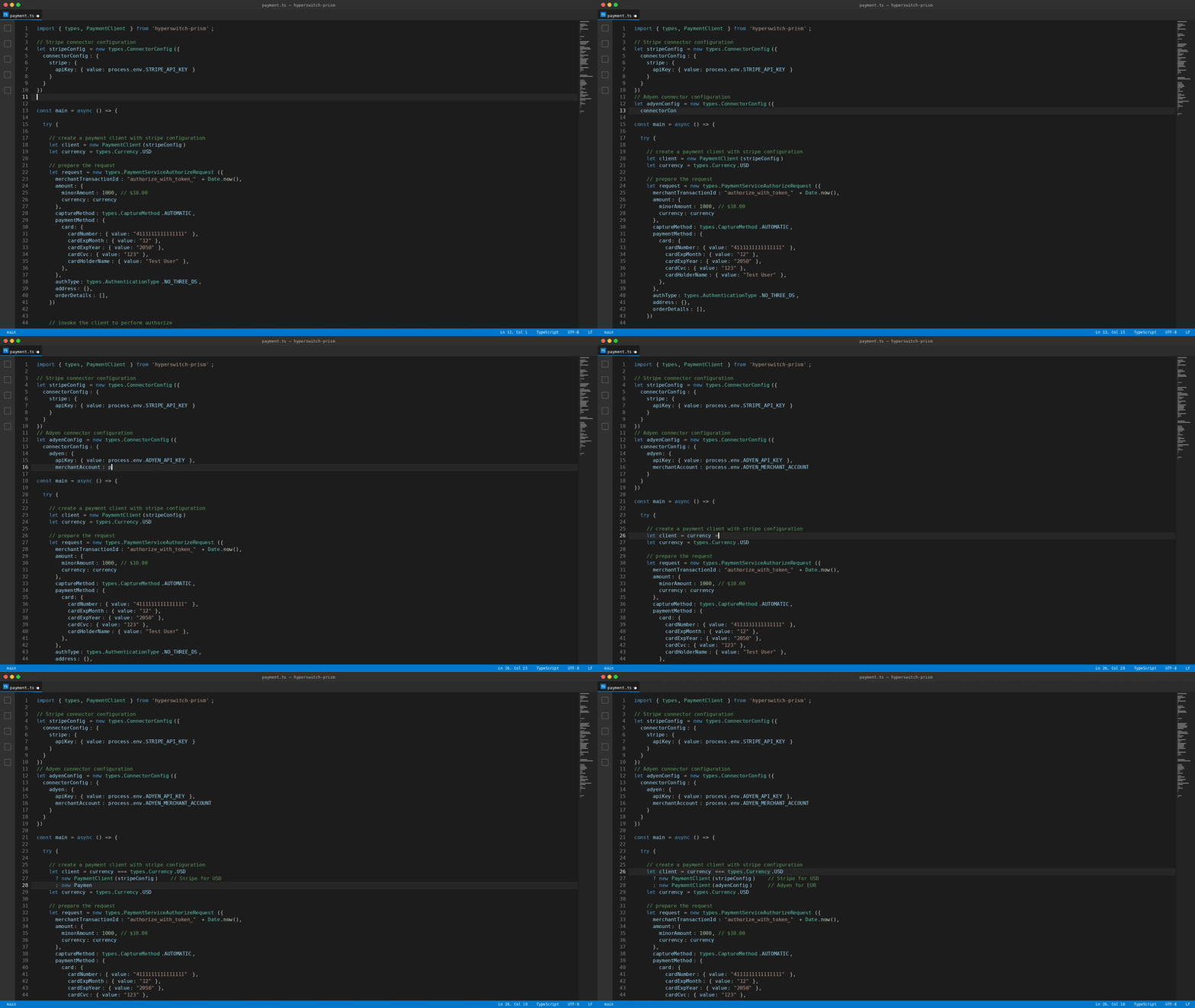
Once the basic plumbing is implemented you can leverage Prism's core benefit - switch payment providers by changing one line.
You may just swap the client with any business rules and smart retry logic for payment processor routing. Each flow uses the same unified schema regardless of the underlying processor's API differences.
If you wish to learn more about routing logic and smart retries, you can checkout intelligent routing and smart retries. It can help configure and manage diverse payment acceptance setup, as well as improve conversion rates.
🔌 Plugins
Ready-made integrations for popular platforms.
Platform
Package
Description
Medusa
@juspay-tech/medusa-custom-payments
Medusa v2 backend payment provider
Medusa
@juspay-tech/medusa-custom-payments-react
React storefront checkout components
🐳 Running the gRPC Server (Docker)
Prism also runs as a standalone gRPC server. Multi-arch images (linux/amd64, linux/arm64) are published to GitHub Container Registry on every nightly tag — browse the available tags. latest follows the most recent nightly; pin a dated tag for anything you need to reproduce.
docker run --rm -p 8000:8000 ghcr.io/juspay/hyperswitch-prism:latest
The server registers its own descriptors, so grpcurl needs no local .proto files — it can list the services and print the exact request schema:
Connector credentials are sent per request in the x-connector-config metadata header, as JSON of the form {"config":{"Stripe":{"api_key":"sk_test_..."}}} — it selects the connector and carries its credentials, and the server keeps neither. The proto definitions are in crates/types-traits/grpc-api-types/proto.
Configuration
The image ships development.toml (default), sandbox.toml and production.toml. Pick one with CS__COMMON__ENVIRONMENT:
docker run --rm -p 8000:8000 \
  -e CS__COMMON__ENVIRONMENT=sandbox \
  ghcr.io/juspay/hyperswitch-prism:latest
Individual keys are overridden with CS__<SECTION>__<KEY> environment variables, for example CS__SERVER__PORT=9000. To supply a config of your own, mount it over the one in the image:
docker run --rm -p 8000:8000 \
  -v "$(pwd)/my-config.toml:/app/config/development.toml:ro" \
  ghcr.io/juspay/hyperswitch-prism:latest
Metrics
Prometheus metrics are served on port 8080. Publish that port as well if you want to scrape them:
docker run --rm -p 8000:8000 -p 8080:8080 ghcr.io/juspay/hyperswitch-prism:latest
curl localhost:8080/metrics
The endpoint is empty until the server has handled its first request.
The image is also built with the OTLP push pipeline compiled in, disabled by default.
Enable it to push metrics to an OpenTelemetry collector over gRPC:
The endpoint must be an OTLP gRPC receiver (default port 4317). Enabling this does
not affect the Prometheus endpoint above.
🛠️ Development
Prerequisites
Rust 1.70+
Protocol Buffers (protoc)
Building from Source
# Clone the repository
git clone https://github.com/juspay/hyperswitch-prism.git
cd hyperswitch-prism

# Build
cargo build --release

# Run tests
cargo test
For the grace/ TypeScript workspace (parity dashboard, AI-assisted connector integration), bootstrap with:
make grace-workspace
This auto-installs pnpm via corepack if needed, then runs the full prereq probe, install, build, and interactive .env scaffold. See grace/grace-workspace/README.md for the full setup story including LLM auth modes (Anthropic OAuth, bare API key, LiteLLM gateway) and runner choice (claude-code vs opencode).
Don't want Node + claude + gh on your host? Use the containerized path instead: make grace-workspace-docker builds a self-contained image and starts the supervisor + dashboard + opencode-serve sidecar via docker-compose. Requires TENXGRACE_PROJECT_ROOT exported. Full prereqs and limitations in the workspace README's "Docker (alternative entry)" section.
💻 Platform Support
The hyperswitch-prism SDK contains platform-specific native libraries compiled for following platforms and architectures.
Trang TopGit này là một snapshot — tab "Readme" hiển thị nguyên văn README của repo (đã bỏ link, giữ ảnh). Repo GitHub ở github.com/juspay/hyperswitch-prism là nguồn chính thức.
juspay/hyperswitch-prism có phải mã nguồn mở không?
Có — juspay/hyperswitch-prism phát hành theo license Apache-2.0, nghĩa là mã nguồn mở để đọc, fork và (tùy license) tái sử dụng. Mã: github.com/juspay/hyperswitch-prism.
juspay/hyperswitch-prism có trang demo không?
Dự án có trang chủ ở https://hyperswitch.io/prism. Tab "Readme" ở trang này thường có ảnh chụp và hướng dẫn bắt đầu nhanh.
juspay/hyperswitch-prism còn đang phát triển không?
Commit gần nhất trên juspay/hyperswitch-prism là 2 tháng trước (theo timestamp GitHub). Repo có 261 fork — một chỉ báo về mức độ quan tâm của cộng đồng.
juspay/hyperswitch-prism dùng license gì?
juspay/hyperswitch-prism phát hành theo license Apache-2.0. Nên mở file LICENSE trên GitHub để xác nhận — license metadata đôi khi lệch với thực tế dự án.
Đọc đầy đủ README ở tab phía trên.
Muốn nghe thêm một ý kiến về hyperswitch-prism?
Hỏi một AI đọc được trang này — một cú bấm là có ngay nhận định về hyperswitch-prism.
 /hyperswitch-prism