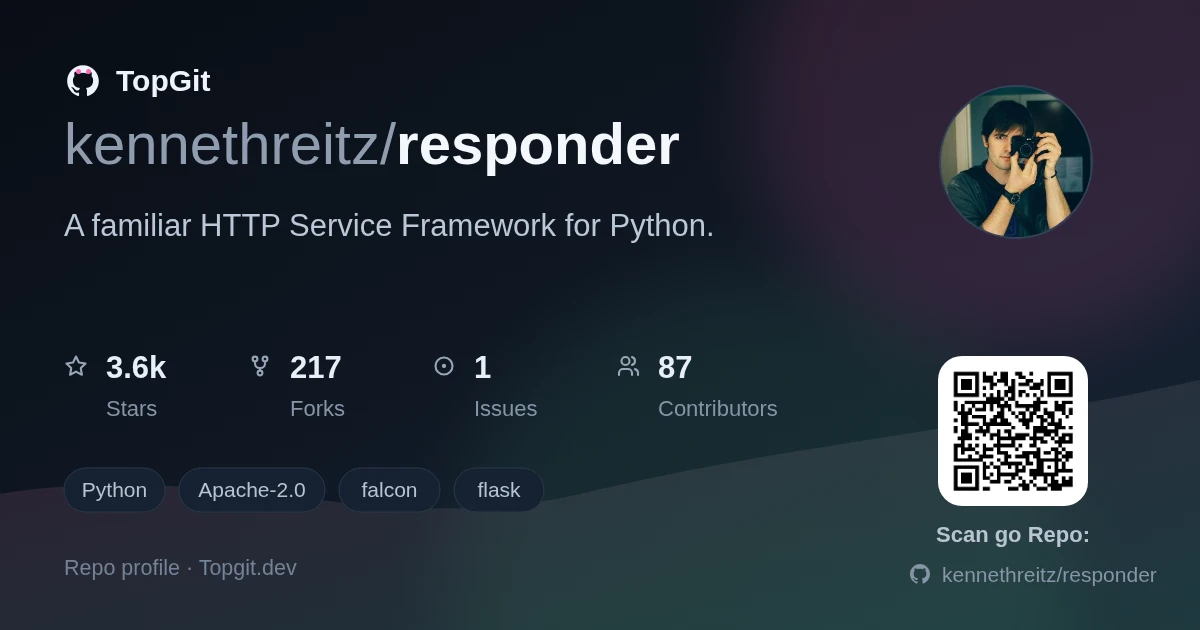
kennethreitz/responder là một trong những repo phía máy chủ mà TopGit theo dõi, hiện có 3.6k sao, viết chủ yếu bằng Python. A familiar HTTP Service Framework for Python.
Tóm tắt dựng từ metadata GitHub của chính dự án — chưa có bài review TopGit. Trang sẽ tự động cập nhật khi bài review đầy đủ được xuất bản.
VÌ SAO CHƯA CÓ REVIEW
TopGit viết bài đầy đủ cho repo có nhiều sao nhất và được yêu cầu nhiều nhất. Trang này là snapshot trong thời gian chờ — xem README gốc ở tab READ ME.
Web services for humans.
A familiar HTTP Service Framework for Python, powered by Starlette.
Documentation
· Quickstart
· Tour
· Examples
· Changelog
import responder

api = responder.API()


@api.get("/hello/{name}")
def hello(req, resp, *, name):
    resp.media = {"hello": name}


if __name__ == "__main__":
    api.run()
$ pip install "responder[orjson]"
$ python app.py
Open http://127.0.0.1:5042/hello/world. That's it.
Responder is the friendly request/response shape of Flask and Falcon, brought
to ASGI with Starlette underneath. Every view receives a req and a resp.
Read from one, write to the other. Sync and async views both work.
Why Responder?
Responder is for people who like small, expressive web frameworks with real
batteries included.
You want
Responder gives you
A simple mental model
def view(req, resp): ... with mutable request and response objects
Modern Python I/O
ASGI, Starlette routing, uvicorn by default, optional Granian
Real API contracts
Typed request/response validation and generated OpenAPI 3.0/3.1
Live typed data
Validated SSE and NDJSON with streaming generated clients
Responder can stay tiny, but it does not stop at toy apps.
from pydantic import BaseModel, Field

import responder
from responder.ext.auth import BearerAuth


class ItemIn(BaseModel):
    name: str = Field(min_length=1)
    price: float = Field(gt=0)


class ItemOut(ItemIn):
    id: int


class User(BaseModel):
    name: str
    scopes: list[str]


api = responder.API(
    title="Store API",
    version="1.0",
    openapi="3.1.0",
    docs_route="/docs",
    request_id=True,
)

users = {"secret-token": User(name="Ada", scopes=["items:write"])}
auth = BearerAuth(verify=lambda token: users.get(token), bearer_format="opaque")
writer = api.policy("writer", auth.requires("items:write"))


@api.post(
    "/items",
    auth=writer,
    status_code=201,
    summary="Create an item",
)
def create_item(req, resp, *, item: ItemIn, user) -> ItemOut:
    return ItemOut(id=1, **item.model_dump())
You get validation, auth enforcement, a documented request body, a documented
response body, 401/403/422 Problem Details responses, request IDs, and
Swagger UI at /docs. The same inference works for collections:
Contracts can stream too. Each event is validated and serialized as it is
yielded, OpenAPI carries the item schema, and generated clients expose a lazy
iterator instead of buffering the response:
from collections.abc import AsyncIterator


@api.sse("/inventory/events", heartbeat=15)
async def inventory_events(
    req, resp
) -> AsyncIterator[responder.SSE[ItemOut]]:
    async for item in inventory.watch():
        yield responder.SSE(item, event="item", id=item.id)


@api.ndjson("/inventory/export")
async def inventory_export(req, resp) -> AsyncIterator[ItemOut]:
    async for item in inventory.all():
        yield item
signed sessions, server-side sessions, CSRF protection, auth helpers, JWT/OAuth2
Operations
request IDs, structured access logs, health checks, Prometheus metrics
Limits
request body caps, streaming multipart uploads, in-memory/Redis rate limiting
Composition
dependencies with teardown, background tasks, WSGI/ASGI mounting, WebSockets
Deployment
built-in uvicorn runner, optional Granian, proxy-header support
Testing
in-process api.requests and configurable api.test_client(...)
v9 Highlights
Responder 9 tightened the production story while keeping the familiar API:
Multipart uploads stream from the wire and spool to disk instead of buffering
entire files in memory.
Request bodies are capped at 100 MiB by default; pass
API(max_request_size=None) for the legacy unlimited behavior.
API(csrf=True) adds session-bound CSRF protection for unsafe requests, with
per-route opt-outs for webhooks.
API(trust_proxy_headers=True) rewrites scheme, host, and client IP from
trusted reverse-proxy headers.
Framework-generated errors use RFC 9457-style application/problem+json
responses by default.
OpenAPI documents operational responses such as CSRF 403, body-cap 413,
rate-limit 429, fail-closed limiter 503, validation 422, and timeout
504 where they can actually happen.
Upgrading from an earlier major version? Start with the
v9 migration guide.
Installation
$ pip install "responder[orjson]"
This is the recommended installation on standard GIL-enabled CPython:
Responder detects orjson automatically and uses it for faster JSON response
encoding. Python 3.11 and newer are supported.
Feature combinations:
$ pip install "responder[orjson,server]"   # Granian production server
$ pip install "responder[graphql,orjson]"  # GraphQL with Graphene
$ pip install "responder[jwt,orjson]"      # JWT auth helpers
With uv:
$ uv add "responder[orjson]"
Free-threaded CPython builds (3.14t and 3.15t) should install the base
package with pip install responder. Responder gracefully falls back to the
standard-library JSON encoder when orjson is unavailable; no application
code changes are required.
Run It
# app.py
import responder

api = responder.API()


@api.get("/")
def index(req, resp):
    resp.text = "hello, world!"


if __name__ == "__main__":
    api.run(port=8000)
$ python app.py
Or through the CLI:
$ responder run app.py
OpenAPI and Clients
Turn on OpenAPI with two arguments:
api = responder.API(
    title="Acme API",
    version="1.0",
    openapi="3.1.0",
    docs_route="/docs",
)
Responder builds the schema from routes, type hints, Pydantic models, auth
helpers, and framework behavior. The docs UI appears at /docs, the schema at
/schema.yml, and client code can be generated for Python, JavaScript,
TypeScript, Ruby, and PHP.
The golden contract app: auth, policies, examples, OpenAPI, generated-client coverage
examples/todo.py
A practical typed Todo API with protected writes and polished schema metadata
examples/fortunes.py
Tiny app wrapping the local fortune CLI tool
examples/tarot.py
A playful API that shuffles, lists, and deals tarot cards
examples/sse_stream.py
Typed Server-Sent Events with metadata, heartbeats, and OpenAPI
examples/websocket_chat.py
WebSocket chat with Responder's route style
examples/marimo_mount.py
Mounting a marimo notebook app under Responder
Run most examples with:
$ responder run examples/todo.py
Philosophy
Responder is intentionally familiar. If you know Flask, Falcon, Requests, or
Starlette, you already know most of the ideas. The framework tries to make the
simple thing feel natural, then keeps enough power nearby for real services:
typed contracts, OpenAPI, auth, rate limiting, streaming uploads, websockets,
and production middleware.
It is a passion project and a practical toolkit. It is especially good for
personal services, internal tools, prototypes, teaching, research apps, and
small APIs where clarity matters more than ceremony.
Documentation
The full guide lives at responder.kennethreitz.org.
kennethreitz/responder có 3.6k sao GitHub — tải lại trang để xem số mới nhất, hoặc xem trực tiếp github.com/kennethreitz/responder. TopGit phản chiếu số sao của GitHub nhưng không cam kết đến từng phút.
kennethreitz/responder có những chủ đề gì?
GitHub topics của kennethreitz/responder: "falcon", "flask", "graphql", "http-framework", "microservices", "python", "web-services". TopGit xếp repo vào nhóm Backend.
kennethreitz/responder còn đang phát triển không?
Commit gần nhất trên kennethreitz/responder là 17 ngày trước (theo timestamp GitHub). Repo có 217 fork — một chỉ báo về mức độ quan tâm của cộng đồng.
kennethreitz/responder là gì?
kennethreitz/responder (kennethreitz/responder) là dự án Python trên GitHub. Theo mô tả gốc: A familiar HTTP Service Framework for Python.
kennethreitz/responder so với các dự án Backend khác thế nào?
kennethreitz/responder được TopGit xếp vào nhóm Backend, với 3.6k sao GitHub và viết bằng Python. Xem trang chủ đề Backend trên TopGit để so sánh với các dự án tương tự theo số sao và mức độ hoạt động.
kennethreitz/responder viết bằng ngôn ngữ gì?
kennethreitz/responder chủ yếu viết bằng Python. Trường "language" của GitHub dựa trên phần lớn byte ở nhánh mặc định.
Vì sao kennethreitz/responder được xếp vào nhóm Backend?
TopGit xếp kennethreitz/responder vào nhóm Backend dựa trên GitHub topics và mô tả của repo (gắn thẻ: "falcon", "flask", "graphql"). Việc phân loại dựa trên metadata thật của repo, không phải đoán theo cảm tính biên tập.
Đọc đầy đủ README ở tab phía trên.
responder có đáng để bạn bỏ thời gian?
ChatGPT, Claude và Perplexity đều đọc được trang này. Hỏi thử xem họ nghĩ gì về responder.
 /responder