Kyubyong/tacotron là dự án AI Tools trên GitHub, viết chủ yếu bằng Python, với 1.8k sao. A TensorFlow Implementation of Tacotron: A Fully End-to-End Text-To-Speech Synthesis Model
Tóm tắt dựng từ metadata GitHub của chính dự án — chưa có bài review TopGit. Trang sẽ tự động cập nhật khi bài review đầy đủ được xuất bản.
VÌ SAO CHƯA CÓ REVIEW
TopGit viết bài đầy đủ cho repo có nhiều sao nhất và được yêu cầu nhiều nhất. Trang này là snapshot trong thời gian chờ — xem README gốc ở tab READ ME.
A (Heavily Documented) TensorFlow Implementation of Tacotron: A Fully End-to-End Text-To-Speech Synthesis Model
Requirements
NumPy >= 1.11.1
TensorFlow >= 1.3
librosa
tqdm
matplotlib
scipy
Data
We train the model on three different speech datasets.
LJ Speech Dataset
Nick Offerman's Audiobooks
The World English Bible
LJ Speech Dataset is recently widely used as a benchmark dataset in the TTS task because it is publicly available. It has 24 hours of reasonable quality samples.
Nick's audiobooks are additionally used to see if the model can learn even with less data, variable speech samples. They are 18 hours long.
The World English Bible is a public domain update of the American Standard Version of 1901 into modern English. Its original audios are freely available here. Kyubyong split each chapter by verse manually and aligned the segmented audio clips to the text. They are 72 hours in total. You can download them at Kaggle Datasets.
Training
STEP 0. Download LJ Speech Dataset or prepare your own data.
STEP 1. Adjust hyper parameters in hyperparams.py. (If you want to do preprocessing, set prepro True`.
STEP 2. Run python train.py. (If you set prepro True, run python prepro.py first)
STEP 3. Run python eval.py regularly during training.
Sample Synthesis
We generate speech samples based on Harvard Sentences as the original paper does. It is already included in the repo.
Run python synthesize.py and check the files in samples.
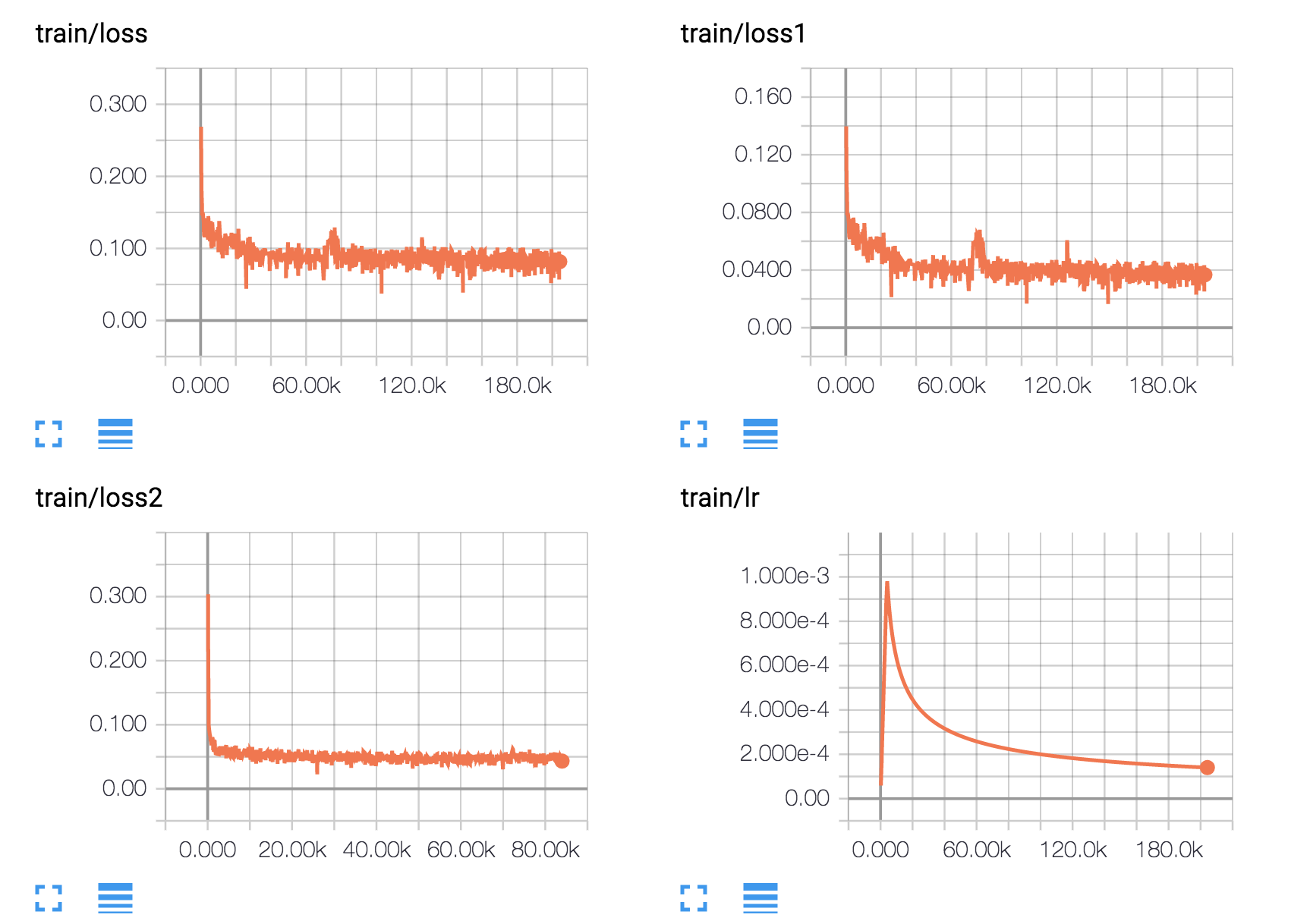
Training Curve
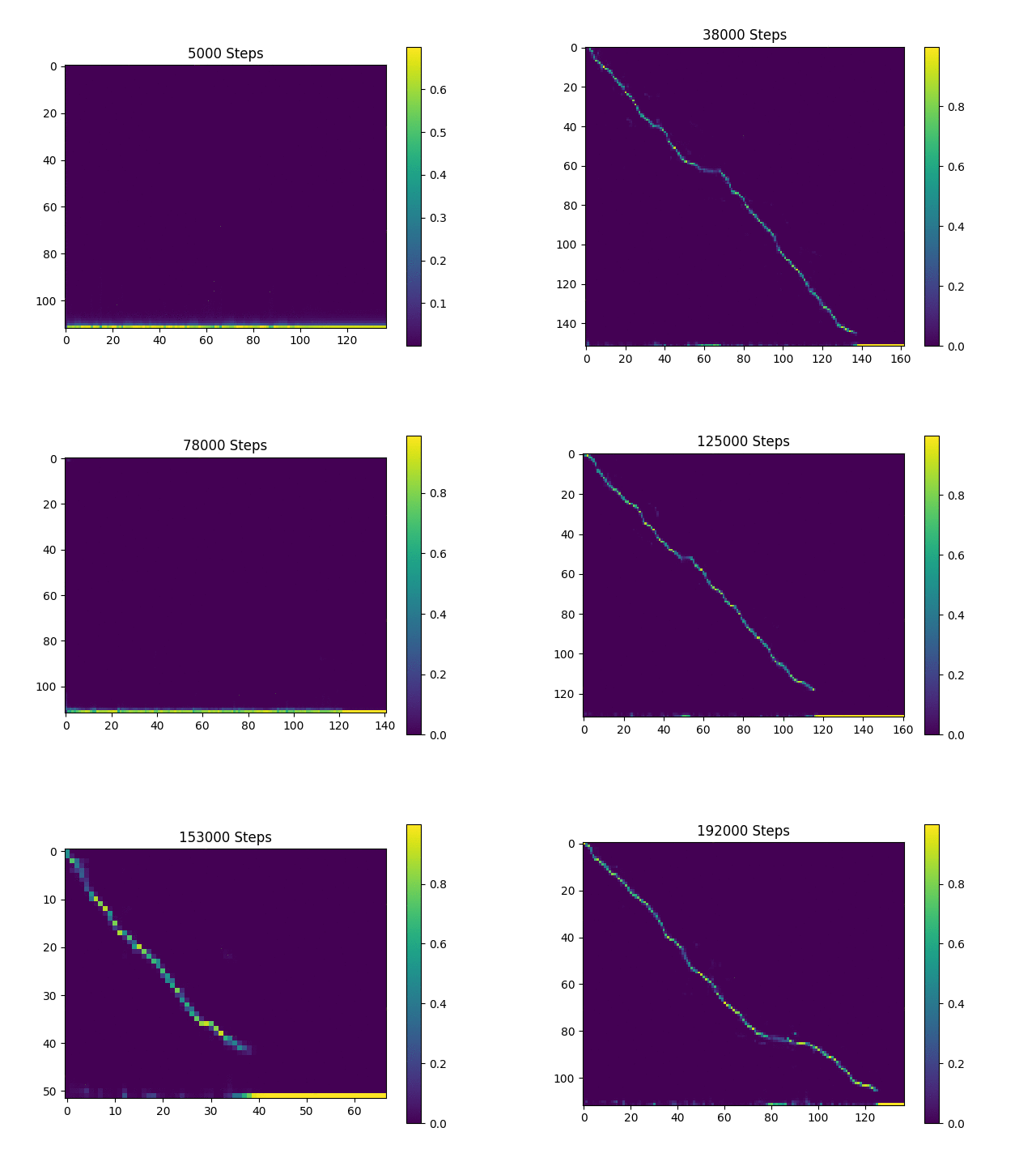
Attention Plot
Generated Samples
LJ at 200k steps
Nick at 215k steps
WEB at 183k steps
Pretrained Files
Keep in mind 200k steps may not be enough for the best performance.
LJ 200k
WEB 200k
Notes
It's important to monitor the attention plots during training. If the attention plots look good (alignment looks linear), and then they look bad (the plots will look similar to what they looked like in the begining of training), then training has gone awry and most likely will need to be restarted from a checkpoint where the attention looked good, because we've learned that it's unlikely that the loss will ever recover. This deterioration of attention will correspond with a spike in the loss.
In the original paper, the authors said, "An important trick we discovered was predicting multiple, non-overlapping output frames at each decoder step" where the number of of multiple frame is the reduction factor, r. We originally interpretted this as predicting non-sequential frames during each decoding step t. Thus were using the following scheme (with r=5) during decoding.
After much experimentation, we were unable to have our model learning anything useful. We then switched to predicting r sequential frames during each decoding step.
With this setup we noticed improvements in the attention and have since kept it.
Perhaps the most important hyperparemeter is the learning rate. With an intitial learning rate of 0.002 we were never able to learn a clean attention, the loss would frequently explode. With an initial learning rate of 0.001 we were able to learn a clean attention and train for much longer get decernable words during synthesis.
Check other TTS models such as DCTTS or deep voice 3.
Differences from the original paper
We use Noam style warmup and decay.
We implement gradient clipping.
Our training batches are bucketed.
After the last convolutional layer of the post-processing net, we apply an affine transformation to bring the dimensionality up to 128 from 80, because the required dimensionality of highway net is 128. In the original highway networks paper, the authors mention that the dimensionality of the input can also be increased with zero-padding, but they used the affine transformation in all their experiments. We do not know what the Tacotron authors chose.
Papers that referenced this repo
Efficiently Trainable Text-to-Speech System Based on Deep Convolutional Networks with Guided Attention
Storytime - End to end neural networks for audiobooks
Trang TopGit này là một snapshot — tab "Readme" hiển thị nguyên văn README của repo (đã bỏ link, giữ ảnh). Repo GitHub ở github.com/Kyubyong/tacotron là nguồn chính thức.
Kyubyong/tacotron có bao nhiêu sao?
Kyubyong/tacotron có 1.8k sao GitHub — tải lại trang để xem số mới nhất, hoặc xem trực tiếp github.com/Kyubyong/tacotron. TopGit phản chiếu số sao của GitHub nhưng không cam kết đến từng phút.
Kyubyong/tacotron có những chủ đề gì?
GitHub topics của Kyubyong/tacotron: "speech", "speech-synthesis-model", "tensorflow", "tts". TopGit xếp repo vào nhóm AI Tools.
Kyubyong/tacotron có website riêng không?
TopGit chưa ghi nhận URL trang chủ cho Kyubyong/tacotron. Phần README ở tab phía trên thường có link demo, hoặc xem mô tả GitHub của repo.
Kyubyong/tacotron còn đang phát triển không?
Commit gần nhất trên Kyubyong/tacotron là 4.9 năm trước (theo timestamp GitHub). Repo có 426 fork — một chỉ báo về mức độ quan tâm của cộng đồng.
Kyubyong/tacotron dùng license gì?
Kyubyong/tacotron phát hành theo license Apache-2.0. Nên mở file LICENSE trên GitHub để xác nhận — license metadata đôi khi lệch với thực tế dự án.
Kyubyong/tacotron viết bằng ngôn ngữ gì?
Kyubyong/tacotron chủ yếu viết bằng Python. Trường "language" của GitHub dựa trên phần lớn byte ở nhánh mặc định.
Đọc đầy đủ README ở tab phía trên.
Muốn nghe thêm một ý kiến về tacotron?
Hỏi một AI đọc được trang này — một cú bấm là có ngay nhận định về tacotron.

 /tacotron