
louthy/language-ext

louthy/language-ext là dự án C# với 7.1k sao. C# pure functional programming framework - come and get declarative!
Tóm tắt dựng từ metadata GitHub của chính dự án — chưa có bài review TopGit. Trang sẽ tự động cập nhật khi bài review đầy đủ được xuất bản.
TopGit viết bài đầy đủ cho repo có nhiều sao nhất và được yêu cầu nhiều nhất. Trang này là snapshot trong thời gian chờ — xem README gốc ở tab READ ME.
Snapshot
Cộng tác viên hàng đầu
Xem cộng tác viên hàng đầu

C# Functional Programming Language Extensions
This library uses and abuses the features of C# to provide a pure functional-programming framework that, if you squint, can look like extensions to the language itself. The desire here is to make programming in C# much more robust by helping the engineer's inertia flow in the direction of declarative and pure functional code rather than imperative. Using these techniques for large code-bases can bring tangible benefits to long-term maintenance by removing hidden complexity and by easing the engineer's and team's cognitive load.

Author on...
- Blog: Notes from a Small Functional Island
- Bluesky: @paullouth.bsky.social
- Mastodon: @[email protected]
- Github ReadME project: 'Functional programming is finally going mainstream'
Contents
- Reference
- Nu-get package
- Getting started
- Prologue
- Features
- Functional effects and IO
- Atomic concurrency, shared state, and collections
- Immutable collections
- Functional streams
- Optional and Alternative value monads
- State managing monads
- Parser combinators
- Pretty: Produce nicely formatted text with smart layouts
- Differencing
- Traits
- Value traits
- Contributing & Code of Conduct
Reference
- API Reference
- Issues that contain documentation and examples
Nu-get
| Nu-get package | Description |
|---|---|
| LanguageExt.Parsec | Port of the Haskell parsec library |
| LanguageExt.Streaming | A set of compositional streaming types |
| LanguageExt.FSharp | F# to C# interop package. Provides interop between the LanguageExt.Core types (like Option, List and Map) to the F# equivalents, as well as interop between core BCL types and F# |
| LanguageExt.Parsec | Port of the Haskell parsec library |
| LanguageExt.Rx | Reactive Extensions support for various types within the Core |
| LanguageExt.Sys | Provides an effects wrapper around the .NET System namespace making common IO operations pure and unit-testable |
Getting started
To use this library, simply include LanguageExt.Core.dll in your project or grab it from NuGet. It is also worth setting up some global using for your project. This is the full list that will cover all functionality and bring it into scope:
global using LanguageExt;
global using LanguageExt.Common;
global using LanguageExt.Traits;
global using LanguageExt.Effects;
global using LanguageExt.Streaming;
global using LanguageExt.Pretty;
global using LanguageExt.Traits.Domain;
global using static LanguageExt.Prelude;
A minimum, might be:
global using LanguageExt;
global using static LanguageExt.Prelude;
The namespace LanguageExt contains most of the core types; LanguageExt.Prelude contains the functions that bring into scope the prelude functions that behave like standalone functions in ML style functional programming languages; LanguageExt.Traits brings in the higher-kinded trait-types and many extensions; LanguageExt.Common brings in the Error type and predefined Errors.
Prologue
From C# 6 onwards we got the ability to treat static classes like namespaces. This means that we can use static methods without qualifying them first. That instantly gives us access to single term method names that look exactly like functions in ML-style functional languages. i.e.
    using static System.Console;

    WriteLine("Hello, World");
This library tries to bring some of the functional world into C#. It won't always sit well with the seasoned C# OO programmer,
especially the choice of camelCase names for a lot of functions and the seeming 'globalness' of a lot of the library.
I can understand that much of this library is non-idiomatic, but when you think of the journey C# has been on, is "idiomatic" necessarily right? A lot of C#'s idioms are inherited from Java and C# 1.0. Since then we've had generics, closures, Func, LINQ, async... C# as a language is becoming more and more like a functional language on every release. In fact, the bulk of the new features are either inspired by or directly taken from features in functional languages. So perhaps it's time to move the C# idioms closer to the functional world's idioms?
My goal with this library is very much to create a whole new community within the larger C# community. This community is not constrained by the dogma of the past or by the norms of C#. It understands that the OOP approach to programming has some problems and tries to address them head-on.
And for those that say "just use F#" or "just use Haskell", sure, go do that. But it's important to remember that C# has a lot going for it:
- Incredible investment into a state-of-the art compiler
- Incredible tooling (Visual Studio and Rider)
- A large ecosystem of open-source libraries
- A large community of developers already using it
- This is also very important for companies that hire engineers
- It is a functional programming language! It has first-class functions, lambdas, etc.
- And with this library it has a functional-first Base Class Library
A note about naming
One of the areas that's likely to get seasoned C# heads worked up is my choice of naming style. The intent is to try and make something that feels like a functional language rather than following rules of naming conventions (mostly set out by the BCL).
There is, however, a naming guide that will keep you in good stead while reading through this documentation:
- Type names are
PascalCasein the normal way - The types all have constructor functions rather than public constructors that you instantiate with
new. They will always bePascalCase:
    Option<int> x = Some(123);
    Option<int> y = None;
    Seq<int> items = Seq(1,2,3,4,5);
    List<int> items = List(1,2,3,4,5);
    HashMap<int, string> dict = HashMap((1, "Hello"), (2, "World"));
    Map<int, string> dict = Map((1, "Hello"), (2, "World"));
- Any (non-type constructor) static function that can be used on its own by
using static LanguageExt.PreludearecamelCase.
var x = map(opt, v => v * 2);
- Any extension methods, or anything "fluent" are
PascalCasein the normal way
var x = opt.Map(v => v * 2);
Even if you disagree with this non-idiomatic approach, all of the camelCase static functions have fluent variants, so you never actually have to see the non-standard stuff.
Features
Functional effects and IO
| Location | Feature | Description |
|---|---|---|
Core | IO<A> | A synchronous and asynchronous side-effect: an IO monad |
Core | Eff<A> | A synchronous and asynchronous side-effect with error handling |
Core | Eff<RT, A> | Same as Eff<A> but with an injectable runtime for dependency-injection: a unit testable IO monad |
Atomic concurrency and collections
| Location | Feature | Description |
|---|---|---|
Core | Atom<A> | A lock-free atomically mutable reference for working with shared state |
Core | Ref<A> | An atomic reference to be used in the transactional memory system |
Core | AtomHashMap<K, V> | An immutable HashMap with a lock-free atomically mutable reference |
Core | AtomSeq<A> | An immutable Seq with a lock-free atomically mutable reference |
Core | VectorClock<A> | Understand distributed causality |
Core | VersionVector<A> | A vector clock with some versioned data |
Core | VersionHashMap <ConflictV, K, V> | Distrubuted atomic versioning of keys in a hash-map |
Immutable collections
| Location | Feature | Description |
|---|---|---|
Core | Arr<A> | Immutable array |
Core | Seq<A> | Lazy immutable list, evaluate at-most-once - very, very fast! |
Core | Iterable<A> | Wrapper around IEnumerable with support for traits - enables the higher-kinded traits to work with enumerables. |
Core | Lst<A> | Immutable list - use Seq over Lst unless you need InsertAt |
Core | Map<K, V> | Immutable map |
Core | Map<OrdK, K, V> | Immutable map with Ord constraint on K |
Core | HashMap<K, V> | Immutable hash-map |
Core | HashMap<EqK, K, V> | Immutable hash-map with Eq constraint on K |
Core | Set<A> | Immutable set |
Core | Set<OrdA, A> | Immutable set with Ord constraint on A |
Core | HashSet<A> | Immutable hash-set |
Core | HashSet<EqA, A> | Immutable hash-set with Eq constraint on A |
Core | Que<A> | Immutable queue |
Core | Stck<A> | Immutable stack |
Functional streams
| Location | Feature | Description |
|---|---|---|
Streaming | Pipes | Connect reusable streaming components into a closed effect |
Streaming | Sink | Entry point to a channel. Sinks receive values and propagate them through a channel |
Streaming | SinkT | As above but with effects |
Streaming | Source | Stream of synchronous or asynchronous values depending on the construction. Values flow downstream and are aggregated with a reducer. |
Streaming | SourceT | As above but with effects |
Streaming | Conduit | Represents a channel with an internal queue. The conduit has a Sink and a Source allowing items to be posted into the conduit, co-mapped, mapped, and consumed. |
Streaming | ConduitT | As above but with effects: the conduit has a SinkT and a SourceT allowing items to be posted into the conduit, co-mapped, mapped, and consumed. |
Optional and alternative value monads
| Location | Feature | Description |
|---|---|---|
Core | Option<A> | Option monad |
Core | OptionT<M, A> | Option monad-transformer |
Core | Either<L,R> | Right/Left choice monad |
Core | EitherT<L, M, R> | Right/Left choice monad-transformer |
Core | Fin<A> | Error handling monad, like Either<Error, A> |
Core | FinT<M, A> | Error handling monad-transformer |
Core | Try<A> | Exception handling monad |
Core | TryT<M, A> | Exception handling monad-transformer |
Core | Validation<FAIL ,SUCCESS> | Validation applicative and monad for collecting multiple errors before aborting an operation |
Core | ValidationT<FAIL, M, SUCCESS> | Validation applicative and monad-transformer |
State managing monads
| Location | Feature | Description |
|---|---|---|
Core | Reader<E, A> | Reader monad |
Core | ReaderT<E, M, A> | Reader monad-transformer |
Core | Writer<W, A> | Writer monad that logs to a W constrained to be a Monoid |
Core | WriterT<W, M, A> | Writer monad-transformer |
Core | State<S, A> | State monad |
Core | StateT<S, M, A> | State monad-transformer |
Parser combinators
| Location | Feature | Description |
|---|---|---|
Parsec | Parser<A> | String parser monad and full parser combinators library |
Parsec | Parser<I, O> | Parser monad that can work with any input stream type |
Pretty
| Location | Feature | Description |
|---|---|---|
Core | Doc<A> | Produce nicely formatted text with smart layouts |
Differencing
| Location | Feature | Description |
|---|---|---|
Core | Patch<EqA, A> | Uses patch-theory to efficiently calculate the difference (Patch.diff(list1, list2)) between two collections of A and build a patch which can be applied (Patch.apply(patch, list)) to one to make the other (think git diff). |
Traits
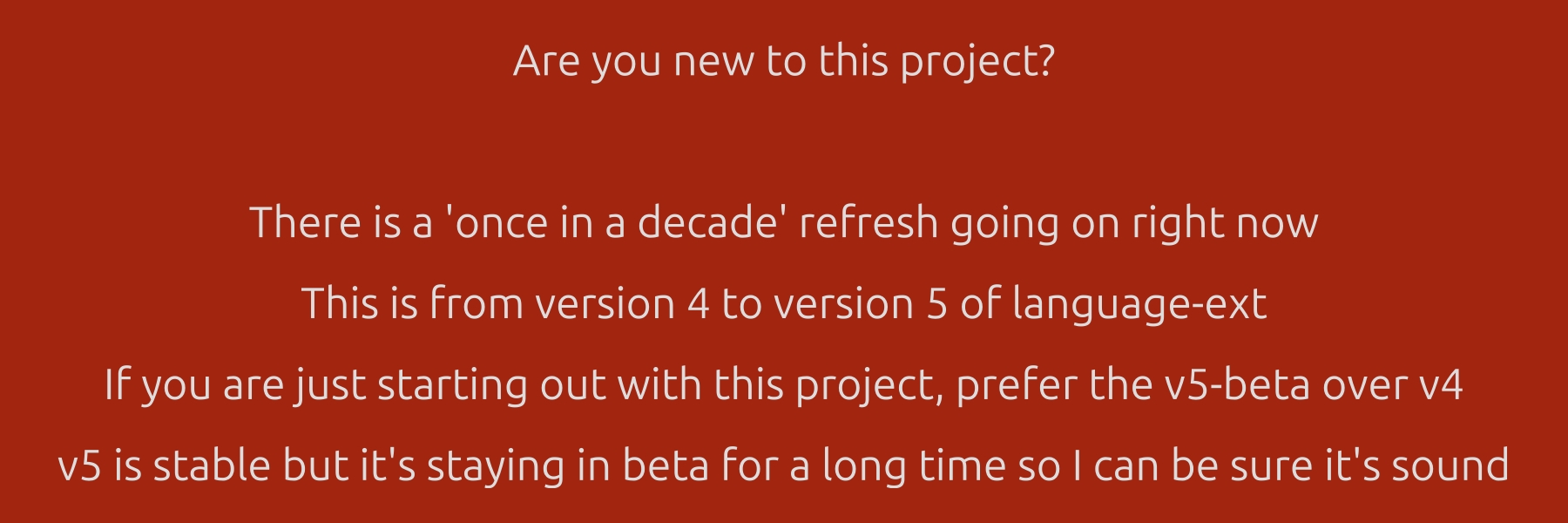
The traits are major feature of v5+ language-ext that makes generic programming with higher-kinds a reality. Check out Paul's series on Higher Kinds to get a deeper insight.
| Location | Feature | Description |
|---|---|---|
Core | Applicative<F> | Applicative functor |
Core | Eq<A> | Ad-hoc equality trait |
Core | Fallible<F> | Trait that describes types that can fail |
Core | Foldable<T> | Aggregation over a structure |
Core | Functor<F> | Functor Map |
Core | Has<M, TRAIT> | Used in runtimes to enable DI-like capabilities |
Core | Hashable<A> | Ad-hoc has-a-hash-code trait |
Core | Local<M, E> | Creates a local environment to run a computation |
Core | Monad<M> | Monad trait |
Core | MonadT<M, N> | Monad transformer trait |
Core | Monoid<A> | A monoid is a type with an identity Empty and an associative binary operation + |
Core | MonoidK<M> | Equivalent of monoids for working on higher-kinded types |
Core | Mutates<M, OUTER_STATE, INNER_STATE> | Used in runtimes to enable stateful operations |
Core | Ord<A> | Ad-hoc ordering / comparisons |
Core | Range<SELF, NumOrdA, A> | Abstraction of a range of values |
Core | Readable<M, Env> | Generalised Reader monad abstraction |
Core | Semigroup<A> | Provides an associative binary operation + |
Core | SemigroupK<M> | Equivalent of semigroups for working with higher-kinded types |
Core | Stateful<M, S> | Generalised State monad abstraction |
Core | Traversable<T> | Traversable structures support element-wise sequencing of Applicative effects |
Core | Writable<M, W> | Generalised Writer monad abstraction |
Value traits
These work a little like type-aliasing but they impart semantic meaning and some common operators for the underlying value.
| Location | Feature | Description |
|---|---|---|
Core | DomainType<SELF, REPR> | Provides a mapping from SELF to an underlying representation: REPR |
Core | Identifier <SELF> | Identifiers (like IDs in databases: PersonId for example), they are equivalent to DomaintType with equality. |
Core | VectorSpace<SELF, SCALAR> | Scalable values; can add and subtract self, but can only multiply and divide by a scalar. Can also negate. |
Core | Amount <SELF, SCALAR> | Quantities, such as the amount of money in USD on a bank account or a file size in bytes. Derives VectorSpace, IdentifierLike, DomainType, and is orderable (comparable). |
Core | Locus <SELF, DISTANCE, SCALAR> | Works with space-like structures. Spaces have absolute and relative distances. Has an origin/zero point and derives DomainType, IdentifierLike, AmountLike and VectorSpace. DISTANCE must also be an AmountLike<SELF, REPR, SCALAR>. |
These features are still a little in-flux as of 17th Oct 2024 - they may evolve, be renamed, or removed - but I like the idea!
Further
For some non-reference like documentation:
- Paul's blog: Notes from a Small Functional Island does deep dives into the philosophy of FP and the inner-workings of language-ext.
- The wiki has some additional documentation, some might be a little out of date since the big
v5refactor, but should give some good insights.
Contributing & Code of Conduct
If you would like to get involved with this project, please first read the Contribution Guidelines and the Code of Conduct.
Repo liên quan
Master programming by recreating your favorite technologies from scratch.
A curated meta-list of curated lists organized by technology domain. The repository acts as a directory pointing to hundreds of specialized awesome lists covering programming languages, platforms, frameworks, and tooling. All content is community-contributed under the CC0 public domain dedication.
Public APIs is a community-curated GitHub repository listing free, publicly accessible APIs across a wide range of categories, with auth type, HTTPS, and CORS noted for each entry. It's a browsable reference, not a library to install.
REA is an MCP server and CLI that gives AI coding agents the ability to reverse engineer binaries, JavaScript apps, .NET assemblies, and websites. It hooks into Hopper, Ghidra, or IDA Pro for native binary work, or runs static JavaScript analysis with just Node.js. Every investigation returns an Evidence bundle that includes what was found, what was not, and the reasoning path. Setup registers REA with supported agents and walks you through connecting an analysis engine. The CLI also works standalone for terminal-first workflows.
Trả lời nhanh
Đọc thêm về louthy/language-ext ở đâu?
Trang TopGit này là một snapshot — tab "Readme" hiển thị nguyên văn README của repo (đã bỏ link, giữ ảnh). Repo GitHub ở github.com/louthy/language-ext là nguồn chính thức.
louthy/language-ext có bao nhiêu sao?
louthy/language-ext có 7.1k sao GitHub — tải lại trang để xem số mới nhất, hoặc xem trực tiếp github.com/louthy/language-ext. TopGit phản chiếu số sao của GitHub nhưng không cam kết đến từng phút.
louthy/language-ext có phải mã nguồn mở không?
Có — louthy/language-ext phát hành theo license MIT, nghĩa là mã nguồn mở để đọc, fork và (tùy license) tái sử dụng. Mã: github.com/louthy/language-ext.
louthy/language-ext có website riêng không?
TopGit chưa ghi nhận URL trang chủ cho louthy/language-ext. Phần README ở tab phía trên thường có link demo, hoặc xem mô tả GitHub của repo.
louthy/language-ext là gì?
louthy/language-ext (louthy/language-ext) là dự án C# trên GitHub. Theo mô tả gốc: C# pure functional programming framework - come and get declarative!
Đọc đầy đủ README ở tab phía trên.
language-ext có đáng để bạn bỏ thời gian?
ChatGPT, Claude và Perplexity đều đọc được trang này. Hỏi thử xem họ nghĩ gì về language-ext.