lululxvi/deepxde — công cụ AI — đang có 4.4k sao GitHub trong nhóm AI Tools. A library for scientific machine learning and physics-informed learning
Tóm tắt dựng từ metadata GitHub của chính dự án — chưa có bài review TopGit. Trang sẽ tự động cập nhật khi bài review đầy đủ được xuất bản.
VÌ SAO CHƯA CÓ REVIEW
TopGit viết bài đầy đủ cho repo có nhiều sao nhất và được yêu cầu nhiều nhất. Trang này là snapshot trong thời gian chờ — xem README gốc ở tab READ ME.
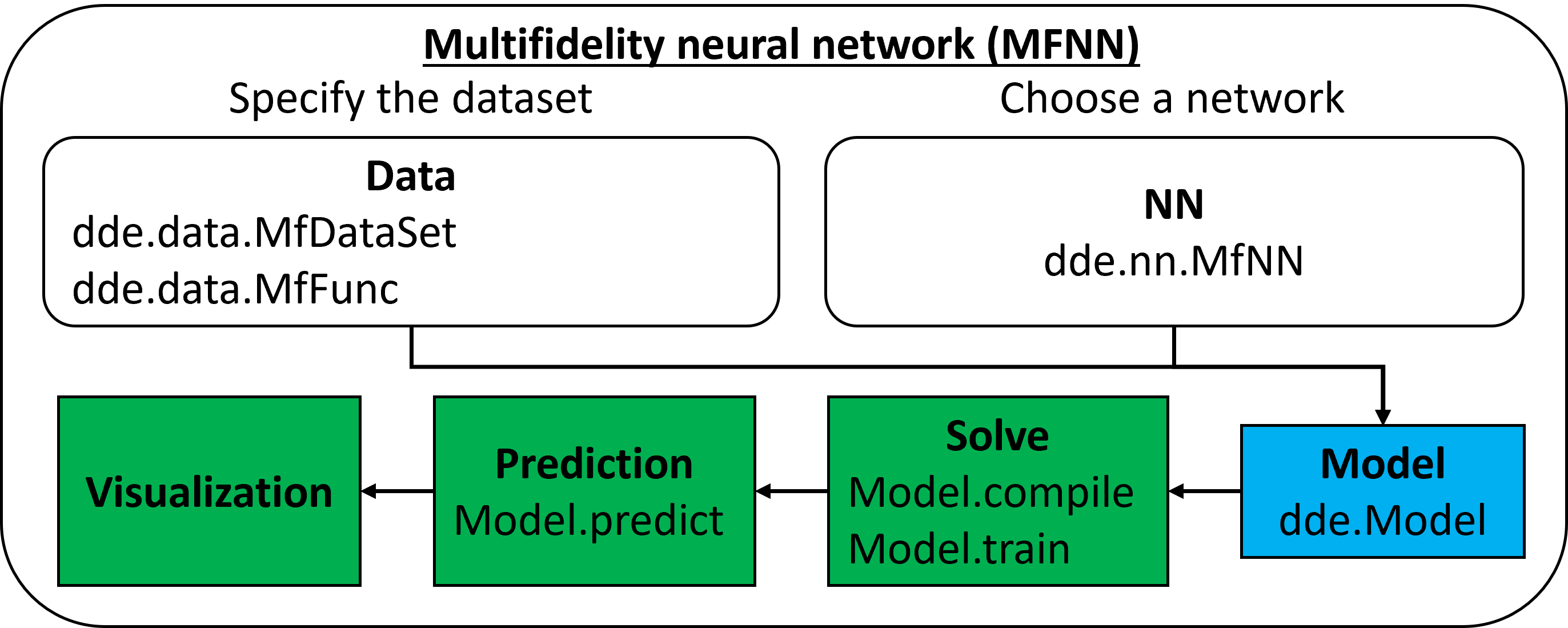
learning from multifidelity data [J. Comput. Phys., PNAS]
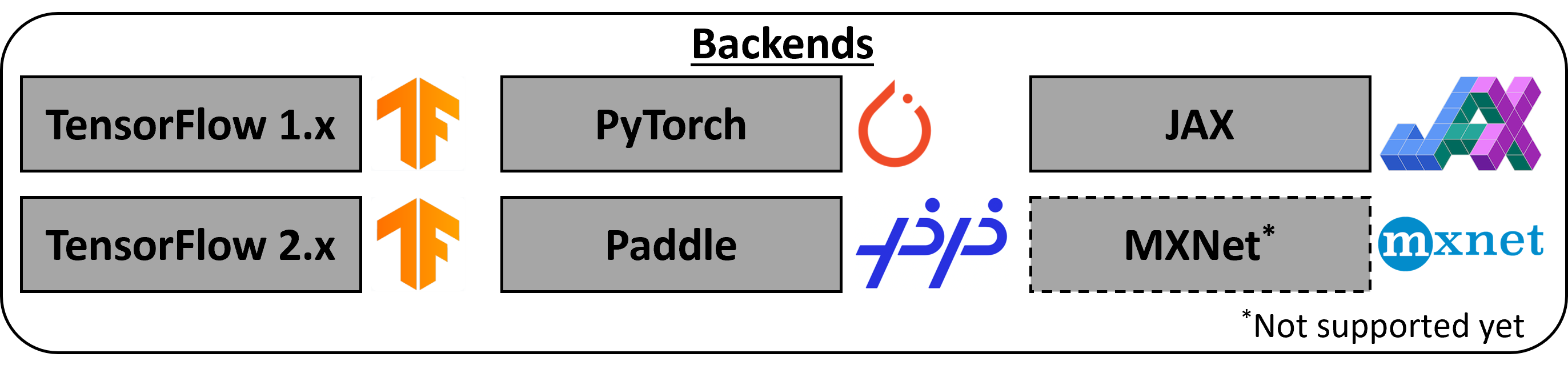
DeepXDE supports five tensor libraries as backends: TensorFlow 1.x (tensorflow.compat.v1 in TensorFlow 2.x), TensorFlow 2.x, PyTorch, JAX, and PaddlePaddle. For how to select one, see Working with different backends.
Documentation: ReadTheDocs
Features
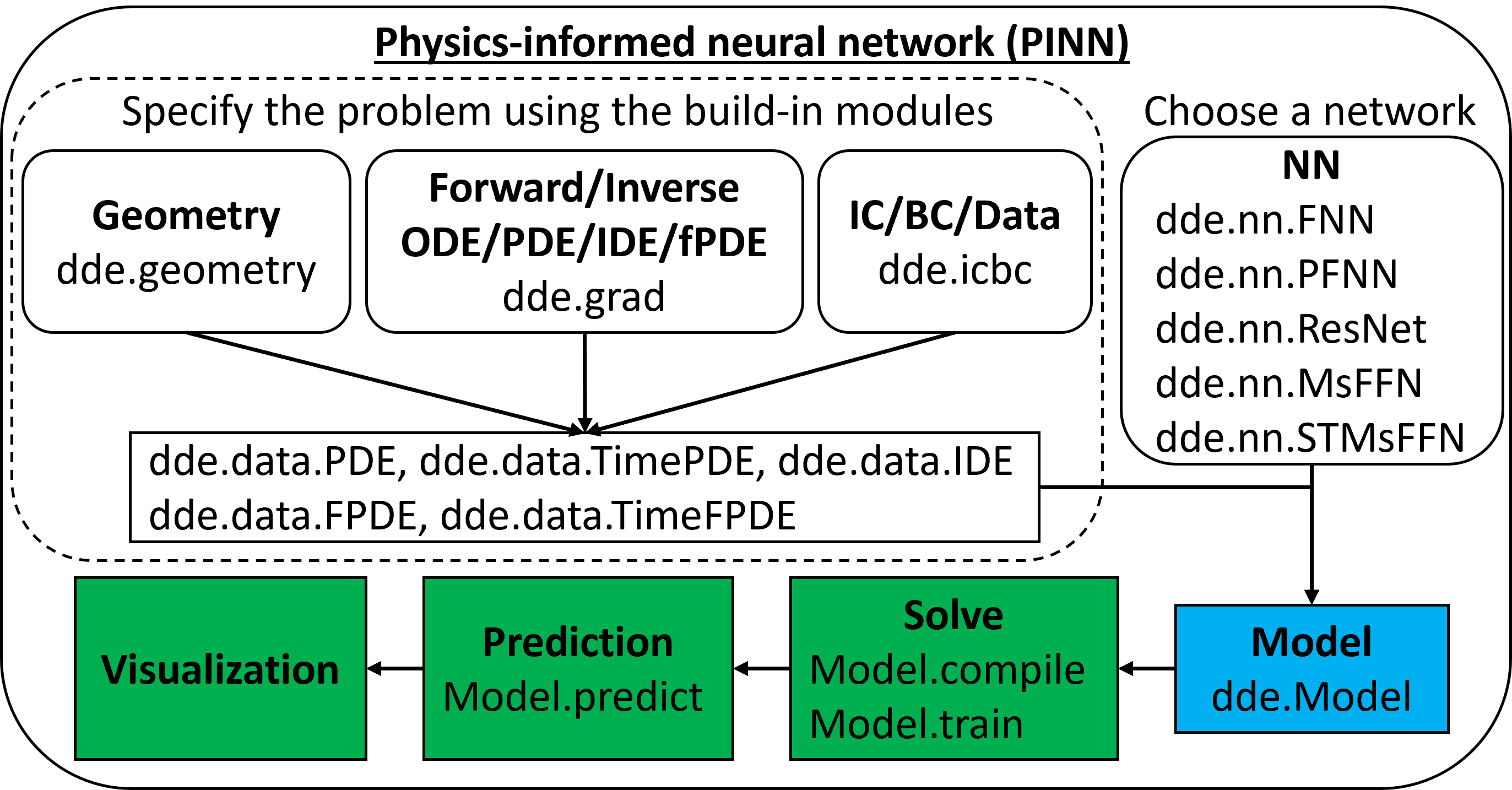
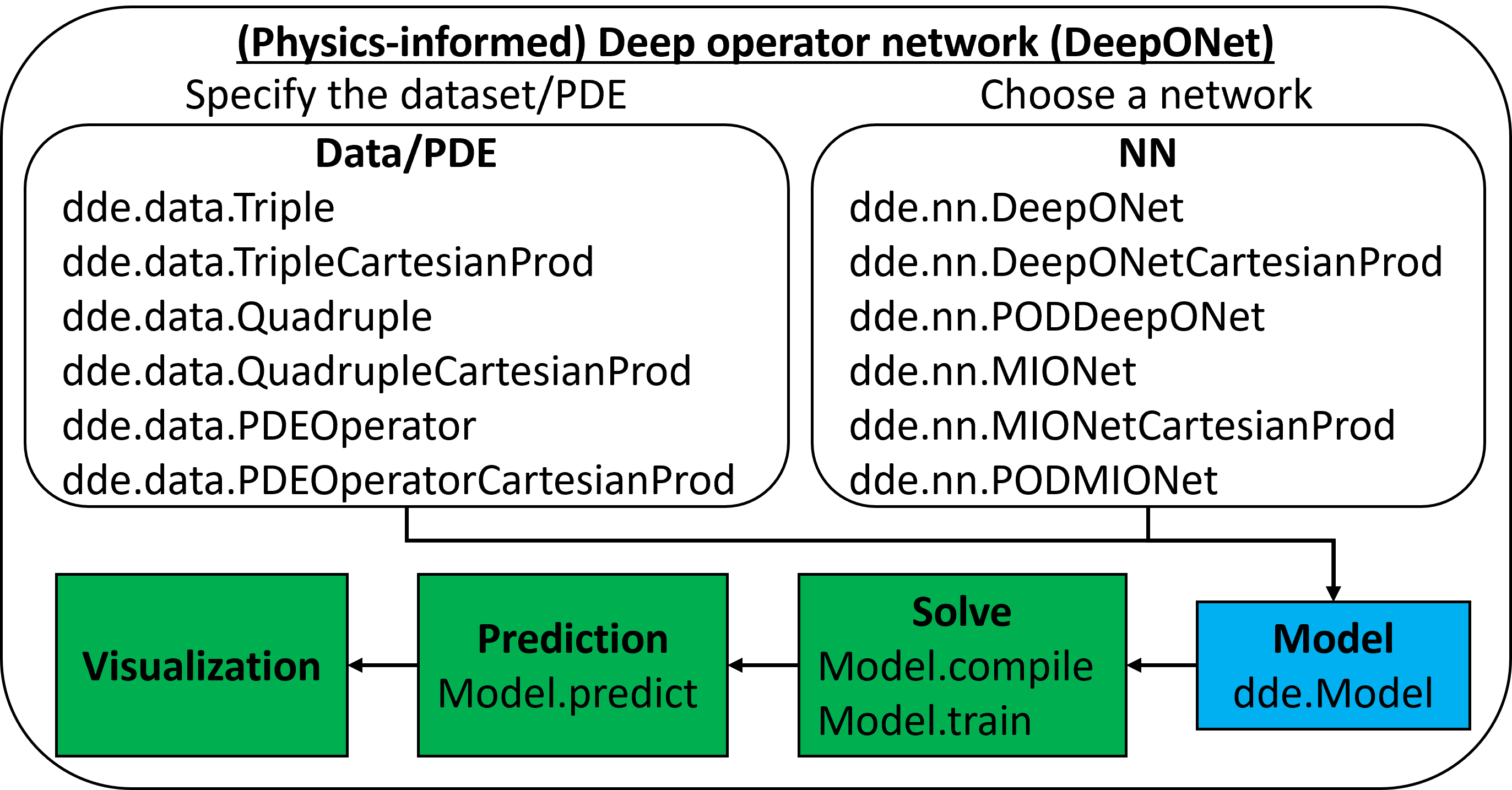
DeepXDE has implemented many algorithms as shown above and supports many features:
enables the user code to be compact, resembling closely the mathematical formulation.
complex domain geometries without tyranny mesh generation. The primitive geometries are interval, triangle, rectangle, polygon, disk, ellipse, star-shaped, cuboid, sphere, hypercube, and hypersphere. Other geometries can be constructed as constructive solid geometry (CSG) using three boolean operations: union, difference, and intersection. DeepXDE also supports a geometry represented by a point cloud.
5 types of boundary conditions (BCs): Dirichlet, Neumann, Robin, periodic, and a general BC, which can be defined on an arbitrary domain or on a point set; and approximate distance functions for hard constraints.
3 automatic differentiation (AD) methods to compute derivatives: reverse mode (i.e., backpropagation), forward mode, and zero coordinate shift (ZCS).
different neural networks: fully connected neural network (FNN), stacked FNN, residual neural network, (spatio-temporal) multi-scale Fourier feature networks, etc.
many sampling methods: uniform, pseudorandom, Latin hypercube sampling, Halton sequence, Hammersley sequence, and Sobol sequence. The training points can keep the same during training or be resampled (adaptively) every certain iterations.
4 function spaces: power series, Chebyshev polynomial, Gaussian random field (1D/2D).
data-parallel training on multiple GPUs.
different optimizers: Adam, L-BFGS, etc.
conveniently save the model during training, and load a trained model.
callbacks to monitor the internal states and statistics of the model during training: early stopping, etc.
uncertainty quantification using dropout.
float16, float32, and float64.
many other useful features: different (weighted) losses, learning rate schedules, metrics, etc.
All the components of DeepXDE are loosely coupled, and thus DeepXDE is well-structured and highly configurable. It is easy to customize DeepXDE to meet new demands.
Installation
DeepXDE requires one of the following backend-specific dependencies to be installed:
If you use DeepXDE for academic research, you are encouraged to cite the following paper:
@article{lu2021deepxde,
  author  = {Lu, Lu and Meng, Xuhui and Mao, Zhiping and Karniadakis, George Em},
  title   = {{DeepXDE}: A deep learning library for solving differential equations},
  journal = {SIAM Review},
  volume  = {63},
  number  = {1},
  pages   = {208-228},
  year    = {2021},
  doi     = {10.1137/19M1274067}
}
Contributing to DeepXDE
First off, thanks for taking the time to contribute!
Reporting bugs. To report a bug, simply open an issue in the GitHub Issues.
Suggesting enhancements. To submit an enhancement suggestion for DeepXDE, including completely new features and minor improvements to existing functionality, let us know by opening an issue in the GitHub Issues.
Pull requests. If you made improvements to DeepXDE, fixed a bug, or had a new example, feel free to send us a pull-request.
Asking questions. To get help on how to use DeepXDE or its functionalities, you can open a discussion in the GitHub Discussions.
Answering questions. If you know the answer to any question in the Discussions, you are welcomed to answer.
Slack. The DeepXDE Slack hosts a primary audience of moderate to experienced DeepXDE users and developers for general chat, online discussions, collaboration, etc. If you need a slack invite, please send me an email.
The Team
DeepXDE was developed by Lu Lu under the supervision of Prof. George Karniadakis at Brown University from the summer of 2018 to 2020. DeepXDE was originally self-hosted in Subversion at Brown University, under the name SciCoNet (Scientific Computing Neural Networks). On Feb 7, 2019, SciCoNet was moved from Subversion to GitHub, renamed to DeepXDE.
DeepXDE is currently maintained by Lu Lu at Yale University with major contributions coming from many talented individuals in various forms and means. A non-exhaustive but growing list needs to mention: Paul Escapil-Inchauspé, Zongren Zou, Jialin Li, Saransh Chopra, Sensen He, Vladimir Dudenkov, Anran Jiao, Zhongyi Jiang, Shunyuan Mao.
lululxvi/deepxde thuộc nhóm AI Tools trên TopGit, cùng 13 topic GitHub. Trang Trending và Topics liệt kê các repo cùng số sao và cùng ngôn ngữ để so sánh.
Đọc thêm về lululxvi/deepxde ở đâu?
Trang TopGit này là một snapshot — tab "Readme" hiển thị nguyên văn README của repo (đã bỏ link, giữ ảnh). Repo GitHub ở github.com/lululxvi/deepxde là nguồn chính thức.
lululxvi/deepxde có bao nhiêu sao?
lululxvi/deepxde có 4.4k sao GitHub — tải lại trang để xem số mới nhất, hoặc xem trực tiếp github.com/lululxvi/deepxde. TopGit phản chiếu số sao của GitHub nhưng không cam kết đến từng phút.
lululxvi/deepxde có những chủ đề gì?
GitHub topics của lululxvi/deepxde: "deep-learning", "deeponet", "jax", "multi-fidelity-data", "neural-network", "operator", "paddle", "pde", "physics-informed-learning", "pinn", "pytorch", "scientific-machine-learning", "tensorflow". TopGit xếp repo vào nhóm AI Tools.
lululxvi/deepxde có phải mã nguồn mở không?
Có — lululxvi/deepxde phát hành theo license LGPL-2.1, nghĩa là mã nguồn mở để đọc, fork và (tùy license) tái sử dụng. Mã: github.com/lululxvi/deepxde.
lululxvi/deepxde có trang demo không?
Dự án có trang chủ ở https://deepxde.readthedocs.io. Tab "Readme" ở trang này thường có ảnh chụp và hướng dẫn bắt đầu nhanh.
lululxvi/deepxde còn đang phát triển không?
Commit gần nhất trên lululxvi/deepxde là 25 ngày trước (theo timestamp GitHub). Repo có 988 fork — một chỉ báo về mức độ quan tâm của cộng đồng.
Đọc đầy đủ README ở tab phía trên.
Chưa chắc deepxde có hợp với bạn?
Để ChatGPT, Claude hoặc Perplexity tìm hiểu giúp — bấm bên dưới và xem AI nói gì về deepxde.
 /deepxde