mailgun/gubernator

mailgun/gubernator là một trong những repo phía máy chủ mà TopGit theo dõi, hiện có 958 sao, viết chủ yếu bằng Go. High Performance Rate Limiting MicroService and Library
Tóm tắt dựng từ metadata GitHub của chính dự án — chưa có bài review TopGit. Trang sẽ tự động cập nhật khi bài review đầy đủ được xuất bản.
TopGit viết bài đầy đủ cho repo có nhiều sao nhất và được yêu cầu nhiều nhất. Trang này là snapshot trong thời gian chờ — xem README gốc ở tab READ ME.
Snapshot
Cộng tác viên hàng đầu
Xem cộng tác viên hàng đầu
Distributed RateLimiting Service
DEVELOPMENT ON GUBERNATOR HAS MOVED TO A NEW HOME AT gubernator-io/gubernator
v2.4.0 is the final version available from his repo, all new features and bug fixes will occur under the new repo.
Gubernator
Gubernator is a distributed, high performance, cloud native and stateless rate-limiting service.
Features
- Gubernator evenly distributes rate limit requests across the entire cluster, which means you can scale the system by simply adding more nodes.
- Gubernator doesn’t rely on external caches like memcached or redis, as such there is no deployment synchronization with a dependant service. This makes dynamically growing or shrinking the cluster in an orchestration system like kubernetes or nomad trivial.
- Gubernator holds no state on disk, It’s configuration is passed to it by the client on a per-request basis.
- Gubernator provides both GRPC and HTTP access to the API.
- It Can be run as a sidecar to services that need rate limiting or as a separate service.
- It Can be used as a library to implement a domain-specific rate limiting service.
- Supports optional eventually consistent rate limit distribution for extremely high throughput environments. (See GLOBAL behavior architecture.md)
- Gubernator is the english pronunciation of governor in Russian, also it sounds cool.
Stateless configuration
Gubernator is stateless in that it doesn’t require disk space to operate. No configuration or cache data is ever synced to disk. This is because every request to gubernator includes the config for the rate limit. At first you might think this an unnecessary overhead to each request. However, In reality a rate limit config is made up of only 4, 64bit integers.
Quick Start
# Download the docker-compose file
$ curl -O https://raw.githubusercontent.com/mailgun/gubernator/master/docker-compose.yaml
# Run the docker container
$ docker-compose up -d
Now you can make rate limit requests via CURL
# Hit the HTTP API at localhost:9080 (GRPC is at 9081)
$ curl http://localhost:9080/v1/HealthCheck

# Make a rate limit request
$ curl http://localhost:9080/v1/GetRateLimits \
  --header 'Content-Type: application/json' \
  --data '{
    "requests": [
        {
            "name": "requests_per_sec",
            "uniqueKey": "account:12345",
            "hits": "1",
            "limit": "10",
            "duration": "1000"
        }
    ]
}'
ProtoBuf Structure
An example rate limit request sent via GRPC might look like the following
rate_limits:
    # Scopes the request to a specific rate limit
  - name: requests_per_sec
    # A unique_key that identifies this instance of a rate limit request
    unique_key: account_id=123|source_ip=172.0.0.1
    # The number of hits we are requesting
    hits: 1
    # The total number of requests allowed for this rate limit
    limit: 100
    # The duration of the rate limit in milliseconds
    duration: 1000
    # The algorithm used to calculate the rate limit
    # 0 = Token Bucket
    # 1 = Leaky Bucket
    algorithm: 0
    # The behavior of the rate limit in gubernator.
    # 0 = BATCHING (Enables batching of requests to peers)
    # 1 = NO_BATCHING (Disables batching)
    # 2 = GLOBAL (Enable global caching for this rate limit)
    behavior: 0
An example response would be
rate_limits:
    # The status of the rate limit.  OK = 0, OVER_LIMIT = 1
  - status: 0,
    # The current configured limit
    limit: 10,
    # The number of requests remaining
    remaining: 7,
    # A unix timestamp in milliseconds of when the bucket will reset, or if
    # OVER_LIMIT is set it is the time at which the rate limit will no
    # longer return OVER_LIMIT.
    reset_time: 1551309219226,
    # Additional metadata about the request the client might find useful
    metadata:
      # This is the name of the coordinator that rate limited this request
      "owner": "api-n03.staging.us-east-1.mailgun.org:9041"
Rate limit Algorithm
Gubernator currently supports 2 rate limit algorithms.
-
Token Bucket implementation starts with an empty bucket, then each
Hitadds a token to the bucket until the bucket is full. Once the bucket is full, requests will returnOVER_LIMITuntil thereset_timeis reached at which point the bucket is emptied and requests will returnUNDER_LIMIT. This algorithm is useful for enforcing very bursty limits. (IE: Applications where a single request can add more than 1hitto the bucket; or non network based queuing systems.) The downside to this implementation is that once you have hit the limit no more requests are allowed until the configured rate limit duration resets the bucket to zero. -
Leaky Bucket is implemented similarly to Token Bucket where
OVER_LIMITis returned when the bucket is full. However tokens leak from the bucket at a consistent rate which is calculated asduration / limit. This algorithm is useful for metering, as the bucket leaks allowing traffic to continue without the need to wait for the configured rate limit duration to reset the bucket to zero.
Performance
In our production environment, for every request to our API we send 2 rate limit requests to gubernator for rate limit evaluation, one to rate the HTTP request and the other is to rate the number of recipients a user can send an email too within the specific duration. Under this setup a single gubernator node fields over 2,000 requests a second with most batched responses returned in under 1 millisecond.
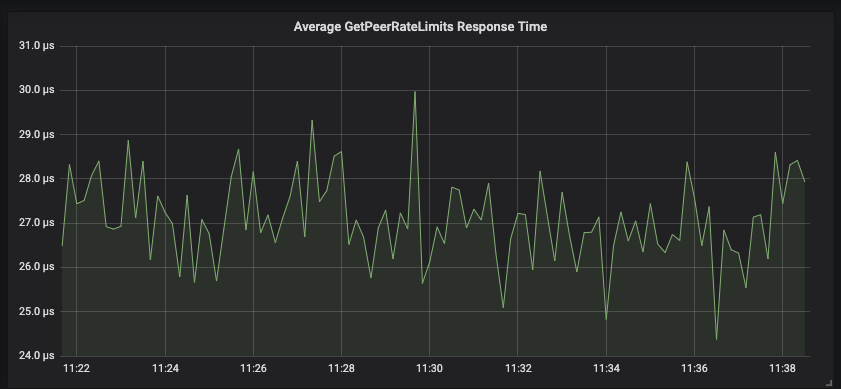
Peer requests forwarded to owning nodes typically respond in under 30 microseconds.
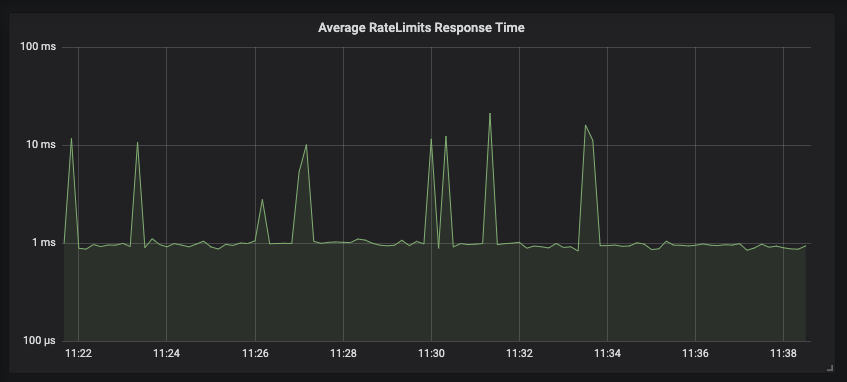
NOTE The above graphs only report the slowest request within the 1 second sample time. So you are seeing the slowest requests that gubernator fields to clients.
Gubernator allows users to choose non-batching behavior which would further reduce latency for client rate limit requests. However because of throughput requirements our production environment uses Behaviour=BATCHING with the default 500 microsecond window. In production we have observed batch sizes of 1,000 during peak API usage. Other users who don’t have the same high traffic demands could disable batching and would see lower latencies but at the cost of throughput.
Gregorian Behavior
Users may choose a behavior called DURATION_IS_GREGORIAN which changes the
behavior of the Duration field. When Behavior is set to DURATION_IS_GREGORIAN
the Duration of the rate limit is reset whenever the end of selected gregorian
calendar interval is reached.
This is useful when you want to impose daily or monthly limits on a resource. Using this behavior you know when the end of the day or month is reached the limit on the resource is reset regardless of when the first rate limit request was received by Gubernator.
Given the following Duration values
- 0 = Minutes
- 1 = Hours
- 2 = Days
- 3 = Weeks
- 4 = Months
- 5 = Years
Examples when using Behavior = DURATION_IS_GREGORIAN
- If
Duration = 2(Days) then the rate limit will reset toCurrent = 0at the end of the current day the rate limit was created. - If
Duration = 0(Minutes) then the rate limit will reset toCurrent = 0at the end of the minute the rate limit was created. - If
Duration = 4(Months) then the rate limit will reset toCurrent = 0at the end of the month the rate limit was created.
Reset Remaining Behavior
Users may add behavior Behavior_RESET_REMAINING to the rate check request.
This will reset the rate limit as if created new on first use.
When using Reset Remaining, the Hits field should be 0.
Drain Over Limit Behavior
Users may add behavior Behavior_DRAIN_OVER_LIMIT to the rate check request.
A GetRateLimits call drains the remaining counter on first over limit event.
Then, successive GetRateLimits calls will return zero remaining counter and
not any residual value. This behavior works best with token bucket algorithm
because the Remaining counter will stay zero after an over limit until reset
time, whereas leaky bucket algorithm will immediately update Remaining to a
non-zero value.
This facilitates scenarios that require an over limit event to stay over limit
until the rate limit resets. This approach is necessary if a process must make
two rate checks, before and after a process, and the Hit amount is not known
until after the process.
- Before process: Call
GetRateLimitswithHits=0to check the value ofRemainingcounter. IfRemainingis zero, it's known that the rate limit is depleted and the process can be aborted. - After process: Call
GetRateLimitswith a user specifiedHitsvalue. If the call returns over limit, the process cannot be aborted because it had already completed. UsingDRAIN_OVER_LIMITbehavior, theRemainingcount will be drained to zero.
Once an over limit occurs in the "After" step, successive processes will detect the over limit state in the "Before" step.
Gubernator as a library
If you are using golang, you can use Gubernator as a library. This is useful if
you wish to implement a rate limit service with your own company specific model
on top. We do this internally here at mailgun with a service we creatively
called ratelimits which keeps track of the limits imposed on a per account
basis. In this way you can utilize the power and speed of Gubernator but still
layer business logic and integrate domain specific problems into your rate
limiting service.
When you use the library, your service becomes a full member of the cluster
participating in the same consistent hashing and caching as a stand alone
Gubernator server would. All you need to do is provide the GRPC server instance
and tell Gubernator where the peers in your cluster are located. The
cmd/gubernator/main.go is a great example of how to use Gubernator as a
library.
Optional Disk Persistence
While the Gubernator server currently doesn't directly support disk
persistence, the Gubernator library does provide interfaces through which
library users can implement persistence. The Gubernator library has two
interfaces available for disk persistence. Depending on the use case an
implementor can implement the Loader interface and only support persistence
of rate limits at startup and shutdown, or users can implement the Store
interface and Gubernator will continuously call OnChange() and Get() to
keep the in memory cache and persistent store up to date with the latest rate
limit data. Both interfaces can be implemented simultaneously to ensure data
is always saved to persistent storage.
For those who choose to implement the Store interface, it is not required to
store ALL the rate limits received via OnChange(). For instance; If you wish
to support rate limit durations longer than a minute, day or month, calls to
OnChange() can check the duration of a rate limit and decide to only persist
those rate limits that have durations over a self determined limit.
API
All methods are accessed via GRPC but are also exposed via HTTP using the GRPC Gateway
Health Check
Health check returns unhealthy in the event a peer is reported by etcd or kubernetes
as up but the server instance is unable to contact that peer via it's advertised address.
GRPC
rpc HealthCheck (HealthCheckReq) returns (HealthCheckResp)
HTTP
GET /v1/HealthCheck
Example response:
{
  "status": "healthy",
  "peer_count": 3
}
Get Rate Limit
Rate limits can be applied or retrieved using this interface. If the client
makes a request to the server with hits: 0 then current state of the rate
limit is retrieved but not incremented.
GRPC
rpc GetRateLimits (GetRateLimitsReq) returns (GetRateLimitsResp)
HTTP
POST /v1/GetRateLimits
Example Payload
{
  "requests": [
    {
      "name": "requests_per_sec",
      "uniqueKey": "account:12345",
      "hits": "1",
      "limit": "10",
      "duration": "1000"
    }
  ]
}
Example response:
{
  "responses": [
    {
      "status": "UNDER_LIMIT",
      "limit": "10",
      "remaining": "9",
      "reset_time": "1690855128786",
      "error": "",
      "metadata": {
        "owner": "gubernator:81"
      }
    }
  ]
}
Deployment
NOTE: Gubernator uses etcd, Kubernetes or round-robin DNS to discover peers and
establish a cluster. If you don't have either, the docker-compose method is the
simplest way to try gubernator out.
Docker with existing etcd cluster
$ docker run -p 8081:81 -p 9080:80 -e GUBER_ETCD_ENDPOINTS=etcd1:2379,etcd2:2379 \
   ghcr.io/mailgun/gubernator:latest

# Hit the HTTP API at localhost:9080
$ curl http://localhost:9080/v1/HealthCheck
Kubernetes
# Download the kubernetes deployment spec
$ curl -O https://raw.githubusercontent.com/mailgun/gubernator/master/k8s-deployment.yaml

# Edit the deployment file to change the environment config variables
$ vi k8s-deployment.yaml

# Create the deployment (includes headless service spec)
$ kubectl create -f k8s-deployment.yaml
Round-robin DNS
If your DNS service supports auto-registration, for example AWS Route53 service discovery,
you can use same fully-qualified domain name to both let your business logic containers or
instances to find gubernator and for gubernator containers/instances to find each other.
TLS
Gubernator supports TLS for both HTTP and GRPC connections. You can see an example with
self signed certs by running docker-compose-tls.yaml
# Run docker compose
$ docker-compose -f docker-compose-tls.yaml up -d

# Hit the HTTP API at localhost:9080 (GRPC is at 9081)
$ curl --cacert certs/ca.cert --cert certs/gubernator.pem --key certs/gubernator.key  https://localhost:9080/v1/HealthCheck
Configuration
Gubernator is configured via environment variables with an optional --config flag
which takes a file of key/values and places them into the local environment before startup.
See the example.conf for all available config options and their descriptions.
Architecture
See architecture.md for a full description of the architecture and the inner workings of gubernator.
Monitoring
Gubernator publishes Prometheus metrics for realtime monitoring. See prometheus.md for details.
OpenTelemetry Tracing (OTEL)
Gubernator supports OpenTelemetry. See tracing.md for details.
Repo liên quan
Awesome Go, maintained at avelino/awesome-go, groups Go frameworks, libraries, and software into topic categories including Actor Model, Artificial Intelligence, Audio and Music, Authentication and Authorization, Blockchain, Bot Building, and Build Automation. Every linked entry gets a short description instead of a bare URL. The repository carries an MIT license, has 180,946 stars and 13,482 forks on GitHub, and takes new entries through pull requests reviewed against its own contribution guidelines.
golang/go is the open source repository behind The Go Programming Language, holding the compiler, runtime, and standard library source that Go's official binaries are built from. The README frames Go's purpose as building software that is simple, reliable, and efficient, credits the project to thousands of contributors, and notes that this GitHub repo mirrors the canonical Git repository at go.googlesource.com/go. It's licensed BSD-3-Clause and has drawn 135,743 stars and 19,282 forks on GitHub.
Caddy is an HTTP/1-2-3 web server, written in Go, which provides automatic HTTPS by default, utilizing services like ZeroSSL and Let's Encrypt for public names or a local CA for internal ones. It supports flexible configuration through its native JSON API, a Caddyfile, or various other formats via config adapters. The project highlights a modular architecture for extensibility, runs on multiple platforms without external dependencies, and benefits from Go's memory safety features. The README indicates it has served trillions of requests and managed millions of TLS certificates, scaling to hundreds of thousands of sites in production. With 74.6k stars, Caddy began development in 2014 and was an early adopter of automatic HTTPS by default.
Moby is the open-source project moby/moby on GitHub, created by Docker to package the pieces of a container system, build tools, a registry, orchestration tools, and a runtime, as separate, well-defined components developers can assemble or swap. It carries 72,019 GitHub stars and 19,206 forks, is written in Go, and ships under the Apache-2.0 license. Docker uses Moby as the upstream for Docker Engine, and the two supported Go modules, client and api, are how other Go programs talk to Docker Engine's API.
Trả lời nhanh
Cùng nhóm Backend còn repo nào?
mailgun/gubernator thuộc nhóm Backend trên TopGit, cùng 7 topic GitHub. Trang Trending và Topics liệt kê các repo cùng số sao và cùng ngôn ngữ để so sánh.
Đọc thêm về mailgun/gubernator ở đâu?
Trang TopGit này là một snapshot — tab "Readme" hiển thị nguyên văn README của repo (đã bỏ link, giữ ảnh). Repo GitHub ở github.com/mailgun/gubernator là nguồn chính thức.
mailgun/gubernator có bao nhiêu sao?
mailgun/gubernator có 958 sao GitHub — tải lại trang để xem số mới nhất, hoặc xem trực tiếp github.com/mailgun/gubernator. TopGit phản chiếu số sao của GitHub nhưng không cam kết đến từng phút.
mailgun/gubernator có phải mã nguồn mở không?
Có — mailgun/gubernator phát hành theo license Apache-2.0, nghĩa là mã nguồn mở để đọc, fork và (tùy license) tái sử dụng. Mã: github.com/mailgun/gubernator.
mailgun/gubernator còn đang phát triển không?
Commit gần nhất trên mailgun/gubernator là 2.3 năm trước (theo timestamp GitHub). Repo có 95 fork — một chỉ báo về mức độ quan tâm của cộng đồng.
mailgun/gubernator dùng license gì?
mailgun/gubernator phát hành theo license Apache-2.0. Nên mở file LICENSE trên GitHub để xác nhận — license metadata đôi khi lệch với thực tế dự án.
mailgun/gubernator là gì?
mailgun/gubernator (mailgun/gubernator) là dự án Go trên GitHub. Theo mô tả gốc: High Performance Rate Limiting MicroService and Library
mailgun/gubernator viết bằng ngôn ngữ gì?
mailgun/gubernator chủ yếu viết bằng Go. Trường "language" của GitHub dựa trên phần lớn byte ở nhánh mặc định.
Đọc đầy đủ README ở tab phía trên.
Chưa chắc gubernator có hợp với bạn?
Để ChatGPT, Claude hoặc Perplexity tìm hiểu giúp — bấm bên dưới và xem AI nói gì về gubernator.