Được TopGit lập chỉ mục từ metadata GitHub: microsoft/computervision-recipes có 9.9k sao, viết chủ yếu bằng Jupyter Notebook. Best Practices, code samples, and documentation for Computer Vision.
Tóm tắt dựng từ metadata GitHub của chính dự án — chưa có bài review TopGit. Trang sẽ tự động cập nhật khi bài review đầy đủ được xuất bản.
VÌ SAO CHƯA CÓ REVIEW
TopGit viết bài đầy đủ cho repo có nhiều sao nhất và được yêu cầu nhiều nhất. Trang này là snapshot trong thời gian chờ — xem README gốc ở tab READ ME.
+ Update July: Added support for action recognition and tracking
+              in the new release v1.2.
Computer Vision
In recent years, we've see an extra-ordinary growth in Computer Vision, with applications in face recognition, image understanding, search, drones, mapping, semi-autonomous and autonomous vehicles. A key part to many of these applications are visual recognition tasks such as image classification, object detection and image similarity.
This repository provides examples and best practice guidelines for building computer vision systems. The goal of this repository is to build a comprehensive set of tools and examples that leverage recent advances in Computer Vision algorithms, neural architectures, and operationalizing such systems. Rather than creating implementations from scratch, we draw from existing state-of-the-art libraries and build additional utility around loading image data, optimizing and evaluating models, and scaling up to the cloud. In addition, having worked in this space for many years, we aim to answer common questions, point out frequently observed pitfalls, and show how to use the cloud for training and deployment.
We hope that these examples and utilities can significantly reduce the “time to market” by simplifying the experience from defining the business problem to development of solution by orders of magnitude. In addition, the example notebooks would serve as guidelines and showcase best practices and usage of the tools in a wide variety of languages.
These examples are provided as Jupyter notebooks and common utility functions. All examples use PyTorch as the underlying deep learning library.
Examples
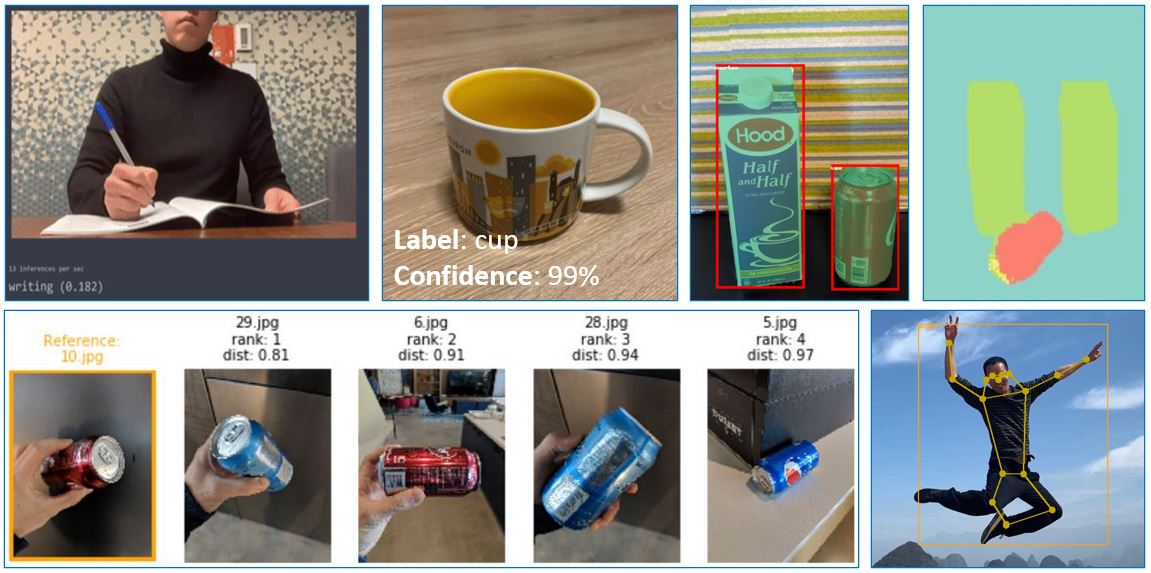
This repository supports various Computer Vision scenarios which either operate on a single image:
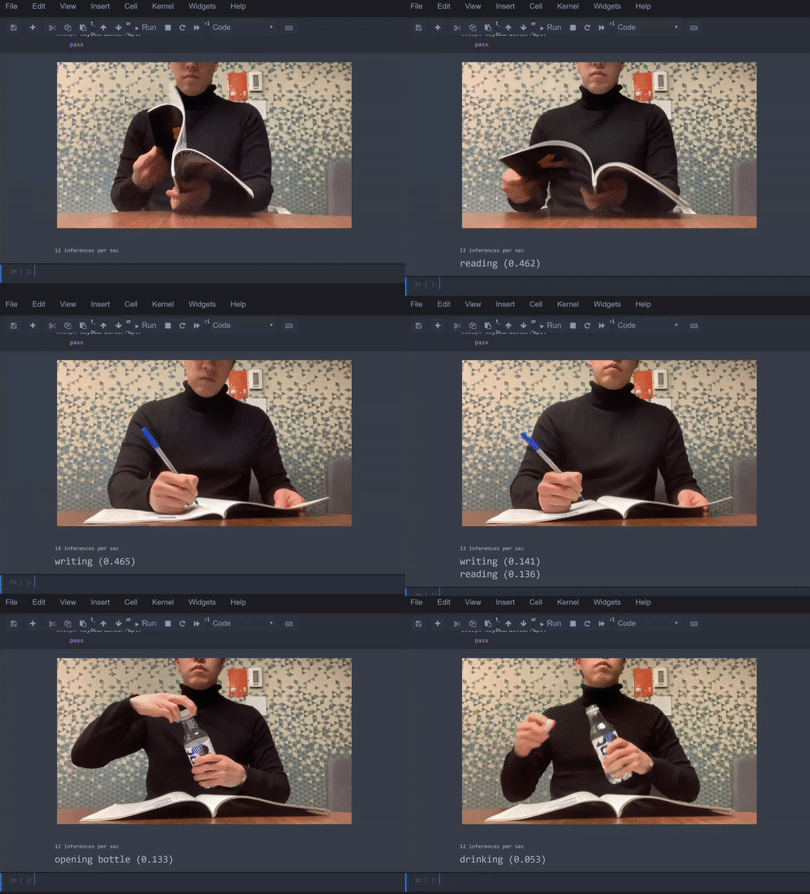
As well as scenarios such as action recognition which take a video sequence as input:
Target Audience
Our target audience for this repository includes data scientists and machine learning engineers with varying levels of Computer Vision knowledge as our content is source-only and targets custom machine learning modelling. The utilities and examples provided are intended to be solution accelerators for real-world vision problems.
Getting Started
To get started, navigate to the Setup Guide, which lists
instructions on how to setup the compute environment and dependencies needed to run the
notebooks in this repo. Once your environment is setup, navigate to the
Scenarios folder and start exploring the notebooks. We recommend to start with the image classification notebooks, since this introduces concepts which are also used by the other scenarios (e.g. pre-training on ImageNet).
Alternatively, we support Binder
which makes it easy to try one of our notebooks in a web-browser simply by following this link. However, Binder is free, and as a result only comes with limited CPU compute power and without GPU support. Expect the notebook to run very slowly (this is somewhat improved by reducing image resolution to e.g. 60 pixels but at the cost of low accuracies).
Scenarios
The following is a summary of commonly used Computer Vision scenarios that are covered in this repository. For each of the main scenarios ("base"), we provide the tools to effectively build your own model. This includes simple tasks such as fine-tuning your own model on your own data, to more complex tasks such as hard-negative mining and even model deployment.
Scenario
Support
Description
Classification
Base
Image Classification is a supervised machine learning technique to learn and predict the category of a given image.
Similarity
Base
Image Similarity is a way to compute a similarity score given a pair of images. Given an image, it allows you to identify the most similar image in a given dataset.
Detection
Base
Object Detection is a technique that allows you to detect the bounding box of an object within an image.
Keypoints
Base
Keypoint detection can be used to detect specific points on an object. A pre-trained model is provided to detect body joints for human pose estimation.
Segmentation
Base
Image Segmentation assigns a category to each pixel in an image.
Action recognition
Base
Action recognition to identify in video/webcam footage what actions are performed (e.g. "running", "opening a bottle") and at what respective start/end times. We also implemented the i3d implementation of action recognition that can be found under (contrib)[contrib].
Tracking
Base
Tracking allows to detect and track multiple objects in a video sequence over time.
Crowd counting
Contrib
Counting the number of people in low-crowd-density (e.g. less than 10 people) and high-crowd-density (e.g. thousands of people) scenarios.
We separate the supported CV scenarios into two locations: (i) base: code and notebooks within the "utils_cv" and "scenarios" folders which follow strict coding guidelines, are well tested and maintained; (ii) contrib: code and other assets within the "contrib" folder, mainly covering less common CV scenarios using bleeding edge state-of-the-art approaches. Code in "contrib" is not regularly tested or maintained.
Computer Vision on Azure
Note that for certain computer vision problems, you may not need to build your own models. Instead, pre-built or easily customizable solutions exist on Azure which do not require any custom coding or machine learning expertise. We strongly recommend evaluating if these can sufficiently solve your problem. If these solutions are not applicable, or the accuracy of these solutions is not sufficient, then resorting to more complex and time-consuming custom approaches may be necessary.
The following Microsoft services offer simple solutions to address common computer vision tasks:
Vision Services
are a set of pre-trained REST APIs which can be called for image tagging, face recognition, OCR, video analytics, and more. These APIs work out of the box and require minimal expertise in machine learning, but have limited customization capabilities. See the various demos available to get a feel for the functionality (e.g. Computer Vision). The service can be used through API calls or through SDKs (available in .NET, Python, Java, Node and Go languages)
Custom Vision
is a SaaS service to train and deploy a model as a REST API given a user-provided training set. All steps including image upload, annotation, and model deployment can be performed using an intuitive UI or through SDKs (available in .NEt, Python, Java, Node and Go languages). Training image classification or object detection models can be achieved with minimal machine learning expertise. The Custom Vision offers more flexibility than using the pre-trained cognitive services APIs, but requires the user to bring and annotate their own data.
If you need to train your own model, the following services and links provide additional information that is likely useful.
Azure Machine Learning service (AzureML)
is a service that helps users accelerate the training and deploying of machine learning models. While not specific for computer vision workloads, the AzureML Python SDK can be used for scalable and reliable training and deployment of machine learning solutions to the cloud. We leverage Azure Machine Learning in several of the notebooks within this repository (e.g. deployment to Azure Kubernetes Service)
Azure AI Reference architectures
provide a set of examples (backed by code) of how to build common AI-oriented workloads that leverage multiple cloud components. While not computer vision specific, these reference architectures cover several machine learning workloads such as model deployment or batch scoring.
Build Status
AzureML Testing
Build Type
Branch
Status
Branch
Status
Linux GPU
master
staging
Linux CPU
master
staging
Notebook unit GPU
master
staging
Contributing
This project welcomes contributions and suggestions. Please see our contribution guidelines.
microsoft/computervision-recipes có bao nhiêu sao?
microsoft/computervision-recipes có 9.9k sao GitHub — tải lại trang để xem số mới nhất, hoặc xem trực tiếp github.com/microsoft/computervision-recipes. TopGit phản chiếu số sao của GitHub nhưng không cam kết đến từng phút.
microsoft/computervision-recipes có những chủ đề gì?
GitHub topics của microsoft/computervision-recipes: "artificial-intelligence", "azure", "computer-vision", "convolutional-neural-networks", "data-science", "deep-learning", "image-classification", "image-processing", "jupyter-notebook", "kubernetes", "machine-learning", "microsoft", "object-detection", "operationalization", "python", "similarity", "tutorial". TopGit xếp repo vào nhóm AI Tools.
microsoft/computervision-recipes còn đang phát triển không?
Commit gần nhất trên microsoft/computervision-recipes là 2.8 năm trước (theo timestamp GitHub). Repo có 1.2k fork — một chỉ báo về mức độ quan tâm của cộng đồng.
microsoft/computervision-recipes là gì?
microsoft/computervision-recipes (microsoft/computervision-recipes) là dự án Jupyter Notebook trên GitHub. Theo mô tả gốc: Best Practices, code samples, and documentation for Computer Vision.
microsoft/computervision-recipes so với các dự án AI Tools khác thế nào?
microsoft/computervision-recipes được TopGit xếp vào nhóm AI Tools, với 9.9k sao GitHub và viết bằng Jupyter Notebook. Xem trang chủ đề AI Tools trên TopGit để so sánh với các dự án tương tự theo số sao và mức độ hoạt động.
microsoft/computervision-recipes viết bằng ngôn ngữ gì?
microsoft/computervision-recipes chủ yếu viết bằng Jupyter Notebook. Trường "language" của GitHub dựa trên phần lớn byte ở nhánh mặc định.
Vì sao microsoft/computervision-recipes được xếp vào nhóm AI Tools?
TopGit xếp microsoft/computervision-recipes vào nhóm AI Tools dựa trên GitHub topics và mô tả của repo (gắn thẻ: "artificial-intelligence", "azure", "computer-vision"). Việc phân loại dựa trên metadata thật của repo, không phải đoán theo cảm tính biên tập.
Đọc đầy đủ README ở tab phía trên.
computervision-recipes có đáng để bạn bỏ thời gian?
ChatGPT, Claude và Perplexity đều đọc được trang này. Hỏi thử xem họ nghĩ gì về computervision-recipes.

 /computervision-recipes

 which makes it easy to try one of our notebooks in a web-browser simply by following this link. However, Binder is free, and as a result only comes with limited CPU compute power and without GPU support. Expect the notebook to run very slowly (this is somewhat improved by reducing image resolution to e.g. 60 pixels but at the cost of low accuracies).