Là một công cụ cho lập trình viên, microsoft/VibeVoice đã đạt 51.9k sao trên GitHub, ngôn ngữ Python. Open-Source Frontier Voice AI
Tóm tắt dựng từ metadata GitHub của chính dự án — chưa có bài review TopGit. Trang sẽ tự động cập nhật khi bài review đầy đủ được xuất bản.
VÌ SAO CHƯA CÓ REVIEW
TopGit viết bài đầy đủ cho repo có nhiều sao nhất và được yêu cầu nhiều nhất. Trang này là snapshot trong thời gian chờ — xem README gốc ở tab READ ME.
2026-07-23: ⚡ We released VibeVoice-ASR-BitNet, an edge CPU inference engine for VibeVoice-ASR. Through heterogeneous quantization (I8_S + I2_S), the model is compressed from 4.62 GB to 1.58 GB with real-time inference (RTF < 1) on 3+ CPU threads — no GPU required. [Code] [Models] [Report]
2026-03-12: 🚀 VibeVoice-ASR is now integrated into Azure AI Foundry Labs! You can now explore and test our unified speech-to-text capabilities directly through Microsoft Foundry.
2026-03-06: 🚀 VibeVoice ASR is now part of a Transformers release! You can now use our speech recognition model directly through the Hugging Face Transformers library for seamless integration into your projects.
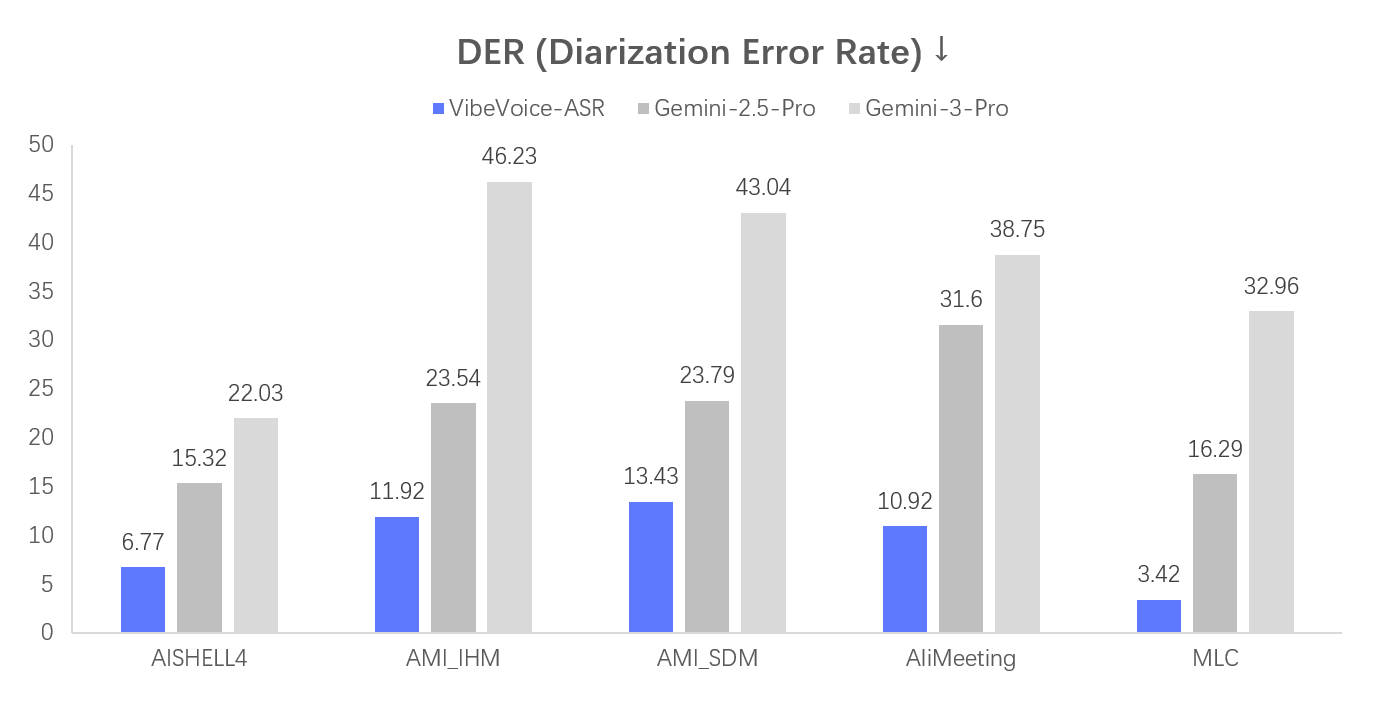
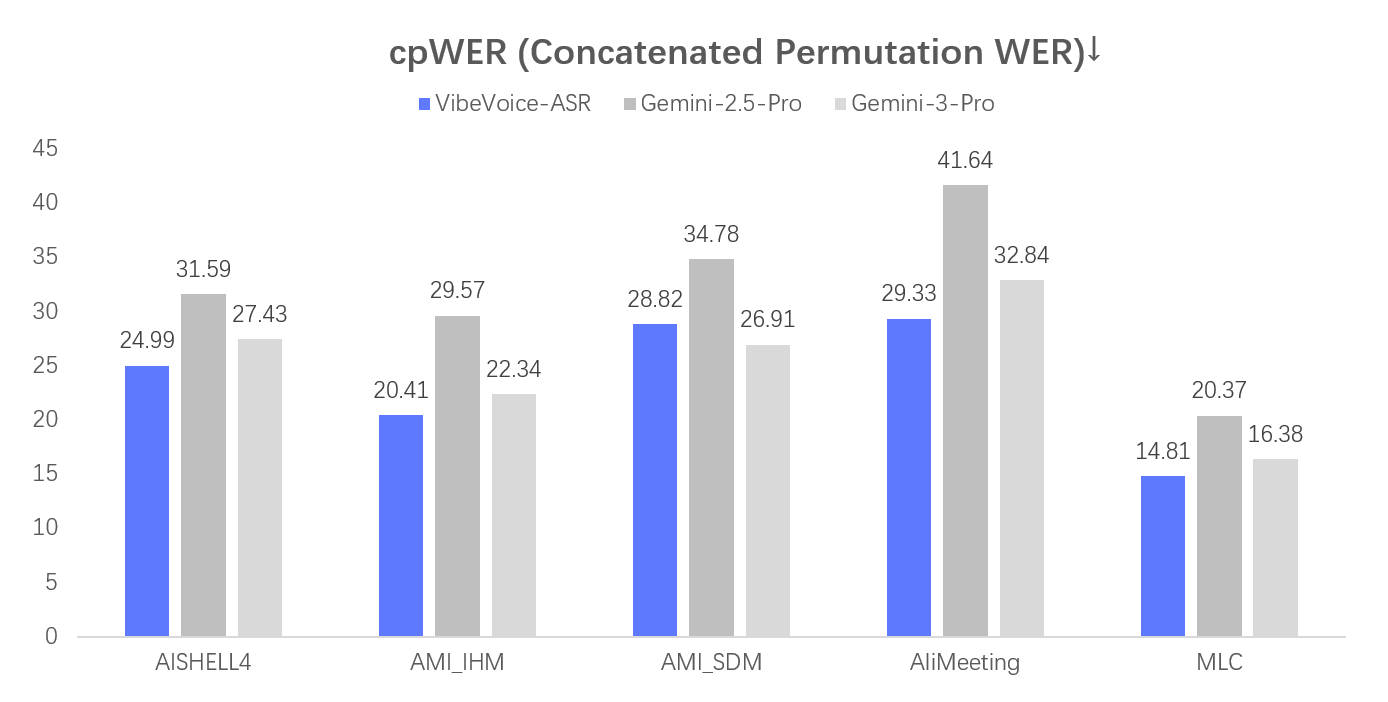
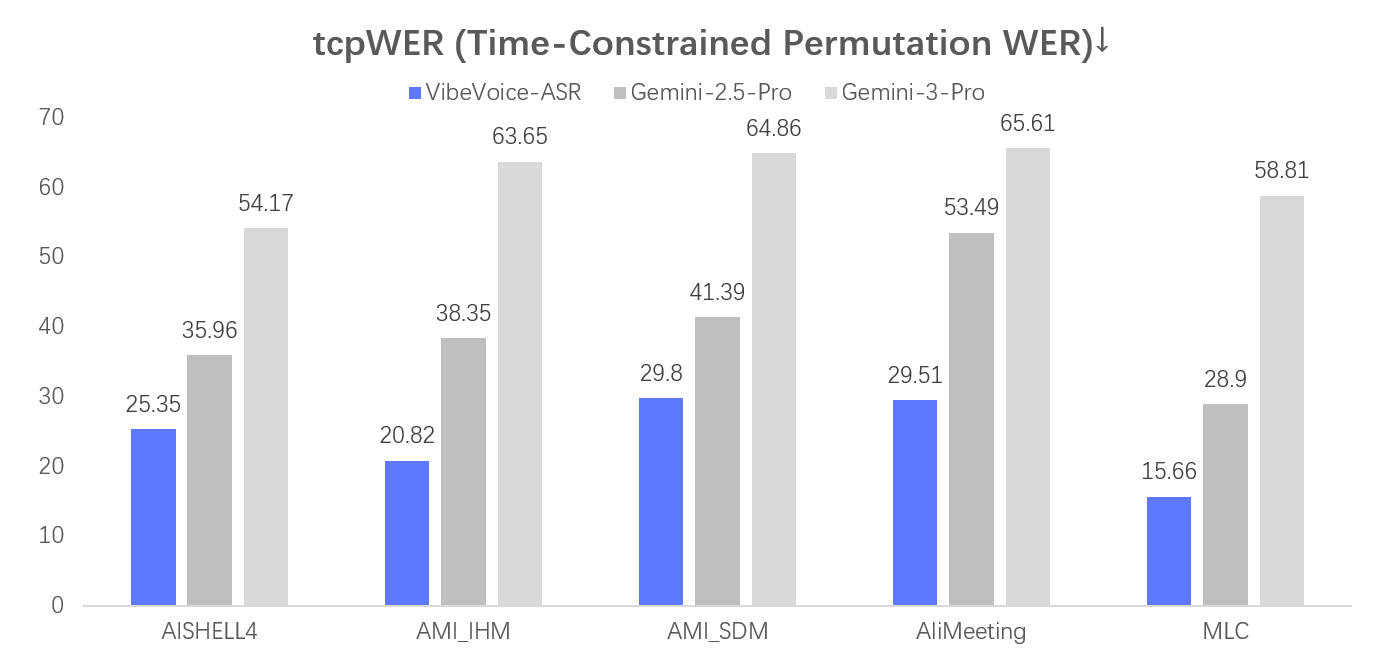
2026-01-21: 📣 We open-sourced VibeVoice-ASR, a unified speech-to-text model designed to handle 60-minute long-form audio in a single pass, generating structured transcriptions containing Who (Speaker), When (Timestamps), and What (Content), with support for User-Customized Context. Try it in Playground.
⭐️ VibeVoice-ASR is natively multilingual, supporting over 50 languages — check the supported languages for details.
🔥 The VibeVoice-ASR finetuning code is now available!
⚡️ vLLM inference is now supported for faster inference; see vllm-asr for more details.
📑 VibeVoice-ASR Technique Report is available.
2025-12-16: 📣 We added experimental speakers to VibeVoice‑Realtime‑0.5B for exploration, including multilingual voices in nine languages (DE, FR, IT, JP, KR, NL, PL, PT, ES) and 11 distinct English style voices. Try it. More speaker types will be added over time.
2025-12-03: 📣 We open-sourced VibeVoice‑Realtime‑0.5B, a real‑time text‑to‑speech model that supports streaming text input and robust long-form speech generation. Try it on Colab.
2025-09-05: VibeVoice is an open-source research framework intended to advance collaboration in the speech synthesis community. After release, we discovered instances where the tool was used in ways inconsistent with the stated intent. Since responsible use of AI is one of Microsoft’s guiding principles, we have removed the VibeVoice-TTS code from this repository.
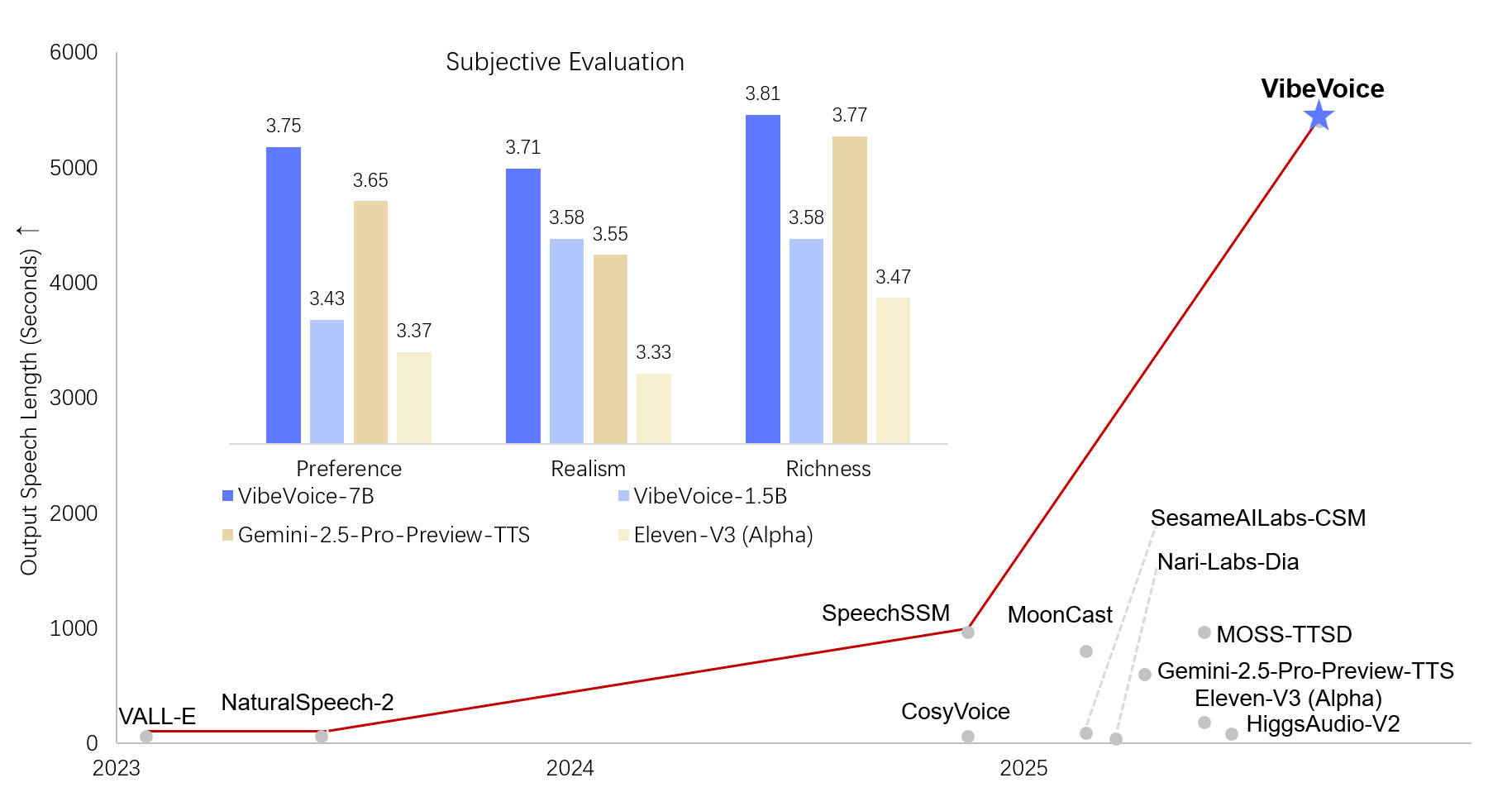
2025-08-25: 📣 We open-sourced VibeVoice-TTS, a long-form multi-speaker text-to-speech model that can synthesize speech up to 90 minutes long with up to 4 distinct speakers. — accepted as an Oral at ICLR 2026! 🔥
Overview
VibeVoice is a family of open-source frontier voice AI models that includes both Text-to-Speech (TTS) and Automatic Speech Recognition (ASR) models.
A core innovation of VibeVoice is its use of continuous speech tokenizers (Acoustic and Semantic) operating at an ultra-low frame rate of 7.5 Hz. These tokenizers efficiently preserve audio fidelity while significantly boosting computational efficiency for processing long sequences. VibeVoice employs a next-token diffusion framework, leveraging a Large Language Model (LLM) to understand textual context and dialogue flow, and a diffusion head to generate high-fidelity acoustic details.
For more information, demos, and examples, please visit our Project Page.
Model
Weight
Quick Try
VibeVoice-ASR-7B
HF Link
Playground
VibeVoice-ASR-BitNet (CPU)
HF Link
VibeASR.cpp
VibeVoice-TTS-1.5B
HF Link
Disabled
VibeVoice-Realtime-0.5B
HF Link
Colab
Models
1. 📖 VibeVoice-ASR - Long-form Speech Recognition
VibeVoice-ASR is a unified speech-to-text model designed to handle 60-minute long-form audio in a single pass, generating structured transcriptions containing Who (Speaker), When (Timestamps), and What (Content), with support for Customized Hotwords.
🕒 60-minute Single-Pass Processing:
Unlike conventional ASR models that slice audio into short chunks (often losing global context), VibeVoice ASR accepts up to 60 minutes of continuous audio input within 64K token length. This ensures consistent speaker tracking and semantic coherence across the entire hour.
👤 Customized Hotwords:
Users can provide customized hotwords (e.g., specific names, technical terms, or background info) to guide the recognition process, significantly improving accuracy on domain-specific content.
📝 Rich Transcription (Who, When, What):
The model jointly performs ASR, diarization, and timestamping, producing a structured output that indicates who said what and when.
📖 Documentation | 🤗 Hugging Face | 🎮 Playground | 🛠️ Finetuning | 📊 Paper
Best for: Long-form conversational audio, podcasts, multi-speaker dialogues
⏱️ 90-minute Long-form Generation:
Synthesizes conversational/single-speaker speech up to 90 minutes in a single pass, maintaining speaker consistency and semantic coherence throughout.
👥 Multi-speaker Support:
Supports up to 4 distinct speakers in a single conversation, with natural turn-taking and speaker consistency across long dialogues.
🎭 Expressive Speech:
Generates expressive, natural-sounding speech that captures conversational dynamics and emotional nuances.
🌐 Multi-lingual Support:
Supports English, Chinese and other languages.
Please see CONTRIBUTING.md for detailed contribution guidelines.
⚠️ Risks and Limitations
While efforts have been made to optimize it through various techniques, it may still produce outputs that are unexpected, biased, or inaccurate. VibeVoice inherits any biases, errors, or omissions produced by its base model (specifically, Qwen2.5 1.5b in this release).
Potential for Deepfakes and Disinformation: High-quality synthetic speech can be misused to create convincing fake audio content for impersonation, fraud, or spreading disinformation. Users must ensure transcripts are reliable, check content accuracy, and avoid using generated content in misleading ways. Users are expected to use the generated content and to deploy the models in a lawful manner, in full compliance with all applicable laws and regulations in the relevant jurisdictions. It is best practice to disclose the use of AI when sharing AI-generated content.
We do not recommend using VibeVoice in commercial or real-world applications without further testing and development. This model is intended for research and development purposes only. Please use responsibly.
Trang TopGit này là một snapshot — tab "Readme" hiển thị nguyên văn README của repo (đã bỏ link, giữ ảnh). Repo GitHub ở github.com/microsoft/VibeVoice là nguồn chính thức.
microsoft/VibeVoice có phải mã nguồn mở không?
Có — microsoft/VibeVoice phát hành theo license MIT, nghĩa là mã nguồn mở để đọc, fork và (tùy license) tái sử dụng. Mã: github.com/microsoft/VibeVoice.
microsoft/VibeVoice có tag gì không?
Bản đồng bộ chưa ghi nhận topic GitHub nào cho microsoft/VibeVoice. GitHub topics hiển thị ở thanh bên phải trang repo — đó là nơi đáng kiểm tra nhất.
microsoft/VibeVoice có trang demo không?
Dự án có trang chủ ở https://microsoft.github.io/VibeVoice/. Tab "Readme" ở trang này thường có ảnh chụp và hướng dẫn bắt đầu nhanh.
microsoft/VibeVoice còn đang phát triển không?
Commit gần nhất trên microsoft/VibeVoice là 18 ngày trước (theo timestamp GitHub). Repo có 5.8k fork — một chỉ báo về mức độ quan tâm của cộng đồng.
microsoft/VibeVoice dùng license gì?
microsoft/VibeVoice phát hành theo license MIT. Nên mở file LICENSE trên GitHub để xác nhận — license metadata đôi khi lệch với thực tế dự án.