Trên GitHub, miloyip/itoa-benchmark đã đạt 340 sao, ngôn ngữ HTML. C++ integer-to-string conversion benchmark
Tóm tắt dựng từ metadata GitHub của chính dự án — chưa có bài review TopGit. Trang sẽ tự động cập nhật khi bài review đầy đủ được xuất bản.
VÌ SAO CHƯA CÓ REVIEW
TopGit viết bài đầy đủ cho repo có nhiều sao nhất và được yêu cầu nhiều nhất. Trang này là snapshot trong thời gian chờ — xem README gốc ở tab READ ME.
Note that itoa() is not a standard function in C and C++, but provided by some compilers.
Procedure
Firstly the program verifies the correctness of implementations.
Then, two cases for benchmark are carried out:
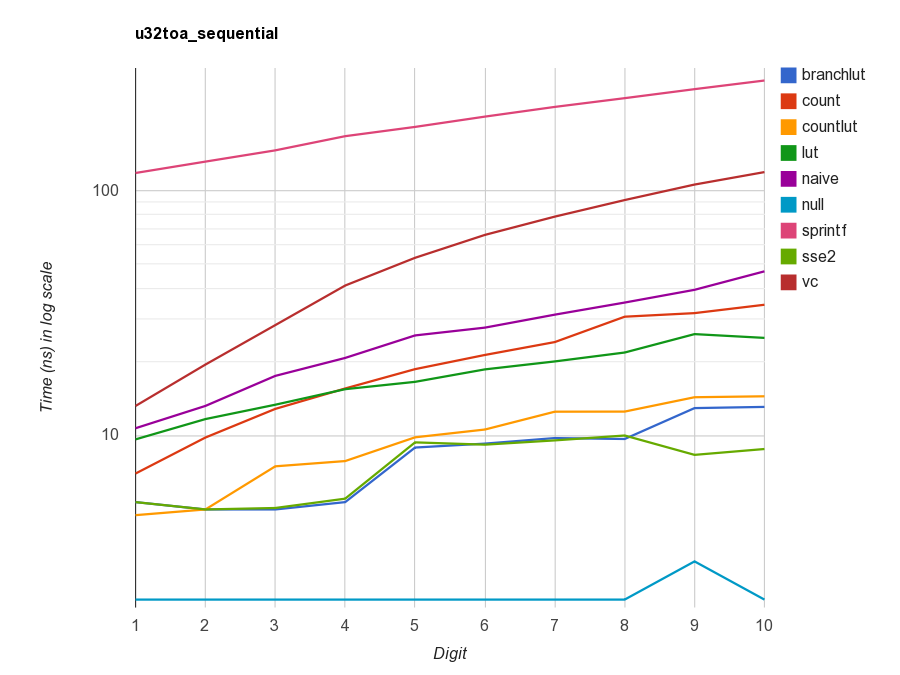
Sequential: Converts consecutive values in same number of decimal digits.
For u32toa(), the tested values are { 1, 2, ..., 9 }, {10, 11, ..., 99 }, ... { 4000000000, 4000000001, ..., 4294967296}, i.e., groups of 1 to 10 decimal digits.
For signed versions, use alternate signs, e.g. { 1, -2, 3, -4, ... 9 }.
For 64-bit integer, there are groups of 1 to 20 decimal digits.
Random: Converts the shuffled sequence of the first case.
Each digit group is run for 100000 times. The minimum time duration is measured for 10 trials.
Build and Run
Obtain premake5.
make
Results
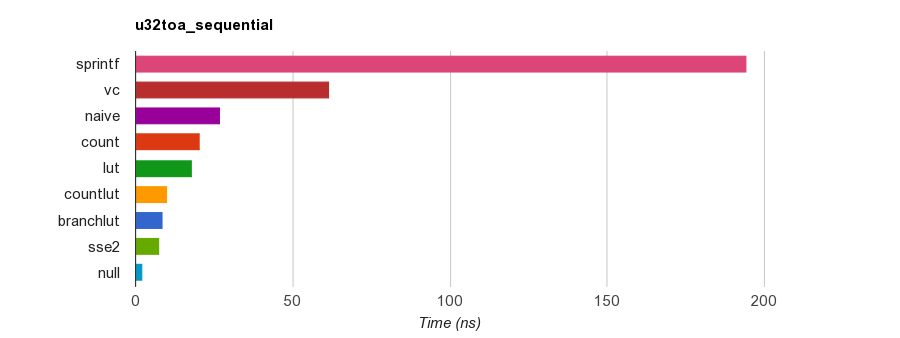
The following are sequential results measured on a PC (Core i7 920 @2.67Ghz), where u32toa() is compiled by Visual C++ 2013 and run on Windows 64-bit. The speedup is based on sprintf().
Function
Time (ns)
Speedup
sprintf
194.225
1.00x
vc
61.522
3.16x
naive
26.743
7.26x
count
20.552
9.45x
lut
17.810
10.91x
countlut
9.926
19.57x
branchlut
8.430
23.04x
sse2
7.614
25.51x
null
2.230
87.09x
Note that the null implementation does nothing. It measures the overheads of looping and function call.
Since the C++ standard library implementations (ostringstream, ostrstream, to_string) are slow, they are turned off by default. User can re-enable them by defining RUN_CPPITOA macro.
Some results of various configurations are located at itoa-benchmark/result. They can be accessed online, with interactivity provided by Google Charts:
Compute division/modulo of 10 for each digit, store digits in temp array and copy to buffer in reverse order.
unnamed
Compute division/modulo of 10 for each digit, store directly in buffer
count
Count number of decimal digits first, using technique from [1].
lut
Uses lookup table (LUT) of digit pairs for division/modulo of 100. Mentioned in [2]
countlut
Combines count and lut.
branchlut
Use branching to divide-and-conquer the range of value, make computation more parallel.
sse2
Based on branchlut scheme, use SSE2 SIMD instructions to convert 8 digits in parallel. The algorithm is designed by Wojciech Muła [3]. (Experiment shows it is useful for values equal to or more than 9 digits)
null
Do nothing.
FAQ
How to add an implementation?
You may clone an existing implementation file (e.g. naive.cpp). And then modify it. Re-run premake to add it to project or makefile. Note that it will automatically register to the benchmark by macro REGISTER_TEST(name).
Making pull request of new implementations is welcome.
Why not converting integers to std::string?
It may introduce heap allocation, which is a big overhead. User can easily wrap these low-level functions to return std::string, if needed.
Why fast itoa() functions is needed?
They are a very common operations in writing data in text format. The standard way of sprintf(), std::stringstream, std::to_string(int) (C++11) often provides poor performance. The author of this benchmark would optimize the "naive" implementation in RapidJSON, thus he creates this project.
References
[1] Anderson, Bit Twiddling Hacks, 1997.
[2] Alexandrescu, Three Optimization Tips for C++, 2012.
[3] Muła, SSE: conversion integers to decimal representation, 2011.
Related Benchmarks and Discussions
[The String Formatters of Manor Farm] (http://www.gotw.ca/publications/mill19.htm) by Herb Sutter, 2001.
C++ itoa benchmark by localvoid
Stackoverflow: C++ performance challenge: integer to std::string conversion
Trang TopGit này là một snapshot — tab "Readme" hiển thị nguyên văn README của repo (đã bỏ link, giữ ảnh). Repo GitHub ở github.com/miloyip/itoa-benchmark là nguồn chính thức.
miloyip/itoa-benchmark có bao nhiêu sao?
miloyip/itoa-benchmark có 340 sao GitHub — tải lại trang để xem số mới nhất, hoặc xem trực tiếp github.com/miloyip/itoa-benchmark. TopGit phản chiếu số sao của GitHub nhưng không cam kết đến từng phút.
miloyip/itoa-benchmark có phải mã nguồn mở không?
Có — miloyip/itoa-benchmark phát hành theo license MIT, nghĩa là mã nguồn mở để đọc, fork và (tùy license) tái sử dụng. Mã: github.com/miloyip/itoa-benchmark.
miloyip/itoa-benchmark còn đang phát triển không?
Commit gần nhất trên miloyip/itoa-benchmark là 1.8 năm trước (theo timestamp GitHub). Repo có 84 fork — một chỉ báo về mức độ quan tâm của cộng đồng.
miloyip/itoa-benchmark dùng license gì?
miloyip/itoa-benchmark phát hành theo license MIT. Nên mở file LICENSE trên GitHub để xác nhận — license metadata đôi khi lệch với thực tế dự án.
miloyip/itoa-benchmark là gì?
miloyip/itoa-benchmark (miloyip/itoa-benchmark) là dự án HTML trên GitHub. Theo mô tả gốc: C++ integer-to-string conversion benchmark
miloyip/itoa-benchmark viết bằng ngôn ngữ gì?
miloyip/itoa-benchmark chủ yếu viết bằng HTML. Trường "language" của GitHub dựa trên phần lớn byte ở nhánh mặc định.
Đọc đầy đủ README ở tab phía trên.
itoa-benchmark có đáng để bạn bỏ thời gian?
ChatGPT, Claude và Perplexity đều đọc được trang này. Hỏi thử xem họ nghĩ gì về itoa-benchmark.

 /itoa-benchmark