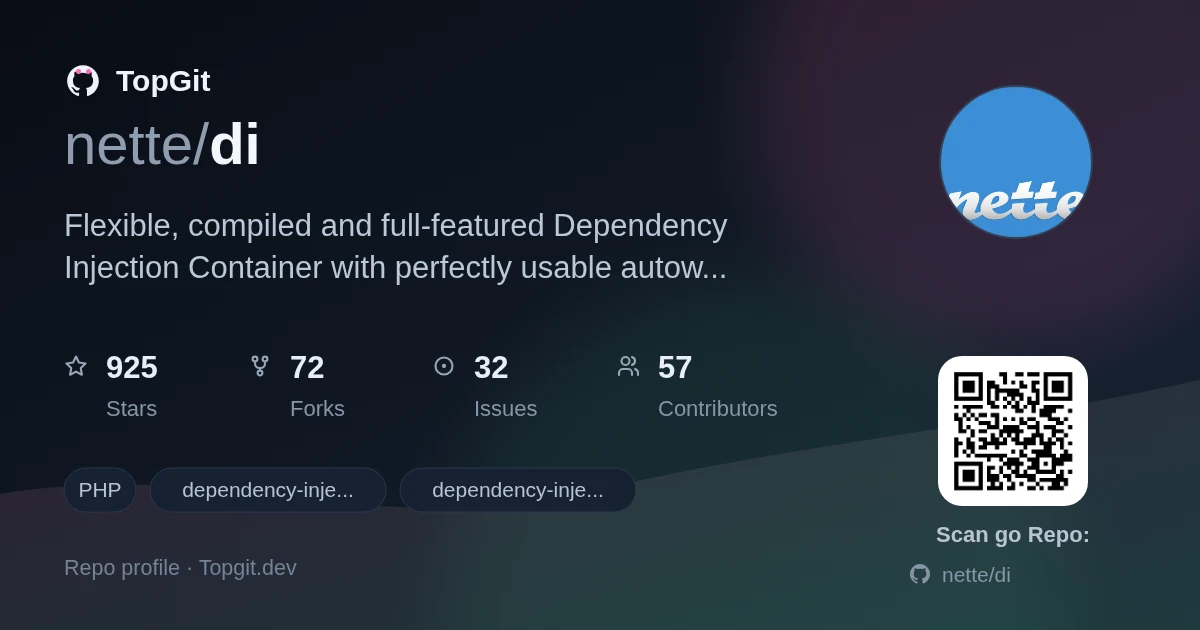
nette/di — dự án backend — đang có 922 sao GitHub trong nhóm Backend. 💎 Flexible, compiled and full-featured Dependency Injection Container with perfectly usable autowiring and support for all new PHP 8 features.
Tóm tắt dựng từ metadata GitHub của chính dự án — chưa có bài review TopGit. Trang sẽ tự động cập nhật khi bài review đầy đủ được xuất bản.
VÌ SAO CHƯA CÓ REVIEW
TopGit viết bài đầy đủ cho repo có nhiều sao nhất và được yêu cầu nhiều nhất. Trang này là snapshot trong thời gian chờ — xem README gốc ở tab READ ME.
Purpose of the Dependecy Injection (DI) is to free classes from the responsibility for obtaining objects that they need for its operation (these objects are called services). To pass them these services on their instantiation instead.
Nette DI is one of the most interesting part of framework. It is compiled DI container, extremely fast and easy to configure.
Documentation can be found on the website.
Support Me
Do you like Nette DI? Are you looking forward to the new features?
Thank you!
Installation
The recommended way to install is via Composer:
composer require nette/di
It requires PHP version 8.2 and supports PHP up to 8.5.
Usage
Let's have an application for sending newsletters. The code is maximally simplified and is available on the GitHub.
We have the object representing email:
class Mail
{
	public string $subject;
	public string $message;
}
An object which can send emails:
interface Mailer
{
	function send(Mail $mail, string $to): void;
}
A support for logging:
interface Logger
{
	function log(string $message): void;
}
And finally, a class that provides sending newsletters:
class NewsletterManager
{
	private Mailer $mailer;
	private Logger $logger;

	public function __construct(Mailer $mailer, Logger $logger)
	{
		$this->mailer = $mailer;
		$this->logger = $logger;
	}

	public function distribute(array $recipients): void
	{
		$mail = new Mail;
		$mail->subject = '...';
		$mail->message = '...';

		foreach ($recipients as $recipient) {
			$this->mailer->send($mail, $recipient);
		}
		$this->logger->log('...');
	}
}
The code respects Dependency Injection, ie. each object uses only variables which we had passed into it.
Also, we have a ability to implement own Logger or Mailer, like this:
class SendMailMailer implements Mailer
{
	public function send(Mail $mail, string $to): void
	{
		mail($to, $mail->subject, $mail->message);
	}
}

class FileLogger implements Logger
{
	private string $file;

	public function __construct(string $file)
	{
		$this->file = $file;
	}

	public function log(string $message): void
	{
		file_put_contents($this->file, $message . "\n", FILE_APPEND);
	}
}
DI container is the supreme architect which can create individual objects (in the terminology DI called services) and assemble and configure them exactly according to our needs.
Container for our application might look like this:
class Container
{
	private ?Logger $logger;
	private ?Mailer $mailer;

	public function getLogger(): Logger
	{
		if (!isset($this->logger)) {
			$this->logger = new FileLogger('log.txt');
		}
		return $this->logger;
	}

	public function getMailer(): Mailer
	{
		if (!isset($this->mailer)) {
			$this->mailer = new SendMailMailer;
		}
		return $this->mailer;
	}

	public function createNewsletterManager(): NewsletterManager
	{
		return new NewsletterManager($this->getMailer(), $this->getLogger());
	}
}
The implementation looks like this because:
the individual services are created only on demand (lazy loading)
doubly called createNewsletterManager will use the same logger and mailer instances
Let's instantiate Container, let it create manager and we can start spamming users with newsletters :-)
$container = new Container;
$manager = $container->createNewsletterManager();
$manager->distribute(...);
Significant to Dependency Injection is that no class depends on the container. Thus it can be easily replaced with another one. For example with the container generated by Nette DI.
Nette DI
Nette DI is the generator of containers. We instruct it (usually) with configuration files. This is configuration that leads to generate nearly the same class as the class Container above:
The big advantage is the shortness of configuration.
Nette DI actually generates PHP code of container. Therefore it is extremely fast. Developer can see the code, so he knows exactly what it is doing. He can even trace it.
Usage of Nette DI is very easy. Save the (above) configuration to the file config.neon and let's create a container:
$loader = new Nette\DI\ContainerLoader(__DIR__ . '/temp');
$class = $loader->load(function($compiler) {
    $compiler->loadConfig(__DIR__ . '/config.neon');
});
$container = new $class;
and then use container to create object NewsletterManager and we can send e-mails:
The container will be generated only once and the code is stored in cache (in directory __DIR__ . '/temp'). Therefore the loading of configuration file is placed in the closure in $loader->load(), so it is called only once.
During development it is useful to activate auto-refresh mode which automatically regenerate the container when any class or configuration file is changed. Just in the constructor ContainerLoader append true as the second argument:
$loader = new Nette\DI\ContainerLoader(__DIR__ . '/temp', autoRebuild: true);
Services
Services are registered in the DI container and their dependencies are automatically passed.
services:
	manager: NewsletterManager
All dependencies declared in the constructor of this service will be automatically passed. Constructor passing is the preferred way of dependency injection for services.
If we want to pass dependencies by the setter, we can add the setup section to the service definition:
class NewsletterManager
{
	private AnotherService $anotherService;

	public function setAnotherService(AnotherService $service): void
	{
		$this->anotherService = $service;
	}

...
We can also add the inject: yes directive. This directive will enable automatic call of inject* methods and passing dependencies to public variables with #[Inject] attribute:
services:
	foo:
		factory: FooClass
		inject: yes
Dependency Service1 will be passed by calling the inject* method, dependency Service2 will be assigned to the $service2 variable:
use Nette\DI\Attributes\Inject;

class FooClass
{
	private Service1 $service1;

	// 1) inject* method:

	public function injectService1(Service1 $service): void
	{
		$this->service1 = $service1;
	}

	// 2) Assign to the variable with the #[Inject] attribute:

	#[Inject]
	public Service2 $service2;
}
However, this method is not ideal, because the variable must be declared as public and there is no way how you can ensure that the passed object will be of the given type. We also lose the ability to handle the assigned dependency in our code and we violate the principles of encapsulation.
Factories
We can use factories generated from an interface. The interface must declare the returning type of the method. Nette will generate a proper implementation of the interface.
The interface must have exactly one method named create. Our factory interface could be declared in the following way:
interface BarFactory
{
	function create(): Bar;
}
The create method will instantiate an Bar with the following definition:
class Bar
{
	private Logger $logger;

	public function __construct(Logger $logger)
	{
		$this->logger = $logger;
	}
}
The factory will be registered in the config.neon file:
services:
	- BarFactory
Nette will check if the declared service is an interface. If yes, it will also generate the corresponding implementation of the factory. The definition can be also written in a more verbose form:
services:
	barFactory:
		implement: BarFactory
This full definition allows us to declare additional configuration of the object using the arguments and setup sections, similarly as for all other services.
In our code, we only have to obtain the factory instance and call the create method:
class Foo
{
	private BarFactory $barFactory;

	function __construct(BarFactory $barFactory)
	{
		$this->barFactory = $barFactory;
	}

	function bar(): void
	{
		$bar = $this->barFactory->create();
	}
}
nette/di thuộc nhóm Backend trên TopGit, cùng 7 topic GitHub. Trang Trending và Topics liệt kê các repo cùng số sao và cùng ngôn ngữ để so sánh.
Đọc thêm về nette/di ở đâu?
Trang TopGit này là một snapshot — tab "Readme" hiển thị nguyên văn README của repo (đã bỏ link, giữ ảnh). Repo GitHub ở github.com/nette/di là nguồn chính thức.
nette/di có phải mã nguồn mở không?
TopGit chưa ghi nhận license cho nette/di. Phần lớn repo public trên GitHub là mã nguồn mở, nhưng điều khoản khác nhau từng repo — mở file LICENSE để xác nhận.
nette/di có trang demo không?
Dự án có trang chủ ở https://doc.nette.org/dependency-injection. Tab "Readme" ở trang này thường có ảnh chụp và hướng dẫn bắt đầu nhanh.
nette/di là gì?
nette/di (nette/di) là dự án PHP trên GitHub. Theo mô tả gốc: 💎 Flexible, compiled and full-featured Dependency Injection Container with perfectly usable autowiring and support for all new PHP 8 features.
Vì sao nette/di được xếp vào nhóm Backend?
TopGit xếp nette/di vào nhóm Backend dựa trên GitHub topics và mô tả của repo (gắn thẻ: "dependency-injection", "dependency-injection-container", "di-container"). Việc phân loại dựa trên metadata thật của repo, không phải đoán theo cảm tính biên tập.
Đọc đầy đủ README ở tab phía trên.
Chưa chắc di có hợp với bạn?
Để ChatGPT, Claude hoặc Perplexity tìm hiểu giúp — bấm bên dưới và xem AI nói gì về di.
 /di