Một mục mã nguồn mở trong kho dữ liệu GitHub của TopGit: openai/tiktoken, 19.7k sao, Python. tiktoken is a fast BPE tokeniser for use with OpenAI's models.
Tóm tắt dựng từ metadata GitHub của chính dự án — chưa có bài review TopGit. Trang sẽ tự động cập nhật khi bài review đầy đủ được xuất bản.
VÌ SAO CHƯA CÓ REVIEW
TopGit viết bài đầy đủ cho repo có nhiều sao nhất và được yêu cầu nhiều nhất. Trang này là snapshot trong thời gian chờ — xem README gốc ở tab READ ME.
tiktoken is a fast BPE tokeniser for use with
OpenAI's models.
import tiktoken
enc = tiktoken.get_encoding("o200k_base")
assert enc.decode(enc.encode("hello world")) == "hello world"

# To get the tokeniser corresponding to a specific model in the OpenAI API:
enc = tiktoken.encoding_for_model("gpt-4o")
The open source version of tiktoken can be installed from PyPI:
pip install tiktoken
The tokeniser API is documented in tiktoken/core.py.
Example code using tiktoken can be found in the
OpenAI Cookbook.
Performance
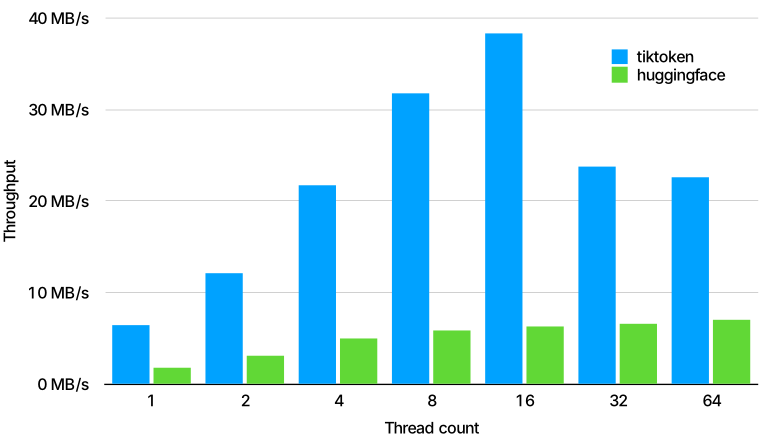
tiktoken is between 3-6x faster than a comparable open source tokeniser:
Performance measured on 1GB of text using the GPT-2 tokeniser, using GPT2TokenizerFast from
tokenizers==0.13.2, transformers==4.24.0 and tiktoken==0.2.0.
Getting help
Please post questions in the issue tracker.
If you work at OpenAI, make sure to check the internal documentation or feel free to contact
@shantanu.
What is BPE anyway?
Language models don't see text like you and I, instead they see a sequence of numbers (known as tokens).
Byte pair encoding (BPE) is a way of converting text into tokens. It has a couple desirable
properties:
It's reversible and lossless, so you can convert tokens back into the original text
It works on arbitrary text, even text that is not in the tokeniser's training data
It compresses the text: the token sequence is shorter than the bytes corresponding to the
original text. On average, in practice, each token corresponds to about 4 bytes.
It attempts to let the model see common subwords. For instance, "ing" is a common subword in
English, so BPE encodings will often split "encoding" into tokens like "encod" and "ing"
(instead of e.g. "enc" and "oding"). Because the model will then see the "ing" token again and
again in different contexts, it helps models generalise and better understand grammar.
tiktoken contains an educational submodule that is friendlier if you want to learn more about
the details of BPE, including code that helps visualise the BPE procedure:
from tiktoken._educational import *

# Train a BPE tokeniser on a small amount of text
enc = train_simple_encoding()

# Visualise how the GPT-4 encoder encodes text
enc = SimpleBytePairEncoding.from_tiktoken("cl100k_base")
enc.encode("hello world aaaaaaaaaaaa")
Extending tiktoken
You may wish to extend tiktoken to support new encodings. There are two ways to do this.
Create your Encoding object exactly the way you want and simply pass it around.
cl100k_base = tiktoken.get_encoding("cl100k_base")

# In production, load the arguments directly instead of accessing private attributes
# See openai_public.py for examples of arguments for specific encodings
enc = tiktoken.Encoding(
    # If you're changing the set of special tokens, make sure to use a different name
    # It should be clear from the name what behaviour to expect.
    name="cl100k_im",
    pat_str=cl100k_base._pat_str,
    mergeable_ranks=cl100k_base._mergeable_ranks,
    special_tokens={
        **cl100k_base._special_tokens,
        "<|im_start|>": 100264,
        "<|im_end|>": 100265,
    }
)
Use the tiktoken_ext plugin mechanism to register your Encoding objects with tiktoken.
This is only useful if you need tiktoken.get_encoding to find your encoding, otherwise prefer
option 1.
To do this, you'll need to create a namespace package under tiktoken_ext.
Layout your project like this, making sure to omit the tiktoken_ext/__init__.py file:
my_encodings.py should be a module that contains a variable named ENCODING_CONSTRUCTORS.
This is a dictionary from an encoding name to a function that takes no arguments and returns
arguments that can be passed to tiktoken.Encoding to construct that encoding. For an example, see
tiktoken_ext/openai_public.py. For precise details, see tiktoken/registry.py.
openai/tiktoken có 19.7k sao GitHub — tải lại trang để xem số mới nhất, hoặc xem trực tiếp github.com/openai/tiktoken. TopGit phản chiếu số sao của GitHub nhưng không cam kết đến từng phút.
openai/tiktoken có tag gì không?
Bản đồng bộ chưa ghi nhận topic GitHub nào cho openai/tiktoken. GitHub topics hiển thị ở thanh bên phải trang repo — đó là nơi đáng kiểm tra nhất.
openai/tiktoken còn đang phát triển không?
Commit gần nhất trên openai/tiktoken là 11 ngày trước (theo timestamp GitHub). Repo có 1.7k fork — một chỉ báo về mức độ quan tâm của cộng đồng.
openai/tiktoken là gì?
openai/tiktoken (openai/tiktoken) là dự án Python trên GitHub. Theo mô tả gốc: tiktoken is a fast BPE tokeniser for use with OpenAI's models.
openai/tiktoken viết bằng ngôn ngữ gì?
openai/tiktoken chủ yếu viết bằng Python. Trường "language" của GitHub dựa trên phần lớn byte ở nhánh mặc định.
Đọc đầy đủ README ở tab phía trên.
Chưa chắc tiktoken có hợp với bạn?
Để ChatGPT, Claude hoặc Perplexity tìm hiểu giúp — bấm bên dưới và xem AI nói gì về tiktoken.

 /tiktoken