Một mục mã nguồn mở trong kho dữ liệu GitHub của TopGit: OpenDriveLab/AgiBot-World, 3.1k sao, Python. [IROS 2025 Best Paper Award Finalist & IEEE TRO 2026] The Large-scale Manipulation Platform for Scalable and Intelligent Embodied Systems
Tóm tắt dựng từ metadata GitHub của chính dự án — chưa có bài review TopGit. Trang sẽ tự động cập nhật khi bài review đầy đủ được xuất bản.
VÌ SAO CHƯA CÓ REVIEW
TopGit viết bài đầy đủ cho repo có nhiều sao nhất và được yêu cầu nhiều nhất. Trang này là snapshot trong thời gian chờ — xem README gốc ở tab READ ME.
Research Blog: GO-1 Open-sourcing | Research Blog: AgiBot World Colosseo | Technical Report
AgiBot World Colosseo is a full-stack large-scale robot learning platform curated for advancing bimanual manipulation in scalable and intelligent embodied systems. It is accompanied by foundation models, benchmarks, and an ecosystem to democratize access to high-quality robot data for the academic community and the industry, paving the path towards the "ImageNet Moment" for Embodied AI.
We have released:
GO-1: Our robotic foundation model pretrained on AgiBot World Dataset
GO-1 Air: GO-1 model without Latent Planner, high-performanced and lightweighted
Task Catalog: Reference sheet outlining the tasks in our dataset, including robot end-effector types, sample action-text descriptions and more
AgiBot World Beta: Our complete dataset featuring 1,003,672 trajectories (~43.8T)
AgiBot World Alpha: A curated subset of AgiBot World Beta, containing 92,214 trajectories (~8.5T)
News📰
[!IMPORTANT]
🌟 Stay up to date at opendrivelab.com!
[2025/09/19] 🚀 Our robotic foundation model GO-1 open-sourced.
[2025/03/10] 📄 Research Blog and Technical Report released.
[2025/03/01] Agibot World Beta released.
[2025/01/03]Agibot World Alpha Sample Dataset released.
[2024/12/30] 🤖 Agibot World Alpha released.
TODO List 📅
AgiBot World Alpha
AgiBot World Beta
~1,000,000 trajectories of high-quality robot data
AgiBot World Foundation Model: GO-1
GO-1 fine-tuning script
GO-1 Air pre-trained checkpoint
GO-1 pre-trained checkpoint
Examples of using GO-1 model
2025 AgiBot World Challenge
Key Features 🔑
1 million+ trajectories from 100 robots.
100+ 1:1 replicated real-life scenarios across 5 target domains.
Cutting-edge hardware: visual tactile sensors / 6-DoF Dexterous hand / mobile dual-arm robots
Wide-spectrum versatile challenging tasks
General robotic policy pretrained on AgiBot World
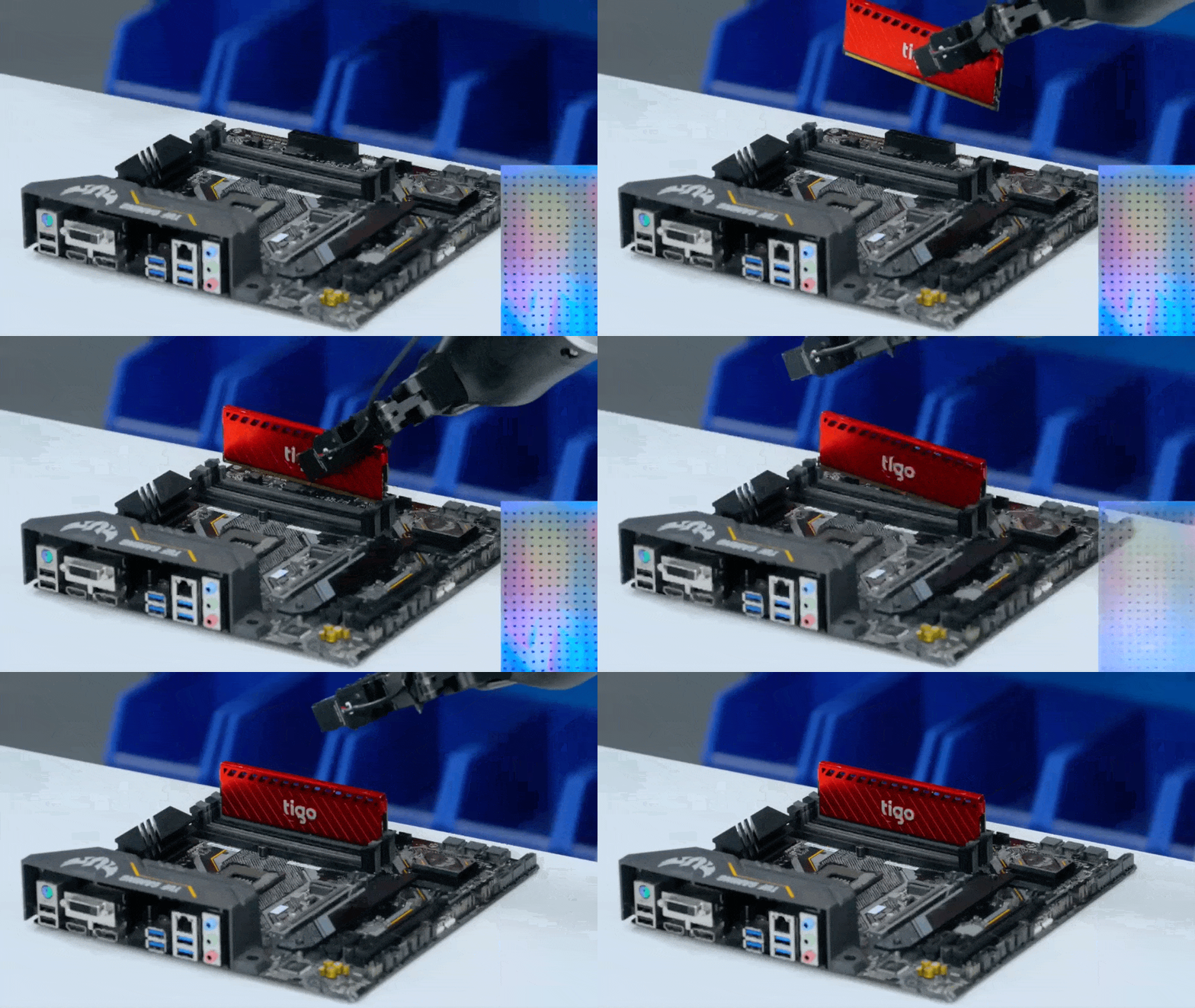
Contact-rich Manipulation
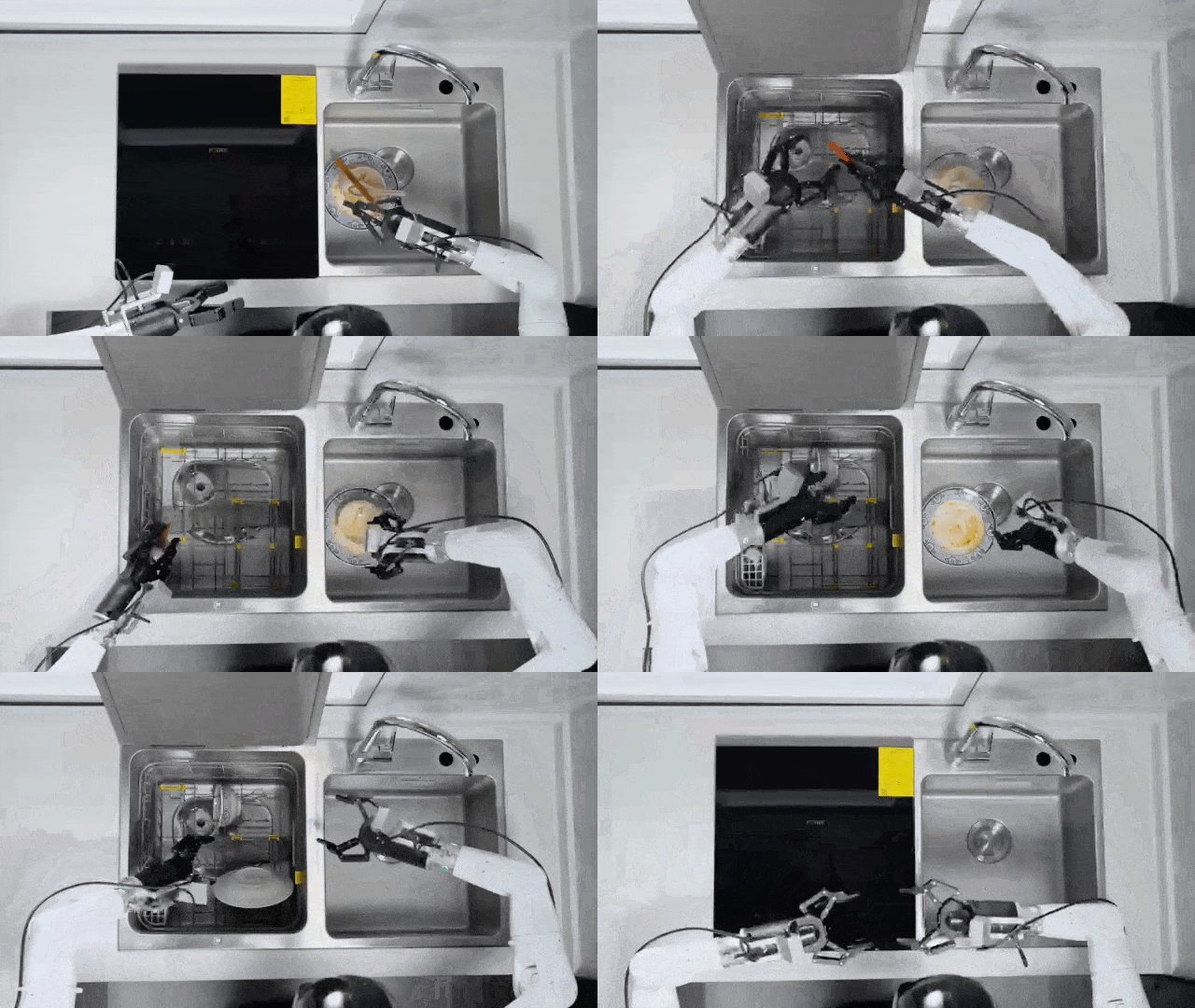
Long-horizon Planning
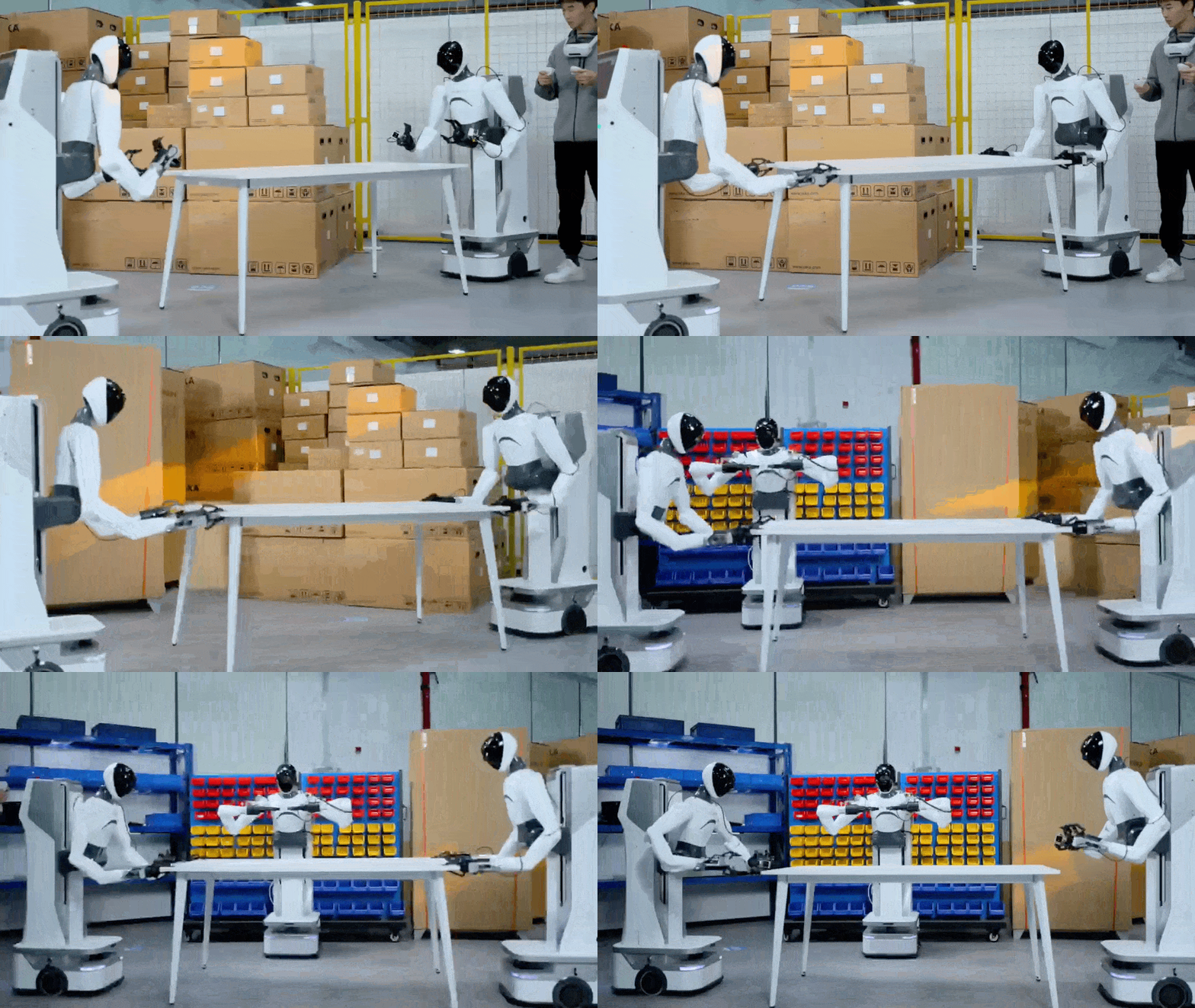
Multi-robot Collaboration
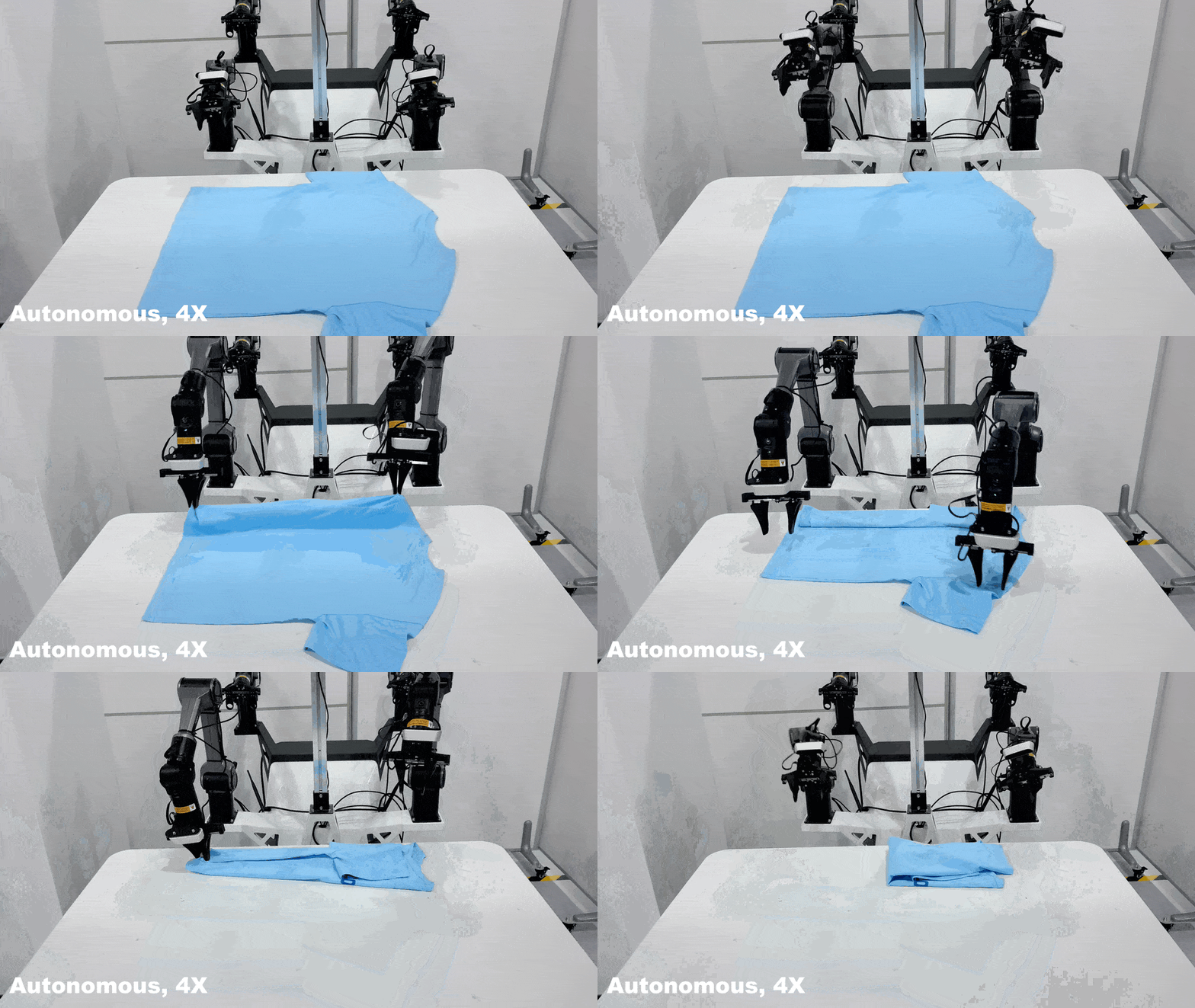
Fold Shirt (AgileX)
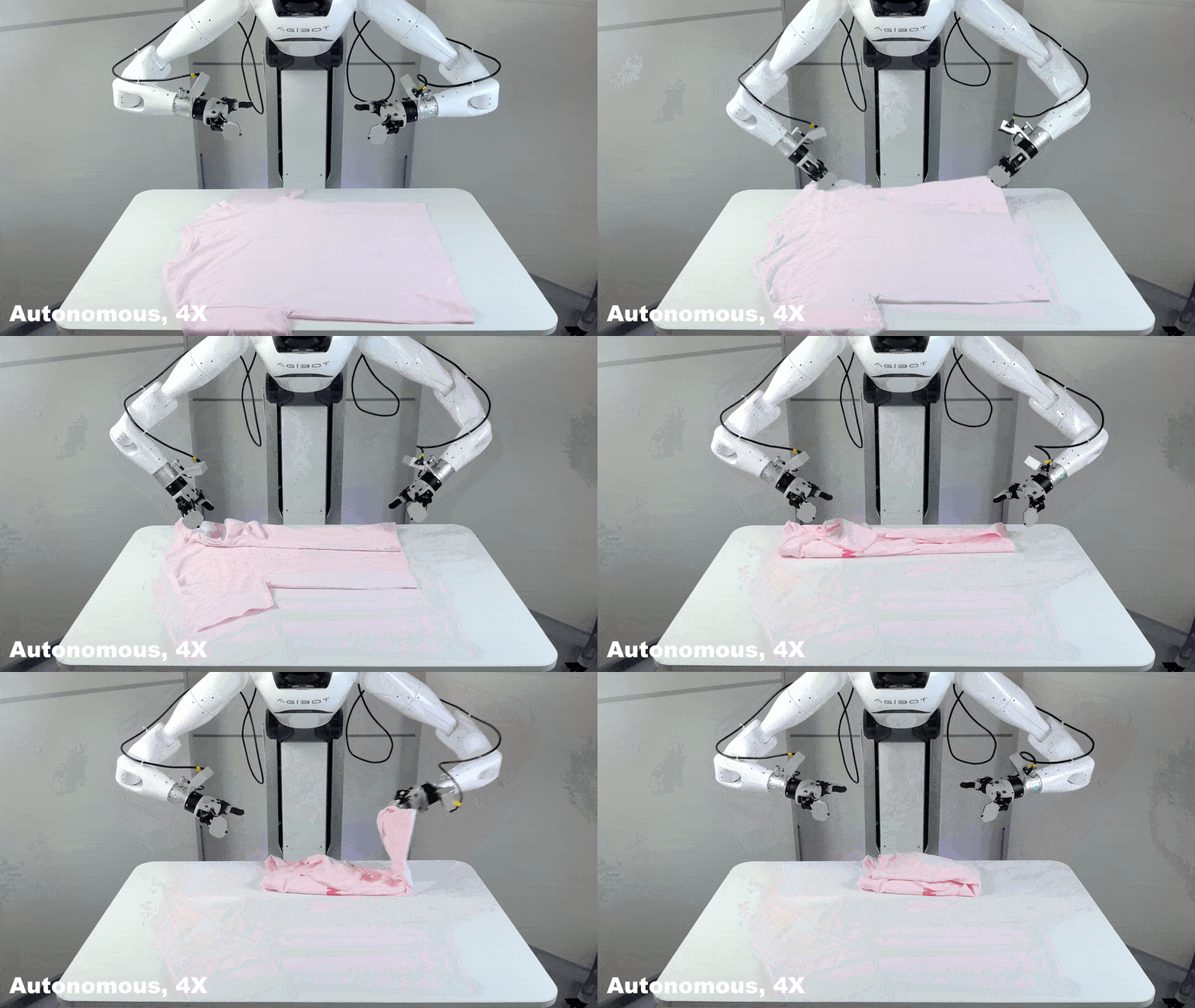
Fold Shirt (AgiBot G1)
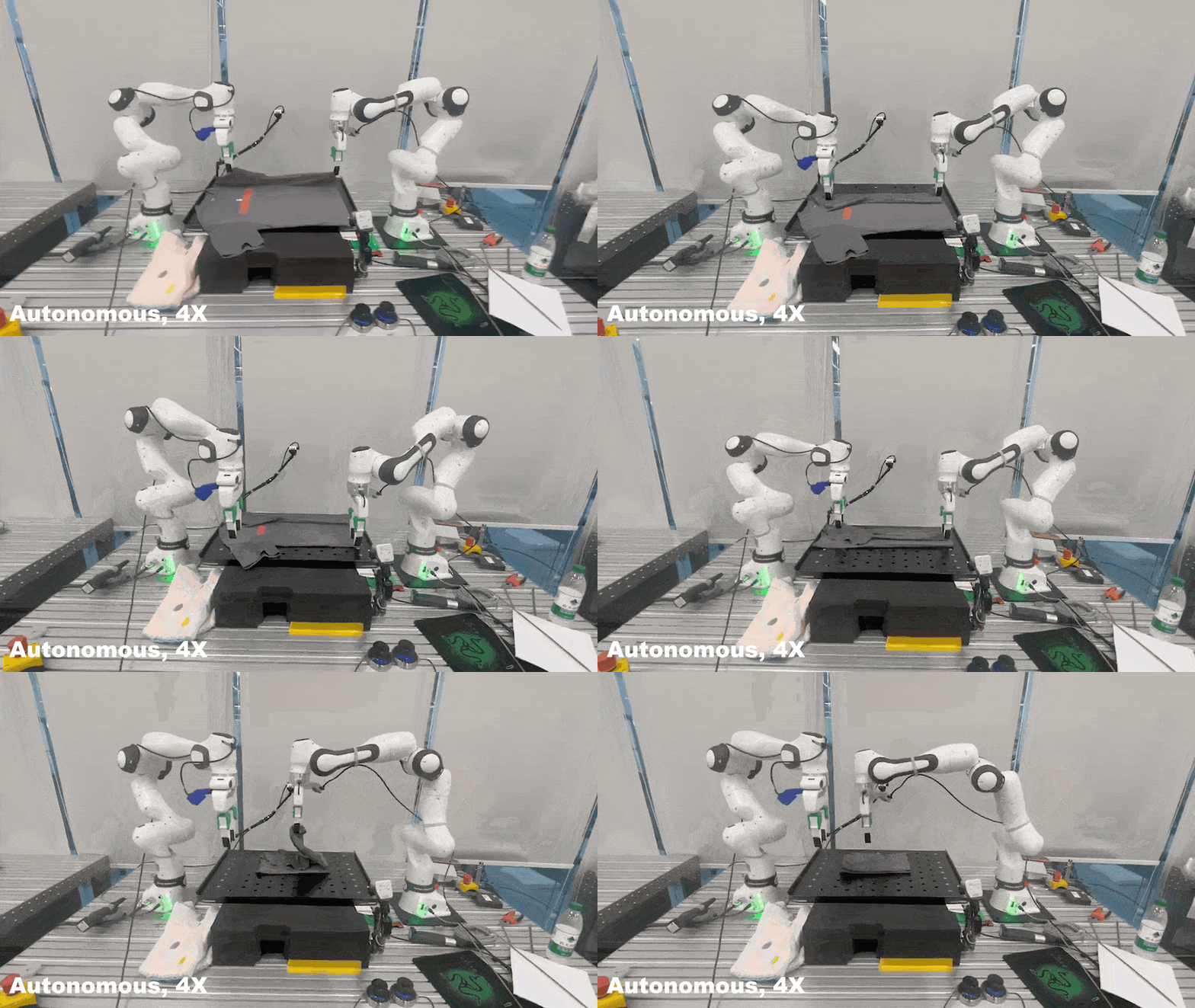
Fold Shirt (Dual Franka)
Table of Contents
News📰
TODO List 📅
Key Features 🔑
Table of Contents
Getting started 🔥
Installation
How to Get Started with Our AgiBot World Data
Download Datasets
Visualize Datasets
How to Get Started with Our GO-1 Model
Requirements
Model Zoo
Fine-tuning on Your Own Dataset
Testing Your Model
More Examples
License and Citation📄
Getting started 🔥
Installation
Download our source code:
git clone https://github.com/OpenDriveLab/AgiBot-World.git
cd AgiBot-World
This project is built on LeRobot (dataset v2.1, commit 2b71789)
⚡️ Our environment has been tested with CUDA 12.4.
pip install -e .
Flash Attention is loaded through the kernels library (installed by the command above), which fetches pre-built Flash Attention 2 binaries on first use — no local compilation required. The binaries are bit-exact with the upstream source build.
If your machine is not covered by the pre-built binaries, the code automatically falls back to a source build of flash-attn, which you can install with:
If you encounter out of RAM issue while installing flash attention, you can set the environment variable MAX_JOBS to limit the number of parallel compilation jobs:
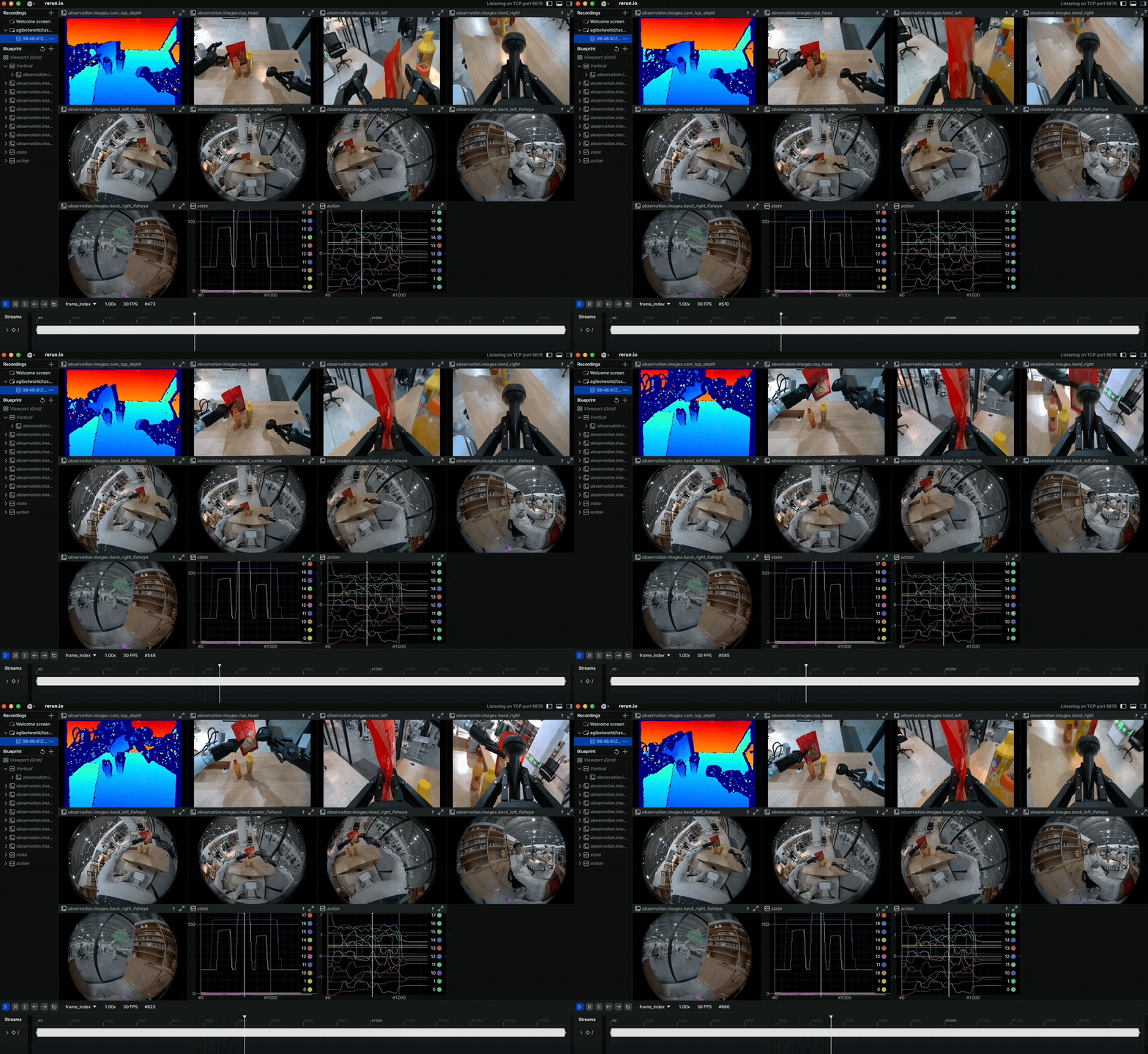
It will open rerun.io and display the camera streams, robot states and actions, like this:
How to Get Started with Our GO-1 Model
Requirements
We strongly recommend full fine-tuning for the best performance. However, if GPU memory is limited, you can alternatively fine-tune only the Action Expert.
Usage
GPU Memory Required
Example GPU
Inference
~7GB
RTX 4090
Fine-tuning (Full)
~70GB (batch size=16)
A100 80GB, H100
Fine-tuning (Only AE)
~24GB (batch size=16)
RTX 4090, A100 40GB
Model Zoo
Model
HF Link
Description
GO-1 Air
https://huggingface.co/agibot-world/GO-1-Air
GO-1 model without Latent Planner pre-trained on AgiBot World dataset
GO-1
https://huggingface.co/agibot-world/GO-1
GO-1 model pre-trained on AgiBot World dataset
Fine-tuning on Your Own Dataset
Here we provide an example of fine-tuning the GO-1 model on the LIBERO dataset. You can easily adapt it for your own data.
1. Prepare Data
We use the LeRobot dataset for our default dataset and dataloader. We provide a script for converting LIBERO to LeRobot format in evaluate/libero/convert_libero_data_to_lerobot.py.
Since TensorFlow is required to read the RLDS format, we recommend creating a separate conda environment to avoid package conflicts:
Checkpoints will be saved in experiment/<YOUR_RUNNAME> and logs will be saved in experiment/<YOUR_RUNNAME>/logs.
Notes:
We also provide a debugging shell which can run on a single RTX4090. It also set DEBUG_MODE to true for faster init.
We do not need to precompute the normalization statistics for the training data, as LeRobot will compute them when loading the dataset. The statistics will be saved to experiment/<YOUR_RUNNAME>/dataset_stats.json.
We set action chunk size and control frequency input as 30 in GO-1 pre-training, as our AgiBot World dataset is collected at 30Hz. We change them to 10 in LIBERO fine-tuning, as the LIBERO dataset is collected at 10Hz. You can change them accordingly in the config file.
Testing Your Model
Local Inference
After fine-tuning, you can test your model locally using an example script in evaluate/deploy.py. You can build a GO1Infer object to load the model and dataset statistics, then call the inference method to run inference:
We also provide a script for open-loop evaluation with training data in evaluate/openloop_eval.py.
Remote Inference
Considering that 1. real robot may not have powerful GPUs, 2. different robots and simulation benchmarks often require different package dependencies, we also provide a policy server for GO-1. A client in another environment or another machine send observations to the server for remote inference.
Start the server and it will listen on port PORT and waits for observations:
For the client, we provide a GO1Client class to send requests to the server and receive actions:
from typing import Dict, Any

import json_numpy
import numpy as np
import requests

json_numpy.patch()

class GO1Client:
  def __init__(self, host: str, port: int):
      self.host = host
      self.port = port

  def predict_action(self, payload: Dict[str, Any]) -> np.ndarray:
      response = requests.post(
          f"http://{self.host}:{self.port}/act", json=payload, headers={"Content-Type": "application/json"}
      )

      if response.status_code == 200:
          result = response.json()
          action = np.array(result)
          return action
      else:
          print(f"Request failed, status code: {response.status_code}")
          print(f"Error message: {response.text}")
          return None
We can then run the LIBERO evaluation script to query the server, see the LIBERO README for details.
More Examples
We will provide more examples of fine-tuning and running inference with GO-1 models on real robots and simulation platforms.
Currently we have:
Genie Studio: AgiBot G1 with out-of-the-box GO-1 model plus integrated data collection, fine-tuning, and deployment pipeline.
AgileX: AgileX Cobot Magic (Aloha)
LIBERO: LIBERO Simulation (Franka)
RoboTwin: RoboTwin Simulation (Aloha)
📄 License and Citation
All the data and code within this repo are under CC BY-NC-SA 4.0.
Please consider citing our work if it helps your research.
For the full authorship and detailed contributions, please refer to contributions.
In alphabetical order by surname:
@article{bu2025agibot_arxiv,
  title={Agibot world colosseo: A large-scale manipulation platform for scalable and intelligent embodied systems},
  author={Bu, Qingwen and Cai, Jisong and Chen, Li and Cui, Xiuqi and Ding, Yan and Feng, Siyuan and Gao, Shenyuan and He, Xindong and Huang, Xu and Jiang, Shu and others},
  journal={arXiv preprint arXiv:2503.06669},
  year={2025}
}

@inproceedings{bu2025agibot_iros,
  title={Agibot world colosseo: A large-scale manipulation platform for scalable and intelligent embodied systems},
  author={Bu, Qingwen and Cai, Jisong and Chen, Li and Cui, Xiuqi and Ding, Yan and Feng, Siyuan and He, Xindong and Huang, Xu and others},
  booktitle={2025 IEEE/RSJ International Conference on Intelligent Robots and Systems (IROS)},
  year={2025},
  organization={IEEE}
}

@article{shi2025diversity,
  title={Is Diversity All You Need for Scalable Robotic Manipulation?},
  author={Shi, Modi and Chen, Li and Chen, Jin and Lu, Yuxiang and Liu, Chiming and Ren, Guanghui and Luo, Ping and Huang, Di and Yao, Maoqing and Li, Hongyang},
  journal={arXiv preprint arXiv:2507.06219},
  year={2025}
}
📝 Blogs
@misc{AgiBotWorldTeam2025agibot-world-colosseo,
          title        = {Introducing AgiBot World Colosseo: A Large-scale Manipulation Platform for Scalable and Intelligent Embodied Systems},
          author       = {Shi, Modi and Lu, Yuxiang and Wang, Huijie and Xie, Chengen and Bu, Qingwen},
          year         = {2025},
          month        = {March},
          howpublished = {\url{https://opendrivelab.com/AgiBot-World/}},
          note         = {Blog post},
        }

@misc{AgiBotWorldTeam2025open-sourcing-go1,
          title        = {Open-sourcing GO-1: The Bitter Lessons of Building VLA Systems at Scale},
          author       = {Shi, Modi and Lu, Yuxiang and Wang, Huijie and Yang, Shaoze},
          year         = {2025},
          month        = {September},
          howpublished = {\url{https://opendrivelab.com/OpenGO1/}},
          note         = {Blog post},
        }
Trang TopGit này là một snapshot — tab "Readme" hiển thị nguyên văn README của repo (đã bỏ link, giữ ảnh). Repo GitHub ở github.com/OpenDriveLab/AgiBot-World là nguồn chính thức.
OpenDriveLab/AgiBot-World có bao nhiêu sao?
OpenDriveLab/AgiBot-World có 3.1k sao GitHub — tải lại trang để xem số mới nhất, hoặc xem trực tiếp github.com/OpenDriveLab/AgiBot-World. TopGit phản chiếu số sao của GitHub nhưng không cam kết đến từng phút.
OpenDriveLab/AgiBot-World có những chủ đề gì?
GitHub topics của OpenDriveLab/AgiBot-World: "pretraining-for-robotics", "robotic-foundation-model", "robotic-manipulation", "vision-language-action-model". TopGit xếp repo vào nhóm mã nguồn mở.
OpenDriveLab/AgiBot-World có trang demo không?
Dự án có trang chủ ở https://opendrivelab.com/AgiBot-World/. Tab "Readme" ở trang này thường có ảnh chụp và hướng dẫn bắt đầu nhanh.
OpenDriveLab/AgiBot-World còn đang phát triển không?
Commit gần nhất trên OpenDriveLab/AgiBot-World là 2 tháng trước (theo timestamp GitHub). Repo có 215 fork — một chỉ báo về mức độ quan tâm của cộng đồng.
OpenDriveLab/AgiBot-World viết bằng ngôn ngữ gì?
OpenDriveLab/AgiBot-World chủ yếu viết bằng Python. Trường "language" của GitHub dựa trên phần lớn byte ở nhánh mặc định.
Đọc đầy đủ README ở tab phía trên.
Vẫn đang phân vân về AgiBot-World?
Một cú bấm sẽ gửi câu hỏi kèm trang này cho AI — xem AI nói gì về AgiBot-World.
 /AgiBot-World