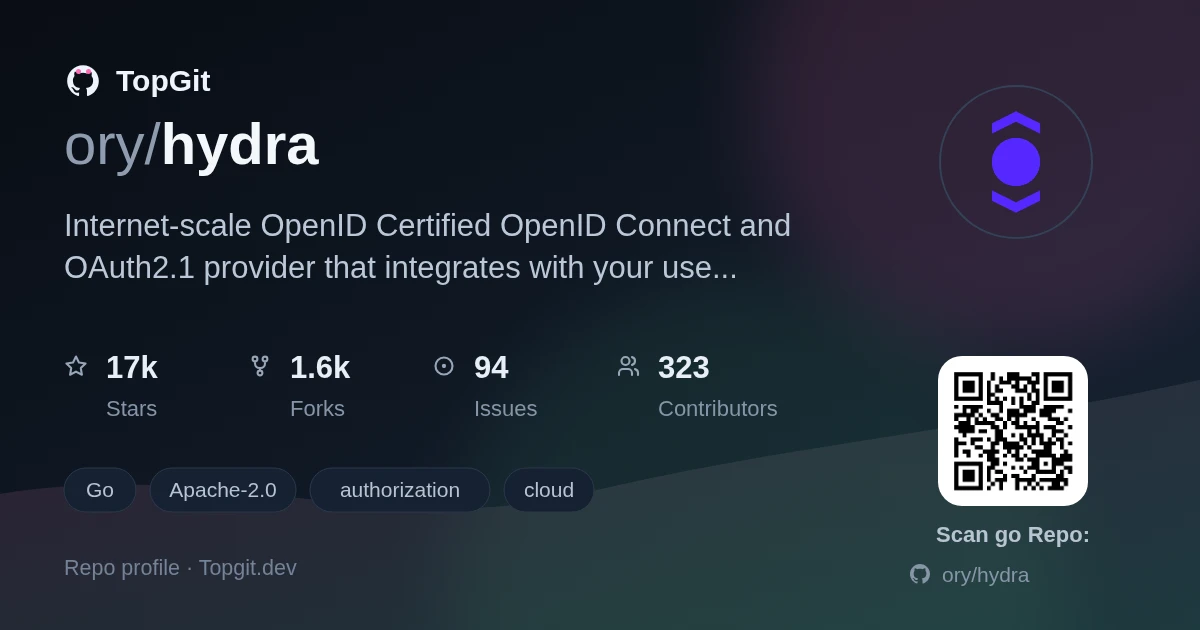
Điểm qua ory/hydra: 17.6k sao trên GitHub, viết chủ yếu bằng Go, thuộc nhóm Security. Internet-scale OpenID Certified™ OpenID Connect and OAuth2.1 provider that integrates with your user management through headless APIs. Solve OIDC/OAuth2 user cases over night. Consume as a service on Ory Network or self-host. Trusted by OpenAI and many others for scale and security. Written in Go.
Tóm tắt dựng từ metadata GitHub của chính dự án — chưa có bài review TopGit. Trang sẽ tự động cập nhật khi bài review đầy đủ được xuất bản.
VÌ SAO CHƯA CÓ REVIEW
TopGit viết bài đầy đủ cho repo có nhiều sao nhất và được yêu cầu nhiều nhất. Trang này là snapshot trong thời gian chờ — xem README gốc ở tab READ ME.
Ory Hydra is a hardened, OpenID Certified OAuth 2.0 Server and OpenID Connect
Provider optimized for low-latency, high throughput, and low resource
consumption. It connects to your existing identity provider through a login and
consent app, giving you absolute control over the user interface and experience.
What is Ory Hydra?
Why Ory Hydra
OAuth2 and OpenID Connect: Open Standards
OpenID Connect Certified
Deployment options
Use Ory Hydra on the Ory Network
Self-host Ory Hydra
Quickstart
Who is using Ory Hydra
Ecosystem
Ory Kratos: Identity and User Infrastructure and Management
Ory Hydra: OAuth2 & OpenID Connect Server
Ory Oathkeeper: Identity & Access Proxy
Ory Keto: Access Control Policies as a Server
Documentation
Developing Ory Hydra
Security
Disclosing vulnerabilities
Telemetry
Libraries and third-party projects
What is Ory Hydra?
Ory Hydra is a server implementation of the OAuth 2.0 authorization framework
and the OpenID Connect Core 1.0. It follows
cloud architecture best practices
and focuses on:
OAuth 2.0 and OpenID Connect flows
Token issuance and validation
Client management
Consent and login flow orchestration
JWKS management
Low latency and high throughput
We recommend starting with the
Ory Hydra introduction docs to learn more
about its architecture, feature set, and how it compares to other systems.
Why Ory Hydra
Ory Hydra is designed to:
Be a standalone OAuth 2.0 and OpenID Connect server without user management
Connect to any existing identity provider through a login and consent app
Give you absolute control over the user interface and experience flows
Work with any authentication endpoint:
Ory Kratos,
authboss,
User Frosting, or your proprietary system
Scale to large numbers of clients and tokens
Fit into modern cloud native environments such as Kubernetes and managed
platforms
OAuth2 and OpenID Connect: Open Standards
Ory Hydra implements Open Standards set by the IETF:
The OAuth 2.0 Authorization Framework
OAuth 2.0 Threat Model and Security Considerations
OpenID Provider Publishing Configuration Information
Dynamic OpenID Provider
To obtain certification, we deployed the
reference user login and consent app
(unmodified) and Ory Hydra v1.0.0.
Deployment options
You can run Ory Hydra in two main ways:
As a managed service on the Ory Network
As a self hosted service under your own control, with or without the Ory
Enterprise License
Use Ory Hydra on the Ory Network
The Ory Network is the fastest way to use Ory
services in production. Ory OAuth2 & OpenID Connect is powered by the open
source Ory Hydra server and is API compatible.
The Ory Network provides:
OAuth2 and OpenID Connect for single sign on, API access, and machine to
machine authorization
Identity and credential management that scales to billions of users and
devices
Registration, login, and account management flows for passkeys, biometrics,
social login, SSO, and multi factor authentication
Prebuilt login, registration, and account management pages and components
Low latency permission checks based on the Zanzibar model with the Ory
Permission Language
GDPR friendly storage with data locality and compliance in mind
Web based Ory Console and Ory CLI for administration and operations
Cloud native APIs compatible with the open source servers
Fair, usage based pricing
Sign up for a
free developer account
to get started.
Self-host Ory Hydra
You can run Ory Hydra yourself for full control over infrastructure, deployment,
and customization.
The install guide explains how to:
Install Hydra on Linux, macOS, Windows, and Docker
Configure databases such as PostgreSQL, MySQL, and CockroachDB
Deploy to Kubernetes and other orchestration systems
Build Hydra from source
This guide uses the open source distribution to get you started without license
requirements. It is a great fit for individuals, researchers, hackers, and
companies that want to experiment, prototype, or run unimportant workloads
without SLAs. You get the full core engine, and you are free to inspect, extend,
and build it from source.
If you run Hydra as part of a business-critical system, for example OAuth2 and
OpenID Connect for all your users, you should use a commercial agreement to
reduce operational and security risk. The Ory Enterprise License (OEL)
layers on top of self-hosted Hydra and provides:
Additional enterprise features that are not available in the open source
version
Regular security releases, including CVE patches, with service level
agreements
Support for advanced scaling, multi-tenancy, and complex deployments
Premium support options with SLAs, direct access to engineers, and onboarding
help
Access to a private Docker registry with frequent and vetted, up-to-date
enterprise builds
For guaranteed CVE fixes, current enterprise builds, advanced features, and
support in production, you need a valid
Ory Enterprise License and access
to the Ory Enterprise Docker registry. To learn more,
contact the Ory team.
Quickstart
Install the Ory CLI and
create a new project to try Ory OAuth2 & OpenID Connect.
# Install the Ory CLI if you do not have it yet:
bash <(curl https://raw.githubusercontent.com/ory/meta/master/install.sh) -b . ory
sudo mv ./ory /usr/local/bin/

# Sign in or sign up
ory auth

# Create a new project
ory create project --create-workspace "Ory Open Source" --name "GitHub Quickstart" --use-project
Try out the OAuth 2.0 Client Credentials flow:
ory create oauth2-client \
    --name "Client Credentials Demo" \
    --grant-type client_credentials
# Note the client ID and secret from output

ory perform client-credentials \
    --client-id <your-client-id> \
    --client-secret <your-client-secret>
# Note the access token from output

ory introspect token <your-access-token>
Try out the OAuth 2.0 Authorize Code + OpenID Connect flow:
The Ory community stands on the shoulders of individuals, companies, and
maintainers. The Ory team thanks everyone involved - from submitting bug reports
and feature requests, to contributing patches and documentation. The Ory
community counts more than 50.000 members and is growing. The Ory stack protects
7.000.000.000+ API requests every day across thousands of companies. None of
this would have been possible without each and everyone of you!
The following list represents companies that have accompanied us along the way
and that have made outstanding contributions to our ecosystem. If you think
that your company deserves a spot here, reach out to
[email protected] now!
Name
Logo
Website
Case Study
OpenAI
openai.com
OpenAI Case Study
Fandom
fandom.com
Fandom Case Study
Lumin
luminpdf.com
Lumin Case Study
Sencrop
sencrop.com
Sencrop Case Study
OSINT Industries
osint.industries
OSINT Industries Case Study
HGV
hgv.it
HGV Case Study
Maxroll
maxroll.gg
Maxroll Case Study
Zezam
zezam.io
Zezam Case Study
T.RowePrice
troweprice.com
Mistral
mistral.ai
Axel Springer
axelspringer.com
Hemnet
hemnet.se
Cisco
cisco.com
Presidencia de la República Dominicana
presidencia.gob.do
Moonpig
moonpig.com
Booster
choosebooster.com
Zaptec
zaptec.com
Klarna
klarna.com
Raspberry PI Foundation
raspberrypi.org
Tulip
tulip.com
Hootsuite
hootsuite.com
Segment
segment.com
Arduino
arduino.cc
Sainsbury's
sainsburys.co.uk
Contraste
contraste.com
inMusic
inmusicbrands.com
Buhta
buhta.com
Amplitude
amplitude.com
Many thanks to all individual contributors
Ecosystem
We build Ory on several guiding principles when it comes to our architecture
design:
Minimal dependencies
Runs everywhere
Scales without effort
Minimize room for human and network errors
Ory's architecture is designed to run best on a Container Orchestration system
such as Kubernetes, CloudFoundry, OpenShift, and similar projects. Binaries are
small (5-15MB) and available for all popular processor types (ARM, AMD64, i386)
and operating systems (FreeBSD, Linux, macOS, Windows) without system
dependencies (Java, Node, Ruby, libxml, ...).
Ory Kratos: Identity and User Infrastructure and Management
Ory Kratos is an API-first Identity and User
Management system that is built according to
cloud architecture best practices.
It implements core use cases that almost every software application needs to
deal with: Self-service Login and Registration, Multi-Factor Authentication
(MFA/2FA), Account Recovery and Verification, Profile, and Account Management.
Ory Hydra: OAuth2 & OpenID Connect Server
Ory Hydra is an OpenID Certified™ OAuth2 and
OpenID Connect Provider which easily connects to any existing identity system by
writing a tiny "bridge" application. It gives absolute control over the user
interface and user experience flows.
Ory Oathkeeper: Identity & Access Proxy
Ory Oathkeeper is a BeyondCorp/Zero Trust
Identity & Access Proxy (IAP) with configurable authentication, authorization,
and request mutation rules for your web services: Authenticate JWT, Access
Tokens, API Keys, mTLS; Check if the contained subject is allowed to perform the
request; Encode resulting content into custom headers (X-User-ID), JSON Web
Tokens and more!
Ory Keto: Access Control Policies as a Server
Ory Keto is a policy decision point. It uses a
set of access control policies, similar to AWS IAM Policies, in order to
determine whether a subject (user, application, service, car, ...) is authorized
to perform a certain action on a resource.
Documentation
The full Ory Hydra documentation is available at
www.ory.com/docs/hydra, including:
Installation guides
Configuration reference
HTTP API documentation
Security architecture
Performance benchmarks
For upgrading and changelogs, check
releases tab and
CHANGELOG.md.
Developing Ory Hydra
See DEVELOP.md for information on:
Contribution guidelines
Prerequisites
Install from source
Running tests
Build Docker image
Preview API documentation
Security
OAuth2 and OAuth2 related specifications are over 400 written pages.
Implementing OAuth2 is easy, getting it right is hard. Ory Hydra is trusted by
companies all around the world, has a vibrant community and faces millions of
requests in production each day. Read
the security guide for
more details on cryptography and security concepts.
Disclosing vulnerabilities
If you think you found a security vulnerability, please refrain from posting it
publicly on the forums, the chat, or GitHub. You can find all info for
responsible disclosure in our
security.txt.
Telemetry
Our services collect summarized, anonymized data that can optionally be turned
off. Click here to learn more.
Libraries and third-party projects
Official:
User Login & Consent Example
Community:
Visit
this document for an overview of community projects and articles
Developer Blog:
Visit the Ory Blog for guides, tutorials and
articles around Ory Hydra and the Ory ecosystem.
ory/hydra thuộc nhóm Security trên TopGit, cùng 20 topic GitHub. Trang Trending và Topics liệt kê các repo cùng số sao và cùng ngôn ngữ để so sánh.
Đọc thêm về ory/hydra ở đâu?
Trang TopGit này là một snapshot — tab "Readme" hiển thị nguyên văn README của repo (đã bỏ link, giữ ảnh). Repo GitHub ở github.com/ory/hydra là nguồn chính thức.
ory/hydra có bao nhiêu sao?
ory/hydra có 17.6k sao GitHub — tải lại trang để xem số mới nhất, hoặc xem trực tiếp github.com/ory/hydra. TopGit phản chiếu số sao của GitHub nhưng không cam kết đến từng phút.
Commit gần nhất trên ory/hydra là 2 tháng trước (theo timestamp GitHub). Repo có 1.6k fork — một chỉ báo về mức độ quan tâm của cộng đồng.
ory/hydra viết bằng ngôn ngữ gì?
ory/hydra chủ yếu viết bằng Go. Trường "language" của GitHub dựa trên phần lớn byte ở nhánh mặc định.
Vì sao ory/hydra được xếp vào nhóm Security?
TopGit xếp ory/hydra vào nhóm Security dựa trên GitHub topics và mô tả của repo (gắn thẻ: "authorization", "cloud", "docker"). Việc phân loại dựa trên metadata thật của repo, không phải đoán theo cảm tính biên tập.
Đọc đầy đủ README ở tab phía trên.
Vẫn đang phân vân về hydra?
Một cú bấm sẽ gửi câu hỏi kèm trang này cho AI — xem AI nói gì về hydra.
 /hydra