Là một dự án mã nguồn mở, pathwaycom/bdh đã đạt 3.6k sao trên GitHub, ngôn ngữ Python. BDH (Dragon Hatchling) – Architecture and Code
Tóm tắt dựng từ metadata GitHub của chính dự án — chưa có bài review TopGit. Trang sẽ tự động cập nhật khi bài review đầy đủ được xuất bản.
VÌ SAO CHƯA CÓ REVIEW
TopGit viết bài đầy đủ cho repo có nhiều sao nhất và được yêu cầu nhiều nhất. Trang này là snapshot trong thời gian chờ — xem README gốc ở tab READ ME.
Dragon Hatchling (BDH): Post-Transformer AI architecture
BDH (Dragon Hatchling) is a Post-Transformer AI architecture developed by Pathway, a frontier AI lab. The BDH architecture makes reasoning, memory and learning part of the model itself. The BDH explainer describes the architecture and its broader research direction.
This repository primarily includes a PyTorch implementation published with the original BDH paper that introduced the BDH architecture. You’ll find here a minimalistic language modeling example on the Tiny Shakespeare dataset.
Repo’s scope: Pathway’s research includes parametric memory, continual learning, and latent reasoning capabilities. The systems used for those results or their pretrained checkpoints are not included here. This toy example does not showcase how BDH models learn continually during inference or reproduce the breakthrough results published by Pathway.
Original paper · BDH explainer · BDH-CQ paper · ARC task generator · Installation
BDH-CQ: In-Context Learning with Recurrent Latent Reasoning
August 2026. We introduced BDH-CQ, a reasoning system built on the BDH architecture. It learns from demonstrations through recurrent memory, then works through the query in a structured, continuous latent space without generating a chain of thought.
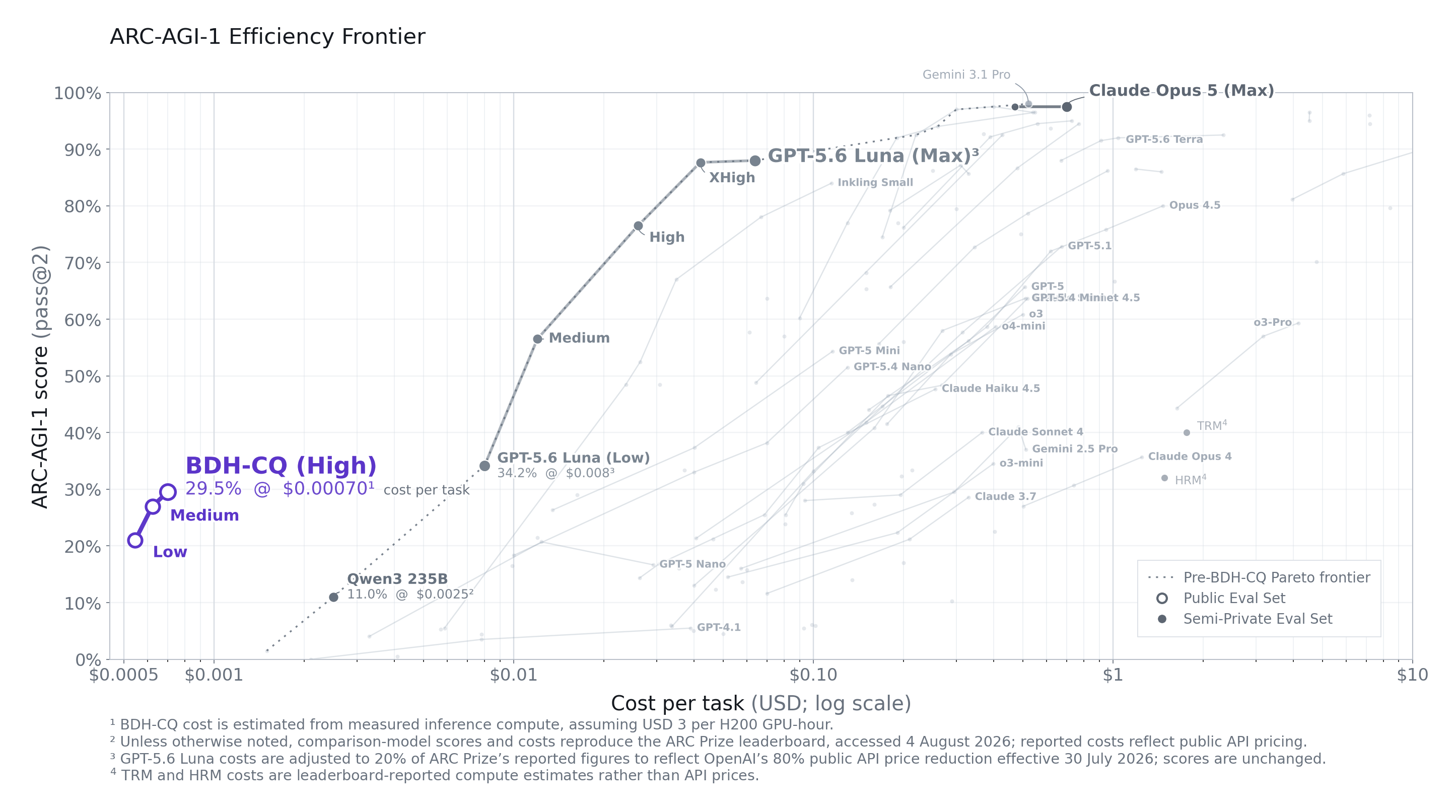
On the public ARC-AGI-1 evaluation set, BDH-CQ, a 150-million-parameter reasoning model, achieved 29.5% pass@2 at a computed inference cost of $0.0007 per task, breaking the cost-efficiency frontier.
Separately, early pretraining experiments from 1B to 600B parameters showed that the BDH architecture follows scaling laws similar to those of Transformers while preserving its recurrent latent reasoning capabilities. See Section 9.2 of the BDH-CQ paper.
ARC-AGI-1 score versus computed cost per task. Data points were collected from the official ARC Prize leaderboard on August 4, 2026. The mark at the left margin indicates the 29.5% pass@2. The point breaks through the previously reported cost and accuracy Pareto frontier and establishes a new state of the art in ARC-AGI-1 cost efficiency.
Read the BDH-CQ research article · Read the paper
Overview of the Dragon Hatchling (BDH) architecture
Dragon Hatchling (BDH) is a Post-Transformer AI architecture. It represents a scale-free, locally interacting network of neurons. Its GPU formulation connects this graph view to efficient tensor computation. The graph can be recovered and inspected, and trained models exhibit interpretable synapses, sparse activity, and Transformer-like scaling.
Locally interacting neuron particles with excitatory/inhibitory dynamics
Hebbian working memory based on synaptic plasticity, displaying monosemanticity
GPU-friendly state-space formulation for efficient implementation
Interpretable activations that are sparse and positive
BDH paper: The Dragon Hatchling: The Missing Link between the Transformer and Models of the Brain, A. Kosowski, P. Uznański, J. Chorowski, Z. Stamirowska, and M. Bartoszkiewicz (2025).
Architecture
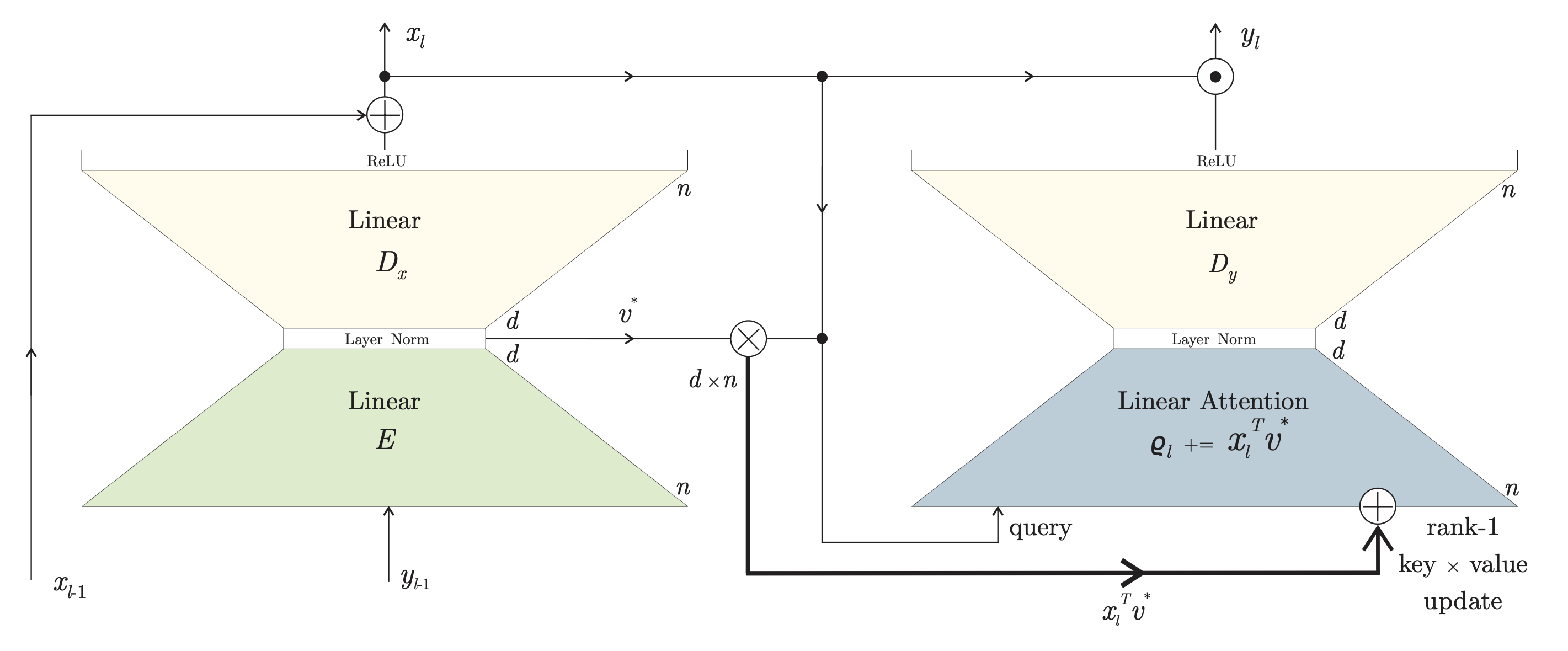
Figure: Architecture illustration for the original BDH model and its GPU formulation, from the September 2025 research.
Relation to Transformers
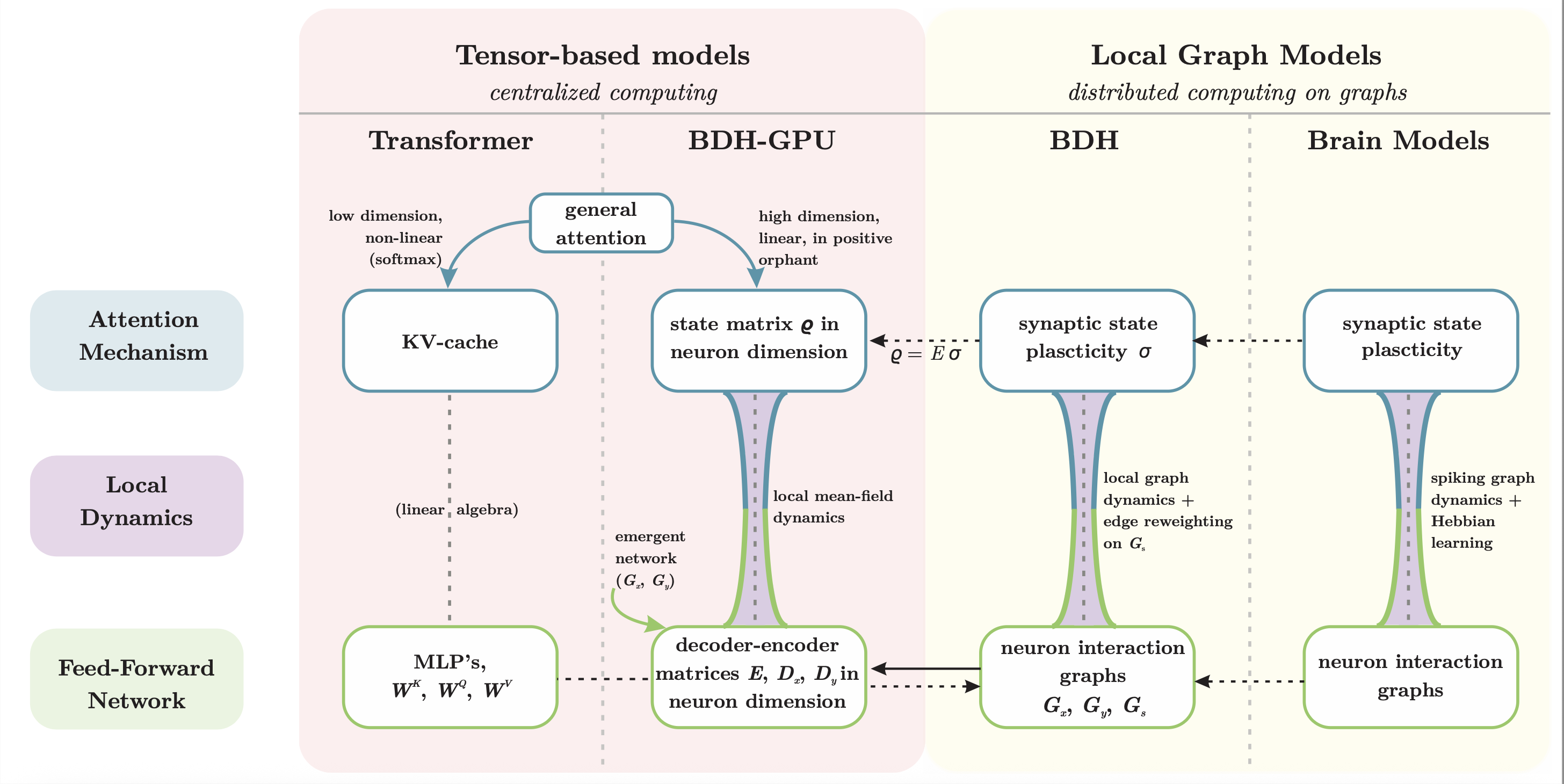
BDH and the Transformer share attention-inspired computation; however, BDH’s graph-based architecture makes its attention emerge naturally from neuron-level interactions, reflecting attention as seen in biological systems. The architecture derivation explains the relationship between the graph model and the tensor formulation.
How BDH differs from the Transformer architecture
Dimension
BDH
Transformer
Attention
Synaptic memory with linear attention
Attention normalized with softmax
Key and query representation
Neuron activity in a large, sparse space
Dense keys and queries in a smaller space
Retrieval interpretation
Lookup interpreted through locality-sensitive hashing
Search interpreted through approximate nearest neighbors
Runtime memory
Synaptic state of fixed size; context has no fixed length boundary but is limited by information capacity
A token-indexed KV cache that grows as the sequence gets longer
Activations
Sparse vectors with non-negative entries
Dense activation vectors
Hardware bridge
A graph represented implicitly through low-rank tensor operations
Dense tensor operations directly
Source: BDH explainer, Chapter 2.
Earlier research: Sudoku Extreme
In March 2026, Pathway reported 97.4% accuracy on Sudoku Extreme using its internal BDH implementation, without chain of thought, solution backtracking, or external tools.
Installation and Training
Run the following from the repository directory:
# Install dependencies
pip install -r requirements.txt

# Train the toy implementation on a toy dataset
python train.py
The example trains a small language model on tiny Shakespeare. It is an entry point for studying the original architecture paper.
Learn and Discuss
BDH: The Missing Link between the Transformer and Models of the Brain https://arxiv.org/abs/2509.26507
BDH-CQ: In-Context Learning with Recurrent Latent Reasoning, https://arxiv.org/abs/2608.09888
Research seminar given at MILA by our CTO and BDH co-inventor, Jan Chorowski, a co-author of Yoshua Bengio and Nobel Prize winner Geoff Hinton https://pathway.com/blog/mila-bdh
Read the three part BDH explainer: motivation, architecture, and interpretability and scaling.
Watch the SuperDataScience conversation with Adrian Kosowski and Jon Krohn.
Read coverage in Forbes, Semafor, The Turing Post, Quantum Zeitgeist, and Golem.
Discuss the original paper on Hugging Face Papers, Alphaxiv, and EmergentMind.
Trang TopGit này là một snapshot — tab "Readme" hiển thị nguyên văn README của repo (đã bỏ link, giữ ảnh). Repo GitHub ở github.com/pathwaycom/bdh là nguồn chính thức.
pathwaycom/bdh có bao nhiêu sao?
pathwaycom/bdh có 3.6k sao GitHub — tải lại trang để xem số mới nhất, hoặc xem trực tiếp github.com/pathwaycom/bdh. TopGit phản chiếu số sao của GitHub nhưng không cam kết đến từng phút.
pathwaycom/bdh có phải mã nguồn mở không?
Có — pathwaycom/bdh phát hành theo license MIT, nghĩa là mã nguồn mở để đọc, fork và (tùy license) tái sử dụng. Mã: github.com/pathwaycom/bdh.
pathwaycom/bdh có website riêng không?
TopGit chưa ghi nhận URL trang chủ cho pathwaycom/bdh. Phần README ở tab phía trên thường có link demo, hoặc xem mô tả GitHub của repo.
pathwaycom/bdh là gì?
pathwaycom/bdh (pathwaycom/bdh) là dự án Python trên GitHub. Theo mô tả gốc: BDH (Dragon Hatchling) – Architecture and Code
Đọc đầy đủ README ở tab phía trên.
Vẫn đang phân vân về bdh?
Một cú bấm sẽ gửi câu hỏi kèm trang này cho AI — xem AI nói gì về bdh.

 /bdh