PRBonn/vdbfusion là dự án mã nguồn mở trên GitHub với 664 sao, viết chủ yếu bằng C++. C++/Python Sparse Volumetric TSDF Fusion
Tóm tắt dựng từ metadata GitHub của chính dự án — chưa có bài review TopGit. Trang sẽ tự động cập nhật khi bài review đầy đủ được xuất bản.
VÌ SAO CHƯA CÓ REVIEW
TopGit viết bài đầy đủ cho repo có nhiều sao nhất và được yêu cầu nhiều nhất. Trang này là snapshot trong thời gian chờ — xem README gốc ở tab READ ME.
VDBFusion: Flexible and Efficient TSDF Integration
This is a small utility library that implements the VDBFusion algorithm, similar to TSDF-based
reconstruction pipelines but using a different data-structure (VDB).
Installation
Take a seat and relax, you only need to:
pip install vdbfusion
If you plan to use our C++ API then you should build this project from source. More details in the Installation instructions.
The ROS-1 C++ wrapper for this library is available at https://github.com/PRBonn/vdbfusion_ros
Usage
The code shown below is not intended to be copy pasted but rather be a spiritual guide for developers. If you really want to give this library a try you should consider checking the standalone Python, Notebooks, and C++ examples.
Data loading
NOTE: This step is not mandatory. Our API only expects points and poses but this is the easiest way to deal with 3D data.
Python
C++
class Dataset:
    def __init__(self, *args, **kwargs):
        # Initialize your dataset here ..

    def __len__(self) -> int:
        return len(self.n_scans)

    def __getitem__(self, idx: int):
        # Returns a PointCloud(np.array(N, 3))
        # and sensor origin(Eigen::Vector3d)
        # in the global coordinate frame.
        return points, origin
class Dataset {
  // Initialize your dataset here ..
  Dataset(...);

  // Return length of the dataset
  std::size_t size() const { return n_scans_; }

  // Returns a Cloud(std::vector<Eigen::Vector3d>)
  // and the sensor origin(Eigen::Vector3d) in the
  // global coordinate frame.
  std::tuple<Cloud, Point> operator[](int idx) const;
};
TSDF Fusion pipeline
Python
C++
import vdbfusion

vdb_volume = vdbfusion.VDBVolume(voxel_size,
                                 sdf_trunc,
                                 space_carving
dataset = Dataset(...)

for scan, origin in dataset:
    vdb_volume.integrate(scan, origin)
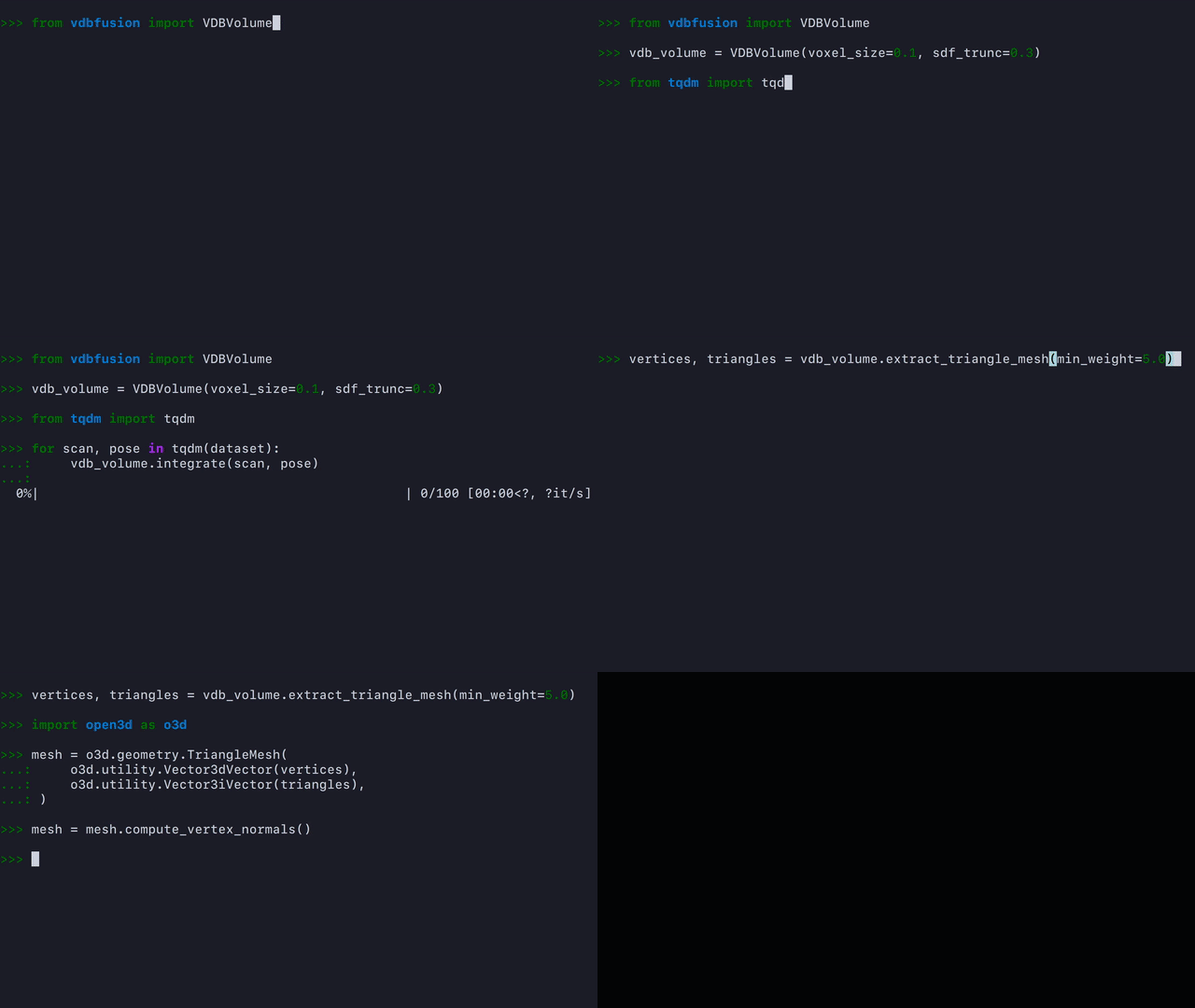
For visualization you can use any 3D library you like. For this example we are going to be using Open3D. If you are using the Python API make sure to pip install open3d before trying this snippet.
Python
C++
import open3d as o3d

# Extract triangle mesh (numpy arrays)
vert, tri = vdb_volume.extract_triangle_mesh()

# Visualize the results
mesh = o3d.geometry.TriangleMesh(
    o3d.utility.Vector3dVector(vert),
    o3d.utility.Vector3iVector(tri),
)

mesh.compute_vertex_normals()
o3d.visualization.draw_geometries([mesh])
#include <open3d/Open3D.h>

// Extract triangle mesh (Eigen).
auto [verts, tris] = vdb_volume.ExtractTriangleMesh();

// Visualize the results
auto mesh = o3d::geometry::TriangleMesh(
    verts,
    tris,
)

mesh.ComputeVertexNormals()
o3d::visualization::DrawGeometries({&mesh})
LICENSE
The LICENSE can be found at the root of this repository. It only applies to the code of VDBFusion but not to its 3rdparty dependencies. Please make sure to check the licenses in there before using any form of this code.
Credits
I would like to thank the Open3D and OpenVDB authors and contributors for making their implementations open source which inspired, helped and guided the implementation of the VDBFusion library.
Citation
If you use this library for any academic work, please cite the original paper.
@article{vizzo2022sensors,
  author         = {Vizzo, Ignacio and Guadagnino, Tiziano and Behley, Jens and Stachniss, Cyrill},
  title          = {VDBFusion: Flexible and Efficient TSDF Integration of Range Sensor Data},
  journal        = {Sensors},
  volume         = {22},
  year           = {2022},
  number         = {3},
  article-number = {1296},
  url            = {https://www.mdpi.com/1424-8220/22/3/1296},
  issn           = {1424-8220},
  doi            = {10.3390/s22031296}
}
Trang TopGit này là một snapshot — tab "Readme" hiển thị nguyên văn README của repo (đã bỏ link, giữ ảnh). Repo GitHub ở github.com/PRBonn/vdbfusion là nguồn chính thức.
PRBonn/vdbfusion có bao nhiêu sao?
PRBonn/vdbfusion có 664 sao GitHub — tải lại trang để xem số mới nhất, hoặc xem trực tiếp github.com/PRBonn/vdbfusion. TopGit phản chiếu số sao của GitHub nhưng không cam kết đến từng phút.
PRBonn/vdbfusion có phải mã nguồn mở không?
Có — PRBonn/vdbfusion phát hành theo license MIT, nghĩa là mã nguồn mở để đọc, fork và (tùy license) tái sử dụng. Mã: github.com/PRBonn/vdbfusion.
PRBonn/vdbfusion còn đang phát triển không?
Commit gần nhất trên PRBonn/vdbfusion là 1.8 năm trước (theo timestamp GitHub). Repo có 70 fork — một chỉ báo về mức độ quan tâm của cộng đồng.
PRBonn/vdbfusion là gì?
PRBonn/vdbfusion (PRBonn/vdbfusion) là dự án C++ trên GitHub. Theo mô tả gốc: C++/Python Sparse Volumetric TSDF Fusion
Đọc đầy đủ README ở tab phía trên.
Vẫn đang phân vân về vdbfusion?
Một cú bấm sẽ gửi câu hỏi kèm trang này cho AI — xem AI nói gì về vdbfusion.

 /vdbfusion