rtqichen/torchdiffeq là một trong những repo mã nguồn mở mà TopGit theo dõi, hiện có 6.5k sao, viết chủ yếu bằng Python. Differentiable ODE solvers with full GPU support and O(1)-memory backpropagation.
Tóm tắt dựng từ metadata GitHub của chính dự án — chưa có bài review TopGit. Trang sẽ tự động cập nhật khi bài review đầy đủ được xuất bản.
VÌ SAO CHƯA CÓ REVIEW
TopGit viết bài đầy đủ cho repo có nhiều sao nhất và được yêu cầu nhiều nhất. Trang này là snapshot trong thời gian chờ — xem README gốc ở tab READ ME.
PyTorch Implementation of Differentiable ODE Solvers
This library provides ordinary differential equation (ODE) solvers implemented in PyTorch. Backpropagation through ODE solutions is supported using the adjoint method for constant memory cost. For usage of ODE solvers in deep learning applications, see reference [1].
As the solvers are implemented in PyTorch, algorithms in this repository are fully supported to run on the GPU.
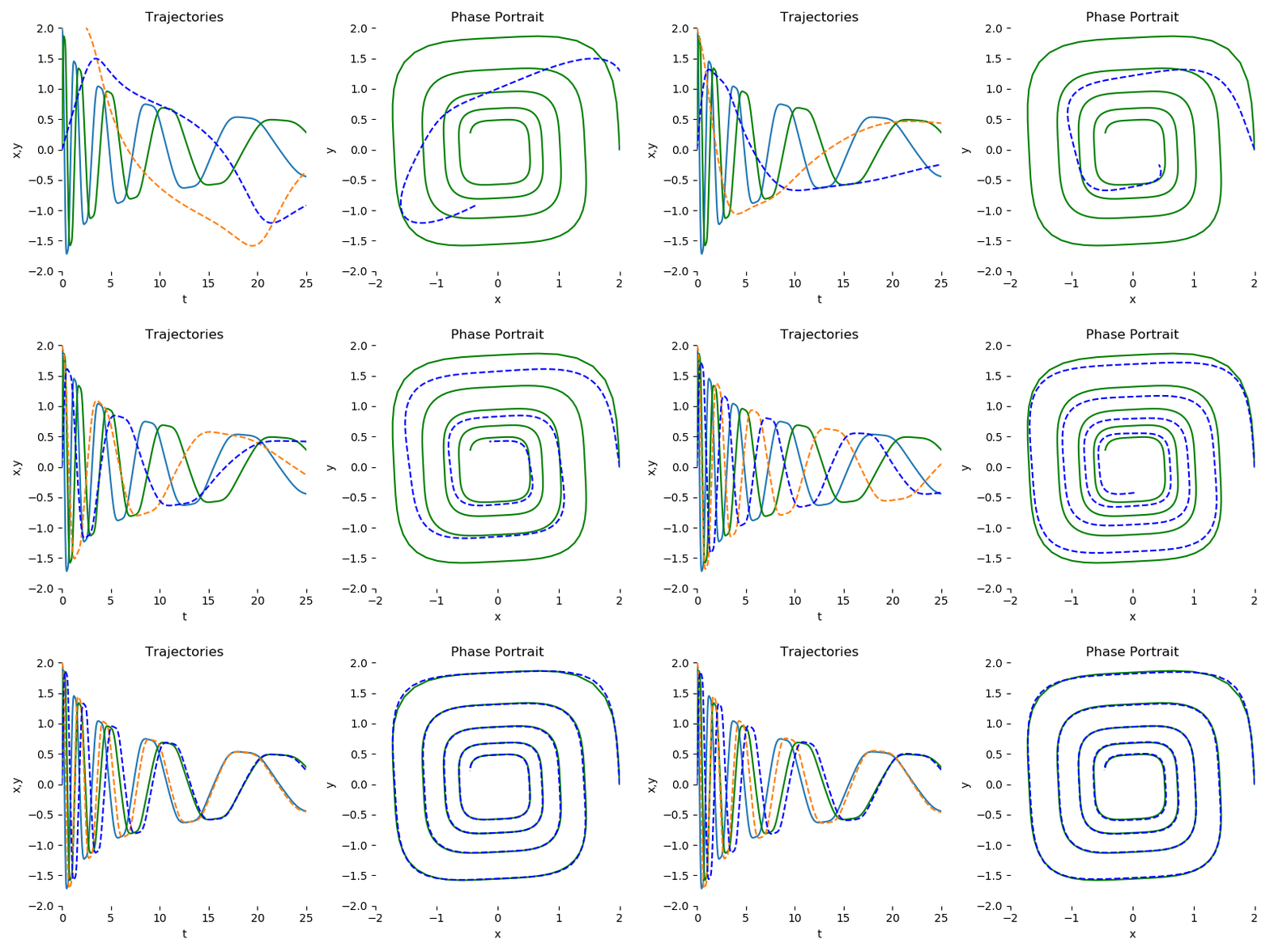
We encourage those who are interested in using this library to take a look at examples/ode_demo.py for understanding how to use torchdiffeq to fit a simple spiral ODE.
Basic usage
This library provides one main interface odeint which contains general-purpose algorithms for solving initial value problems (IVP), with gradients implemented for all main arguments. An initial value problem consists of an ODE and an initial value,
dy/dt = f(t, y) y(t_0) = y_0.
The goal of an ODE solver is to find a continuous trajectory satisfying the ODE that passes through the initial condition.
To solve an IVP using the default solver:
from torchdiffeq import odeint

odeint(func, y0, t)
where func is any callable implementing the ordinary differential equation f(t, x), y0 is an any-D Tensor representing the initial values, and t is a 1-D Tensor containing the evaluation points. The initial time is taken to be t[0].
Backpropagation through odeint goes through the internals of the solver. Note that this is not numerically stable for all solvers (but should probably be fine with the default dopri5 method). Instead, we encourage the use of the adjoint method explained in [1], which will allow solving with as many steps as necessary due to O(1) memory usage.
To use the adjoint method:
from torchdiffeq import odeint_adjoint as odeint

odeint(func, y0, t)
odeint_adjoint simply wraps around odeint, but will use only O(1) memory in exchange for solving an adjoint ODE in the backward call.
The biggest gotcha is that func must be a nn.Module when using the adjoint method. This is used to collect parameters of the differential equation.
Differentiable event handling
We allow terminating an ODE solution based on an event function. Backpropagation through most solvers is supported. For usage of event handling in deep learning applications, see reference [2].
t0 is a scalar representing the initial time value.
event_fn(t, y) returns a tensor, and is a required keyword argument.
reverse_time is a boolean specifying whether we should solve in reverse time. Default is False.
odeint_interface is one of odeint or odeint_adjoint, specifying whether adjoint mode should be used for differentiating through the ODE solution. Default is odeint.
**kwargs: any remaining keyword arguments are passed to odeint_interface.
The solve is terminated at an event time t and state y when an element of event_fn(t, y) is equal to zero. Multiple outputs from event_fn can be used to specify multiple event functions, of which the first to trigger will terminate the solve.
Both the event time and final state are returned from odeint_event, and can be differentiated. Gradients will be backpropagated through the event function. NOTE: parameters for the event function must be in the state itself to obtain gradients.
The numerical precision for the event time is determined by the atol argument.
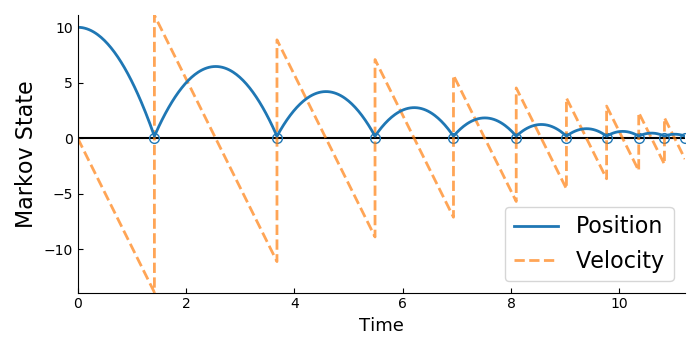
See example of simulating and differentiating through a bouncing ball in examples/bouncing_ball.py. See example code for learning a simple event function in examples/learn_physics.py.
Keyword arguments for odeint(_adjoint)
Keyword arguments:
rtol Relative tolerance.
atol Absolute tolerance.
method One of the solvers listed below.
options A dictionary of solver-specific options, see the further documentation.
List of ODE Solvers:
Adaptive-step:
dopri8 Runge-Kutta of order 8 of Dormand-Prince-Shampine.
dopri5 Runge-Kutta of order 5 of Dormand-Prince-Shampine [default].
bosh3 Runge-Kutta of order 3 of Bogacki-Shampine.
fehlberg2 Runge-Kutta-Fehlberg of order 2.
adaptive_heun Runge-Kutta of order 2.
Fixed-step:
euler Euler method.
midpoint Midpoint method.
rk4 Fourth-order Runge-Kutta with 3/8 rule.
explicit_adams Explicit Adams-Bashforth.
implicit_adams Implicit Adams-Bashforth-Moulton.
Additionally, all solvers available through SciPy are wrapped for use with scipy_solver.
For most problems, good choices are the default dopri5, or to use rk4 with options=dict(step_size=...) set appropriately small. Adjusting the tolerances (adaptive solvers) or step size (fixed solvers), will allow for trade-offs between speed and accuracy.
Frequently Asked Questions
Take a look at our FAQ for frequently asked questions.
Further documentation
For details of the adjoint-specific and solver-specific options, check out the further documentation.
References
Applications of differentiable ODE solvers and event handling are discussed in these two papers:
Ricky T. Q. Chen, Yulia Rubanova, Jesse Bettencourt, David Duvenaud. "Neural Ordinary Differential Equations." Advances in Neural Information Processing Systems. 2018. [arxiv]
@article{chen2018neuralode,
  title={Neural Ordinary Differential Equations},
  author={Chen, Ricky T. Q. and Rubanova, Yulia and Bettencourt, Jesse and Duvenaud, David},
  journal={Advances in Neural Information Processing Systems},
  year={2018}
}
Ricky T. Q. Chen, Brandon Amos, Maximilian Nickel. "Learning Neural Event Functions for Ordinary Differential Equations." International Conference on Learning Representations. 2021. [arxiv]
@article{chen2021eventfn,
  title={Learning Neural Event Functions for Ordinary Differential Equations},
  author={Chen, Ricky T. Q. and Amos, Brandon and Nickel, Maximilian},
  journal={International Conference on Learning Representations},
  year={2021}
}
The seminorm option for computing adjoints is discussed in
Patrick Kidger, Ricky T. Q. Chen, Terry Lyons. "'Hey, that’s not an ODE': Faster ODE Adjoints via Seminorms." International Conference on Machine
Learning. 2021. [arxiv]
@article{kidger2021hey,
  title={"Hey, that's not an ODE": Faster ODE Adjoints via Seminorms.},
  author={Kidger, Patrick and Chen, Ricky T. Q. and Lyons, Terry J.},
  journal={International Conference on Machine Learning},
  year={2021}
}
If you found this library useful in your research, please consider citing.
@misc{torchdiffeq,
	author={Chen, Ricky T. Q.},
	title={torchdiffeq},
	year={2018},
	url={https://github.com/rtqichen/torchdiffeq},
}
rtqichen/torchdiffeq có 6.5k sao GitHub — tải lại trang để xem số mới nhất, hoặc xem trực tiếp github.com/rtqichen/torchdiffeq. TopGit phản chiếu số sao của GitHub nhưng không cam kết đến từng phút.
rtqichen/torchdiffeq có tag gì không?
Bản đồng bộ chưa ghi nhận topic GitHub nào cho rtqichen/torchdiffeq. GitHub topics hiển thị ở thanh bên phải trang repo — đó là nơi đáng kiểm tra nhất.
rtqichen/torchdiffeq còn đang phát triển không?
Commit gần nhất trên rtqichen/torchdiffeq là 1.6 năm trước (theo timestamp GitHub). Repo có 1.0k fork — một chỉ báo về mức độ quan tâm của cộng đồng.
rtqichen/torchdiffeq là gì?
rtqichen/torchdiffeq (rtqichen/torchdiffeq) là dự án Python trên GitHub. Theo mô tả gốc: Differentiable ODE solvers with full GPU support and O(1)-memory backpropagation.
rtqichen/torchdiffeq viết bằng ngôn ngữ gì?
rtqichen/torchdiffeq chủ yếu viết bằng Python. Trường "language" của GitHub dựa trên phần lớn byte ở nhánh mặc định.
Đọc đầy đủ README ở tab phía trên.
Chưa chắc torchdiffeq có hợp với bạn?
Để ChatGPT, Claude hoặc Perplexity tìm hiểu giúp — bấm bên dưới và xem AI nói gì về torchdiffeq.

 /torchdiffeq