Điểm qua scikit-learn-contrib/MAPIE: 1.6k sao trên GitHub, viết chủ yếu bằng Jupyter Notebook, thuộc nhóm Data. A scikit-learn-compatible library for estimating prediction intervals and controlling risks, based on conformal predictions.
Tóm tắt dựng từ metadata GitHub của chính dự án — chưa có bài review TopGit. Trang sẽ tự động cập nhật khi bài review đầy đủ được xuất bản.
VÌ SAO CHƯA CÓ REVIEW
TopGit viết bài đầy đủ cho repo có nhiều sao nhất và được yêu cầu nhiều nhất. Trang này là snapshot trong thời gian chờ — xem README gốc ở tab READ ME.
MAPIE - Model Agnostic Prediction Interval Estimator
An open-source Python library for quantifying uncertainties and controlling the risks of machine learning models.
🚀 MAPIE in 2026 🚀 New features have been implemented, starting with the application of risk control to emerging use cases such as LLM-as-Judge and image segmentation. In addition, exchangeability tests have been introduced to help users verify when MAPIE can be legitimately applied. Also, new adaptive conformal prediction methods have been added. Finally, the documentation has been updated with a new design!
🎉 MAPIE in 2025 🎉 MAPIE v1 is live! This new version introduces major changes to the API. Check out the release notes.
See GitHub Releases and HISTORY.md for up-to-date details on the new features.
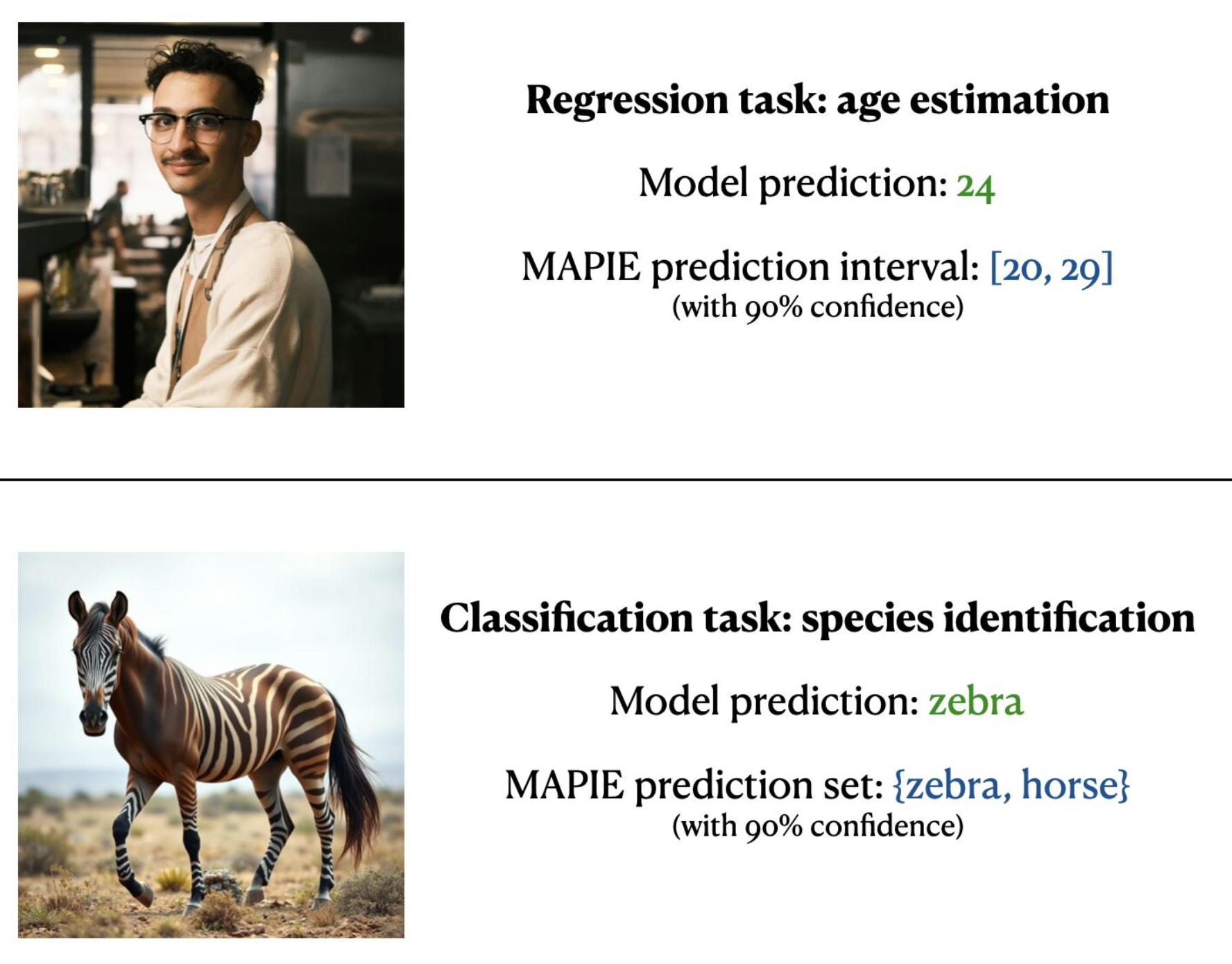
Image credits: Cemrecan Yurtman (portrait) and hogrmahmood (zebra-horse hybrid).
MAPIE allows you to:
Compute prediction intervals or prediction sets for regression,
classification, and time series by estimating your model uncertainty on a
conformalization dataset.
Control risks of more complex tasks such as multi-label classification
and semantic segmentation in computer vision, providing probabilistic
guarantees on metrics like recall and precision.
Easily use any model (scikit-learn, TensorFlow, PyTorch) thanks to scikit-learn-compatible wrapper if needed. MAPIE is part of the scikit-learn-contrib ecosystem.
MAPIE relies notably on the fields of Conformal Prediction and Distribution-Free Inference. It implements peer-reviewed algorithms that are model and use case agnostic and possesses theoretical guarantees under minimal assumptions on the data and the model.
🛠 Requirements & installation
MAPIE runs on:
Python >=3.9
NumPy >=1.23
scikit-learn >=1.4
MAPIE can be installed in different ways:
$ pip install mapie  # installation via `pip`
$ conda install -c conda-forge mapie  # or via `conda`
$ pip install git+https://github.com/scikit-learn-contrib/MAPIE  # or directly from the github repository
⚡ Quickstart and documentation
Below are two simple examples from our documentation that show how MAPIE is used in a regression setting and a classification setting:
Uncertainty quantification for a regression task
Uncertainty quantification for a classification task
📝 Contributing
You are welcome to propose and contribute new ideas.
We encourage you to open an issue so that we can align on the work to be done.
It is generally a good idea to have a quick discussion before opening a pull request that is potentially out-of-scope.
For more information on the contribution process, read our contribution guidelines.
🔍 References
Vovk, Vladimir, Alexander Gammerman, and Glenn Shafer. Algorithmic Learning in a Random World. Springer Nature, 2022.
Angelopoulos, Anastasios N., and Stephen Bates. "Conformal prediction: A gentle introduction." Foundations and Trends® in Machine Learning 16.4 (2023): 494–591.
Barber, Rina Foygel, Emmanuel J. Candès, Aaditya Ramdas, and Ryan J. Tibshirani. "Predictive inference with the jackknife+." Annals of Statistics 49.1 (2021): 486–507.
Kim, Byol, Chen Xu, and Rina Barber. "Predictive inference is free with the jackknife+-after-bootstrap." Advances in Neural Information Processing Systems 33 (2020): 4138–4149.
Sadinle, Mauricio, Jing Lei, and Larry Wasserman. "Least ambiguous set-valued classifiers with bounded error levels." Journal of the American Statistical Association 114.525 (2019): 223–234.
Romano, Yaniv, Matteo Sesia, and Emmanuel Candès. "Classification with valid and adaptive coverage." Advances in Neural Information Processing Systems 33 (2020): 3581–3591.
Angelopoulos, Anastasios N., et al. "Uncertainty sets for image classifiers using conformal prediction." International Conference on Learning Representations (2021).
Romano, Yaniv, Evan Patterson, and Emmanuel Candès. "Conformalized quantile regression." Advances in Neural Information Processing Systems 32 (2019).
Xu, Chen, and Yao Xie. "Conformal prediction interval for dynamic time-series." International Conference on Machine Learning. PMLR, 2021.
Bates, Stephen, et al. "Distribution-free, risk-controlling prediction sets." Journal of the ACM 68.6 (2021): 1–34.
Angelopoulos, Anastasios N., Stephen Bates, Adam Fisch, Lihua Lei, and Tal Schuster. "Conformal Risk Control." (2022).
Angelopoulos, Anastasios N., Stephen Bates, Emmanuel J. Candès, et al. "Learn Then Test: Calibrating Predictive Algorithms to Achieve Risk Control." (2022).
📚 License & citation
MAPIE is free and open-source software licensed under the BSD-3-Clause license.
If you use MAPIE in your research, please cite the main paper:
Cordier, Thibault, et al. "Flexible and systematic uncertainty estimation with conformal prediction via the MAPIE library." Conformal and Probabilistic Prediction with Applications. PMLR, 2023.
@inproceedings{Cordier_Flexible_and_Systematic_2023,
    author = {Cordier, Thibault and Blot, Vincent and Lacombe, Louis and Morzadec, Thomas and Capitaine, Arnaud and Brunel, Nicolas},
    booktitle = {Conformal and Probabilistic Prediction with Applications},
    title = {{Flexible and Systematic Uncertainty Estimation with Conformal Prediction via the MAPIE library}},
    year = {2023}
}
You can also cite the ICML workshop manuscript:
Taquet, Vianney, et al. "MAPIE: an open-source library for distribution-free uncertainty quantification." arXiv preprint arXiv:2207.12274 (2022).
@article{taquet2022mapie,
    title = {MAPIE: an open-source library for distribution-free uncertainty quantification},
    author = {Taquet, Vianney and Blot, Vincent and Morzadec, Thomas and Lacombe, Louis and Brunel, Nicolas},
    journal = {arXiv preprint arXiv:2207.12274},
    year = {2022}
}
🤝 Affiliations
MAPIE has been developed through a collaboration between Capgemini Invent,
Quantmetry, Michelin, ENS Paris-Saclay, and with the financial support from
Région Île-de-France and Confiance.ai.
Trang TopGit này là một snapshot — tab "Readme" hiển thị nguyên văn README của repo (đã bỏ link, giữ ảnh). Repo GitHub ở github.com/scikit-learn-contrib/MAPIE là nguồn chính thức.
scikit-learn-contrib/MAPIE có bao nhiêu sao?
scikit-learn-contrib/MAPIE có 1.6k sao GitHub — tải lại trang để xem số mới nhất, hoặc xem trực tiếp github.com/scikit-learn-contrib/MAPIE. TopGit phản chiếu số sao của GitHub nhưng không cam kết đến từng phút.
scikit-learn-contrib/MAPIE có những chủ đề gì?
GitHub topics của scikit-learn-contrib/MAPIE: "classification", "confidence-intervals", "conformal-prediction", "data-science", "python", "regression", "risk-control", "sklearn". TopGit xếp repo vào nhóm Data.
scikit-learn-contrib/MAPIE có trang demo không?
Dự án có trang chủ ở https://mapie.readthedocs.io/en/stable/. Tab "Readme" ở trang này thường có ảnh chụp và hướng dẫn bắt đầu nhanh.
scikit-learn-contrib/MAPIE còn đang phát triển không?
Commit gần nhất trên scikit-learn-contrib/MAPIE là 20 ngày trước (theo timestamp GitHub). Repo có 148 fork — một chỉ báo về mức độ quan tâm của cộng đồng.
scikit-learn-contrib/MAPIE dùng license gì?
scikit-learn-contrib/MAPIE phát hành theo license BSD-3-Clause. Nên mở file LICENSE trên GitHub để xác nhận — license metadata đôi khi lệch với thực tế dự án.
scikit-learn-contrib/MAPIE viết bằng ngôn ngữ gì?
scikit-learn-contrib/MAPIE chủ yếu viết bằng Jupyter Notebook. Trường "language" của GitHub dựa trên phần lớn byte ở nhánh mặc định.
Đọc đầy đủ README ở tab phía trên.
MAPIE có đáng để bạn bỏ thời gian?
ChatGPT, Claude và Perplexity đều đọc được trang này. Hỏi thử xem họ nghĩ gì về MAPIE.
 /MAPIE