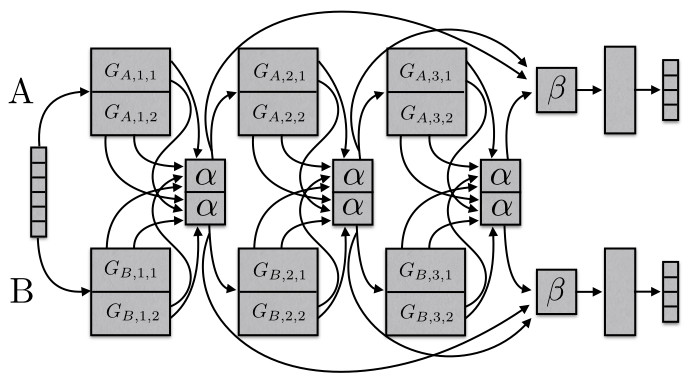
Là một công cụ AI, sebastianruder/sluice-networks đã đạt 155 sao trên GitHub, ngôn ngữ Python. Code for Sluice networks: Learning what to share between loosely related tasks
Tóm tắt dựng từ metadata GitHub của chính dự án — chưa có bài review TopGit. Trang sẽ tự động cập nhật khi bài review đầy đủ được xuất bản.
VÌ SAO CHƯA CÓ REVIEW
TopGit viết bài đầy đủ cho repo có nhiều sao nhất và được yêu cầu nhiều nhất. Trang này là snapshot trong thời gian chờ — xem README gốc ở tab READ ME.
Sluice networks: Learning what to share between loosely related tasks
Sebastian Ruder, Joachim Bingel, Isabelle Augenstein, Anders Søgaard (2017).
Sluice networks: Learning what to share between loosely related tasks.
arXiv preprint arXiv:1705.08142.
Installation instructions
The code works with Python 3.5. The main requirement is DyNet (and its
dependencies).
DyNet can be installed using the instructions here
(the detailed instructions, not TL;DR).
Besides that, we use progress to track the training progress, which can be
installed via pip install progress.
Repository structure
constants.py: Contains constants used across all files.
predictors.py: Contains classes for sequence predictors and layers.
PTB2chunks.py: A script to extract chunks from the PTB format.
run_sluice_net.py: Script to train, load, and evaluate SluiceNetwork.
sluice_net.py: The main logic for the SluiceNetwork.
utils.py: Utility methods for data processing.
Model
The code for the Bi-LSTM we use as basis for SluiceNetwork is based on the
state-of-the-art hierarchical Bi-LSTM tagger by Plank et al. (2016). You can
find their repo here. For most of the
Bi-LSTM hyperparameters, we adopt their choices.
--task-names chunk pos: run the model with chunking as main task and POS
tagging as auxiliary task
--h-layers 3: use 3 layers in the model
--cross-stitch: use cross-stitch (alpha) units
--layer-connect stitch: use layer-stitch (beta) units before the FC layer
--num-subspaces 2: use two subspaces
--constraint-weight 0.1: use subspace orthogonality constraint with a
weight of 0.1
--constrain-matrices 1 2: place the constraint on the LSTM matrices with
indices 1 and 2
--patience 3: use patience 3 for training
--train-dir, --dev-dir, --test-dir: use the specified directories for
training, development, and testing (the train, development, and test
directories of the CoNLL formatted OntoNotes 5.0 data)
--train bc: train the model on the bc domain
--test bn mz nw wb: test the model on the bn, mz, nw, and wb domains
--model-dir: the directory of the model
--log-dir: the directory for logging
Data
We use the English OntoNotes v5.0 data
in the format used by the CoNLL 2011/2012
shared task.
In order to obtain the data, you need to follow these steps:
Obtain the OntoNotes v5.0 data
from the LDC. Most universities have a copy of it.
Convert the data to the CoNLL 2011/2012 format using the scripts here.
Following this, you will have a file tree that looks like the following:
conll-formatted-ontonotes-5.0/
└── data
   ├── development
   |   └── data
   |       └── english
   |           └── annotations
   |               ├── bc
   |               ├── bn
   |               ├── mz
   |               ├── nw
   |               ├── pt
   |               ├── tc
   |               └── wb
   ├── test
   │   └── data
   │       └── english
   │           └── annotations
   │               ├── bc
   │               ├── bn
   │               ├── mz
   │               ├── nw
   │               ├── pt
   │               ├── tc
   │               └── wb
   └── train
       └── data
           └── english
               └── annotations
                   ├── bc
                   ├── bn
                   ├── mz
                   ├── nw
                   ├── pt
                   ├── tc
                   └── wb
A leaf folder such as bc has the following structure:
Each 00 folder should then contain *.gold_skel files containing the CoNLL
skeleton annotations and *.gold_conll files containing the word forms and
annotations in CoNLL format.
The *.gold_conll files contain annotations for POS tagging, parsing,
word sense disambiguation, named entity recognition (NER), semantic role
labeling (SRL), and coreference resolution (see
here).
We only use POS tags, NER labels and predicate labels of SRL in our
experiments.
In order to obtain annotations for chunking, run the provided PTB2chunks.py
script with the following command:
where ORIG_FOLDER is the root of the original OntoNotes 5.0 data directory
(where annotations is the first subdirectory) and --conll-folder is the
conll-formatted-ontonotes-5.0/ directory above.
The script will then extract the chunk annotations and create *.chunks files
that are saved next to *.gold_skel and *.gold_conll.
Reference
If you make use of the contents of this repository, we appreciate citing the following paper:
@article{ruder2017sluice,
  title={Sluice networks: Learning what to share between loosely related tasks},
  author={Ruder, Sebastian and Bingel, Joachim and Augenstein, Isabelle and S{\o}gaard, Anders},
  journal={arXiv preprint arXiv:1705.08142},
  year={2017}
}
Trang TopGit này là một snapshot — tab "Readme" hiển thị nguyên văn README của repo (đã bỏ link, giữ ảnh). Repo GitHub ở github.com/sebastianruder/sluice-networks là nguồn chính thức.
sebastianruder/sluice-networks có bao nhiêu sao?
sebastianruder/sluice-networks có 155 sao GitHub — tải lại trang để xem số mới nhất, hoặc xem trực tiếp github.com/sebastianruder/sluice-networks. TopGit phản chiếu số sao của GitHub nhưng không cam kết đến từng phút.
sebastianruder/sluice-networks có phải mã nguồn mở không?
TopGit chưa ghi nhận license cho sebastianruder/sluice-networks. Phần lớn repo public trên GitHub là mã nguồn mở, nhưng điều khoản khác nhau từng repo — mở file LICENSE để xác nhận.
sebastianruder/sluice-networks còn đang phát triển không?
Commit gần nhất trên sebastianruder/sluice-networks là 7.6 năm trước (theo timestamp GitHub). Repo có 35 fork — một chỉ báo về mức độ quan tâm của cộng đồng.
sebastianruder/sluice-networks là gì?
sebastianruder/sluice-networks (sebastianruder/sluice-networks) là dự án Python trên GitHub. Theo mô tả gốc: Code for Sluice networks: Learning what to share between loosely related tasks
sebastianruder/sluice-networks so với các dự án AI Tools khác thế nào?
sebastianruder/sluice-networks được TopGit xếp vào nhóm AI Tools, với 155 sao GitHub và viết bằng Python. Xem trang chủ đề AI Tools trên TopGit để so sánh với các dự án tương tự theo số sao và mức độ hoạt động.
Đọc đầy đủ README ở tab phía trên.
sluice-networks có đáng để bạn bỏ thời gian?
ChatGPT, Claude và Perplexity đều đọc được trang này. Hỏi thử xem họ nghĩ gì về sluice-networks.
 /sluice-networks