
sebastianstarke/AI4Animation

Là một dự án mã nguồn mở, sebastianstarke/AI4Animation đã đạt 8.9k sao trên GitHub, ngôn ngữ C++. Bringing Characters to Life with Computer Brains in Unity
Tóm tắt dựng từ metadata GitHub của chính dự án — chưa có bài review TopGit. Trang sẽ tự động cập nhật khi bài review đầy đủ được xuất bản.
TopGit viết bài đầy đủ cho repo có nhiều sao nhất và được yêu cầu nhiều nhất. Trang này là snapshot trong thời gian chờ — xem README gốc ở tab READ ME.
Snapshot
Cộng tác viên hàng đầu
Xem cộng tác viên hàng đầu
AI4Animation: Deep Learning for Character Control
This repository explores the opportunities of deep learning for character animation and control. It aims to be a comprehensive framework for data-driven character animation, including data processing, neural network training and runtime control. The various projects below demonstrate such capabilities using neural networks for animating biped locomotion, quadruped locomotion, and character-scene interactions with objects and the environment, plus sports and fighting games, as well as embodied avatar motions in AR/VR. Further advances on this research will continue being added to this project.
2026 - Python Remake (AI4AnimationPy)
View repository →
Paul Starke,
Sebastian Starke
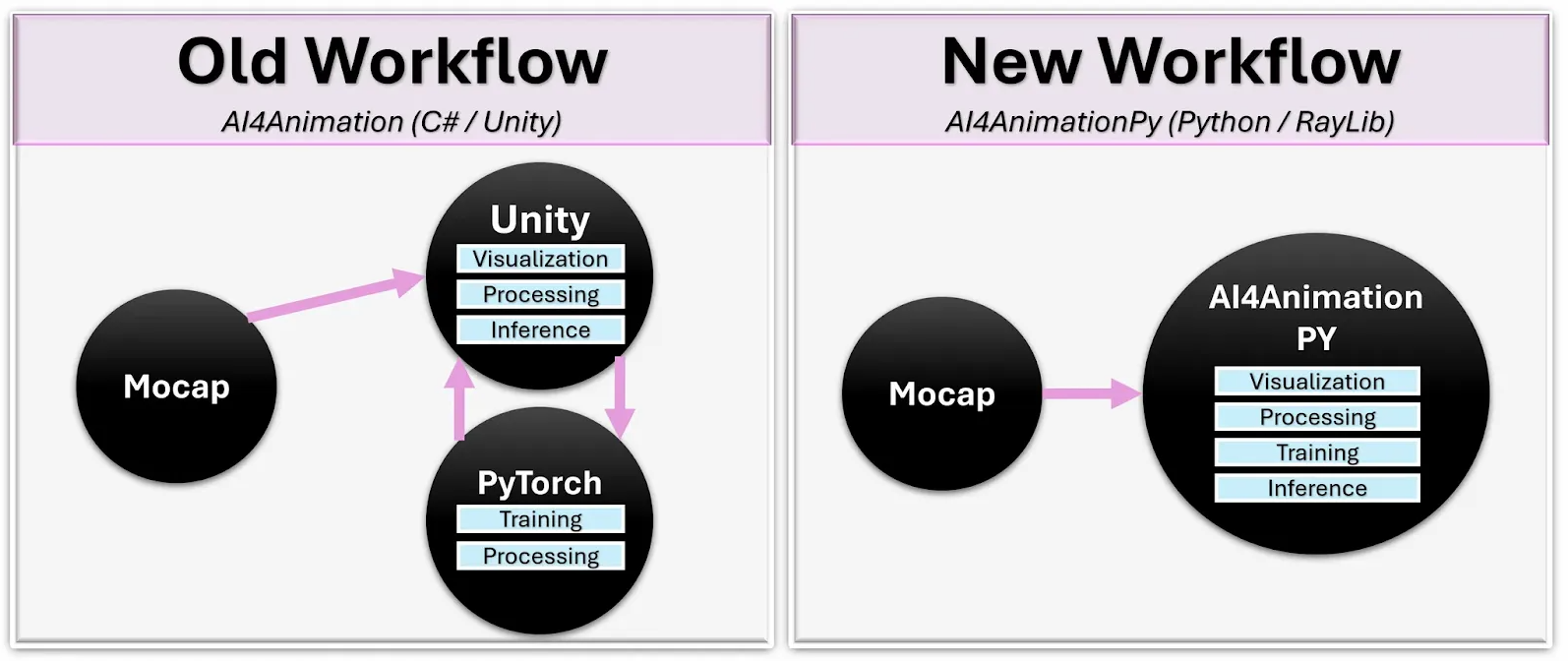
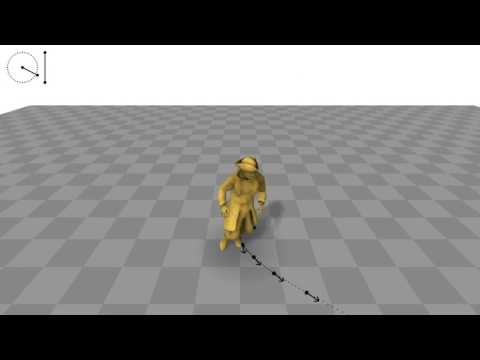
This version brings AI4Animation to Python — removing the Unity dependency for data-processing, feature-extraction, inference, and post-processing while keeping similar game-engine-style architecture (ECS, update loops, rendering pipeline). Everything runs on NumPy or PyTorch, so training, inference, and visualization happen in one unified environment which helps streamlining the research process.
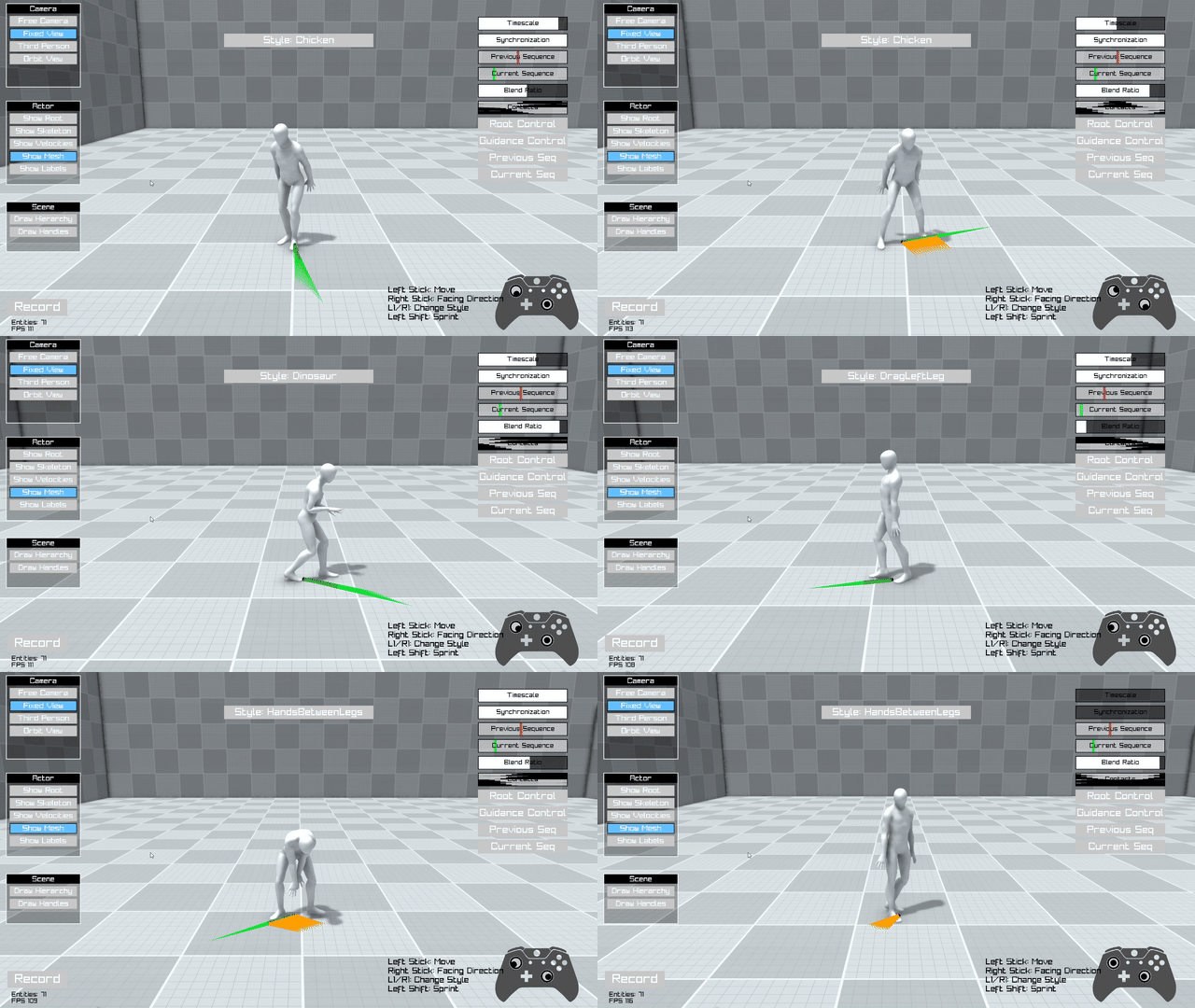 |  |
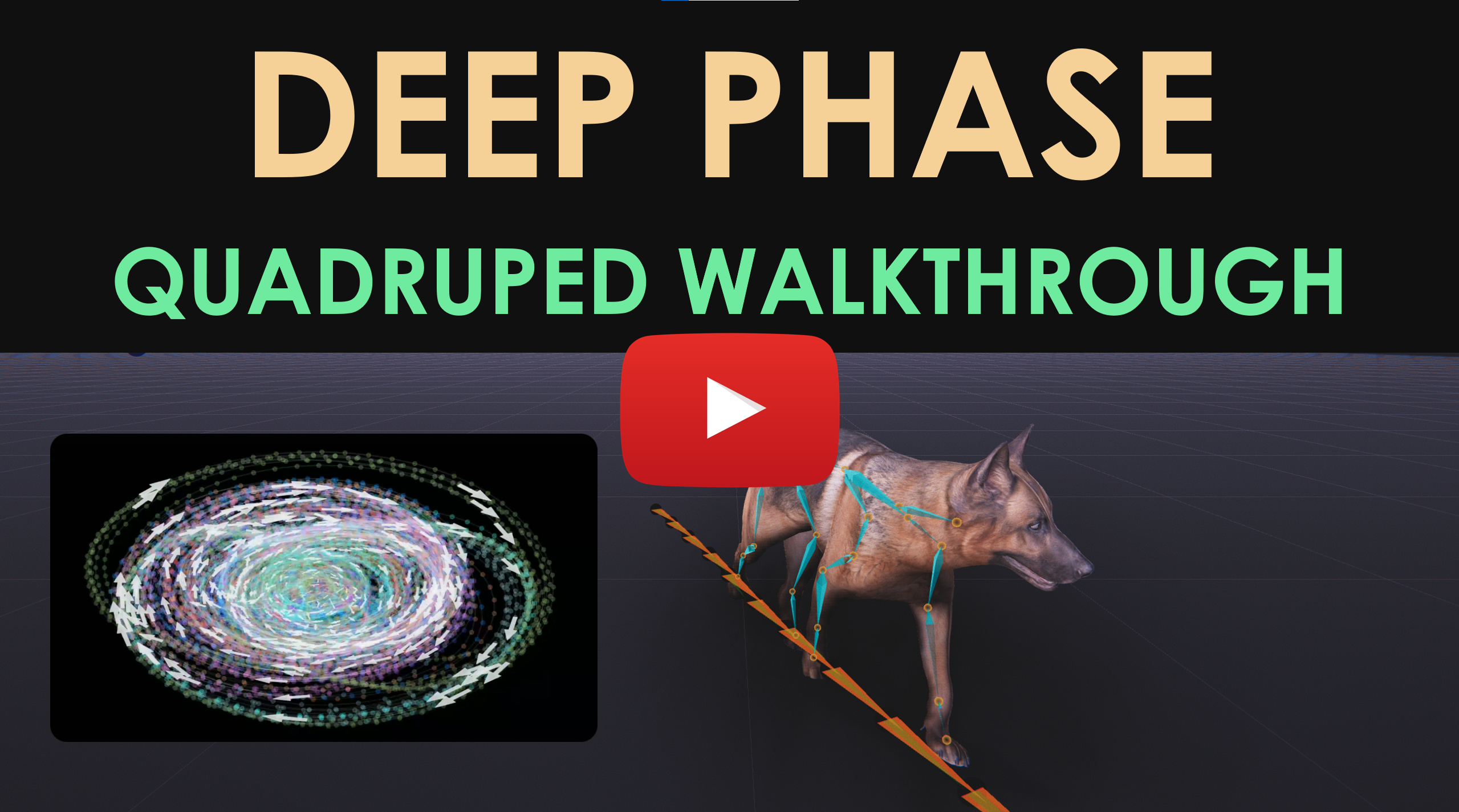
| Stylized Biped Locomotion Controller trained on style100 | Quadruped Locomotion Controller — Interactive dog locomotion with gait transitions and action poses |
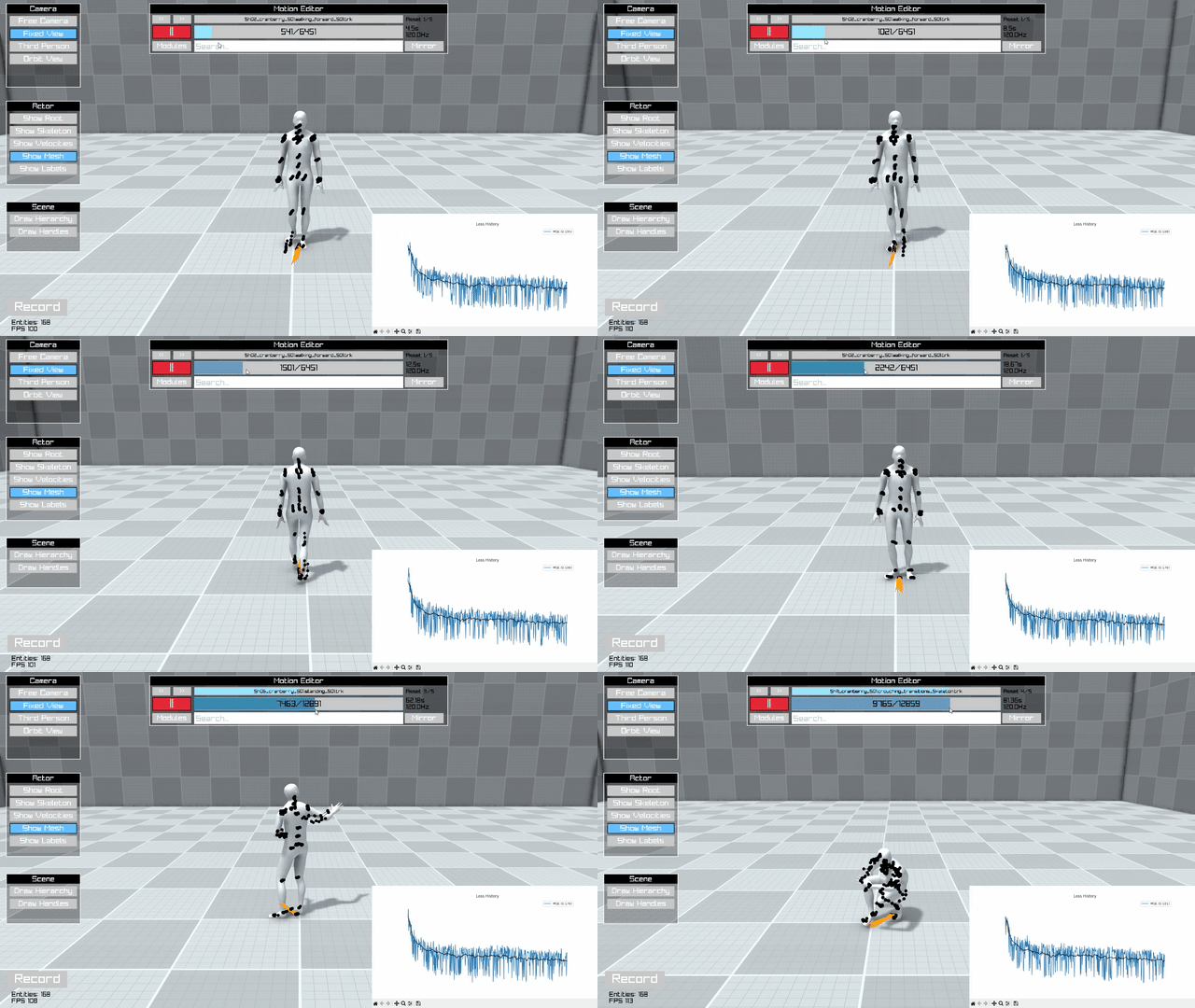 | 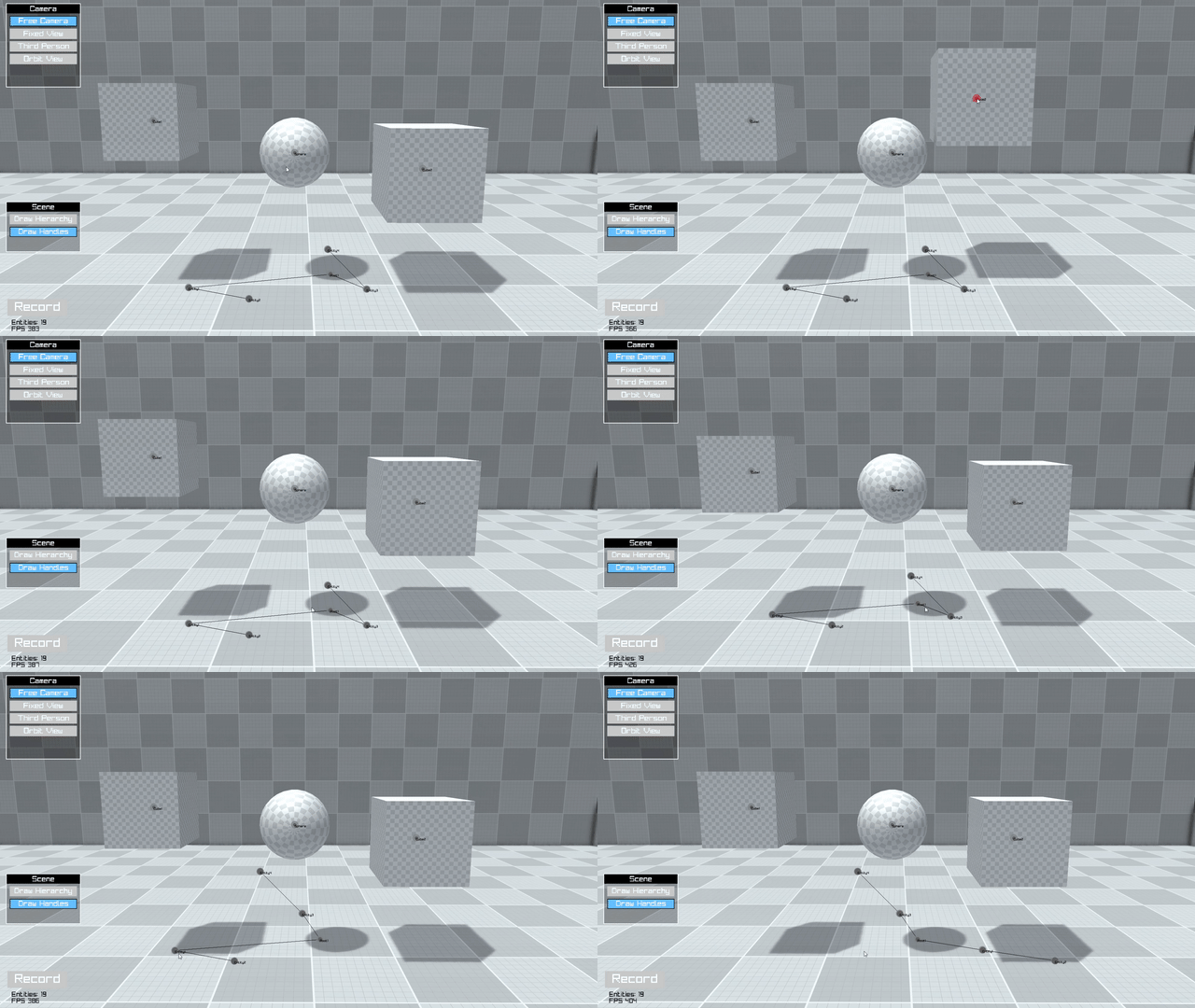 |
| Future Motion Anticipation with Interactive model training visualization | ECS — Entity hierarchy and component system |
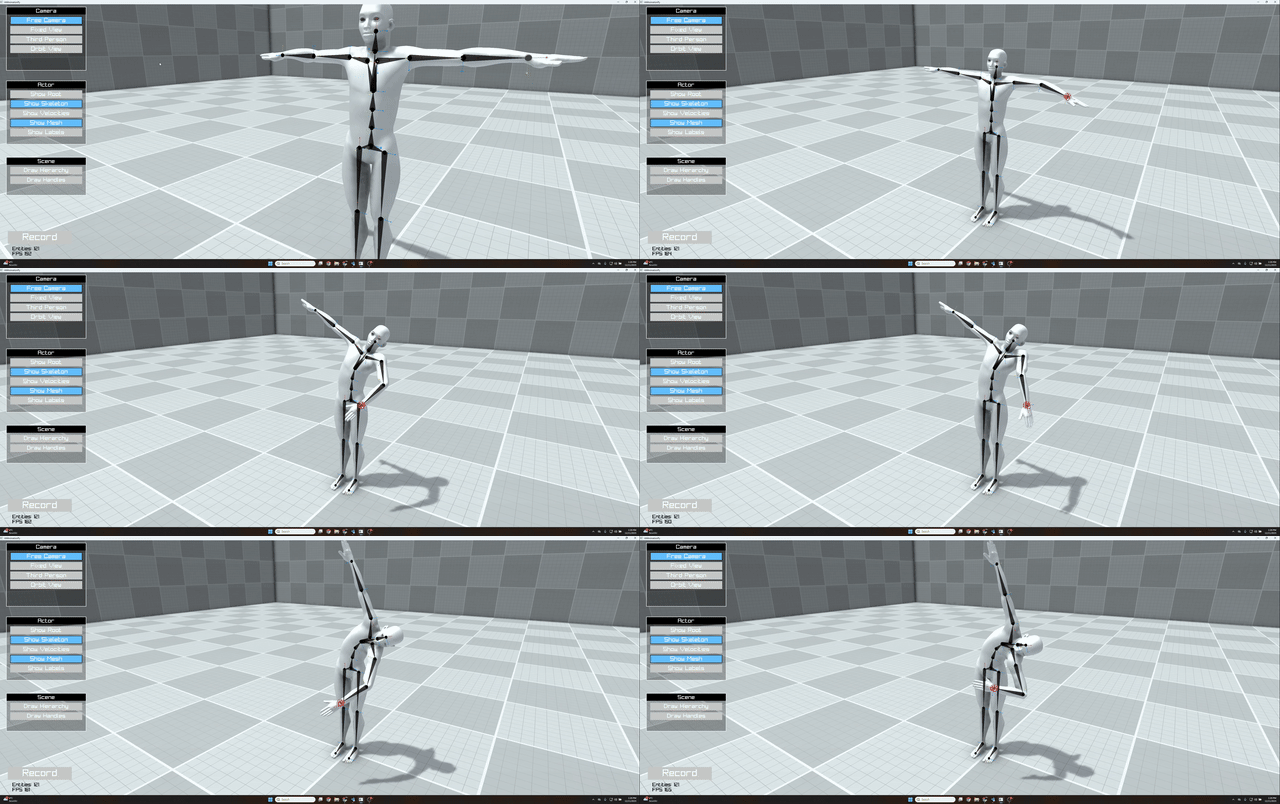 | 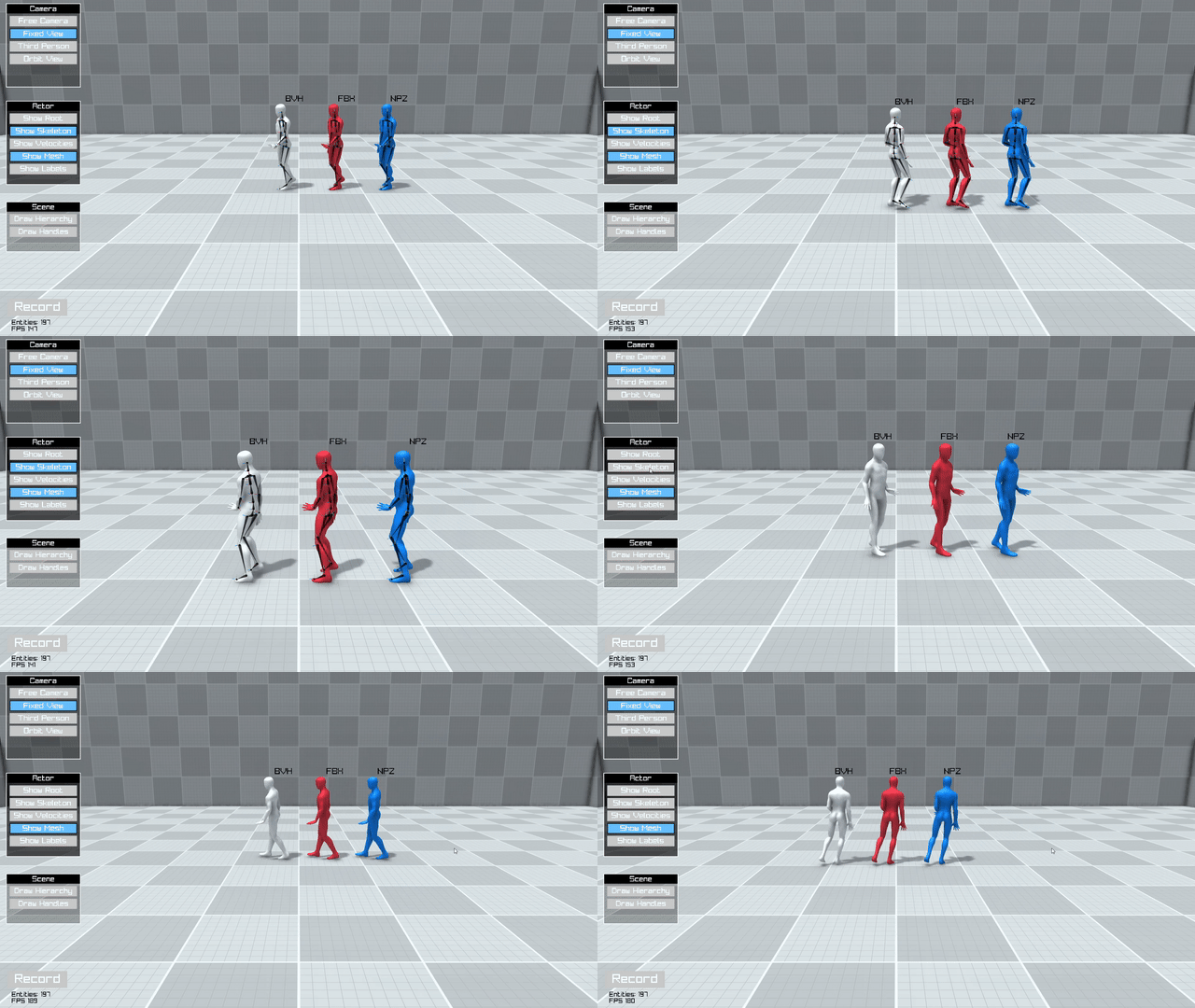 |
| Inverse Kinematics — Real-time IK solving | Motion Capture Import — GLB/FBX/BVH/NPZ loading |
 | |
| Motion Editor — animation browsing and feature visualization |
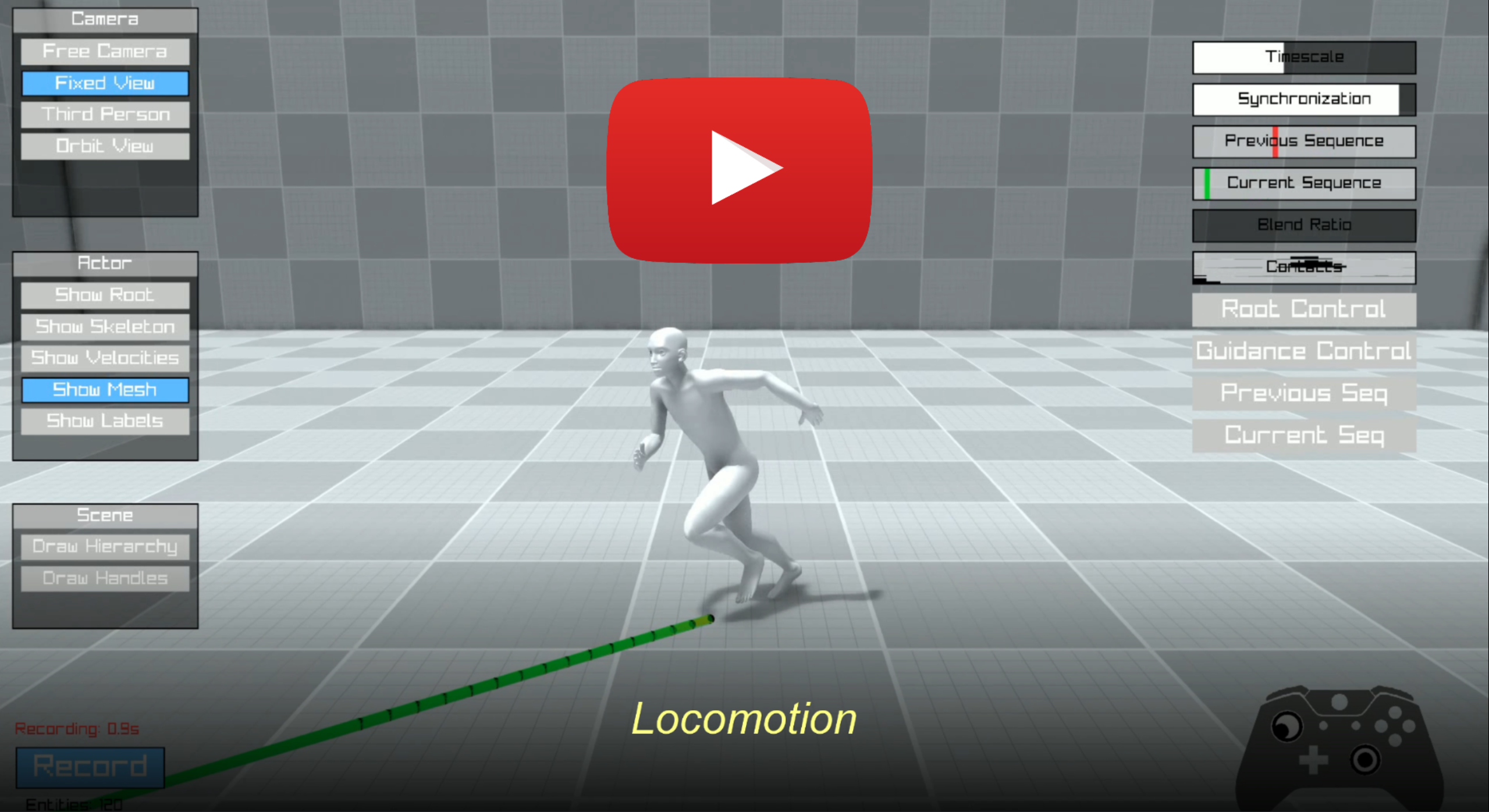
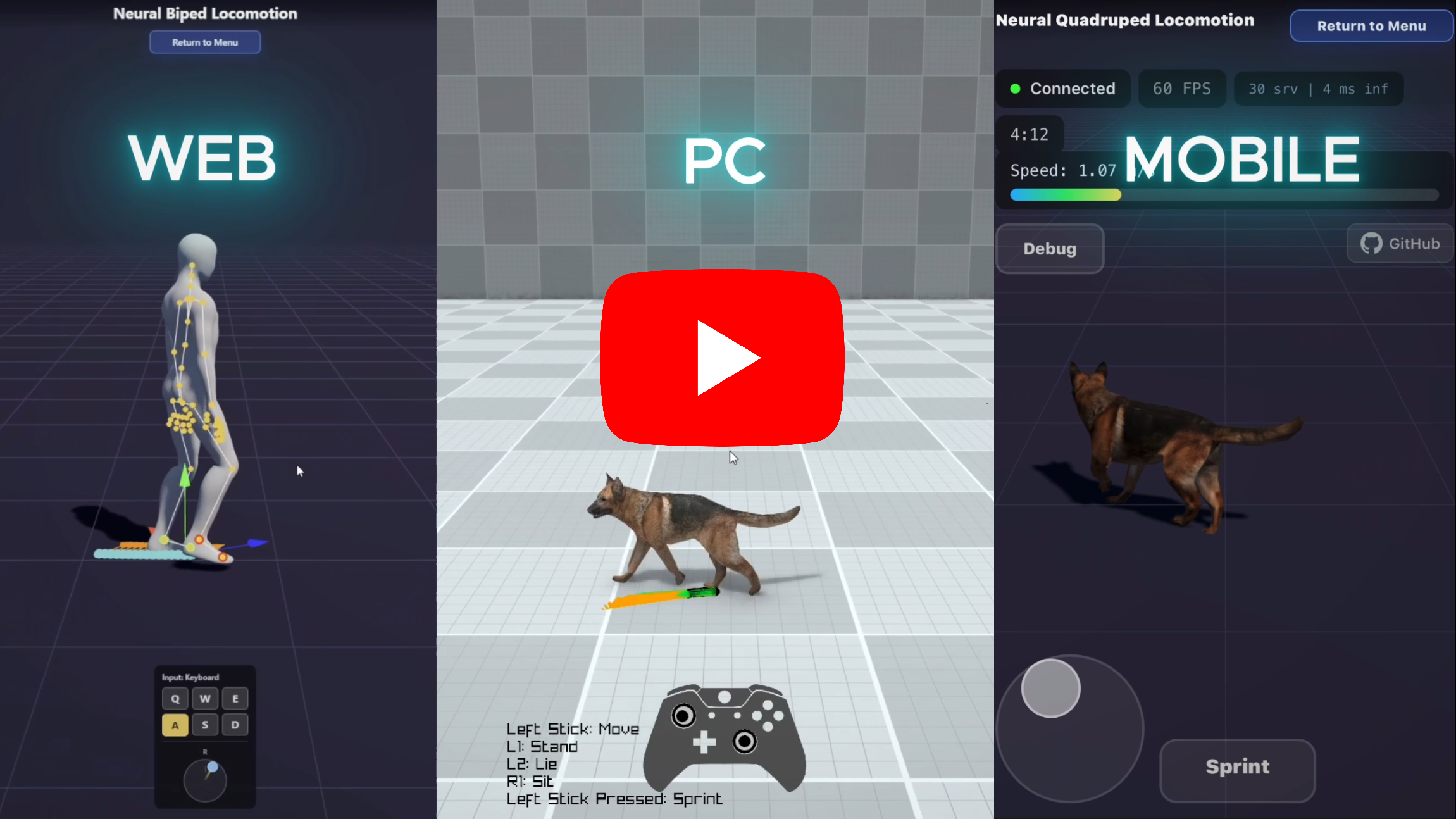
SIGGRAPH 2024
Categorical Codebook Matching for Embodied Character Controllers
Sebastian Starke,
Paul Starke,
Nicky He,
Taku Komura,
Yuting Ye,
ACM Trans. Graph. 43, 4, Article 142.
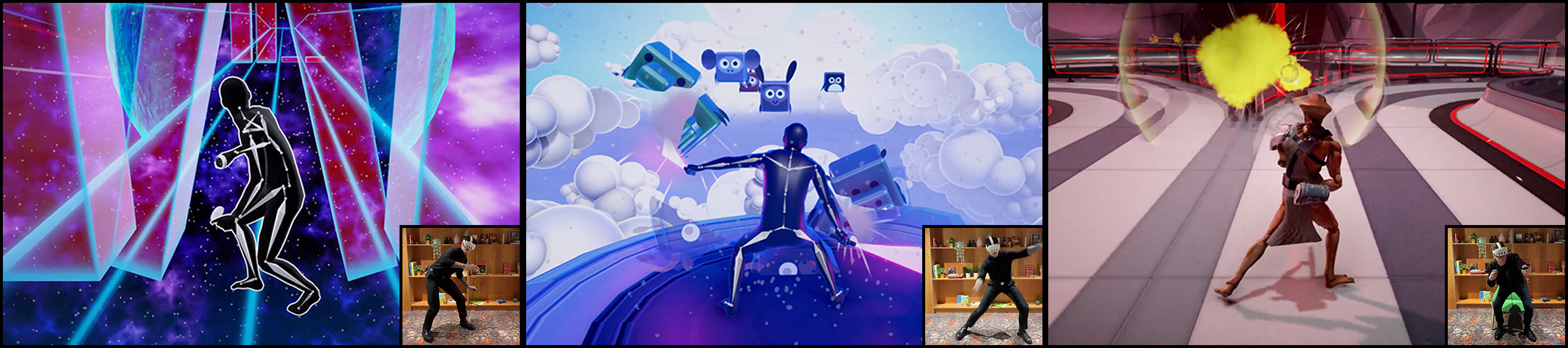
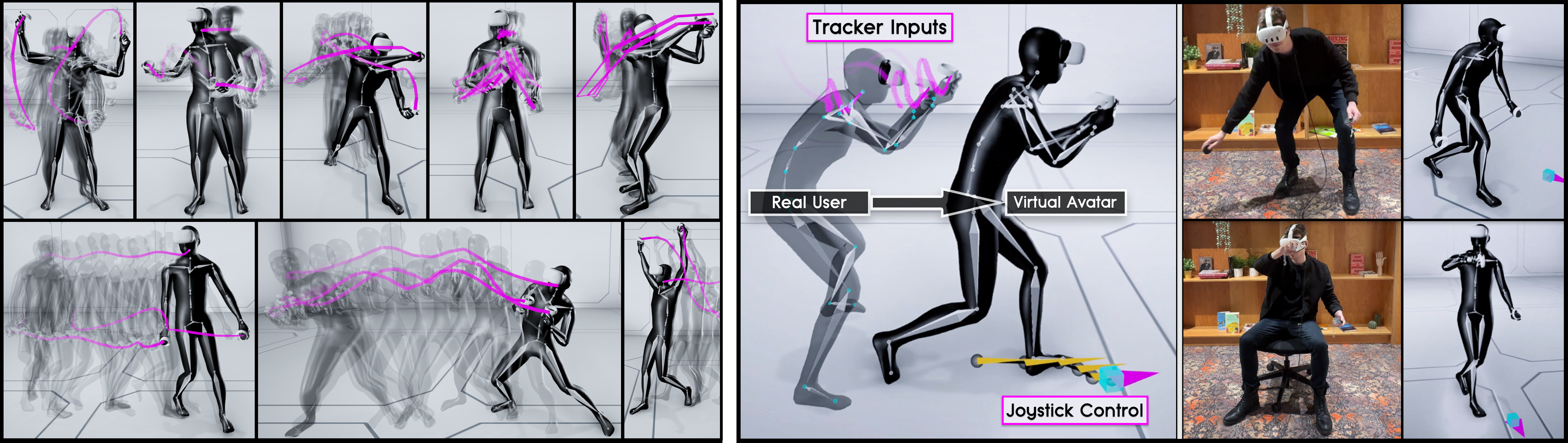
Translating motions from a real user onto a virtual embodied avatar is a key challenge for character animation in the metaverse. In this work, we present a novel generative framework that enables mapping from a set of sparse sensor signals to a full body avatar motion in real-time while faithfully preserving the motion context of the user. In contrast to existing techniques that require training a motion prior and its mapping from control to motion separately, our framework is able to learn the motion manifold as well as how to sample from it at the same time in an end-to-end manner. To achieve that, we introduce a technique called codebook matching which matches the probability distribution between two categorical codebooks for the inputs and outputs for synthesizing the character motions. We demonstrate this technique can successfully handle ambiguity in motion generation and produce high quality character controllers from unstructured motion capture data. Our method is especially useful for interactive applications like virtual reality or video games where high accuracy and responsiveness are needed.
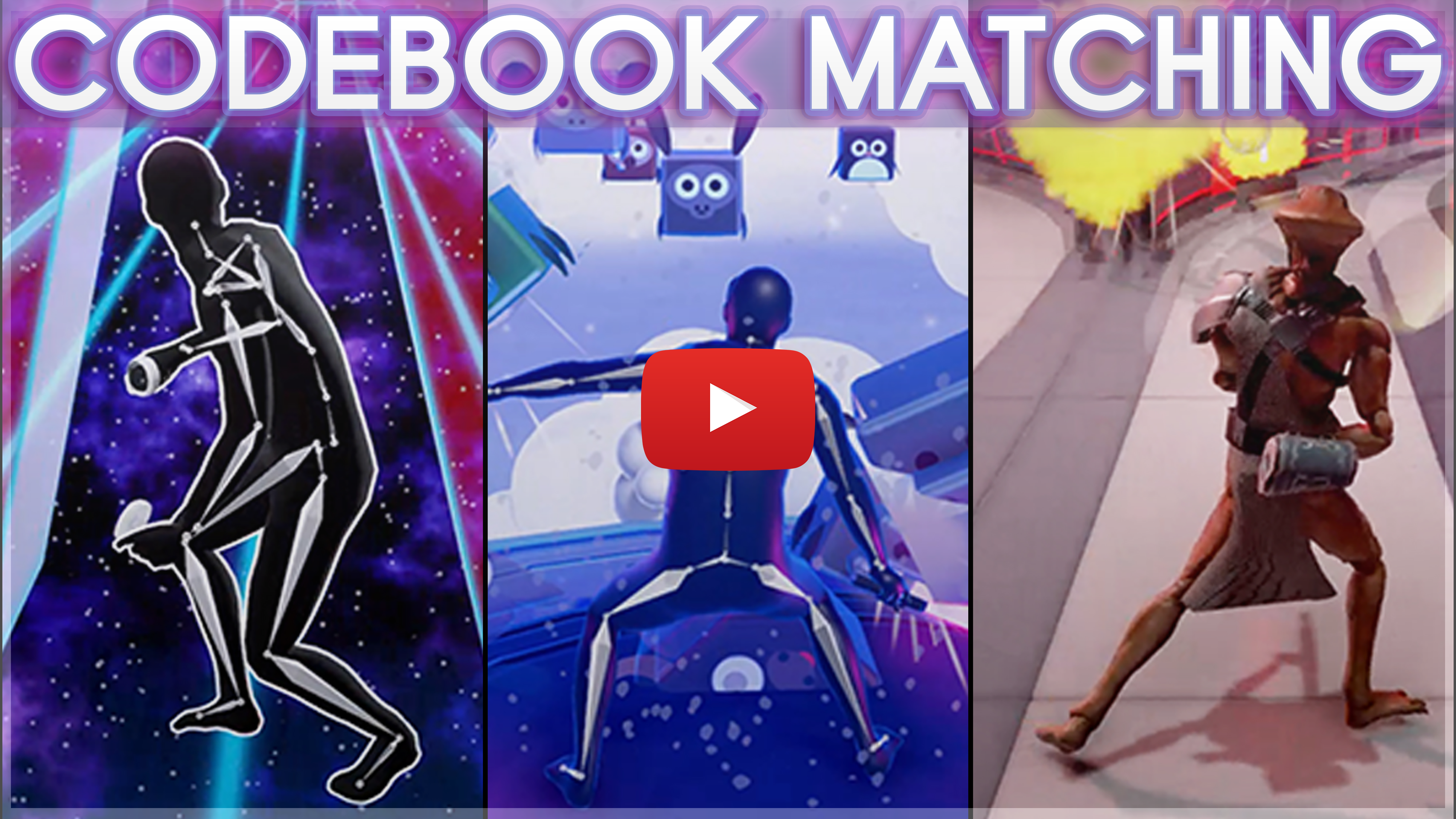
- Video - Paper - Dataset - Code - VR Demo - Windows Demo - Mac Demo - ReadMe -
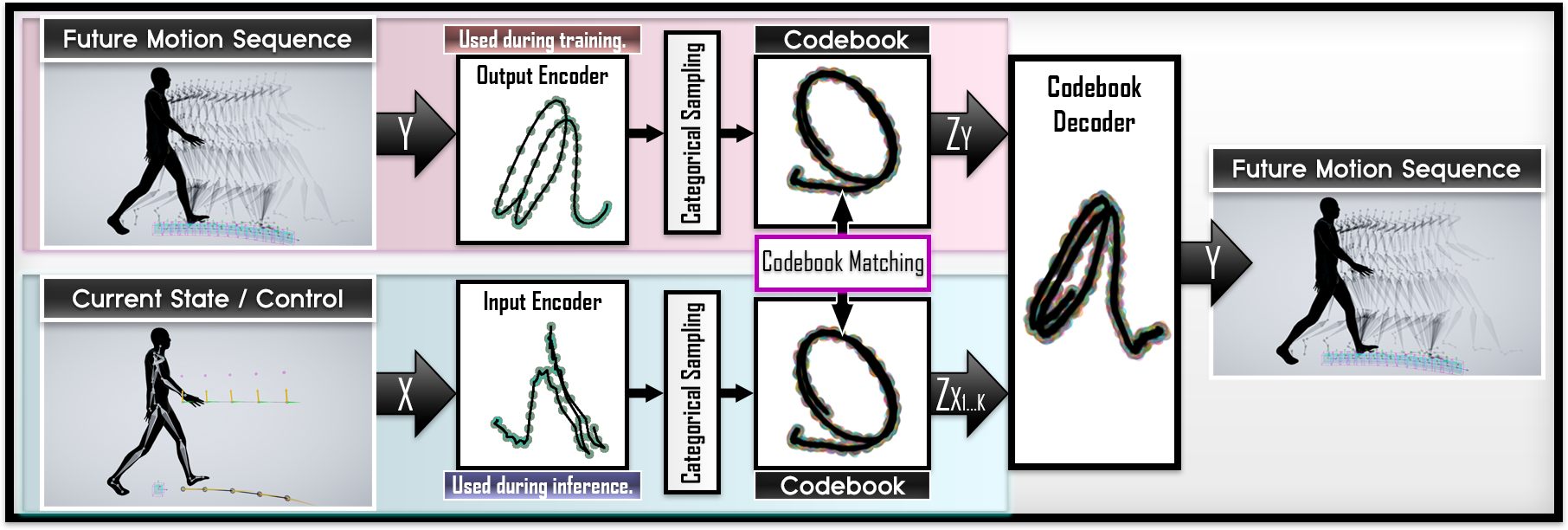
Unlike existing methods for kinematic character control that learn a direct mapping between inputs and outputs or utilize a motion prior that is trained on the motion data alone, our framework learns from both the inputs and outputs simultaneously to form a motion manifold that is informed about the control signals. To learn such setup in a supervised manner, we propose a technique that we call Codebook Matching which enforces similarity between both latent probability distributions $Z_𝑋$ and $Z_𝑌$. In the context of motion generation, instead of directly predicting the motions outputs from the control inputs, we only predict their probabilities for each of them to appear. By introducing a matching loss between both categorical probability distributions, our codebook matching technique allows to substitute $Z_𝑌$ by $Z_𝑋$ during test time.
Training:
\begin{cases}
    Y \rightarrow Z_Y \rightarrow Y
    \\
    X \rightarrow Z_X
    \\
    Z_X \sim Z_Y
\end{cases}

Inference:
X \rightarrow Z_X \rightarrow Y
Our method is not limited to three-point inputs but we can also use it to generate embodied character movements with additional joystick or button controls by what we call hybrid control mode. In this setting, the user, engineer or artist can additionally tell the character where to go via a simple goal location while preserving the original context of motion from three-point tracking signals. This changes the scope of applications we can address by walking / running / crouching in the virtual world while standing or even sitting in the real world.
Furthermore, our codebook matching architecture shares many similarities with motion matching and is able to learn a similar structure in an end-to-end manner. While motion matching can bypass ambiguity in the mapping from control to motion by selecting among candidates with similar query distances, our setup selects possible outcomes from predicted probabilities and naturally projects against valid output motions if their probabilities are similar. However, in contrast to database searches, our codebook matching is able to effectively compress the motion data where same motions map to same codes, and can bypass ambiguity issues which existing learning-based methods such as standard feed-forward networks (MLP) or variational models (CVAE) may struggle with. We demonstrate such capabilities by reconstructing the ambiguous toy example functions in the figure below.

SIGGRAPH 2022
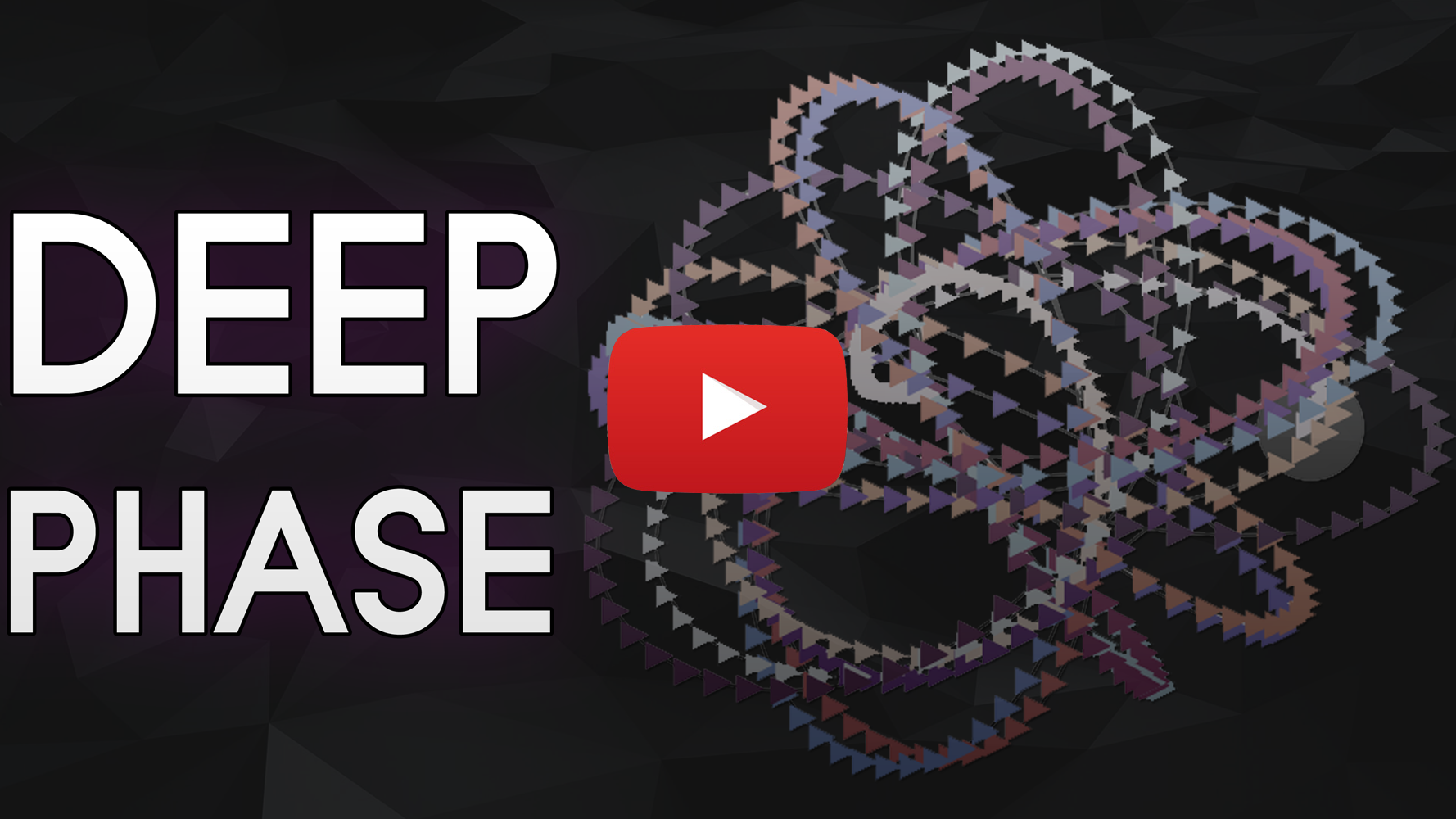
DeepPhase: Periodic Autoencoders for Learning Motion Phase Manifolds
Sebastian Starke,
Ian Mason,
Taku Komura,
ACM Trans. Graph. 41, 4, Article 136.
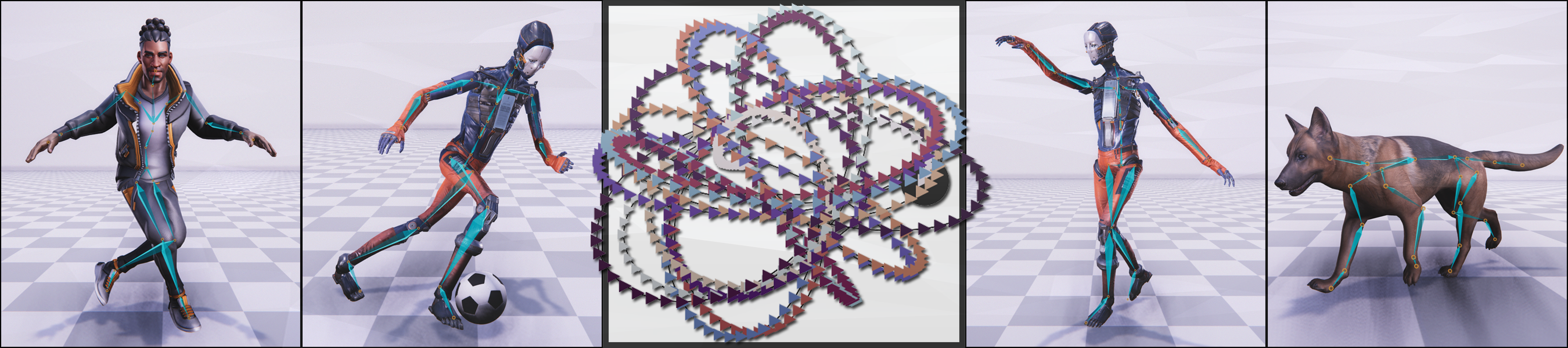
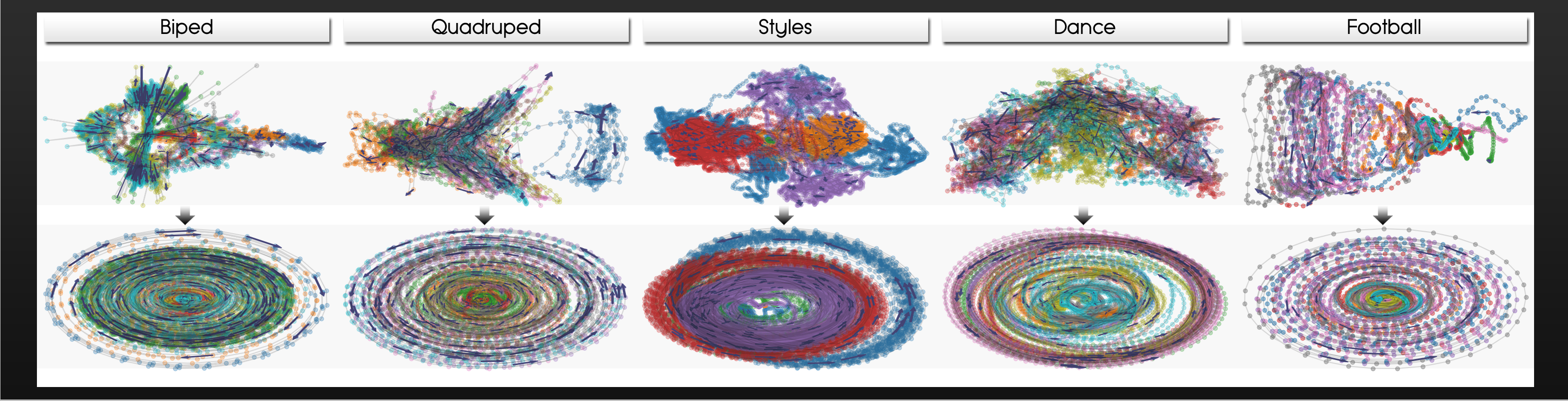
Learning the spatial-temporal structure of body movements is a fundamental problem for character motion synthesis. In this work, we propose a novel neural network architecture called the Periodic Autoencoder that can learn periodic features from large unstructured motion datasets in an unsupervised manner. The character movements are decomposed into multiple latent channels that capture the non-linear periodicity of different body segments while progressing forward in time. Our method extracts a multi-dimensional phase space from full-body motion data, which effectively clusters animations and produces a manifold in which computed feature distances provide a better similarity measure than in the original motion space to achieve better temporal and spatial alignment. We demonstrate that the learned periodic embedding can significantly help to improve neural motion synthesis in a number of tasks, including diverse locomotion skills, style-based movements, dance motion synthesis from music, synthesis of dribbling motions in football, and motion query for matching poses within large animation databases.
- Video - Paper - PAE Code & Demo - Animation Code & Demo - Explanation and Addendum - Tutorial -
- Motion In-Betweening System -

SIGGRAPH 2021
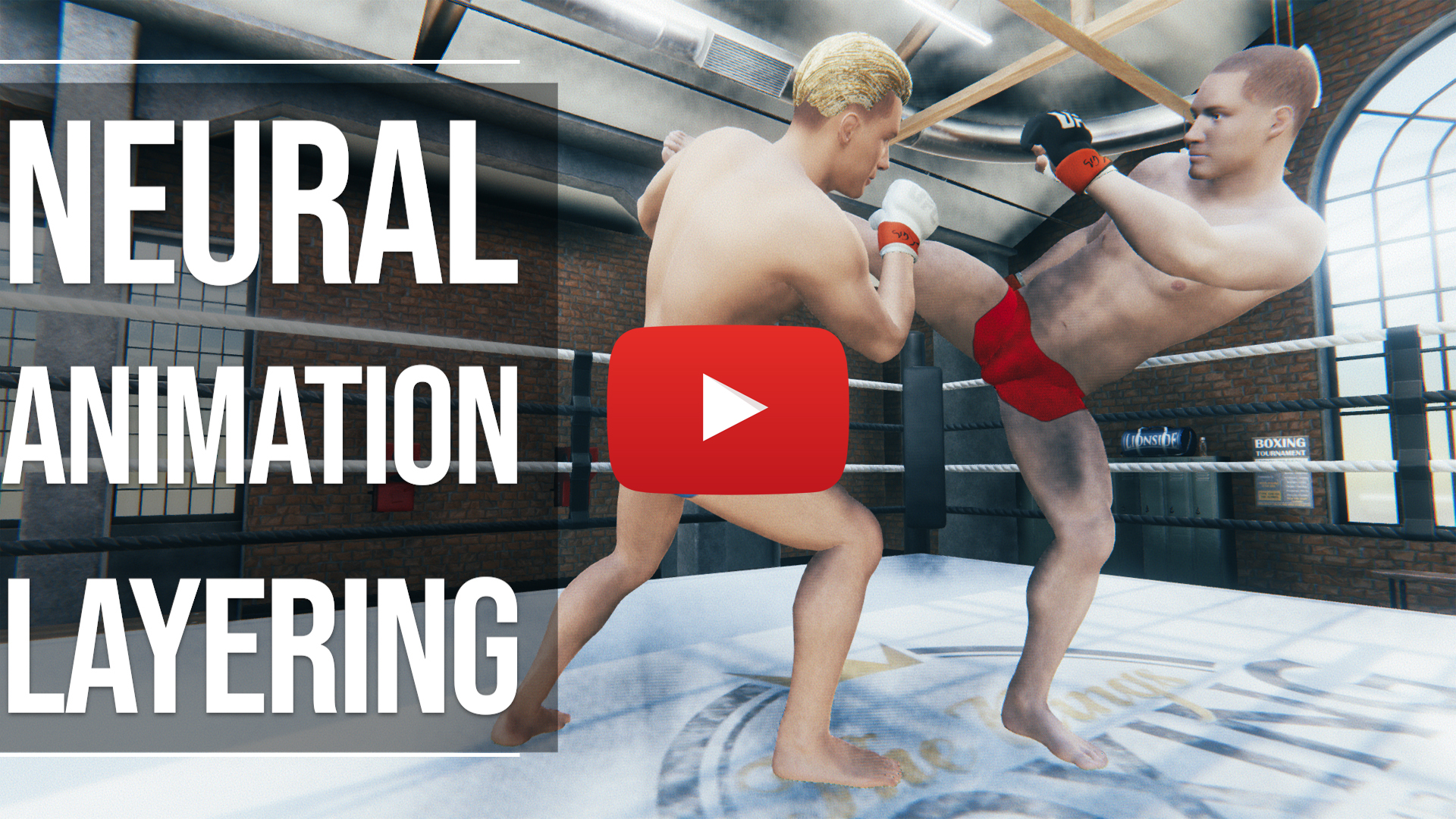
Neural Animation Layering for Synthesizing Martial Arts Movements
Sebastian Starke,
Yiwei Zhao,
Fabio Zinno,
Taku Komura,
ACM Trans. Graph. 40, 4, Article 92.
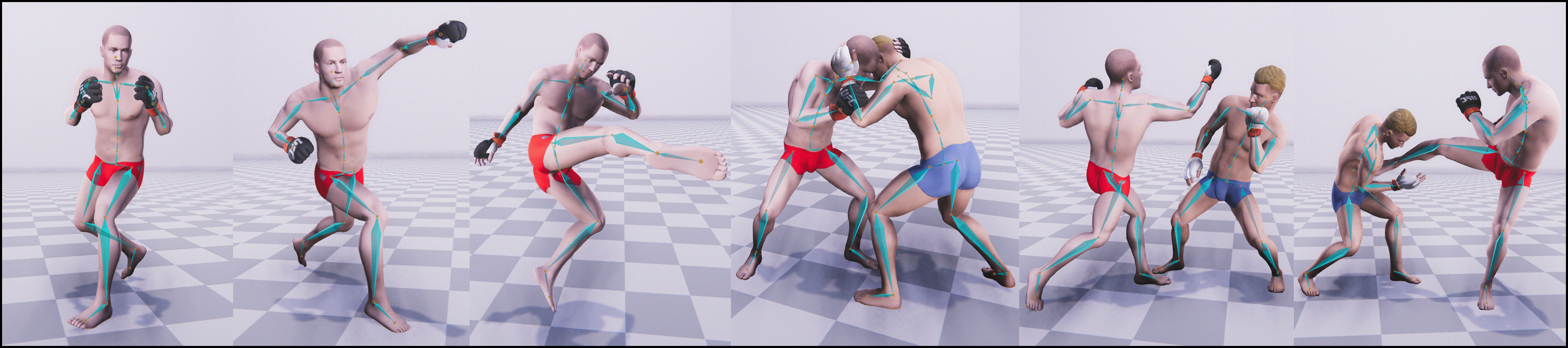
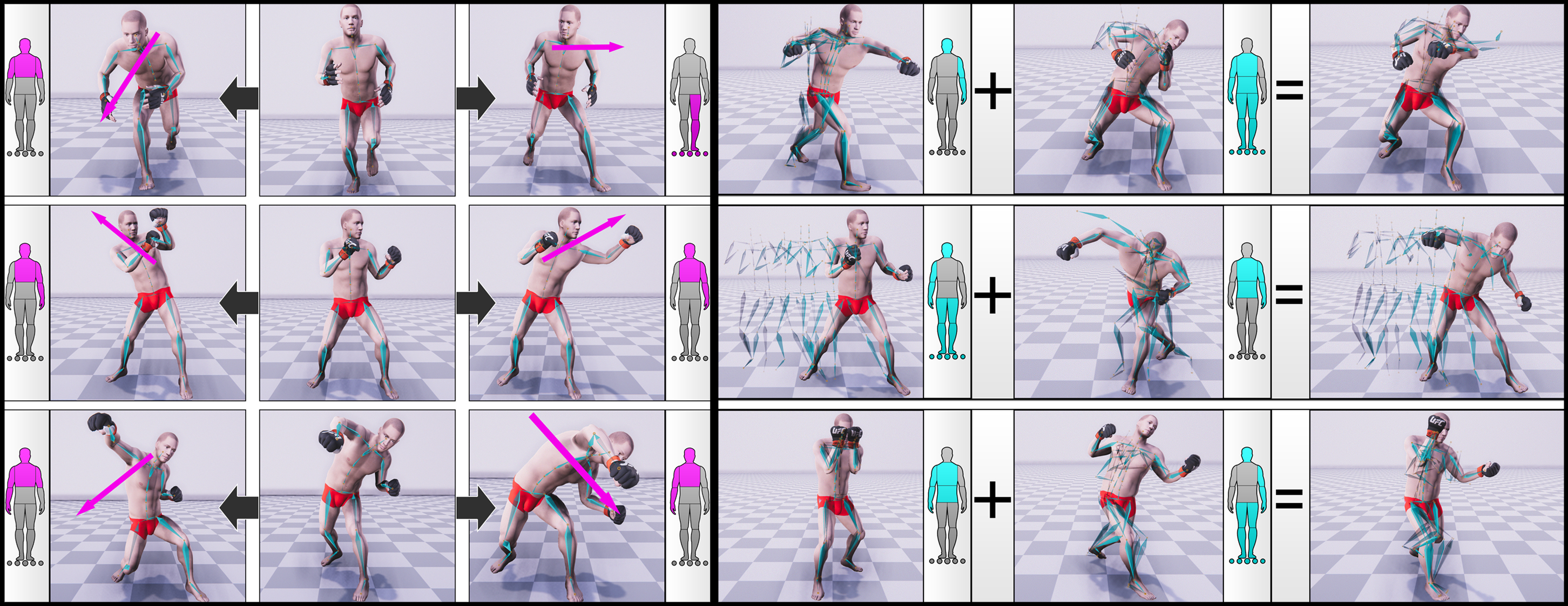
Interactively synthesizing novel combinations and variations of character movements from different motion skills is a key problem in computer animation. In this research, we propose a deep learning framework to produce a large variety of martial arts movements in a controllable manner from raw motion capture data. Our method imitates animation layering using neural networks with the aim to overcome typical challenges when mixing, blending and editing movements from unaligned motion sources. The system can be used for offline and online motion generation alike, provides an intuitive interface to integrate with animator workflows, and is relevant for real-time applications such as computer games.
- Video - Paper -
SIGGRAPH 2020
Local Motion Phases for Learning Multi-Contact Character Movements
Sebastian Starke,
Yiwei Zhao,
Taku Komura,
Kazi Zaman.
ACM Trans. Graph. 39, 4, Article 54.
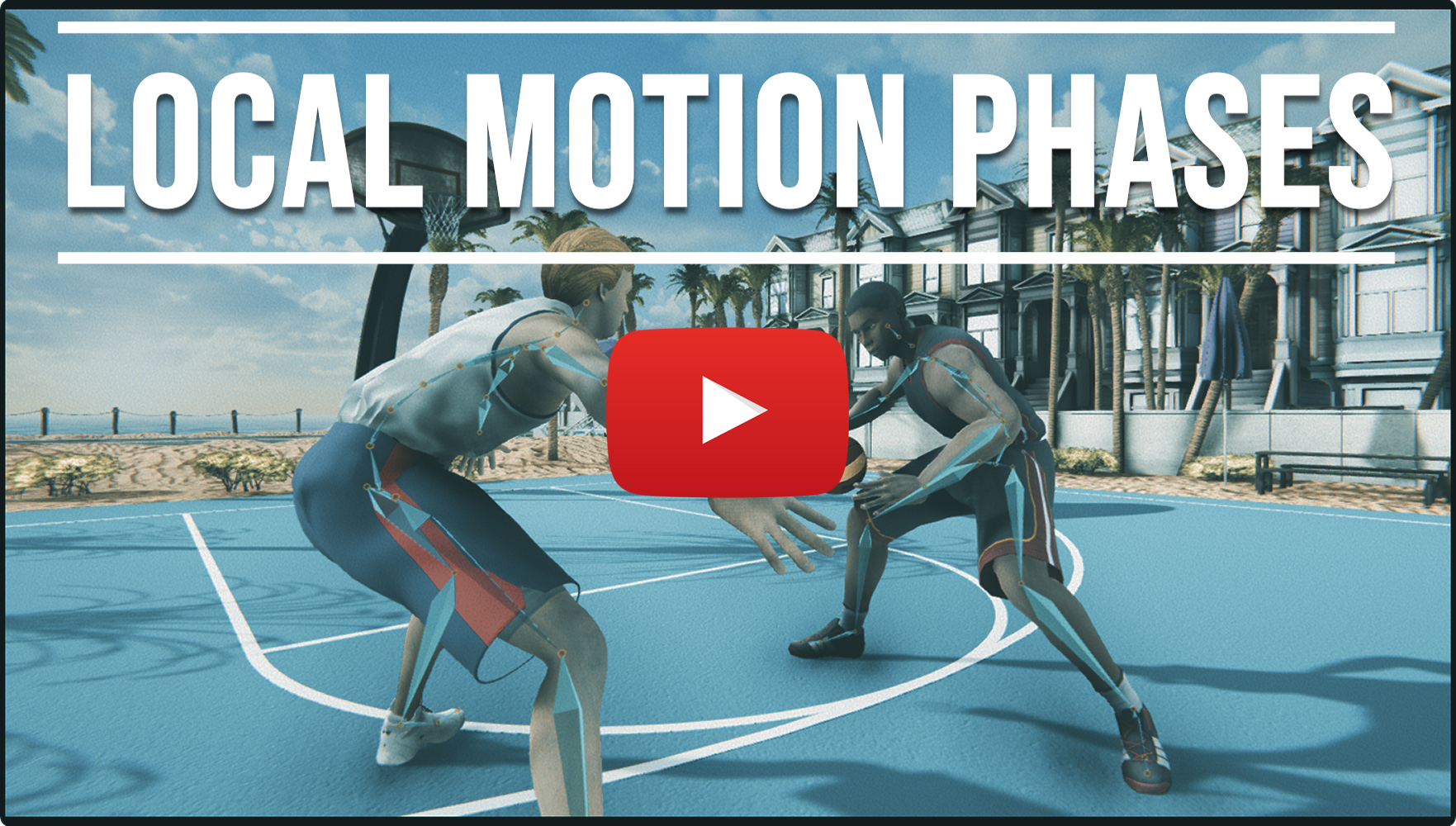
Not sure how to align complex character movements? Tired of phase labeling? Unclear how to squeeze everything into a single phase variable? Don't worry, a solution exists!
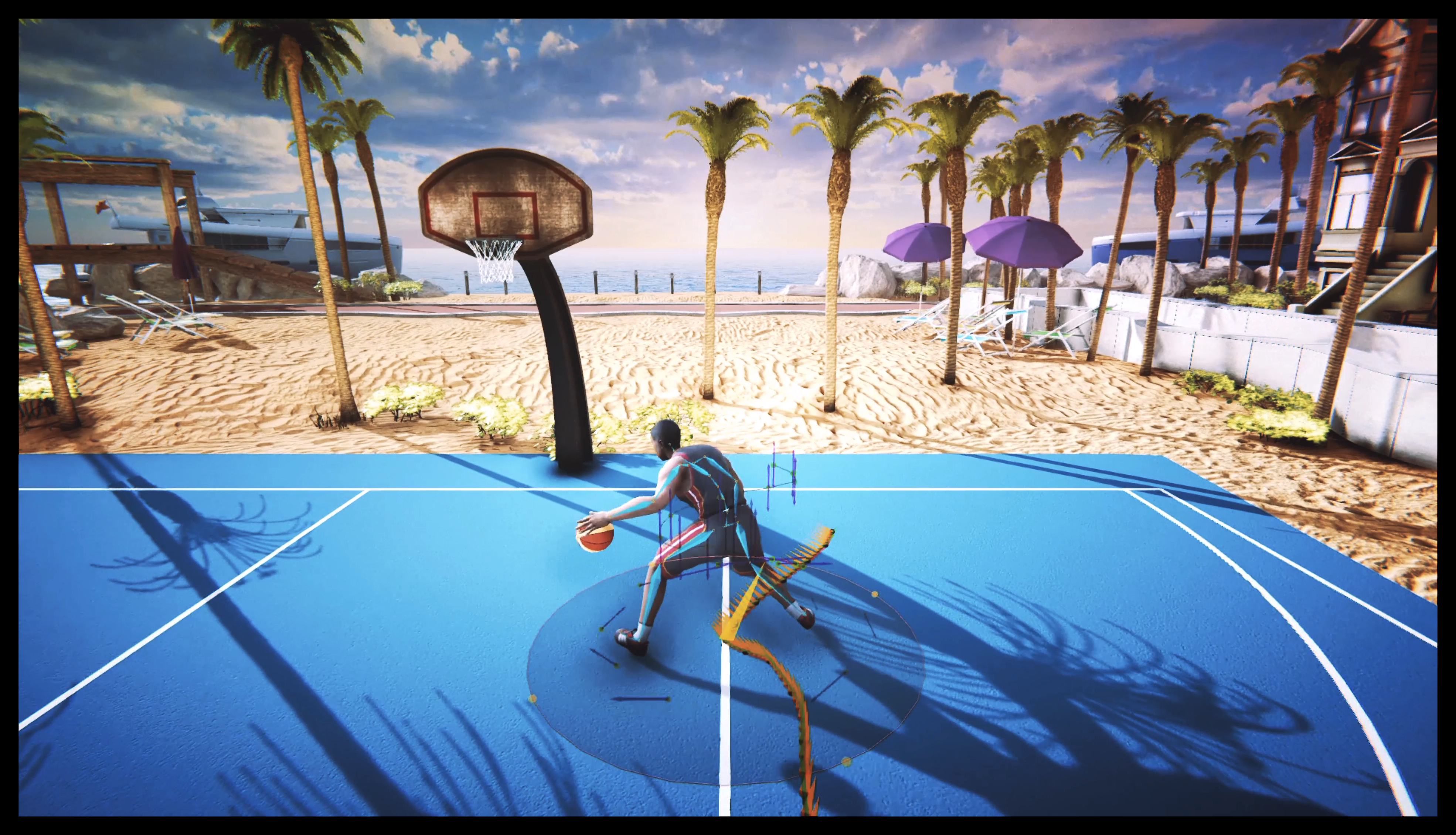
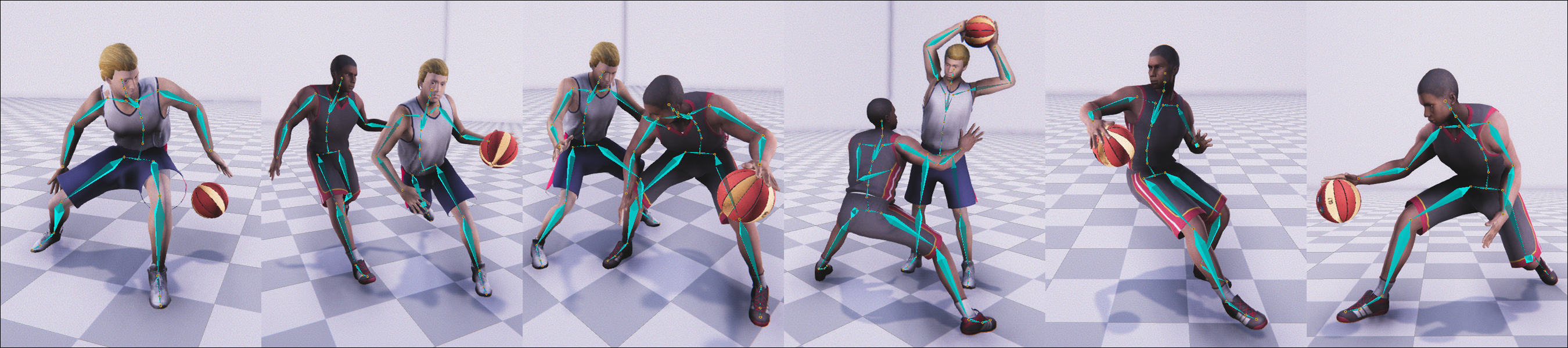
Controlling characters to perform a large variety of dynamic, fast-paced and quickly changing movements is a key challenge in character animation. In this research, we present a deep learning framework to interactively synthesize such animations in high quality, both from unstructured motion data and without any manual labeling. We introduce the concept of local motion phases, and show our system being able to produce various motion skills, such as ball dribbling and professional maneuvers in basketball plays, shooting, catching, avoidance, multiple locomotion modes as well as different character and object interactions, all generated under a unified framework.
- Video - Paper - Code - Windows Demo - ReadMe -
SIGGRAPH Asia 2019
Neural State Machine for Character-Scene Interactions
Sebastian Starke+,
He Zhang+,
Taku Komura,
Jun Saito.
ACM Trans. Graph. 38, 6, Article 178.
(+Joint First Authors)
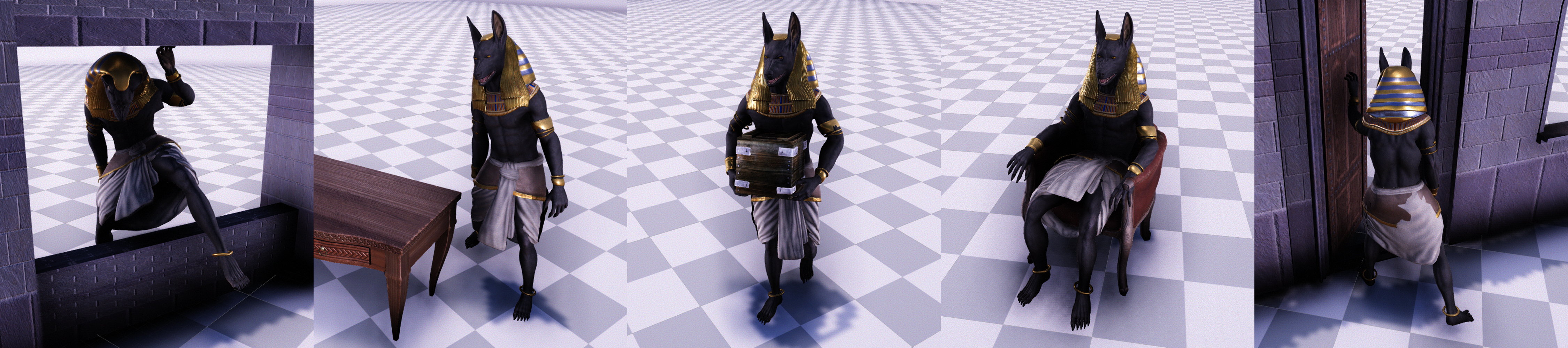
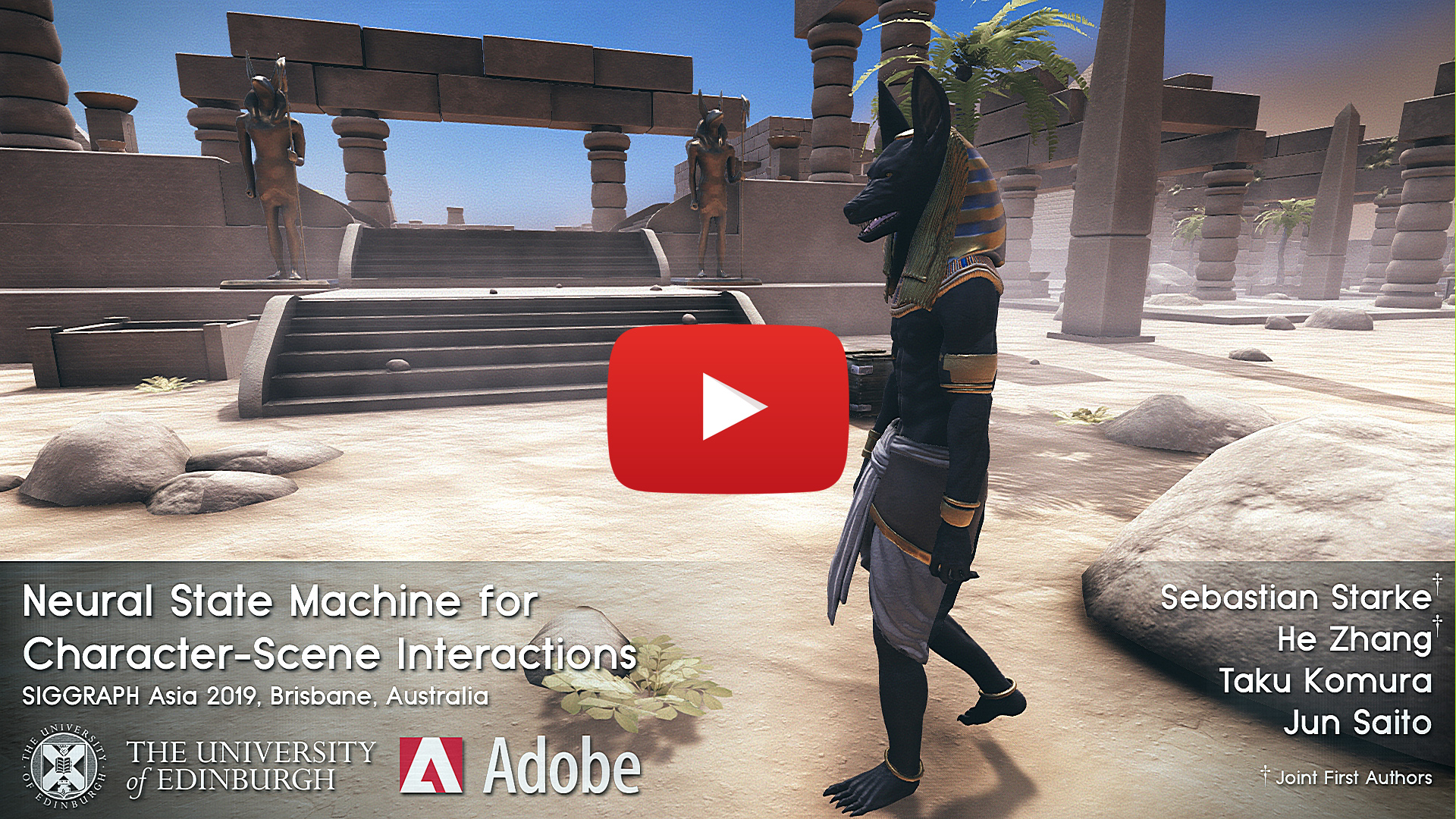
Animating characters can be an easy or difficult task - interacting with objects is one of the latter. In this research, we present the Neural State Machine, a data-driven deep learning framework for character-scene interactions. The difficulty in such animations is that they require complex planning of periodic as well as aperiodic movements to complete a given task. Creating them in a production-ready quality is not straightforward and often very time-consuming. Instead, our system can synthesize different movements and scene interactions from motion capture data, and allows the user to seamlessly control the character in real-time from simple control commands. Since our model directly learns from the geometry, the motions can naturally adapt to variations in the scene. We show that our system can generate a large variety of movements, icluding locomotion, sitting on chairs, carrying boxes, opening doors and avoiding obstacles, all from a single model. The model is responsive, compact and scalable, and is the first of such frameworks to handle scene interaction tasks for data-driven character animation.
- Video - Paper - Code & Demo - Mocap Data - ReadMe -
SIGGRAPH 2018
Mode-Adaptive Neural Networks for Quadruped Motion Control
He Zhang+,
Sebastian Starke+,
Taku Komura,
Jun Saito.
ACM Trans. Graph. 37, 4, Article 145.
(+Joint First Authors)
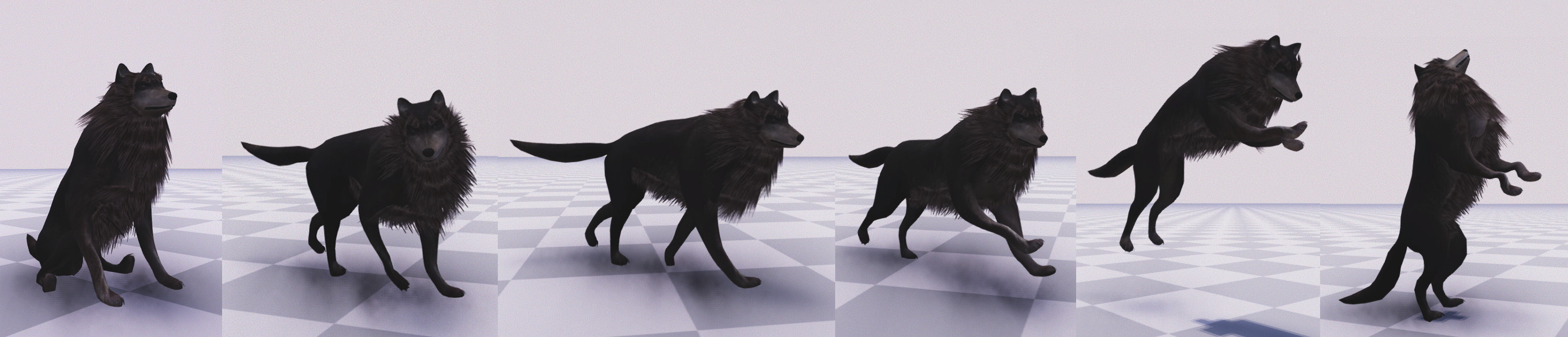
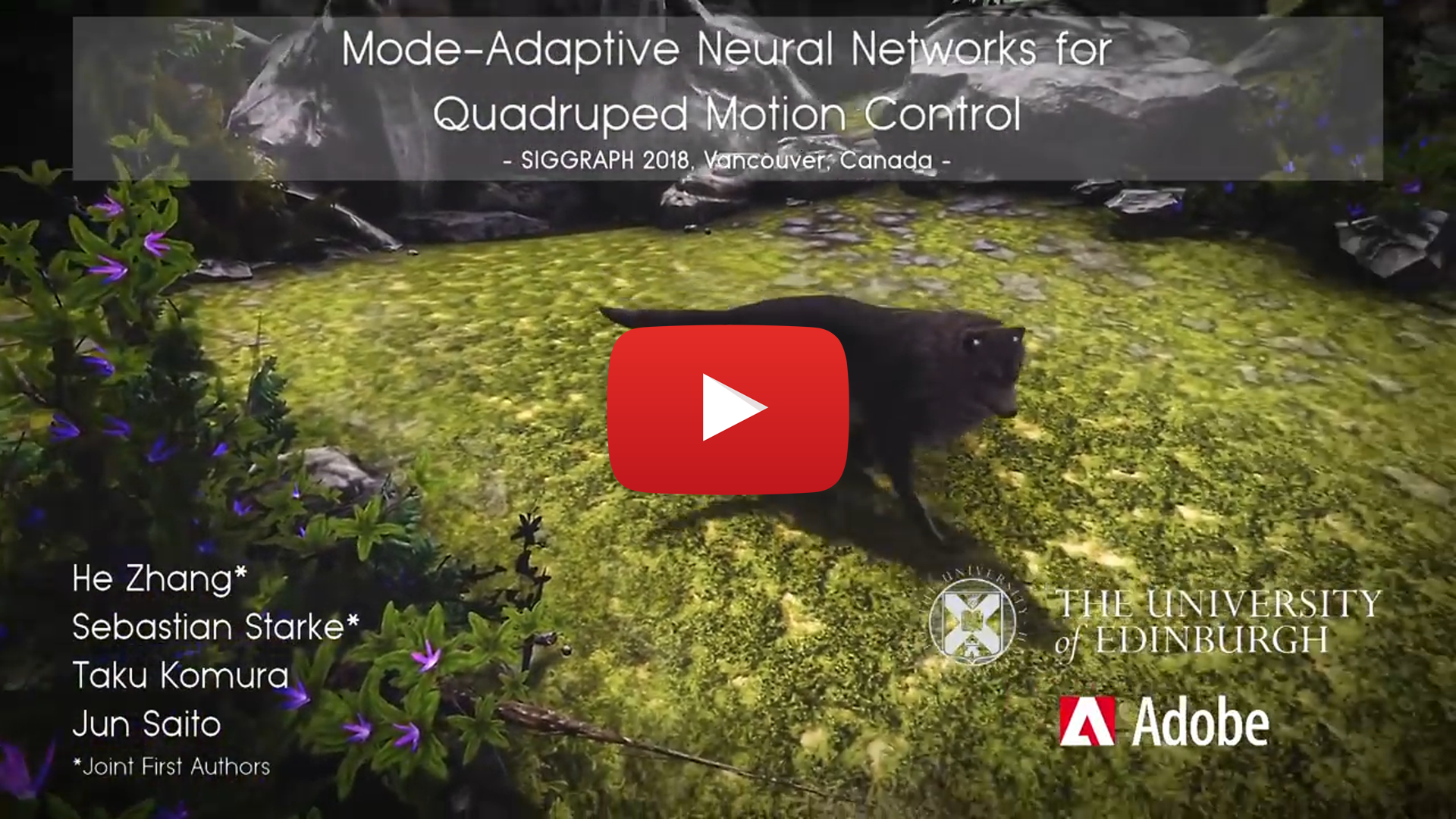
Animating characters can be a pain, especially those four-legged monsters! This year, we will be presenting our recent research on quadruped animation and character control at the SIGGRAPH 2018 in Vancouver. The system can produce natural animations from real motion data using a novel neural network architecture, called Mode-Adaptive Neural Networks. Instead of optimising a fixed group of weights, the system learns to dynamically blend a group of weights into a further neural network, based on the current state of the character. That said, the system does not require labels for the phase or locomotion gaits, but can learn from unstructured motion capture data in an end-to-end fashion.
- Video - Paper - Code - Mocap Data - Windows Demo - Linux Demo - Mac Demo - ReadMe -
- Animation Authoring Tool -

SIGGRAPH 2017
Phase-Functioned Neural Networks for Character Control
Daniel Holden,
Taku Komura,
Jun Saito.
ACM Trans. Graph. 36, 4, Article 42.

This work continues the recent work on PFNN (Phase-Functioned Neural Networks) for character control. A demo in Unity3D using the original weights for terrain-adaptive locomotion is contained in the Assets/Demo/SIGGRAPH_2017/Original folder. Another demo on flat ground using the Adam character is contained in the Assets/Demo/SIGGRAPH_2017/Adam folder. In order to run them, you need to download the neural network weights from the link provided in the Link.txt file, extract them into the /NN folder, and store the parameters via the custom inspector button.
- Video - Paper - Code (Unity) - Windows Demo - Linux Demo - Mac Demo -
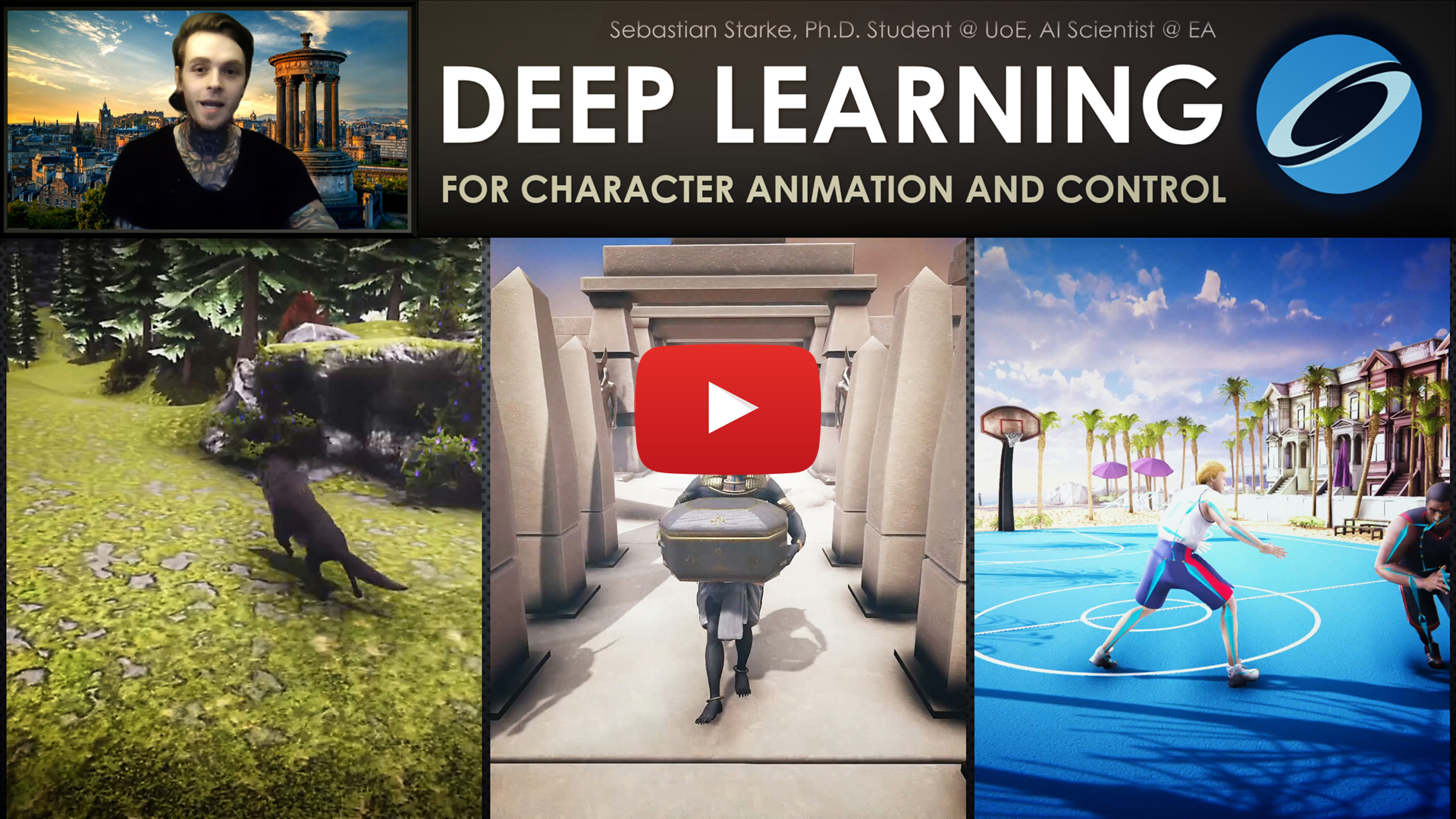
Thesis Fast Forward Presentation from SIGGRAPH 2020
Copyright Information
This project is only for research or education purposes, and not freely available for commercial use or redistribution. The motion capture data is available only under the terms of the Attribution-NonCommercial 4.0 International (CC BY-NC 4.0) license.
Repo liên quan
Master programming by recreating your favorite technologies from scratch.
A curated meta-list of curated lists organized by technology domain. The repository acts as a directory pointing to hundreds of specialized awesome lists covering programming languages, platforms, frameworks, and tooling. All content is community-contributed under the CC0 public domain dedication.
Public APIs is a community-curated GitHub repository listing free, publicly accessible APIs across a wide range of categories, with auth type, HTTPS, and CORS noted for each entry. It's a browsable reference, not a library to install.
REA is an MCP server and CLI that gives AI coding agents the ability to reverse engineer binaries, JavaScript apps, .NET assemblies, and websites. It hooks into Hopper, Ghidra, or IDA Pro for native binary work, or runs static JavaScript analysis with just Node.js. Every investigation returns an Evidence bundle that includes what was found, what was not, and the reasoning path. Setup registers REA with supported agents and walks you through connecting an analysis engine. The CLI also works standalone for terminal-first workflows.
Trả lời nhanh
Đọc thêm về sebastianstarke/AI4Animation ở đâu?
Trang TopGit này là một snapshot — tab "Readme" hiển thị nguyên văn README của repo (đã bỏ link, giữ ảnh). Repo GitHub ở github.com/sebastianstarke/AI4Animation là nguồn chính thức.
sebastianstarke/AI4Animation có bao nhiêu sao?
sebastianstarke/AI4Animation có 8.9k sao GitHub — tải lại trang để xem số mới nhất, hoặc xem trực tiếp github.com/sebastianstarke/AI4Animation. TopGit phản chiếu số sao của GitHub nhưng không cam kết đến từng phút.
sebastianstarke/AI4Animation có tag gì không?
Bản đồng bộ chưa ghi nhận topic GitHub nào cho sebastianstarke/AI4Animation. GitHub topics hiển thị ở thanh bên phải trang repo — đó là nơi đáng kiểm tra nhất.
sebastianstarke/AI4Animation còn đang phát triển không?
Commit gần nhất trên sebastianstarke/AI4Animation là 7 tháng trước (theo timestamp GitHub). Repo có 1.1k fork — một chỉ báo về mức độ quan tâm của cộng đồng.
sebastianstarke/AI4Animation viết bằng ngôn ngữ gì?
sebastianstarke/AI4Animation chủ yếu viết bằng C++. Trường "language" của GitHub dựa trên phần lớn byte ở nhánh mặc định.
Đọc đầy đủ README ở tab phía trên.
AI4Animation có đáng để bạn bỏ thời gian?
ChatGPT, Claude và Perplexity đều đọc được trang này. Hỏi thử xem họ nghĩ gì về AI4Animation.