sequelize/sequelize-auto

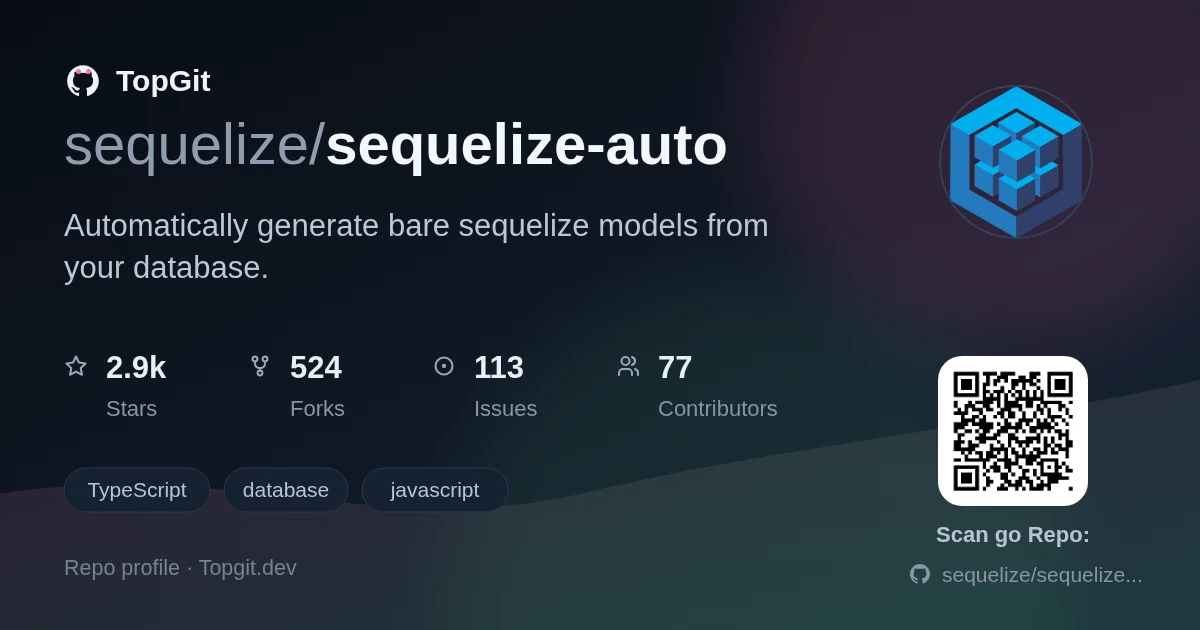
sequelize/sequelize-auto là dự án Data trên GitHub, viết chủ yếu bằng TypeScript, với 2.9k sao. Automatically generate bare sequelize models from your database.
Tóm tắt dựng từ metadata GitHub của chính dự án — chưa có bài review TopGit. Trang sẽ tự động cập nhật khi bài review đầy đủ được xuất bản.
TopGit viết bài đầy đủ cho repo có nhiều sao nhất và được yêu cầu nhiều nhất. Trang này là snapshot trong thời gian chờ — xem README gốc ở tab READ ME.
Snapshot
Cộng tác viên hàng đầu
Xem cộng tác viên hàng đầu
Sequelize-Auto



Automatically generate models for SequelizeJS via the command line.
Install
npm install sequelize-auto
Prerequisites
You will need to install sequelize; it's no longer installed by sequelize-auto.
You will need to install the correct dialect binding before using sequelize-auto.
| Dialect | Install |
|---|---|
| MySQL/MariaDB | npm install sequelize mysql2 |
| Postgres | npm install sequelize pg pg-hstore |
| Sqlite | npm install sequelize sqlite3 |
| MSSQL | npm install sequelize tedious |
Usage
sequelize-auto -h <host> -d <database> -u <user> -x [password] -p [port] --dialect [dialect] -c [/path/to/config] -o [/path/to/models] -t [tableName]
Options:
    --help               Show help                                   [boolean]
    --version            Show version number                         [boolean]
-h, --host               IP/Hostname for the database.                [string]
-d, --database           Database name.                               [string]
-u, --user               Username for database.                       [string]
-x, --pass               Password for database. If specified without providing
                          a password, it will be requested interactively from
                          the terminal.
-p, --port               Port number for database (not for sqlite). Ex:
                          MySQL/MariaDB: 3306, Postgres: 5432, MSSQL: 1433
                                                                      [number]
-c, --config             Path to JSON file for Sequelize-Auto options and
                          Sequelize's constructor "options" flag object as
                          defined here:
                          https://sequelize.org/api/v6/class/src/sequelize.js~sequelize#instance-constructor-constructor
                                                                      [string]
-o, --output             What directory to place the models.          [string]
-e, --dialect            The dialect/engine that you're using: postgres,
                          mysql, sqlite, mssql                         [string]
-a, --additional         Path to JSON file containing model options (for all
                          tables). See the options: https://sequelize.org/api/v6/class/src/model.js~model#static-method-init
                                                                      [string]
    --indentation        Number of spaces to indent                   [number]
-t, --tables             Space-separated names of tables to import     [array]
-T, --skipTables         Space-separated names of tables to skip       [array]
--caseModel, --cm        Set case of model names: c|l|o|p|u
                          c = camelCase
                          l = lower_case
                          o = original (default)
                          p = PascalCase
                          u = UPPER_CASE
--caseProp, --cp         Set case of property names: c|l|o|p|u
--caseFile, --cf         Set case of file names: c|l|o|p|u|k
                          k = kebab-case
--noAlias                Avoid creating alias `as` property in relations
                                                                     [boolean]
--noInitModels           Prevent writing the init-models file        [boolean]
-n, --noWrite            Prevent writing the models to disk          [boolean]
-s, --schema             Database schema from which to retrieve tables[string]
-v, --views              Include database views in generated models  [boolean]
-l, --lang               Language for Model output: es5|es6|esm|ts
                          es5 = ES5 CJS modules (default)
                          es6 = ES6 CJS modules
                          esm = ES6 ESM modules
                          ts = TypeScript                             [string]
--useDefine              Use `sequelize.define` instead of `init` for es6|esm|ts
--singularize, --sg      Singularize model and file names from plural table
                          names                                      [boolean]
On Windows, provide the path to sequelize-auto:
node_modules\.bin\sequelize-auto [args]
Example
sequelize-auto -o "./models" -d sequelize_auto_test -h localhost -u my_username -p 5432 -x my_password -e postgres
Produces a file/files such as ./models/User.js which looks like:
module.exports = function(sequelize, DataTypes) {
  return sequelize.define('User', {
    id: {
      type: DataTypes.INTEGER,
      allowNull: false,
      primaryKey: true,
      autoIncrement: true
    },
    username: {
      type: DataTypes.STRING(20),
      allowNull: true
    },
    aNumber: {
      type: DataTypes.SMALLINT,
      allowNull: true
    },
    dateAllowNullTrue: {
      type: DataTypes.DATE,
      allowNull: true
    },
    defaultValueBoolean: {
      type: DataTypes.BOOLEAN,
      allowNull: true,
      defaultValue: true
    }
  }, {
    tableName: 'User',
  });
};
Sequelize-auto also generates an initialization file, ./models/init-models.js, which contains the code to load each model definition into Sequelize:
var DataTypes = require("sequelize").DataTypes;
var _User = require("./User");
var _Product = require("./Product");

function initModels(sequelize) {
  var User = _User(sequelize, DataTypes);
  var Product = _Product(sequelize, DataTypes);

  return {
    User,
    Product,
  };
}
module.exports = { initModels };
This makes it easy to import all your models into Sequelize by calling initModels(sequelize).
var initModels = require("./models/init-models");
...
var models = initModels(sequelize);

models.User.findAll({ where: { username: "tony" }}).then(...);
Alternatively, you can Sequelize.import each model (for Sequelize versions < 6), or require each file and call the returned function:
var User = require('path/to/user')(sequelize, DataTypes);
ES6
You can use the -l es6 option to create the model definition files as ES6 classes, or -l esm option to create ES6 modules. Then you would require or import the classes and call the init(sequelize, DataTypes) method on each class.
TypeScript
Add -l ts to cli options or lang: 'ts' to programmatic options. This will generate a TypeScript class in each model file, and an init-model.ts file
to import and initialize all the classes.
Note that you need TypeScript 4.x to compile the generated files.
The TypeScript model classes are created as described in the Sequelize manual
Example model class, order.ts:
import Sequelize, { DataTypes, Model, Optional } from 'sequelize';
import type { Customer, CustomerId } from './customer';
import type { OrderItem, OrderItemId } from './order_item';

export interface OrderAttributes {
  id: number;
  orderDate: Date;
  orderNumber?: string;
  customerId: number;
  totalAmount?: number;
  status: 'PROCESSING' | 'SHIPPED' | 'UNKNOWN';
}

export type OrderPk = "id";
export type OrderId = Order[OrderPk];
export type OrderCreationAttributes = Optional<OrderAttributes, OrderPk>;

export class Order extends Model<OrderAttributes, OrderCreationAttributes> implements OrderAttributes {
  id!: number;
  orderDate!: Date;
  orderNumber?: string;
  customerId!: number;
  totalAmount?: number;
  status!: 'PROCESSING' | 'SHIPPED' | 'UNKNOWN';

  // Order belongsTo Customer via customerId
  customer!: Customer;
  getCustomer!: Sequelize.BelongsToGetAssociationMixin<Customer>;
  setCustomer!: Sequelize.BelongsToSetAssociationMixin<Customer, CustomerId>;
  createCustomer!: Sequelize.BelongsToCreateAssociationMixin<Customer>;
  // Order hasMany OrderItem via orderId
  orderItems!: OrderItem[];
  getOrderItems!: Sequelize.HasManyGetAssociationsMixin<OrderItem>;
  setOrderItems!: Sequelize.HasManySetAssociationsMixin<OrderItem, OrderItemId>;
  addOrderItem!: Sequelize.HasManyAddAssociationMixin<OrderItem, OrderItemId>;
  addOrderItems!: Sequelize.HasManyAddAssociationsMixin<OrderItem, OrderItemId>;
  createOrderItem!: Sequelize.HasManyCreateAssociationMixin<OrderItem>;
  removeOrderItem!: Sequelize.HasManyRemoveAssociationMixin<OrderItem, OrderItemId>;
  removeOrderItems!: Sequelize.HasManyRemoveAssociationsMixin<OrderItem, OrderItemId>;
  hasOrderItem!: Sequelize.HasManyHasAssociationMixin<OrderItem, OrderItemId>;
  hasOrderItems!: Sequelize.HasManyHasAssociationsMixin<OrderItem, OrderItemId>;
  countOrderItems!: Sequelize.HasManyCountAssociationsMixin;

  static initModel(sequelize: Sequelize.Sequelize): typeof Order {
    Order.init({
    id: {
      autoIncrement: true,
      type: DataTypes.INTEGER,
      allowNull: false,
      primaryKey: true
    },
    orderDate: {
      type: DataTypes.DATE,
      allowNull: false,
      defaultValue: Sequelize.literal('CURRENT_TIMESTAMP'),
      field: 'OrderDate'
    },
    orderNumber: {
      type: DataTypes.STRING(10),
      allowNull: true,
      field: 'OrderNumber'
    },
    customerId: {
      type: DataTypes.INTEGER,
      allowNull: false,
      references: {
        model: 'customer',
        key: 'Id'
      },
      field: 'CustomerId'
    },
    totalAmount: {
      type: DataTypes.DECIMAL(12,2),
      allowNull: true,
      defaultValue: 0.00,
      field: 'TotalAmount'
    },
    status: {
      type: DataTypes.ENUM('PROCESSING','SHIPPED','UNKNOWN'),
      allowNull: false,
      defaultValue: "UNKNOWN",
      field: 'Status'
    }
  }, {
    sequelize,
    tableName: 'order',
    timestamps: false,
  });
  return Order;
  }
}
Example init-models.ts:
import { Sequelize } from "sequelize";
import { Customer, CustomerAttributes, CustomerCreationAttributes } from "./customer";
import { Order, OrderAttributes, OrderCreationAttributes } from "./order";
import { OrderItem, OrderItemAttributes, OrderItemCreationAttributes } from "./order_item";
import { Product, ProductAttributes, ProductCreationAttributes } from "./product";
import { Supplier, SupplierAttributes, SupplierCreationAttributes } from "./supplier";

export {
  Customer, CustomerAttributes, CustomerCreationAttributes,
  Order, OrderAttributes, OrderCreationAttributes,
  OrderItem, OrderItemAttributes, OrderItemCreationAttributes,
  Product, ProductAttributes, ProductCreationAttributes,
  Supplier, SupplierAttributes, SupplierCreationAttributes,
};

export function initModels(sequelize: Sequelize) {
  Customer.initModel(sequelize);
  Order.initModel(sequelize);
  OrderItem.initModel(sequelize);
  Product.initModel(sequelize);
  Supplier.initModel(sequelize);

  Order.belongsTo(Customer, { as: "customer", foreignKey: "customerId"});
  Customer.hasMany(Order, { as: "orders", foreignKey: "customerId"});
  OrderItem.belongsTo(Order, { as: "order", foreignKey: "orderId"});
  Order.hasMany(OrderItem, { as: "orderItems", foreignKey: "orderId"});
  OrderItem.belongsTo(Product, { as: "product", foreignKey: "productId"});
  Product.hasMany(OrderItem, { as: "orderItems", foreignKey: "productId"});
  Product.belongsTo(Supplier, { as: "supplier", foreignKey: "supplierId"});
  Supplier.hasMany(Product, { as: "products", foreignKey: "supplierId"});

  return {
    Customer: Customer,
    OrderItem: OrderItem,
    Order: Order,
    Product: Product,
    Supplier: Supplier,
  };
}
Model usage in a TypeScript program:
// Order is the sequelize Model class
// OrderAttributes is the interface defining the fields
// OrderCreationAttributes is the interface defining the fields when creating a new record
import { initModels, Order, OrderCreationAttributes } from "./models/init-models";

// import models into sequelize instance
initModels(this.sequelize);

const myOrders = await Order.findAll({ where: { "customerId": cust.id }, include: ['customer'] });

const attr: OrderCreationAttributes = {
  customerId: cust.id,
  orderDate: new Date(),
  orderNumber: "ORD123",
  totalAmount: 223.45
};
const newOrder = await Order.create(attr);
Configuration options
For the -c, --config option, various JSON/configuration parameters are defined by Sequelize's options flag within the constructor. See the Sequelize docs for more info.
Programmatic API
const SequelizeAuto = require('sequelize-auto');
const auto = new SequelizeAuto('database', 'user', 'pass');

auto.run().then(data => {
  console.log(data.tables);      // table and field list
  console.log(data.foreignKeys); // table foreign key list
  console.log(data.indexes);     // table indexes
  console.log(data.hasTriggerTables); // tables that have triggers
  console.log(data.relations);   // relationships between models
  console.log(data.text)         // text of generated models
});
With options:
const auto = new SequelizeAuto('database', 'user', 'pass', {
    host: 'localhost',
    dialect: 'mysql'|'mariadb'|'sqlite'|'postgres'|'mssql',
    directory: './models', // where to write files
    port: 'port',
    caseModel: 'c', // convert snake_case column names to camelCase field names: user_id -> userId
    caseFile: 'c', // file names created for each model use camelCase.js not snake_case.js
    singularize: true, // convert plural table names to singular model names
    additional: {
        timestamps: false
        // ...options added to each model
    },
    tables: ['table1', 'table2', 'myschema.table3'] // use all tables, if omitted
    //...
})
Or you can create the sequelize instance first, using a connection string,
and then pass it to SequelizeAuto:
const SequelizeAuto = require('sequelize-auto');
const Sequelize = require('sequelize');

// const sequelize = new Sequelize('sqlite::memory:');
const sequelize = new Sequelize('postgres://user:[email protected]:5432/dbname');
const options = { caseFile: 'l', caseModel: 'p', caseProp: 'c' };

const auto = new SequelizeAuto(sequelize, null, null, options);
auto.run();
Resources
- Changelog
Testing
To set up:
-
Create an empty database called
sequelize_auto_teston your database server (sqlite excepted) -
Create a
.envfile fromsample.envand set your username/password/port etc. The env is read bytest/config.js -
Build the TypeScript from the
srcdirectory into thelibdirectory:npm run build
Then run one of the test commands below:
# mysql only
npm run test-mysql

# postgres only
npm run test-postgres

# mssql  only
npm run test-mssql

# sqlite only
npm run test-sqlite
Also see the sample directory which has an example including database scripts, export script, and a sample app.
Repo liên quan
Prisma ORM is a type-safe database toolkit for Node.js and TypeScript that generates a query builder from a schema you define. You describe your models in a `.prisma` schema, run `prisma generate`, and get a client where every query is typed against your tables — including the exact shape of partial selects.
TypeScript & JavaScript ORM for Node.js — supports PostgreSQL, MySQL, MariaDB, SQLite, SQL Server, Oracle, and more.
Feature-rich ORM for modern Node.js and TypeScript, it supports PostgreSQL (with JSON and JSONB support), MySQL, MariaDB, SQLite, MS SQL Server, Snowflake, Oracle DB, DB2 and DB2 for IBM i.
Redis is an in-memory data structure server at redis/redis, used as a cache, a broker for messaging, and an engine for querying documents and vectors, sitting in front of a primary database. Beyond simple key-value storage it natively supports hashes, lists, sets, sorted sets, JSON, streams, and vector sets, and the README documents Redis Open Source (renamed from Redis Community Edition at v8.0), plus the separately offered Redis Software and Redis Cloud.
Trả lời nhanh
Đọc thêm về sequelize/sequelize-auto ở đâu?
Trang TopGit này là một snapshot — tab "Readme" hiển thị nguyên văn README của repo (đã bỏ link, giữ ảnh). Repo GitHub ở github.com/sequelize/sequelize-auto là nguồn chính thức.
sequelize/sequelize-auto có bao nhiêu sao?
sequelize/sequelize-auto có 2.9k sao GitHub — tải lại trang để xem số mới nhất, hoặc xem trực tiếp github.com/sequelize/sequelize-auto. TopGit phản chiếu số sao của GitHub nhưng không cam kết đến từng phút.
sequelize/sequelize-auto có những chủ đề gì?
GitHub topics của sequelize/sequelize-auto: "database", "javascript", "orm", "sequelize". TopGit xếp repo vào nhóm Data.
sequelize/sequelize-auto có website riêng không?
TopGit chưa ghi nhận URL trang chủ cho sequelize/sequelize-auto. Phần README ở tab phía trên thường có link demo, hoặc xem mô tả GitHub của repo.
sequelize/sequelize-auto còn đang phát triển không?
Commit gần nhất trên sequelize/sequelize-auto là 2.0 năm trước (theo timestamp GitHub). Repo có 523 fork — một chỉ báo về mức độ quan tâm của cộng đồng.
sequelize/sequelize-auto viết bằng ngôn ngữ gì?
sequelize/sequelize-auto chủ yếu viết bằng TypeScript. Trường "language" của GitHub dựa trên phần lớn byte ở nhánh mặc định.
Đọc đầy đủ README ở tab phía trên.
Muốn nghe thêm một ý kiến về sequelize-auto?
Hỏi một AI đọc được trang này — một cú bấm là có ngay nhận định về sequelize-auto.