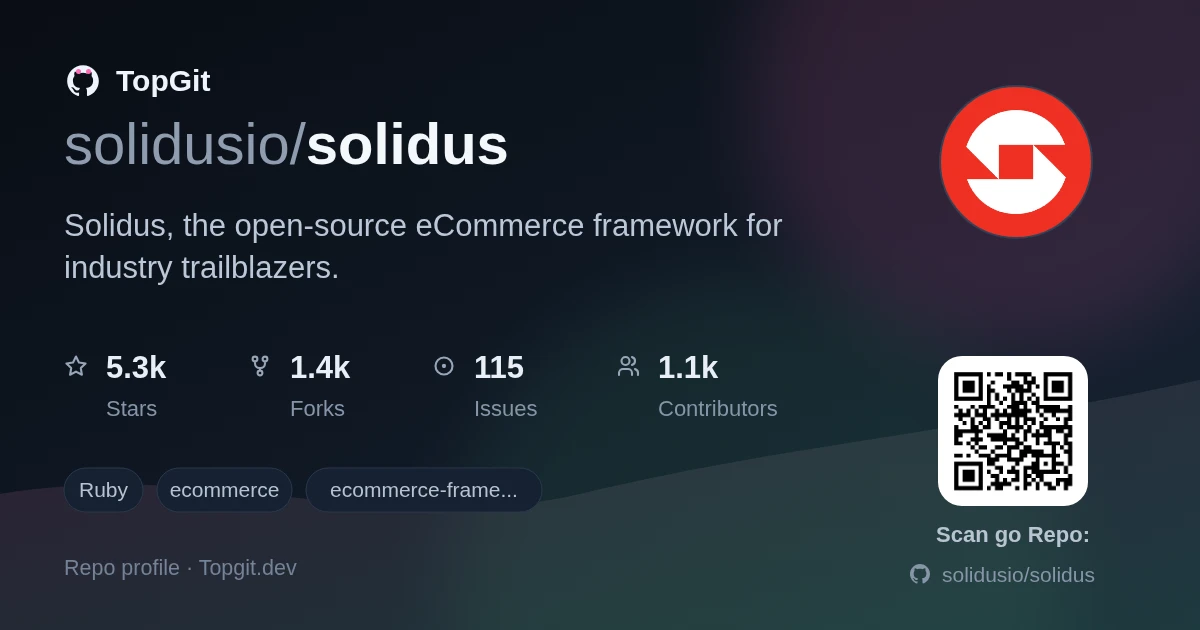
solidusio/solidus — dự án backend — đang có 5.3k sao GitHub trong nhóm Backend. 🛒 Solidus, the open-source eCommerce framework for industry trailblazers.
Tóm tắt dựng từ metadata GitHub của chính dự án — chưa có bài review TopGit. Trang sẽ tự động cập nhật khi bài review đầy đủ được xuất bản.
VÌ SAO CHƯA CÓ REVIEW
TopGit viết bài đầy đủ cho repo có nhiều sao nhất và được yêu cầu nhiều nhất. Trang này là snapshot trong thời gian chờ — xem README gốc ở tab READ ME.
A free, open-source e-commerce platform that gives you complete control over your store.
Visit our website: https://solidus.io/
Read our Community Guidelines: https://guides.solidus.io/policies/community-guidelines/
View the project roadmap: https://github.com/orgs/solidusio/projects/7
Read our guides: https://guides.solidus.io/
Join our Slack: http://slack.solidus.io/
Solidus Security: mailing list
Table of Contents
Supporting Solidus
Summary
Demo
Getting Started
Installation Options
Performance
Developing Solidus
Contributing
Supporting Solidus
As a community-driven project, Solidus relies on funds and time donated by developers and stakeholders who use Solidus for their businesses. If you'd like to help Solidus keep growing, please consider:
Become a backer or sponsor on Open Collective.
Contribute to the project.
Main Contributor & Director
At present, Nebulab is the main code contributor and director of Solidus, providing technical guidance and coordinating community efforts and activities.
Ambassadors
Support this project by becoming a Solidus Ambassador. Your logo will show up here with a link to your website. Become an Ambassador.
Summary
Solidus is a complete open source e-commerce solution built with Ruby on Rails.
It is a fork of Spree.
See the Solidus class documentation and the Solidus
Guides for information about the functionality that
Solidus provides.
Solidus consists of several gems. When you require the solidus gem in your
Gemfile, Bundler will install all of the following gems:
solidus_api (RESTful API)
solidus_backend (Admin area)
solidus_core (Essential models, mailers, and classes)
solidus_sample (Sample data)
All of the gems are designed to work together to provide a fully functional
e-commerce platform. However, you may only want to use the
solidus_core gem
combine it with your own custom frontend, admin interface, and API.
Demo
You can try the live Solidus demo here. The admin section can be accessed here.
Getting started
Begin by making sure you have
Imagemagick installed, which is
required for Paperclip. (You can install it using Homebrew if
you're on a Mac.)
To install Solidus with the current storefront, follow the instructions in
storefront/README.md.
Accessing Solidus Store
Start the Rails server with the command:
bin/rails s
The storefront will be accessible at
http://localhost:3000/ and the admin can be found at
http://localhost:3000/admin/.
For information on how to customize your store, check out the customization guides.
Default Username/Password
As part of running the above installation steps, you will be asked to set an admin email/password combination. The default values are [email protected] and test123, respectively.
Questions?
The best way to ask questions is to join the Solidus Slack and join the #support channel.
Installation options
Instead of a stable build, if you want to use the bleeding edge version of
Solidus, use this line:
gem 'solidus', github: 'solidusio/solidus'
Note: The master branch is not guaranteed to ever be in a fully functioning
state. It is too risky to use this branch in production.
By default, the installation generator (solidus:install) will run
migrations as well as adding seed and sample data. This can be disabled using
bin/rails g solidus:install --migrate=false --sample=false --seed=false
You can always perform any of these steps later by using these commands.
There are also options and rake tasks provided by
solidus_auth_devise.
Performance
You may notice that your Solidus store runs slowly in development mode. This
can be because in development each CSS and JavaScript is loaded as a separate
include. This can be disabled by adding the following to
config/environments/development.rb.
config.assets.debug = false
Turbolinks
To gain some extra speed you may enable Turbolinks inside of Solidus admin.
Add gem 'turbolinks', '~> 5.0.0' into your Gemfile (if not already present)
and change vendor/assets/javascripts/spree/backend/all.js as follows:
# sqlite
docker-compose exec app sqlite3 /path/to/db
# postgres
docker-compose exec app env PGPASSWORD=password psql -U root -h postgres
# mysql
docker-compose exec app mysql -u root -h mysql -ppassword
In order to be able to access the sandbox application, just make
sure to provide the appropriate --binding option to rails server. By
default, port 3000 is exposed, but you can change it through SANDBOX_PORT
environment variable:
Solidus is meant to be run within the context of Rails application. You can
easily create a sandbox application inside of your cloned source directory for
testing purposes.
This sandbox includes solidus_auth_devise and generates with seed and sample
data already loaded.
Create the sandbox application
bin/sandbox
You can create a sandbox with PostgreSQL, MySQL, or MariaDB by setting the DB environment variable.
# PostgreSQL
export DB=postgresql
bin/sandbox

# MySQL or MariaDB (mysql2 adapter)
export DB=mysql
bin/sandbox
Depending on your local environment, it may be necessary for you to set environment variables for your RDBMS, namely:
DB_HOST
DB_USER
DB_PASSWORD
If you need to create a Rails 5.2 application for your sandbox, for example
if you are still using Ruby 2.4 which is not supported by Rails 6, you can
use the RAILS_VERSION environment variable.
You can start the Rails server and other services from either the Solidus folder or the
sandbox one by running the command:
bin/dev
Please note: if you run bin/rails server or similar commands, only the Rails server will
start. This might cause the error couldn't find file 'solidus_admin/tailwind.css' when you
try to load all pages.
Tests
Solidus uses RSpec for tests. Refer to its documentation for
more information about the testing library.
CI/CD
We use GitHub Actions to run Solidus' test suites against all supported versions
of Ruby and Rails. Before a pull request can be merged, all of the tests must
pass.
You can see the build statuses on the repository's GitHub Actions
page.
Run all tests
ChromeDriver is required to run
the backend test suites.
To execute all of the test specs, run the bin/build script at the root of the Solidus project:
createuser --superuser --echo postgres # only the first time
bin/build
The bin/build script runs using PostgreSQL by default, but it can be overridden by setting the DB environment variable to DB=sqlite or DB=mysql (MariaDB uses DB=mysql). For example:
env DB=mysql bin/build
If the command fails with MySQL or MariaDB related errors you can try creating a user with this command:
# Creates a user with the same name as the current user and no restrictions.
mysql --user="root" --execute="CREATE USER '$USER'@'localhost'; GRANT ALL PRIVILEGES ON * . * TO '$USER'@'localhost';"
Run an individual test suite
Each gem contains its own series of tests. To run the tests for the core project:
cd core
bundle exec rspec
By default, rspec runs the tests for SQLite 3. If you would like to run specs
against another database you may specify the database in the command:
env DB=postgresql bundle exec rspec
Code coverage reports
If you want to run the SimpleCov code
coverage report:
COVERAGE=true bundle exec rspec
Extensions
In addition to core functionality provided in Solidus, there are a number of
ways to add features to your store that are not (or not yet) part of the core
project.
A list can be found at extensions.solidus.io.
If you want to write an extension for Solidus, you can use the
solidus_dev_support gem.
Contributing
Solidus is an open source project and we encourage contributions. Please read
CONTRIBUTING.md before contributing.
Trang TopGit này là một snapshot — tab "Readme" hiển thị nguyên văn README của repo (đã bỏ link, giữ ảnh). Repo GitHub ở github.com/solidusio/solidus là nguồn chính thức.
solidusio/solidus có những chủ đề gì?
GitHub topics của solidusio/solidus: "ecommerce", "ecommerce-framework", "ecommerce-platform", "hacktoberfest", "rails", "ruby", "solidus", "storefront". TopGit xếp repo vào nhóm Backend.
solidusio/solidus có phải mã nguồn mở không?
Có — solidusio/solidus phát hành theo license BSD-3-Clause, nghĩa là mã nguồn mở để đọc, fork và (tùy license) tái sử dụng. Mã: github.com/solidusio/solidus.
solidusio/solidus có trang demo không?
Dự án có trang chủ ở https://solidus.io. Tab "Readme" ở trang này thường có ảnh chụp và hướng dẫn bắt đầu nhanh.
solidusio/solidus còn đang phát triển không?
Commit gần nhất trên solidusio/solidus là 3 tháng trước (theo timestamp GitHub). Repo có 1.4k fork — một chỉ báo về mức độ quan tâm của cộng đồng.
solidusio/solidus dùng license gì?
solidusio/solidus phát hành theo license BSD-3-Clause. Nên mở file LICENSE trên GitHub để xác nhận — license metadata đôi khi lệch với thực tế dự án.
Đọc đầy đủ README ở tab phía trên.
Muốn nghe thêm một ý kiến về solidus?
Hỏi một AI đọc được trang này — một cú bấm là có ngay nhận định về solidus.

 /solidus