Được TopGit lập chỉ mục từ metadata GitHub: THU-MIG/yolov10 có 11.3k sao, viết chủ yếu bằng Python. YOLOv10: Real-Time End-to-End Object Detection [NeurIPS 2024]
Tóm tắt dựng từ metadata GitHub của chính dự án — chưa có bài review TopGit. Trang sẽ tự động cập nhật khi bài review đầy đủ được xuất bản.
VÌ SAO CHƯA CÓ REVIEW
TopGit viết bài đầy đủ cho repo có nhiều sao nhất và được yêu cầu nhiều nhất. Trang này là snapshot trong thời gian chờ — xem README gốc ở tab READ ME.
Comparison of performance, training cost, and inference efficiency between YOLOE (Ours) and YOLO-Worldv2 in terms of open text prompts.
YOLOE(ye) is a highly efficient, unified, and open object detection and segmentation model for real-time seeing anything, like human eye, under different prompt mechanisms, like texts, visual inputs, and prompt-free paradigm, with zero inference and transferring overhead compared with closed-set YOLOs.
Abstract
Object detection and segmentation are widely employed in computer vision applications, yet conventional models like YOLO series, while efficient and accurate, are limited by predefined categories, hindering adaptability in open scenarios. Recent open-set methods leverage text prompts, visual cues, or prompt-free paradigm to overcome this, but often compromise between performance and efficiency due to high computational demands or deployment complexity. In this work, we introduce YOLOE, which integrates detection and segmentation across diverse open prompt mechanisms within a single highly efficient model, achieving real-time seeing anything. For text prompts, we propose Re-parameterizable Region-Text Alignment (RepRTA) strategy. It refines pretrained textual embeddings via a re-parameterizable lightweight auxiliary network and enhances visual-textual alignment with zero inference and transferring overhead. For visual prompts, we present Semantic-Activated Visual Prompt Encoder (SAVPE). It employs decoupled semantic and activation branches to bring improved visual embedding and accuracy with minimal complexity. For prompt-free scenario, we introduce Lazy Region-Prompt Contrast (LRPC) strategy. It utilizes a built-in large vocabulary and specialized embedding to identify all objects, avoiding costly language model dependency. Extensive experiments show YOLOE's exceptional zero-shot performance and transferability with high inference efficiency and low training cost. Notably, on LVIS, with $3\times$ less training cost and $1.4\times$ inference speedup, YOLOE-v8-S surpasses YOLO-Worldv2-S by 3.5 AP. When transferring to COCO, YOLOE-v8-L achieves 0.6 $AP^b$ and 0.4 $AP^m$ gains over closed-set YOLOv8-L with nearly $4\times$ less training time.
YOLOv10: Real-Time End-to-End Object Detection
Official PyTorch implementation of YOLOv10. NeurIPS 2024.
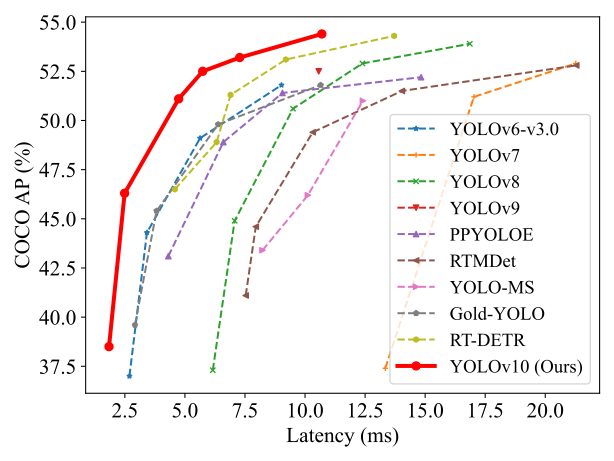
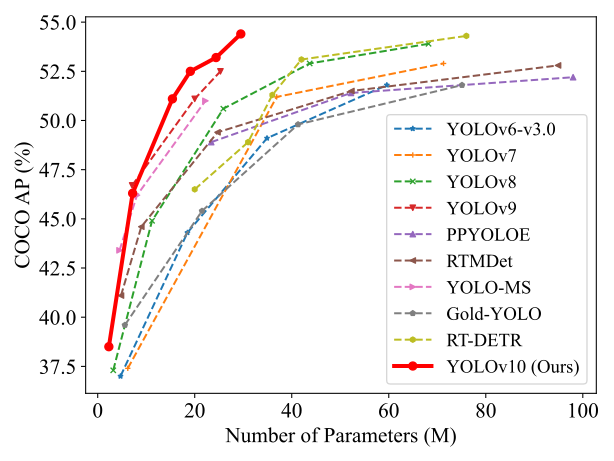
Comparisons with others in terms of latency-accuracy (left) and size-accuracy (right) trade-offs.
YOLOv10: Real-Time End-to-End Object Detection.
Ao Wang, Hui Chen, Lihao Liu, Kai Chen, Zijia Lin, Jungong Han, and Guiguang Ding
Abstract
Over the past years, YOLOs have emerged as the predominant paradigm in the field of real-time object detection owing to their effective balance between computational cost and detection performance. Researchers have explored the architectural designs, optimization objectives, data augmentation strategies, and others for YOLOs, achieving notable progress. However, the reliance on the non-maximum suppression (NMS) for post-processing hampers the end-to-end deployment of YOLOs and adversely impacts the inference latency. Besides, the design of various components in YOLOs lacks the comprehensive and thorough inspection, resulting in noticeable computational redundancy and limiting the model's capability. It renders the suboptimal efficiency, along with considerable potential for performance improvements. In this work, we aim to further advance the performance-efficiency boundary of YOLOs from both the post-processing and the model architecture. To this end, we first present the consistent dual assignments for NMS-free training of YOLOs, which brings the competitive performance and low inference latency simultaneously. Moreover, we introduce the holistic efficiency-accuracy driven model design strategy for YOLOs. We comprehensively optimize various components of YOLOs from both the efficiency and accuracy perspectives, which greatly reduces the computational overhead and enhances the capability. The outcome of our effort is a new generation of YOLO series for real-time end-to-end object detection, dubbed YOLOv10. Extensive experiments show that YOLOv10 achieves the state-of-the-art performance and efficiency across various model scales. For example, our YOLOv10-S is 1.8$\times$ faster than RT-DETR-R18 under the similar AP on COCO, meanwhile enjoying 2.8$\times$ smaller number of parameters and FLOPs. Compared with YOLOv9-C, YOLOv10-B has 46\% less latency and 25\% fewer parameters for the same performance.
Notes
2024/05/31: Please use the exported format for benchmark. In the non-exported format, e.g., pytorch, the speed of YOLOv10 is biased because the unnecessary cv2 and cv3 operations in the v10Detect are executed during inference.
2024/05/30: We provide some clarifications and suggestions for detecting smaller objects or objects in the distance with YOLOv10. Thanks to SkalskiP!
2024/05/27: We have updated the checkpoints with class names, for ease of use.
UPDATES 🔥
2024/06/01: Thanks to ErlanggaYudiPradana for the integration with C++ | OpenVINO | OpenCV
2024/06/01: Thanks to NielsRogge and AK for hosting the models on the HuggingFace Hub!
2024/05/31: Build yolov10-jetson docker image by youjiang!
2024/05/31: Thanks to mohamedsamirx for the integration with BoTSORT, DeepOCSORT, OCSORT, HybridSORT, ByteTrack, StrongSORT using BoxMOT library!
2024/05/31: Thanks to kaylorchen for the integration with rk3588!
2024/05/30: Thanks to eaidova for the integration with OpenVINO™!
2024/05/29: Add the gradio demo for running the models locally. Thanks to AK!
2024/05/27: Thanks to sujanshresstha for the integration with DeepSORT!
2024/05/26: Thanks to CVHub520 for the integration into X-AnyLabeling!
2024/05/26: Thanks to DanielSarmiento04 for integrate in c++ | ONNX | OPENCV!
2024/05/25: Add Transformers.js demo and onnx weights(yolov10n/s/m/b/l/x). Thanks to xenova!
2024/05/25: Add colab demo, HuggingFace Demo, and HuggingFace Model Page. Thanks to SkalskiP and kadirnar!
yolo val model=jameslahm/yolov10{n/s/m/b/l/x} data=coco.yaml batch=256
Or
from ultralytics import YOLOv10

model = YOLOv10.from_pretrained('jameslahm/yolov10{n/s/m/b/l/x}')
# or
# wget https://github.com/THU-MIG/yolov10/releases/download/v1.1/yolov10{n/s/m/b/l/x}.pt
model = YOLOv10('yolov10{n/s/m/b/l/x}.pt')

model.val(data='coco.yaml', batch=256)
from ultralytics import YOLOv10

model = YOLOv10()
# If you want to finetune the model with pretrained weights, you could load the
# pretrained weights like below
# model = YOLOv10.from_pretrained('jameslahm/yolov10{n/s/m/b/l/x}')
# or
# wget https://github.com/THU-MIG/yolov10/releases/download/v1.1/yolov10{n/s/m/b/l/x}.pt
# model = YOLOv10('yolov10{n/s/m/b/l/x}.pt')

model.train(data='coco.yaml', epochs=500, batch=256, imgsz=640)
Push to hub to 🤗
Optionally, you can push your fine-tuned model to the Hugging Face hub as a public or private model:
# let's say you have fine-tuned a model for crop detection
model.push_to_hub("<your-hf-username-or-organization/yolov10-finetuned-crop-detection")

# you can also pass `private=True` if you don't want everyone to see your model
model.push_to_hub("<your-hf-username-or-organization/yolov10-finetuned-crop-detection", private=True)
Prediction
Note that a smaller confidence threshold can be set to detect smaller objects or objects in the distance. Please refer to here for details.
yolo predict model=jameslahm/yolov10{n/s/m/b/l/x}
Or
from ultralytics import YOLOv10

model = YOLOv10.from_pretrained('jameslahm/yolov10{n/s/m/b/l/x}')
# or
# wget https://github.com/THU-MIG/yolov10/releases/download/v1.1/yolov10{n/s/m/b/l/x}.pt
model = YOLOv10('yolov10{n/s/m/b/l/x}.pt')

model.predict()
from ultralytics import YOLOv10

model = YOLOv10.from_pretrained('jameslahm/yolov10{n/s/m/b/l/x}')
# or
# wget https://github.com/THU-MIG/yolov10/releases/download/v1.1/yolov10{n/s/m/b/l/x}.pt
model = YOLOv10('yolov10{n/s/m/b/l/x}.pt')

model.export(...)
Acknowledgement
The code base is built with ultralytics and RT-DETR.
Thanks for the great implementations!
Citation
If our code or models help your work, please cite our paper:
@article{wang2024yolov10,
  title={YOLOv10: Real-Time End-to-End Object Detection},
  author={Wang, Ao and Chen, Hui and Liu, Lihao and Chen, Kai and Lin, Zijia and Han, Jungong and Ding, Guiguang},
  journal={arXiv preprint arXiv:2405.14458},
  year={2024}
}
Trang TopGit này là một snapshot — tab "Readme" hiển thị nguyên văn README của repo (đã bỏ link, giữ ảnh). Repo GitHub ở github.com/THU-MIG/yolov10 là nguồn chính thức.
THU-MIG/yolov10 có bao nhiêu sao?
THU-MIG/yolov10 có 11.3k sao GitHub — tải lại trang để xem số mới nhất, hoặc xem trực tiếp github.com/THU-MIG/yolov10. TopGit phản chiếu số sao của GitHub nhưng không cam kết đến từng phút.
THU-MIG/yolov10 có phải mã nguồn mở không?
Có — THU-MIG/yolov10 phát hành theo license AGPL-3.0, nghĩa là mã nguồn mở để đọc, fork và (tùy license) tái sử dụng. Mã: github.com/THU-MIG/yolov10.
THU-MIG/yolov10 còn đang phát triển không?
Commit gần nhất trên THU-MIG/yolov10 là 1.4 năm trước (theo timestamp GitHub). Repo có 1.2k fork — một chỉ báo về mức độ quan tâm của cộng đồng.
THU-MIG/yolov10 là gì?
THU-MIG/yolov10 (THU-MIG/yolov10) là dự án Python trên GitHub. Theo mô tả gốc: YOLOv10: Real-Time End-to-End Object Detection [NeurIPS 2024]
THU-MIG/yolov10 so với các dự án Developer Tools khác thế nào?
THU-MIG/yolov10 được TopGit xếp vào nhóm Developer Tools, với 11.3k sao GitHub và viết bằng Python. Xem trang chủ đề Developer Tools trên TopGit để so sánh với các dự án tương tự theo số sao và mức độ hoạt động.
Đọc đầy đủ README ở tab phía trên.
yolov10 có đáng để bạn bỏ thời gian?
ChatGPT, Claude và Perplexity đều đọc được trang này. Hỏi thử xem họ nghĩ gì về yolov10.
 /yolov10