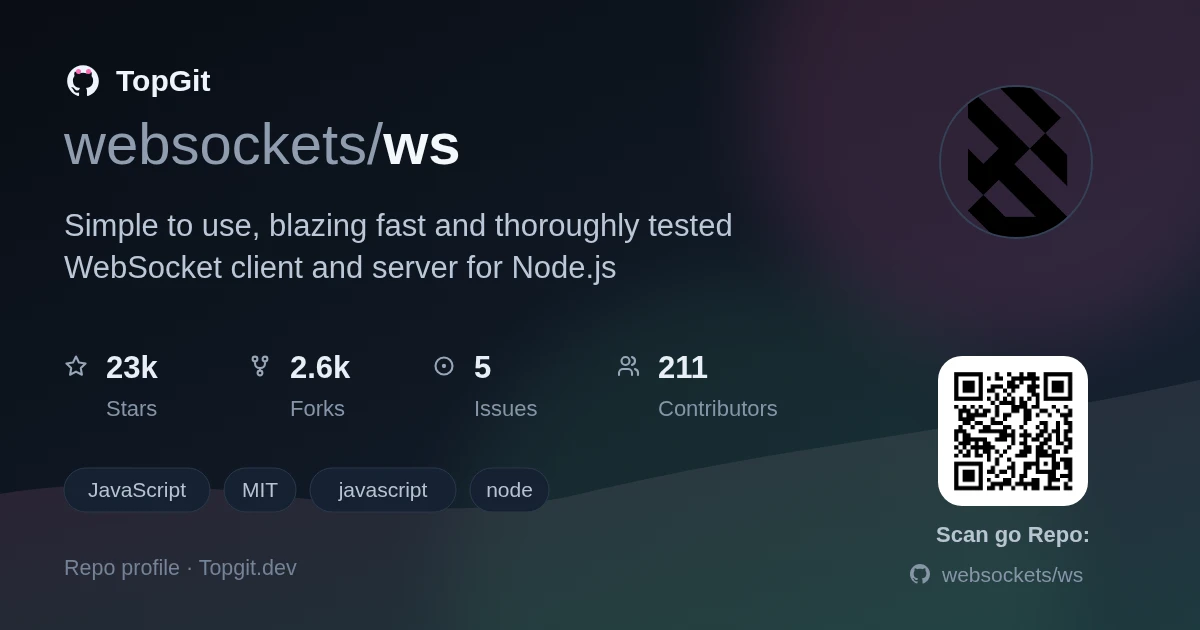
websockets/ws là một trong những repo phía máy chủ mà TopGit theo dõi, hiện có 22.8k sao, viết chủ yếu bằng JavaScript. Simple to use, blazing fast and thoroughly tested WebSocket client and server for Node.js
Tóm tắt dựng từ metadata GitHub của chính dự án — chưa có bài review TopGit. Trang sẽ tự động cập nhật khi bài review đầy đủ được xuất bản.
VÌ SAO CHƯA CÓ REVIEW
TopGit viết bài đầy đủ cho repo có nhiều sao nhất và được yêu cầu nhiều nhất. Trang này là snapshot trong thời gian chờ — xem README gốc ở tab READ ME.
ws is a simple to use, blazing fast, and thoroughly tested WebSocket client and
server implementation.
Passes the quite extensive Autobahn test suite: server,
client.
Note: This module does not work in the browser. The client in the docs is a
reference to a backend with the role of a client in the WebSocket communication.
Browser clients must use the native
WebSocket
object. To make the same code work seamlessly on Node.js and the browser, you
can use one of the many wrappers available on npm, like
isomorphic-ws.
Table of Contents
Protocol support
Installing
Opt-in for performance
Legacy opt-in for performance
API docs
WebSocket compression
Usage examples
Sending and receiving text data
Sending binary data
Simple server
External HTTP/S server
Multiple servers sharing a single HTTP/S server
Client authentication
Server broadcast
Round-trip time
Use the Node.js streams API
Other examples
FAQ
How to get the IP address of the client?
How to detect and close broken connections?
How to connect via a proxy?
Changelog
License
Protocol support
HyBi drafts 07-12 (Use the option protocolVersion: 8)
bufferutil is an optional module that can be installed alongside the ws
module:
npm install --save-optional bufferutil
This is a binary addon that improves the performance of certain operations such
as masking and unmasking the data payload of the WebSocket frames. Prebuilt
binaries are available for the most popular platforms, so you don't necessarily
need to have a C++ compiler installed on your machine.
To force ws to not use bufferutil, use the
WS_NO_BUFFER_UTIL environment variable. This
can be useful to enhance security in systems where a user can put a package in
the package search path of an application of another user, due to how the
Node.js resolver algorithm works.
Legacy opt-in for performance
If you are running on an old version of Node.js (prior to v18.14.0), ws also
supports the utf-8-validate module:
npm install --save-optional utf-8-validate
This contains a binary polyfill for buffer.isUtf8().
To force ws not to use utf-8-validate, use the
WS_NO_UTF_8_VALIDATE environment variable.
API docs
See /doc/ws.md for Node.js-like documentation of ws classes and
utility functions.
WebSocket compression
ws supports the permessage-deflate extension which enables
the client and server to negotiate a compression algorithm and its parameters,
and then selectively apply it to the data payloads of each WebSocket message.
The extension is disabled by default on the server and enabled by default on the
client. It adds a significant overhead in terms of performance and memory
consumption so we suggest to enable it only if it is really needed.
Note that Node.js has a variety of issues with high-performance compression,
where increased concurrency, especially on Linux, can lead to catastrophic
memory fragmentation and slow performance. If you intend to use
permessage-deflate in production, it is worthwhile to set up a test
representative of your workload and ensure Node.js/zlib will handle it with
acceptable performance and memory usage.
Tuning of permessage-deflate can be done via the options defined below. You can
also use zlibDeflateOptions and zlibInflateOptions, which is passed directly
into the creation of raw deflate/inflate streams.
See the docs for more options.
import WebSocket, { WebSocketServer } from 'ws';

const wss = new WebSocketServer({
  port: 8080,
  perMessageDeflate: {
    zlibDeflateOptions: {
      // See zlib defaults.
      chunkSize: 1024,
      memLevel: 7,
      level: 3
    },
    zlibInflateOptions: {
      chunkSize: 10 * 1024
    },
    // Other options settable:
    clientNoContextTakeover: true, // Defaults to negotiated value.
    serverNoContextTakeover: true, // Defaults to negotiated value.
    serverMaxWindowBits: 10, // Defaults to negotiated value.
    // Below options specified as default values.
    concurrencyLimit: 10, // Limits zlib concurrency for perf.
    threshold: 1024 // Size (in bytes) below which messages
    // should not be compressed if context takeover is disabled.
  }
});
The client will only use the extension if it is supported and enabled on the
server. To always disable the extension on the client, set the
perMessageDeflate option to false.
import WebSocket from 'ws';

const ws = new WebSocket('ws://www.host.com/path', {
  perMessageDeflate: false
});
Usage examples
Sending and receiving text data
import WebSocket from 'ws';

const ws = new WebSocket('ws://www.host.com/path');

ws.on('error', console.error);

ws.on('open', function open() {
  ws.send('something');
});

ws.on('message', function message(data) {
  console.log('received: %s', data);
});
Sending binary data
import WebSocket from 'ws';

const ws = new WebSocket('ws://www.host.com/path');

ws.on('error', console.error);

ws.on('open', function open() {
  const array = new Float32Array(5);

  for (var i = 0; i < array.length; ++i) {
    array[i] = i / 2;
  }

  ws.send(array);
});
Simple server
import { WebSocketServer } from 'ws';

const wss = new WebSocketServer({ port: 8080 });

wss.on('connection', function connection(ws) {
  ws.on('error', console.error);

  ws.on('message', function message(data) {
    console.log('received: %s', data);
  });

  ws.send('something');
});
External HTTP/S server
import { createServer } from 'https';
import { readFileSync } from 'fs';
import { WebSocketServer } from 'ws';

const server = createServer({
  cert: readFileSync('/path/to/cert.pem'),
  key: readFileSync('/path/to/key.pem')
});
const wss = new WebSocketServer({ server });

wss.on('connection', function connection(ws) {
  ws.on('error', console.error);

  ws.on('message', function message(data) {
    console.log('received: %s', data);
  });

  ws.send('something');
});

server.listen(8080);
Multiple servers sharing a single HTTP/S server
import { createServer } from 'http';
import { WebSocketServer } from 'ws';

const server = createServer();
const wss1 = new WebSocketServer({ noServer: true });
const wss2 = new WebSocketServer({ noServer: true });

wss1.on('connection', function connection(ws) {
  ws.on('error', console.error);

  // ...
});

wss2.on('connection', function connection(ws) {
  ws.on('error', console.error);

  // ...
});

server.on('upgrade', function upgrade(request, socket, head) {
  const { pathname } = new URL(request.url, 'wss://base.url');

  if (pathname === '/foo') {
    wss1.handleUpgrade(request, socket, head, function done(ws) {
      wss1.emit('connection', ws, request);
    });
  } else if (pathname === '/bar') {
    wss2.handleUpgrade(request, socket, head, function done(ws) {
      wss2.emit('connection', ws, request);
    });
  } else {
    socket.destroy();
  }
});

server.listen(8080);
Client authentication
import { createServer } from 'http';
import { WebSocketServer } from 'ws';

function onSocketError(err) {
  console.error(err);
}

const server = createServer();
const wss = new WebSocketServer({ noServer: true });

wss.on('connection', function connection(ws, request, client) {
  ws.on('error', console.error);

  ws.on('message', function message(data) {
    console.log(`Received message ${data} from user ${client}`);
  });
});

server.on('upgrade', function upgrade(request, socket, head) {
  socket.on('error', onSocketError);

  // This function is not defined on purpose. Implement it with your own logic.
  authenticate(request, function next(err, client) {
    if (err || !client) {
      socket.write('HTTP/1.1 401 Unauthorized\r\n\r\n');
      socket.destroy();
      return;
    }

    socket.removeListener('error', onSocketError);

    wss.handleUpgrade(request, socket, head, function done(ws) {
      wss.emit('connection', ws, request, client);
    });
  });
});

server.listen(8080);
Also see the provided example using express-session.
Server broadcast
A client WebSocket broadcasting to all connected WebSocket clients, including
itself.
import WebSocket, { WebSocketServer } from 'ws';

const wss = new WebSocketServer({ port: 8080 });

wss.on('connection', function connection(ws) {
  ws.on('error', console.error);

  ws.on('message', function message(data, isBinary) {
    wss.clients.forEach(function each(client) {
      if (client.readyState === WebSocket.OPEN) {
        client.send(data, { binary: isBinary });
      }
    });
  });
});
A client WebSocket broadcasting to every other connected WebSocket clients,
excluding itself.
import WebSocket, { WebSocketServer } from 'ws';

const wss = new WebSocketServer({ port: 8080 });

wss.on('connection', function connection(ws) {
  ws.on('error', console.error);

  ws.on('message', function message(data, isBinary) {
    wss.clients.forEach(function each(client) {
      if (client !== ws && client.readyState === WebSocket.OPEN) {
        client.send(data, { binary: isBinary });
      }
    });
  });
});
Round-trip time
import WebSocket from 'ws';

const ws = new WebSocket('wss://websocket-echo.com/');

ws.on('error', console.error);

ws.on('open', function open() {
  console.log('connected');
  ws.send(Date.now());
});

ws.on('close', function close() {
  console.log('disconnected');
});

ws.on('message', function message(data) {
  console.log(`Round-trip time: ${Date.now() - data} ms`);

  setTimeout(function timeout() {
    ws.send(Date.now());
  }, 500);
});
For a full example with a browser client communicating with a ws server, see the
examples folder.
Otherwise, see the test cases.
FAQ
How to get the IP address of the client?
The remote IP address can be obtained from the raw socket.
import { WebSocketServer } from 'ws';

const wss = new WebSocketServer({ port: 8080 });

wss.on('connection', function connection(ws, req) {
  const ip = req.socket.remoteAddress;

  ws.on('error', console.error);
});
When the server runs behind a proxy like NGINX, the de-facto standard is to use
the X-Forwarded-For header.
wss.on('connection', function connection(ws, req) {
  const ip = req.headers['x-forwarded-for'].split(',')[0].trim();

  ws.on('error', console.error);
});
How to detect and close broken connections?
Sometimes, the link between the server and the client can be interrupted in a
way that keeps both the server and the client unaware of the broken state of the
connection (e.g. when pulling the cord).
In these cases, ping messages can be used as a means to verify that the remote
endpoint is still responsive.
Pong messages are automatically sent in response to ping messages as required by
the spec.
Just like the server example above, your clients might as well lose connection
without knowing it. You might want to add a ping listener on your clients to
prevent that. A simple implementation would be:
import WebSocket from 'ws';

function heartbeat() {
  clearTimeout(this.pingTimeout);

  // Use `WebSocket#terminate()`, which immediately destroys the connection,
  // instead of `WebSocket#close()`, which waits for the close timer.
  // Delay should be equal to the interval at which your server
  // sends out pings plus a conservative assumption of the latency.
  this.pingTimeout = setTimeout(() => {
    this.terminate();
  }, 30000 + 1000);
}

const client = new WebSocket('wss://websocket-echo.com/');

client.on('error', console.error);
client.on('open', heartbeat);
client.on('ping', heartbeat);
client.on('close', function clear() {
  clearTimeout(this.pingTimeout);
});
How to connect via a proxy?
Use a custom http.Agent implementation like https-proxy-agent or
socks-proxy-agent.
Changelog
We're using the GitHub releases for changelog entries.
websockets/ws thuộc nhóm Backend trên TopGit, cùng 9 topic GitHub. Trang Trending và Topics liệt kê các repo cùng số sao và cùng ngôn ngữ để so sánh.
Đọc thêm về websockets/ws ở đâu?
Trang TopGit này là một snapshot — tab "Readme" hiển thị nguyên văn README của repo (đã bỏ link, giữ ảnh). Repo GitHub ở github.com/websockets/ws là nguồn chính thức.
Vì sao websockets/ws được xếp vào nhóm Backend?
TopGit xếp websockets/ws vào nhóm Backend dựa trên GitHub topics và mô tả của repo (gắn thẻ: "javascript", "node", "nodejs"). Việc phân loại dựa trên metadata thật của repo, không phải đoán theo cảm tính biên tập.
websockets/ws có bao nhiêu sao?
websockets/ws có 22.8k sao GitHub — tải lại trang để xem số mới nhất, hoặc xem trực tiếp github.com/websockets/ws. TopGit phản chiếu số sao của GitHub nhưng không cam kết đến từng phút.
websockets/ws có những chủ đề gì?
GitHub topics của websockets/ws: "javascript", "node", "nodejs", "real-time", "rfc-6455", "websocket", "websocket-client", "websocket-compression", "websocket-server". TopGit xếp repo vào nhóm Backend.
websockets/ws còn đang phát triển không?
Commit gần nhất trên websockets/ws là 1 tháng trước (theo timestamp GitHub). Repo có 2.6k fork — một chỉ báo về mức độ quan tâm của cộng đồng.
websockets/ws viết bằng ngôn ngữ gì?
websockets/ws chủ yếu viết bằng JavaScript. Trường "language" của GitHub dựa trên phần lớn byte ở nhánh mặc định.
Đọc đầy đủ README ở tab phía trên.
Chưa chắc ws có hợp với bạn?
Để ChatGPT, Claude hoặc Perplexity tìm hiểu giúp — bấm bên dưới và xem AI nói gì về ws.
 /ws
/ws