Điểm qua yenchenlin/DeepLearningFlappyBird: 6.8k sao trên GitHub, viết chủ yếu bằng Python, thuộc nhóm AI Tools. Flappy Bird hack using Deep Reinforcement Learning (Deep Q-learning).
Tóm tắt dựng từ metadata GitHub của chính dự án — chưa có bài review TopGit. Trang sẽ tự động cập nhật khi bài review đầy đủ được xuất bản.
VÌ SAO CHƯA CÓ REVIEW
TopGit viết bài đầy đủ cho repo có nhiều sao nhất và được yêu cầu nhiều nhất. Trang này là snapshot trong thời gian chờ — xem README gốc ở tab READ ME.
Using Deep Q-Network to Learn How To Play Flappy Bird
7 mins version: DQN for flappy bird
Overview
This project follows the description of the Deep Q Learning algorithm described in Playing Atari with Deep Reinforcement Learning [2] and shows that this learning algorithm can be further generalized to the notorious Flappy Bird.
Installation Dependencies:
Python 2.7 or 3
TensorFlow 0.7
pygame
OpenCV-Python
How to Run?
git clone https://github.com/yenchenlin1994/DeepLearningFlappyBird.git
cd DeepLearningFlappyBird
python deep_q_network.py
What is Deep Q-Network?
It is a convolutional neural network, trained with a variant of Q-learning, whose input is raw pixels and whose output is a value function estimating future rewards.
For those who are interested in deep reinforcement learning, I highly recommend to read the following post:
Demystifying Deep Reinforcement Learning
Deep Q-Network Algorithm
The pseudo-code for the Deep Q Learning algorithm, as given in [1], can be found below:
Initialize replay memory D to size N
Initialize action-value function Q with random weights
for episode = 1, M do
    Initialize state s_1
    for t = 1, T do
        With probability ϵ select random action a_t
        otherwise select a_t=max_a  Q(s_t,a; θ_i)
        Execute action a_t in emulator and observe r_t and s_(t+1)
        Store transition (s_t,a_t,r_t,s_(t+1)) in D
        Sample a minibatch of transitions (s_j,a_j,r_j,s_(j+1)) from D
        Set y_j:=
            r_j for terminal s_(j+1)
            r_j+γ*max_(a^' )  Q(s_(j+1),a'; θ_i) for non-terminal s_(j+1)
        Perform a gradient step on (y_j-Q(s_j,a_j; θ_i))^2 with respect to θ
    end for
end for
Experiments
Environment
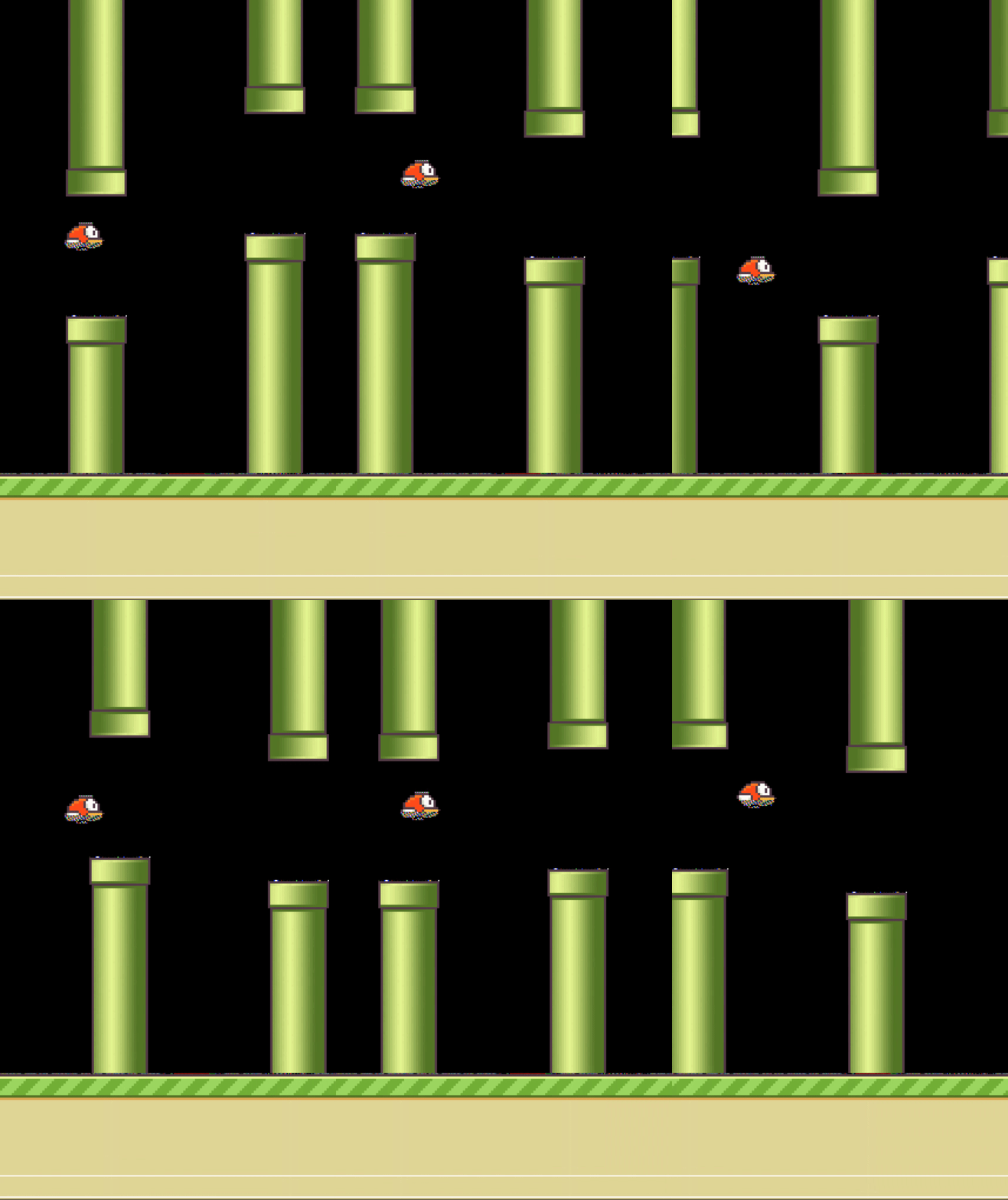
Since deep Q-network is trained on the raw pixel values observed from the game screen at each time step, [3] finds that remove the background appeared in the original game can make it converge faster. This process can be visualized as the following figure:
Network Architecture
According to [1], I first preprocessed the game screens with following steps:
Convert image to grayscale
Resize image to 80x80
Stack last 4 frames to produce an 80x80x4 input array for network
The architecture of the network is shown in the figure below. The first layer convolves the input image with an 8x8x4x32 kernel at a stride size of 4. The output is then put through a 2x2 max pooling layer. The second layer convolves with a 4x4x32x64 kernel at a stride of 2. We then max pool again. The third layer convolves with a 3x3x64x64 kernel at a stride of 1. We then max pool one more time. The last hidden layer consists of 256 fully connected ReLU nodes.
The final output layer has the same dimensionality as the number of valid actions which can be performed in the game, where the 0th index always corresponds to doing nothing. The values at this output layer represent the Q function given the input state for each valid action. At each time step, the network performs whichever action corresponds to the highest Q value using a ϵ greedy policy.
Training
At first, I initialize all weight matrices randomly using a normal distribution with a standard deviation of 0.01, then set the replay memory with a max size of 500,00 experiences.
I start training by choosing actions uniformly at random for the first 10,000 time steps, without updating the network weights. This allows the system to populate the replay memory before training begins.
Note that unlike [1], which initialize ϵ = 1, I linearly anneal ϵ from 0.1 to 0.0001 over the course of the next 3000,000 frames. The reason why I set it this way is that agent can choose an action every 0.03s (FPS=30) in our game, high ϵ will make it flap too much and thus keeps itself at the top of the game screen and finally bump the pipe in a clumsy way. This condition will make Q function converge relatively slow since it only start to look other conditions when ϵ is low.
However, in other games, initialize ϵ to 1 is more reasonable.
During training time, at each time step, the network samples minibatches of size 32 from the replay memory to train on, and performs a gradient step on the loss function described above using the Adam optimization algorithm with a learning rate of 0.000001. After annealing finishes, the network continues to train indefinitely, with ϵ fixed at 0.001.
[1] Mnih Volodymyr, Koray Kavukcuoglu, David Silver, Andrei A. Rusu, Joel Veness, Marc G. Bellemare, Alex Graves, Martin Riedmiller, Andreas K. Fidjeland, Georg Ostrovski, Stig Petersen, Charles Beattie, Amir Sadik, Ioannis Antonoglou, Helen King, Dharshan Kumaran, Daan Wierstra, Shane Legg, and Demis Hassabis. Human-level Control through Deep Reinforcement Learning. Nature, 529-33, 2015.
[2] Volodymyr Mnih, Koray Kavukcuoglu, David Silver, Alex Graves, Ioannis Antonoglou, Daan Wierstra, and Martin Riedmiller. Playing Atari with Deep Reinforcement Learning. NIPS, Deep Learning workshop
[3] Kevin Chen. Deep Reinforcement Learning for Flappy Bird Report | Youtube result
Đọc thêm về yenchenlin/DeepLearningFlappyBird ở đâu?
Trang TopGit này là một snapshot — tab "Readme" hiển thị nguyên văn README của repo (đã bỏ link, giữ ảnh). Repo GitHub ở github.com/yenchenlin/DeepLearningFlappyBird là nguồn chính thức.
yenchenlin/DeepLearningFlappyBird có những chủ đề gì?
GitHub topics của yenchenlin/DeepLearningFlappyBird: "deep-learning", "deep-reinforcement-learning", "game". TopGit xếp repo vào nhóm AI Tools.
yenchenlin/DeepLearningFlappyBird có phải mã nguồn mở không?
Có — yenchenlin/DeepLearningFlappyBird phát hành theo license MIT, nghĩa là mã nguồn mở để đọc, fork và (tùy license) tái sử dụng. Mã: github.com/yenchenlin/DeepLearningFlappyBird.
yenchenlin/DeepLearningFlappyBird có website riêng không?
TopGit chưa ghi nhận URL trang chủ cho yenchenlin/DeepLearningFlappyBird. Phần README ở tab phía trên thường có link demo, hoặc xem mô tả GitHub của repo.
yenchenlin/DeepLearningFlappyBird còn đang phát triển không?
Commit gần nhất trên yenchenlin/DeepLearningFlappyBird là 2.3 năm trước (theo timestamp GitHub). Repo có 2.1k fork — một chỉ báo về mức độ quan tâm của cộng đồng.
yenchenlin/DeepLearningFlappyBird dùng license gì?
yenchenlin/DeepLearningFlappyBird phát hành theo license MIT. Nên mở file LICENSE trên GitHub để xác nhận — license metadata đôi khi lệch với thực tế dự án.
Đọc đầy đủ README ở tab phía trên.
Vẫn đang phân vân về DeepLearningFlappyBird?
Một cú bấm sẽ gửi câu hỏi kèm trang này cho AI — xem AI nói gì về DeepLearningFlappyBird.

 /DeepLearningFlappyBird