
yzhao062/anywhere-agents

yzhao062/anywhere-agents — dự án mã nguồn mở — đang có 263 sao GitHub. One config to rule all your AI agents: portable (every project, every session), effective (curated writing, routing, skills), and safer (destructive-command guard).
Tóm tắt dựng từ metadata GitHub của chính dự án — chưa có bài review TopGit. Trang sẽ tự động cập nhật khi bài review đầy đủ được xuất bản.
TopGit viết bài đầy đủ cho repo có nhiều sao nhất và được yêu cầu nhiều nhất. Trang này là snapshot trong thời gian chờ — xem README gốc ở tab READ ME.
Snapshot
Cộng tác viên hàng đầu
Xem cộng tác viên hàng đầu

English · 中文
anywhere-agents
One config for every agent — Claude Code, Codex, and whatever comes next.
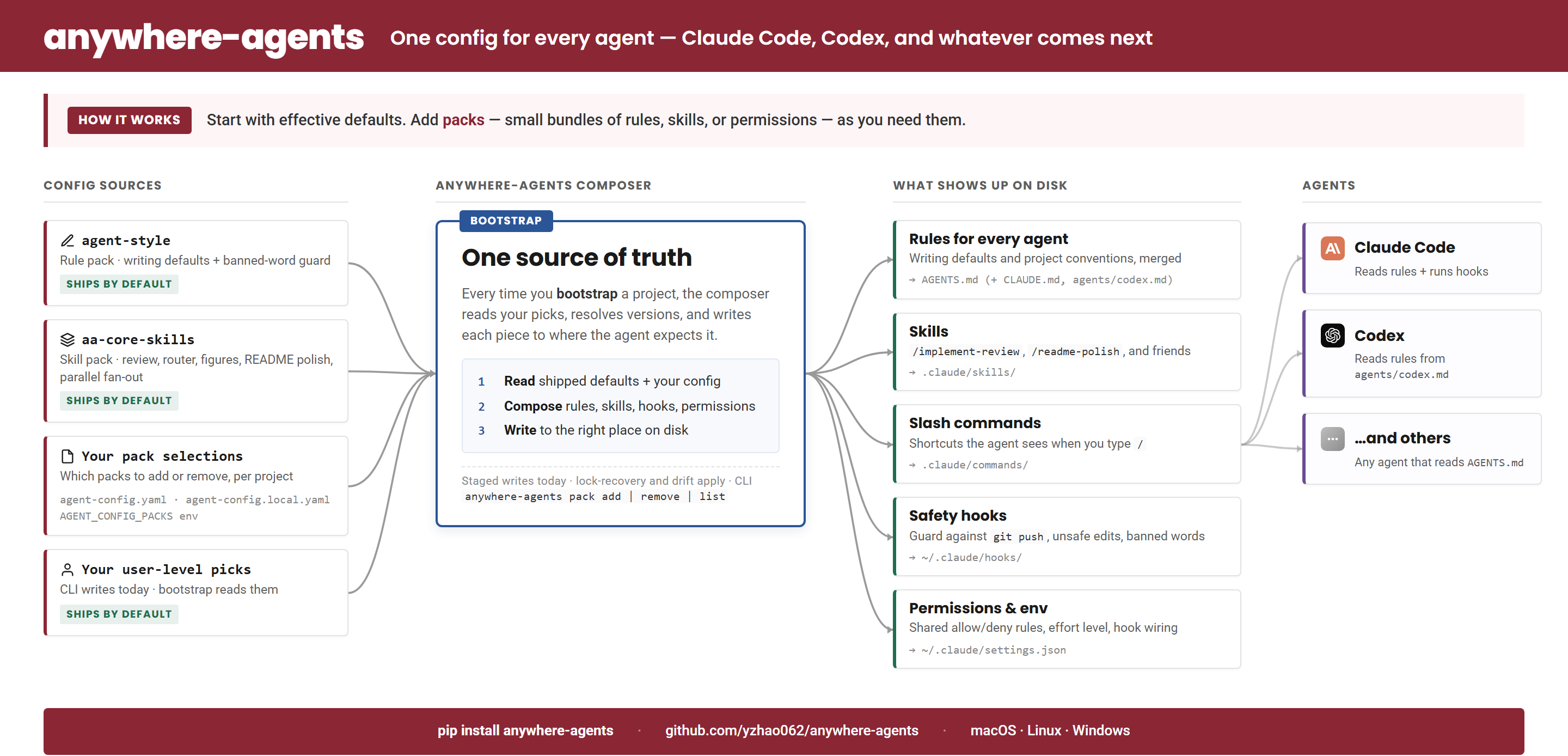
Start with effective defaults. Add packs, small bundles of rules, skills, or permissions, as you need them. One AGENTS.md drives every agent in every repo on every machine.





Install • Why • How it works • Pack CLI • Docs • Fork
[!NOTE] Condensed from daily use. The sanitized public release of the agent config I have run daily since early 2026 across research, paper writing, and dev work (PyOD 3, LaTeX, admin) on macOS, Windows, and Linux. Not a weekend project. Maintained by Yue Zhao — USC CS faculty and author of PyOD (9.8k★ · 38M+ downloads · ~12k citations).
[!IMPORTANT] Highly customized. The defaults are my own working setup, shipped as is: which agent reviews, which model and effort level run each role (
user/agent-models.json), including the model Claude Code consults as its advisor, and which gates are on. Read them before you rely on them, then override what does not fit inAGENTS.local.mdand your own settings, or fork. Each advisor call rereads the whole conversation and is billed on top of the main model: against a subscription's usage limits, at API rates, or to usage credits on plans where the advisor's model bills there. To turn the advisor off on a machine, setCLAUDE_CODE_DISABLE_ADVISOR_TOOL=1in theenvblock of~/.claude/settings.json;/advisor offlasts only until the next bootstrap.
Why You'd Use This
Four problems this fixes:
You use more than one agent. Claude Code at work, Codex on personal projects, Cursor on the side. Without anywhere-agents, three configs to keep in sync. With it, one AGENTS.md drives all three.
You work across many repos. Every new project repeats the same setup ritual: writing-style rules, permission policies, custom skills. Without anywhere-agents, you copy-paste between repos and watch them drift. With it, bootstrap pulls shared defaults and layers repo-local overrides on top.
You want a review loop before you push. anywhere-agents ships /implement-review and its short alias /vet, which hand your staged diff to a second reviewer from another model family. Codex stays the no-argument default; /vet agy selects Gemini through the official Antigravity CLI, with headless Claude Code also available. Every automated backend can run tests, experiments, shell commands, and network verification without interactive permission gates. Without it, you wire reviewer CLIs per project. With it, the skill is present the first time you bootstrap.
You want your agents to follow writing conventions automatically. The default agent-style rule pack bans ~45 AI-tell words and formatting patterns; a PreToolUse guard denies any .md / .tex / .rst write that contains one. Without anywhere-agents, the banned words land in your files. With it, the guard blocks the write.
As of v0.7.7: Bare anywhere-agents is the canonical apply command: one verb bootstraps, deploys, applies prompt-policy drift on mutable refs, and regenerates CLAUDE.md. v0.7.x also moved releases to OIDC automatic publishing through gh release create and registered prun in aa-core-skills for parallel delegation fan-out. The agent-pack reference repo is the blueprint for any pack you want to author: your own profile, paper workflow, team conventions, custom skills. The pattern is fork-and-replace. Fork ap, replace its three packs with your content, tag a release, then point pack add at your fork:
anywhere-agents pack add https://github.com/yzhao062/agent-pack --ref v0.1.0
The auth chain handles private repos automatically: SSH agent → gh CLI → GITHUB_TOKEN → anonymous, in that order, with whatever you already have configured. --ref is optional (defaults to main); pin a tag for production.
How It Works
A pack is a small bundle (a rule set, a skill, or a permission policy) that the composer deploys to wherever it needs to land: AGENTS.md, .claude/skills/, .claude/commands/, ~/.claude/hooks/, or ~/.claude/settings.json.
bootstrap installs shipped defaults (agent-style, aa-core-skills, which currently ships eight skills: agent-models, ci-mockup-figure, editable-figure, implement-review, my-router, programmatic-figure, prun, and readme-polish; completing an editable-figure PPTX deliverable requires desktop PowerPoint on Windows or macOS, and its bundled export script is Windows-only) and assembles project-active selections from rule_packs: in agent-config.yaml, rule_packs: in agent-config.local.yaml, and the AGENT_CONFIG_PACKS env var as a transient name list. Each entry is either a registered name (resolved against bootstrap/packs.yaml) or a direct-URL form with a source: {url, ref} field. v0.5.0's 4-method auth chain fetches both public and private repos with whatever Git authentication you already have configured.
Since v0.6.0, the bundled-default policy table is agent-style (passive) → auto (silent refresh + stderr summary) and aa-core-skills (active) → prompt (apply-by-default + stderr summary). Third-party packs default to prompt. Bare anywhere-agents applies prompt-policy drift on mutable refs inline; the run prints one stderr summary line per affected pack (applied 1 update for <pack> @ <ref>: <old> -> <new>). Per-run skip is available via ANYWHERE_AGENTS_UPDATE=skip (v0.5.0 contract) or the --no-apply-drift CLI flag (the flag wins when both are set). Durable fail-closed: pin update_policy: locked in agent-config.yaml. The anywhere-agents pack add | remove | list CLI writes a user-level manifest at $XDG_CONFIG_HOME/anywhere-agents/config.yaml. Since v0.5.2, pack add is one-shot: it writes the entry, runs the composer, and deploys in a single command.
anywhere-agents is the sync step. Re-run it on any machine or repo, and the same command reproduces the shipped defaults plus the project-level selections, applies any drift, and refreshes generated files.
What This Looks Like
Every Session Opens with a Status Banner
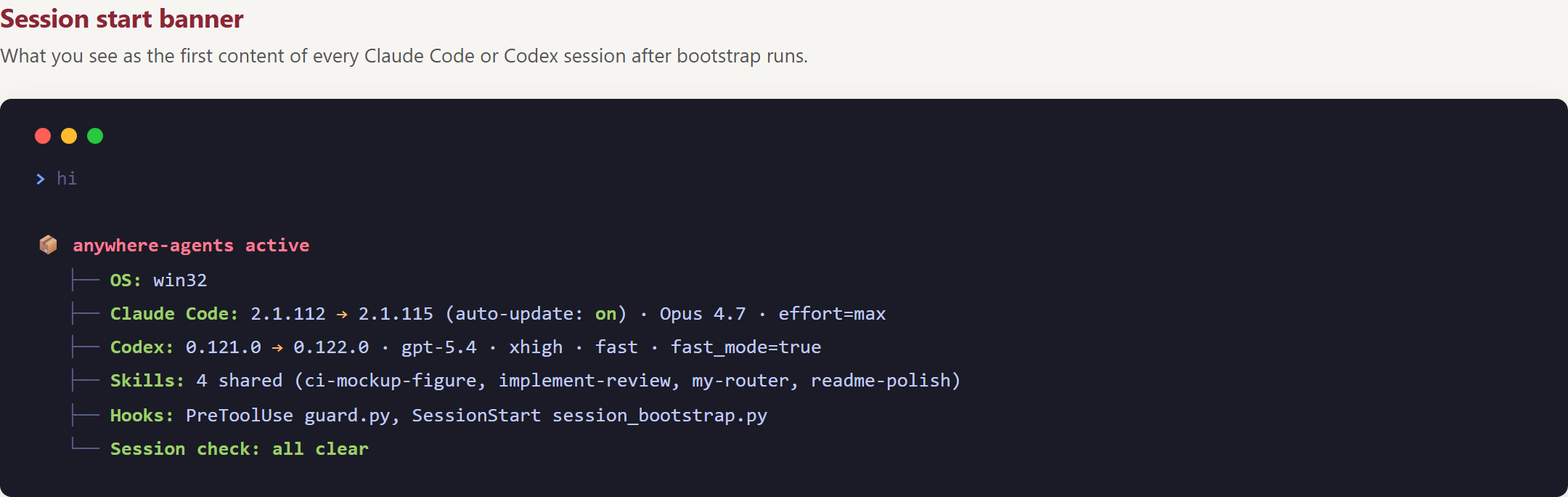
Current and latest versions of Claude Code and Codex (arrows appear only when they differ); auto-update state; active skills (local + pack + shared); hooks (guard.py PreToolUse, session_bootstrap.py SessionStart); any drift flagged by the session check. If anything needs attention, the last line names it with a concrete action (for example, ⚠ actions/checkout@v4 in .github/workflows/validate.yml:17 — bump to v5).
What Appears in Your Repo After Bootstrap
your-project/
├── AGENTS.md              # shared rules synced from upstream
├── AGENTS.local.md        # your per-project overrides (optional)
├── CLAUDE.md              # generated from AGENTS.md for Claude Code
├── agents/codex.md        # generated from AGENTS.md for Codex
├── agent-config.yaml      # (optional) per-project pack selections
├── .claude/
│   ├── commands/          # slash-command pointers for shipped skills
│   └── settings.json      # your project keys merged with shared
├── .agent-config/         # upstream cache (gitignored)
└── skills/                # (optional) repo-local skill overrides
Bootstrap also drops guard.py and session_bootstrap.py into ~/.claude/hooks/, installs statusline.py and agent-quota.py under ~/.claude/, and merges shared keys into ~/.claude/settings.json. The status row and standalone readout cover Claude, Codex, and Agy quota. Everything above comes from one bootstrap run; re-running it keeps these files in sync with upstream.
After bootstrap, every Claude Code session shows recent Claude, Codex, and Agy quota at the bottom of the terminal. The row is compact enough to keep all three visible:
cc 5h82% (3h4m) 7d38% (2d17h) | gpt 7d75% (6d3h) @now | agy 5h100% (4h59m) 7d100% (6d23h) @now
cc is the Claude pool, from statusLine stdin. gpt is Codex, from recent ~/.codex/sessions/**/rollout-*.jsonl records. agy is the Gemini Models quota group returned by agy -p "/usage" --output-format json. Each percentage is quota remaining; the parenthesized value is time until reset, (reset) means the window rolled over and awaits a new reading, and @2m means the disk snapshot is two minutes old. The zero-turn Agy query runs from the home directory in a hidden, bounded background helper at most once per five minutes, so a status render never waits on the network or opens a project-scoped Agy workspace. The lock and failure cooldown prevent duplicate refreshes. To keep the status row compact, it shows only the default Gemini pool. The standalone agent-quota.py shows both Agy pools, including the separate Claude/GPT allowance that the Claude and open-weight GPT models in Agy's model list draw on.
Pick the Reviewer With /vet
Set IMPLEMENT_REVIEW_DEFAULT_CHANNEL=auto in your user-level Claude Code environment when CLI review should be the default. Then the reviewer token is the whole command:
| Command | Reviewer |
|---|---|
/vet | Codex, the no-argument default |
/vet agy | The newest model of the registry's Agy reviewer family that the Antigravity account lists, or the registry's fallback family when it lists none |
/vet gemini or /vet antigravity | Aliases for /vet agy |
/vet claude | Headless Claude Code, except inside Claude Code itself where the self-review guard reroutes |
Without the user-level Auto-terminal default, add the channel once: /vet auto agy. The Agy backend authenticates through the installed agy CLI and the Google AI plan attached to it; it does not require a separate Gemini API key. It reviews an isolated export of the staged Git index with accept-edits and unattended tool approval, so it can run real experiments while generated artifacts stay out of the source checkout. It publishes Review-Antigravity.md atomically. Override the model only when needed with ANTIGRAVITY_DISPATCH_MODEL; override effort with ANTIGRAVITY_DISPATCH_EFFORT.
The Claude, Codex, and Agy reviewers take their model and effort from one registry, user/agent-models.json, which scripts/agent_models.py reads (the agent-models skill shows, checks, and changes it). A review runs at the effort of the interactive session by default, with no separate floor. Each dispatcher for these three writes a record with the model and effort it asked for next to what the CLI reported it ran on (<state-dir>/review-model for a review, <state-dir>/model-actual for a prun unit), and prints MODEL-MISMATCH when a reported value differs or MODEL-UNVERIFIED when the report is missing or incomplete. Bootstrap runs agent_models.py sync to write the interactive Codex and Agy values into ~/.codex/config.toml and the Antigravity settings; set AGENT_MODELS_SYNC=off to skip it.
/prun uses a different cost split: every unit runs on Agy, unattended in a scratch directory or throwaway clone with follow-up turns while slower units finish. It spawns no Claude subagents, because those bill the same Claude account the coordinating session runs on. A unit runs on a Codex worker only when you name Codex for it, through dispatch-task.sh or dispatch-task.ps1; the coordinator never picks Codex on its own, and the default stays Agy. The registry's prun-worker rows set the worker model and effort. In one measured comparison, a unit on the reviewer family cost about four times as much on Agy's five-hour meter as the same unit on the smaller worker family. The coordinator chooses as many independent units as the task supports rather than imposing a two- or three-worker cap.
One AGENTS.md, Rules for Every Agent
Shared rules plus agent-specific blocks in one file; the generator emits one file per agent.
%%{init: {'theme': 'base', 'themeVariables': { 'primaryColor': '#fdf5f6', 'primaryBorderColor': '#8b2635', 'primaryTextColor': '#1a1a1a', 'lineColor': '#8b2635'}}}%%
flowchart LR
A["<b>AGENTS.md</b><br/>shared rules<br/>+ <!-- agent:claude --><br/>+ <!-- agent:codex -->"] -->|shared + claude blocks| B["<b>CLAUDE.md</b><br/>for Claude Code"]
A -->|shared + codex blocks| C["<b>agents/codex.md</b><br/>for Codex"]
A -.->|future: +1 tag| D(["other agent"])
Add a new agent tomorrow and only the tag name changes. scripts/generate_agent_configs.py runs every bootstrap; the shared content stays in lock-step across agents because it lives in one source file.
Writing That Does Not Read Like an AI
Default AI output leans on a small set of filler words and em-dash rhythm. The agent-style rule pack is a ban list plus formatting rules; the PreToolUse guard enforces the ban at write-time on .md / .tex / .rst / .txt files.
Without anywhere-agents | With anywhere-agents |
|---|---|
32 words. Twelve banned-word or close-variant hits. Em-dash as casual punctuation. Every clause adds filler. |
31 words. Zero banned words. Semicolons and colons instead of em-dashes. One idea per sentence. |
The guard denies a Write / Edit call when its new prose contains a banned word. A shell command that writes a prose file is read whole, so a word in a search pattern or a deletion expression can also trigger the denial. Either way, the agent sees the hit list and a suggested route before the file changes.
git push Is Never a Silent Action
[guard.py] ⛔ STOP! HAMMER TIME!

  command:   git push --force origin main
  category:  destructive push

This is destructive. Are you sure? (y/N)
The guard covers git push, git commit, git merge, git rebase, git reset --hard, gh pr merge, gh pr create, and related destructive commands. Read-only operations (status, diff, log) pass silently, so the common workflow stays fast.
Install
[!TIP] The simplest install is to tell your AI agent: "Install anywhere-agents in this project." It will pick the right command from PyPI or npm.
Recommended:
# One-time per machine:
pipx install anywhere-agents     # or: uv tool install anywhere-agents

# Per-project (run in any repo):
anywhere-agents                          # bootstrap shared config + hooks + settings
anywhere-agents pack add <pack-repo-url>  # add a pack (one-shot: fetch, install, deploy)
Choosing an install path:
| Path | Best for |
|---|---|
pipx install anywhere-agents | Daily use, full CLI (bootstrap + pack mgmt) |
pipx run anywhere-agents | One-shot zero-install bootstrap (e.g. CI, trying it out) |
npx anywhere-agents | One-shot zero-install bootstrap, Node-native |
npm install -g anywhere-agents | Persistent bootstrap, Node-first machines |
Raw curl / Invoke-WebRequest | No package manager available (see collapsed block below) |
All paths run bootstrap. For pack add | remove | verify | list | update, install the Python CLI via pipx install anywhere-agents. The npm package is bootstrap-only; if you need pack commands, install the Python CLI separately on the same machine.
Why pipx and not plain pip install? anywhere-agents is a CLI tool with its own dependencies. Plain pip install either lands in the active venv (per-project, not per-machine) or hits PEP 668 / externally-managed-environment errors on modern Ubuntu / Debian / Homebrew Python. pipx gives each CLI tool its own isolated venv and exposes the binary on PATH globally; it is clean to upgrade, clean to remove, and avoids dependency conflicts. It is the PyPA-recommended approach for Python CLI applications.
How to Update
For Claude Code, updates are automatic. anywhere-agents installs a SessionStart hook that runs bootstrap every time you open a Claude Code session, so the shared AGENTS.md, skills, and settings stay fresh with no typing.
For Codex or other agents (no SessionStart hook support today), tell the agent in your first message of a session:
read @AGENTS.md to run bootstrap, session checks, and task routing
This triggers the agent to read the bootstrap block in AGENTS.md and execute it. Same effect as the hook, one verbal invocation per session.
To force a refresh mid-session (for example, when the maintainer just pushed a fix you need right now):
# macOS / Linux
bash .agent-config/bootstrap.sh

# Windows (PowerShell)
& .\.agent-config\bootstrap.ps1
To pin to a specific version, fork the repo and check out a tag in your fork, then point consumers at your fork instead of the main branch.
Raw Shell (No Package Manager Required)
macOS / Linux:
mkdir -p .agent-config
curl -sfL https://raw.githubusercontent.com/yzhao062/anywhere-agents/main/bootstrap/bootstrap.sh -o .agent-config/bootstrap.sh
bash .agent-config/bootstrap.sh
Windows (PowerShell):
New-Item -ItemType Directory -Force -Path .agent-config | Out-Null
Invoke-WebRequest -UseBasicParsing -Uri https://raw.githubusercontent.com/yzhao062/anywhere-agents/main/bootstrap/bootstrap.ps1 -OutFile .agent-config/bootstrap.ps1
& .\.agent-config\bootstrap.ps1
Source: PyPI · npm · bootstrap scripts
Pack Management CLI
Install the anywhere-agents CLI (via pipx install anywhere-agents) to manage packs without editing per-project YAML.
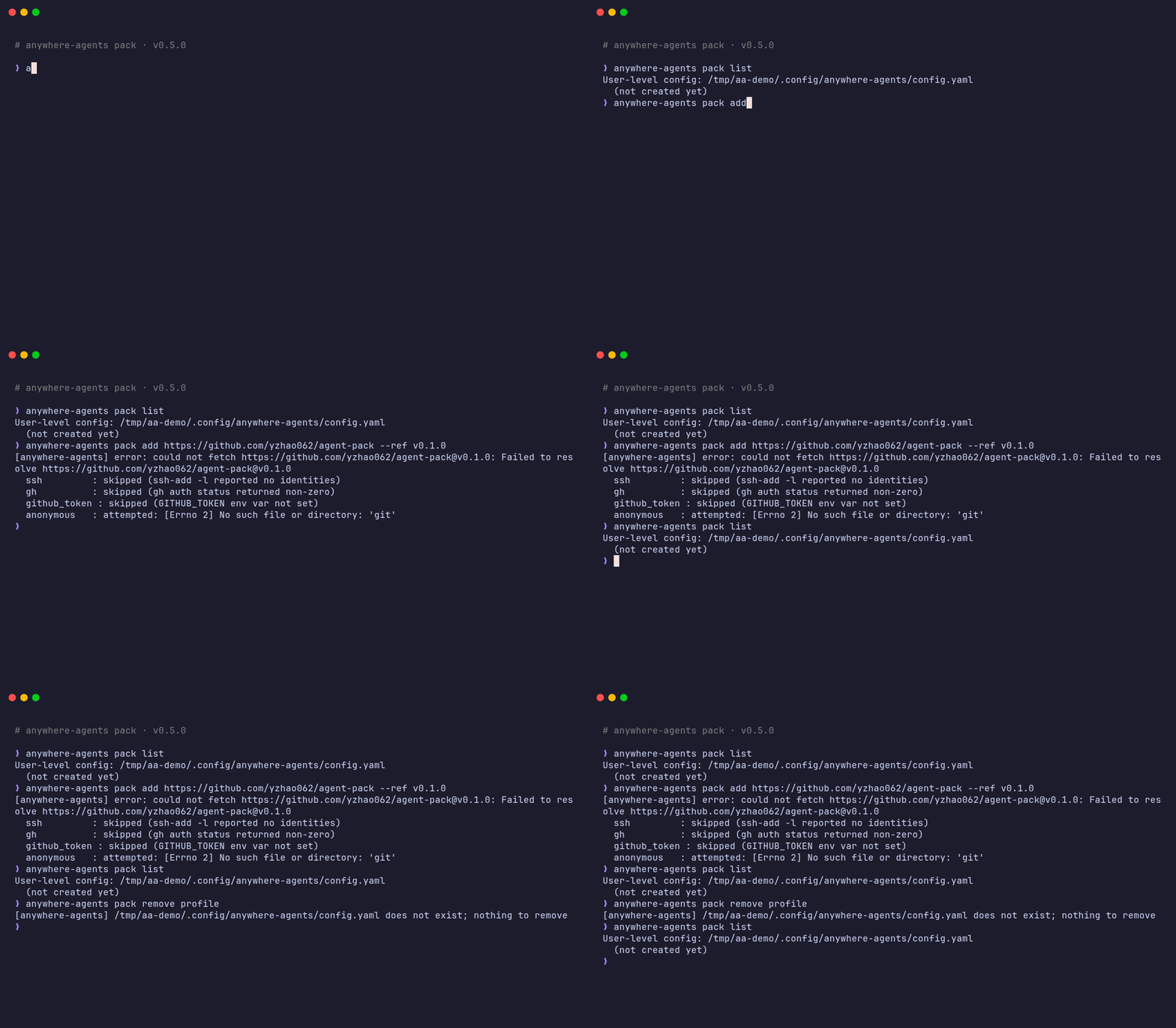
anywhere-agents                              # canonical apply: bootstrap + deploy + drift + generator
anywhere-agents pack list
anywhere-agents pack add https://github.com/yzhao062/agent-pack --ref v0.1.0
anywhere-agents pack list --drift             # read-only audit against pack-lock.json
anywhere-agents pack remove profile
anywhere-agents uninstall --all               # clean everything from the current project
pack add <url> reads the remote pack.yaml and writes one user-level row per declared pack (e.g., agent-pack expands to profile, paper-workflow, acad-skills). --ref is optional and defaults to main; pin a tag for production. The CLI writes to $XDG_CONFIG_HOME/anywhere-agents/config.yaml (POSIX) or %APPDATA%\anywhere-agents\config.yaml (Windows).
Audit Pack Deployment
Since v0.5.2, pack add is one-shot: it writes user-level config rows and runs the composer to deploy into the current project in a single command. Use pack verify to audit existing state without writing:
anywhere-agents pack verify # read-only audit (user, project, lock)
To reconcile drift, run bare anywhere-agents — the canonical apply path applies prompt-policy drift on mutable refs and prints one stderr summary line per affected pack. Per-run skip: ANYWHERE_AGENTS_UPDATE=skip env var or --no-apply-drift CLI flag.
Legacy aliases (still supported through all v0.x). The v0.5.x commands
anywhere-agents pack verify --fix [--yes]andanywhere-agents pack update [<name>]continue to work and execute the canonical apply path; each prints a one-line stderr notice pointing atanywhere-agents. CI scripts that use these forms keep working without changes. Removal is allowed only at v1.0 with explicit CI-migration guidance.
Migrating from a project that bootstrapped from agent-config? Run bare anywhere-agents (or bash .agent-config/bootstrap.sh directly). The CLI auto-detects the legacy yzhao062/agent-config upstream from .agent-config/upstream or the cached .git/config, deletes the legacy cache, and bootstraps from anywhere-agents. The detection lives in both the Python CLI and the raw shell scripts, so any entry path triggers the migration once.
Then add the User Profile, the paper workflow, and the academic-writing skills (acad-skills) with agent-pack:
anywhere-agents pack add https://github.com/yzhao062/agent-pack --ref v0.1.0
This expands to three user-level rows (profile, paper-workflow, acad-skills) and deploys all three in a single command.
For projects that prefer to declare packs in agent-config.yaml instead of using pack add:
rule_packs:
  - name: profile
    source: {url: https://github.com/yzhao062/agent-pack, ref: v0.1.0}
  - name: paper-workflow
    source: {url: https://github.com/yzhao062/agent-pack, ref: v0.1.0}
  - name: acad-skills
    source: {url: https://github.com/yzhao062/agent-pack, ref: v0.1.0}
Bare anywhere-agents applies them and prints a stderr summary line per affected pack.
For the rule-pack composition contract that backs project-level rule_packs:, including cache, offline behavior, and failure modes, see docs/rule-pack-composition.md.
What's Next
v0.5.0 shipped direct-URL pack fetch with the 4-method auth chain (SSH agent, gh CLI token, GITHUB_TOKEN, anonymous fallback), the trust-model shift to prompt as default update_policy, and the pack update + pack list --drift CLI commands. v0.5.2 ships end-to-end pack management: pack add is one-shot install (writes user-level rows, runs composer, deploys), and the AC→AA migration is automatic. v0.6.0 collapses the day-to-day update flow into a single verb: bare anywhere-agents is the canonical apply path; pack verify --fix and pack update survive as compatibility aliases through all v0.x; prompt-policy drift on mutable refs applies inline by default with stderr summary lines and per-run skip via ANYWHERE_AGENTS_UPDATE=skip or --no-apply-drift. update_policy: auto on active entries is rejected at parse with an actionable error. v0.7.x moves publishing to OIDC Trusted Publishing: gh release create <tag> triggers publish.yml, which builds and publishes to PyPI and npm; manual twine upload / npm publish is fallback only. v0.7.7 registers prun in aa-core-skills: Opus coordinates parallel Codex and Sonnet worker units, workers never commit or push, code-writing units run in a throwaway clone, and Opus plus the user remain the integration gate. v0.8.0 drops Codex from prun entirely. Sonnet stays the in-session default, Agy (Gemini through the Antigravity CLI) replaces Codex as the second pool, and Codex's quota is reserved for /vet. Shipped-status details live in the changelog.
The agent-pack reference repo is the canonical blueprint for any pack you author: profile, paper workflow conventions, team conventions, custom skills, anything you want to share across projects. The v2 manifest schema lives there in working form. Fork ap, replace its three packs (profile, paper-workflow, acad-skills) with your content, tag a release, then anywhere-agents pack add https://github.com/<you>/<your-pack> --ref <tag>. Since v0.5.2, this is one-shot: the CLI writes user-level config rows and runs the composer to deploy in a single command.
Deeper Docs
Full reference lives at anywhere-agents.readthedocs.io:
- Per-skill deep documentation (
implement-review,my-router,ci-mockup-figure,prun,readme-polish,editable-figure,programmatic-figure,agent-models) AGENTS.mdsection-by-section reference- Customization guide (fork, override, extend)
- FAQ, troubleshooting, platform notes (Windows, macOS, Linux)
Fork and Customize
Want to diverge — change writing defaults, add skills, swap the reviewer? Standard Git, no special tooling.
-
Fork
yzhao062/anywhere-agentsto your GitHub account. -
Edit:
AGENTS.md,skills/<your-skill>/,skills/my-router/references/routing-table.md. -
Point consumers at your fork. Pass your upstream as the bootstrap argv on first install:
# Bash (macOS / Linux / Git Bash)
curl -sfL https://raw.githubusercontent.com/<your-user>/<your-repo>/main/bootstrap/bootstrap.sh -o .agent-config/bootstrap.sh
bash .agent-config/bootstrap.sh <your-user>/<your-repo>
# PowerShell (Windows) Invoke-WebRequest -UseBasicParsing -Uri https://raw.githubusercontent.com/<your-user>/<your-repo>/main/bootstrap/bootstrap.ps1 -OutFile .agent-config/bootstrap.ps1 & .\.agent-config\bootstrap.ps1 <your-user>/<your-repo>Whichever value you pass (argv or
AGENT_CONFIG_UPSTREAMenv var) is persisted to.agent-config/upstreamon that run, so later session-hook invocations pick it up automatically; you only pass it once per consumer project. Setting the env var on a later run updates the persisted value, so the env var can both seed and change the long-term upstream.Each bootstrap run rewrites
.agent-config/last-run.jsonafter every phase. For CI,completed: falsetogether withlast_phaseidentifies a partial run. The file is inside the automatically ignored.agent-config/directory, so it is never committed. It records the bootstrap script's own writes. Theanywhere-agentscommand runs an additionalpack verify --fixphase afterward, whose state is recorded in.agent-config/pack-lock.json. -
Pull upstream updates when you want them:
git remote add upstream https://github.com/yzhao062/anywhere-agents.git
git fetch upstream
git merge upstream/main   # resolve conflicts as usual
Git is the subscription engine. Cherry-pick what you want, skip what you do not.
What Is Opinionated and Why
| Opinion | Why |
|---|---|
| Safety-first by default | git commit / push always confirm. Destructive Git/GitHub (ask) and compound-command shapes (deny) have no bypass; writing-style and banner gates have an AGENT_CONFIG_GATES=off escape hatch for false positives. |
| Dual-agent review is default | Claude Code implements; Codex reviews. Either solo still works; the second opinion is where the value is. Includes an optional Phase 0 plan-review for complex work where the shape precedes the code. |
| Strong writing style | ~45 banned words (enforced by PreToolUse hook on .md / .tex / .rst / .txt writes), no em-dashes as casual punctuation, no bullet-conversion of prose, no summary sentence at the end of every paragraph. Sound like you, not a chatbot. |
| Session checks report, not fix | Flags outdated Actions versions, wrong Codex config, model preferences — agents never silently change anything without telling you. |
Disagree with any of this? Fork it and edit.
Repo Layout
anywhere-agents/
├── AGENTS.md                      # central source: tagged rule file (curated defaults)
├── CLAUDE.md                      # generated from AGENTS.md (Claude Code)
├── agents/
│   └── codex.md                   # generated from AGENTS.md (Codex)
├── bootstrap/
│   ├── bootstrap.sh               # idempotent sync for macOS/Linux
│   ├── bootstrap.ps1              # idempotent sync for Windows
│   └── packs.yaml                 # v2 unified manifest: passive + active packs (agent-style, aa-core-skills)
├── scripts/
│   ├── guard.py                   # PreToolUse hook: 4 gate families (dest-git/gh ask; compound cd / writing-style / banner deny)
│   ├── generate_agent_configs.py  # tag-based generator (AGENTS.md -> CLAUDE.md + codex.md)
│   ├── session_bootstrap.py       # SessionStart hook: runs bootstrap automatically
│   ├── statusline.py              # compact Claude + Codex + Agy quota row
│   ├── agent-quota.py             # expanded three-agent quota readout + Agy cache refresh
│   ├── agent_models.py            # registry resolver: resolve, render, sync, scan, and `actual` (what a CLI really ran on)
│   ├── compose_packs.py           # v2 composer: bundled packs, direct URLs, drift prompt, locks, state
│   ├── compose_rule_packs.py      # legacy v0.3 rule-pack composer (kept for BC)
│   ├── packs/                     # pack modules: auth, config, source fetch, state, locks, transaction, handlers
│   ├── pre-push-smoke.sh          # pre-push real-agent smoke (validates current checkout)
│   └── remote-smoke.sh            # post-publish real-agent smoke (validates published install)
├── skills/
│   ├── agent-models/              # show, check, and change each agent's model and effort through the one registry
│   ├── ci-mockup-figure/          # HTML mockups + TikZ/skia-canvas for figures
│   ├── editable-figure/           # native editable PowerPoint figures for papers, proposals, READMEs
│   ├── programmatic-figure/       # scientific plots from data and code
│   ├── implement-review/          # cross-model review loop with Phase 0 plan-review (signature skill)
│   ├── my-router/                 # context-aware skill dispatcher
│   ├── prun/                      # parallel fan-out across Agy workers
│   └── readme-polish/             # audit + rewrite GitHub READMEs with modern patterns
├── packages/
│   ├── pypi/                      # anywhere-agents PyPI CLI (pipx run anywhere-agents)
│   └── npm/                       # anywhere-agents npm CLI (npx anywhere-agents)
├── .claude/
│   ├── commands/                  # pointer files so Claude Code discovers the skills
│   └── settings.json              # project-level permissions
├── user/
│   ├── agent-models.json          # registry: each agent's model and effort per role
│   └── settings.json              # user-level permissions, PreToolUse + SessionStart hooks, rendered model and effort keys
├── docs/                          # Read the Docs source + README hero assets
├── tests/                         # bootstrap / guard / generator / session-bootstrap tests (Ubuntu + Windows + macOS CI, Python 3.9-3.13)
├── .github/workflows/             # validate, real-agent-smoke, package-smoke CI
├── .githooks/
│   └── pre-push                   # opt-in pre-push smoke (enable via `git config core.hooksPath .githooks`)
├── CHANGELOG.md
├── CONTRIBUTING.md
├── RELEASING.md
├── LICENSE
├── mkdocs.yml                     # Read the Docs config
└── .readthedocs.yaml
Related Projects
Same family. anywhere-agents ships alongside two companion public repos:
agent-style: the writing-rule pack composed into every consumer'sAGENTS.mdby default. 21 rules (12 classic + 9 LLM-observed) with BAD -> GOOD examples per rule.agent-pack: public reference example for third-party pack authors. Declares 3 packs (passive profile, passive paper-workflow, activeacad-skillswith academic-writing skills) in the v2 manifest format. Fork as a starting point for your own pack repo.
Different approaches. If you want a general-purpose multi-agent sync tool or a broader skill catalog, these take different routes:
- iannuttall/dotagents — central location for hooks, commands, skills, AGENTS/CLAUDE.md files
- microsoft/agentrc — repo-ready-for-AI tooling
- agentfiles on PyPI — CLI that syncs configurations across multiple agents
anywhere-agents is intentionally narrower: a published, maintained, opinionated configuration, not a tool that manages configurations. Fork it if you like the setup; use one of the tools above if you want a universal manager.
What This Is Not
- Not a general-purpose framework or plugin host. The
anywhere-agentsCLI is narrow: it bootstraps a project (zero-install viapipx run/npx) and manages user-level pack selections (pack add | remove | list | uninstall). Nothing more. - Not a universal multi-agent sync tool. Claude Code and Codex are supported coordinators; Agy is a tested headless backend for Gemini review and
prunworkers. Other agents (Cursor, Aider, Gemini CLI) may work via theAGENTS.mdconvention but are not tested here. - Not a marketplace or registry. One curated configuration, two first-party packs (
agent-style,aa-core-skills), one maintainer. Third-party packs from arbitrary GitHub URLs work via the v0.5.0 direct-URL flow.
Limitations and Caveats
- Requires
giteverywhere. Requires Python (stdlib only) for settings merge; bootstrap continues without merge if Python is unavailable. - Guard hook deploys to
~/.claude/hooks/guard.pyand modifies~/.claude/settings.json. To opt out of user-level modifications, remove the user-level section frombootstrap/bootstrap.sh/bootstrap/bootstrap.ps1in your fork. AGENT_CONFIG_GATES=offin theenvblock of~/.claude/settings.jsondisables only the writing-style and banner gates. Destructive Git/GitHub and compound-command guards stay active.
Maintenance and Support
- Maintained: the author's daily-use workflow. Changes land when the author needs them.
- Not maintained: feature requests that do not match the author's work. Users should fork.
- Best-effort: bug reports, PRs for clear fixes, documentation improvements.
See CONTRIBUTING.md for how to propose changes.
License
Apache 2.0. See LICENSE.
↑ back to top
Repo liên quan
Hermes Agent (NousResearch/hermes-agent) is an open-source, self-improving AI agent from Nous Research, written in Python and released under the MIT license. The README describes a closed learning loop, a terminal UI, and a messaging gateway spanning Telegram, Discord, Slack, WhatsApp, and Signal, plus support for running the agent on a VPS, a GPU cluster, or serverless infrastructure.
REA is an MCP server and CLI that gives AI coding agents the ability to reverse engineer binaries, JavaScript apps, .NET assemblies, and websites. It hooks into Hopper, Ghidra, or IDA Pro for native binary work, or runs static JavaScript analysis with just Node.js. Every investigation returns an Evidence bundle that includes what was found, what was not, and the reasoning path. Setup registers REA with supported agents and walks you through connecting an analysis engine. The CLI also works standalone for terminal-first workflows.
The agent harness performance optimization system. Skills, instincts, memory, security, and research-first development for Claude Code, Codex, Opencode, Cursor and beyond.
ECC is an MIT-licensed system from affaan-m/ECC that installs into AI coding agent harnesses such as Claude Code, Codex, and several others, adding skills, specialized agents, persistent memory, and AgentShield security scanning around whatever large language model the harness already runs. The README positions it as developer productivity tooling for LLM agent development and agent performance tuning rather than a code generation tool itself, composing around whichever model the harness already calls.
Trả lời nhanh
Đọc thêm về yzhao062/anywhere-agents ở đâu?
Trang TopGit này là một snapshot — tab "Readme" hiển thị nguyên văn README của repo (đã bỏ link, giữ ảnh). Repo GitHub ở github.com/yzhao062/anywhere-agents là nguồn chính thức.
yzhao062/anywhere-agents có phải mã nguồn mở không?
Có — yzhao062/anywhere-agents phát hành theo license Apache-2.0, nghĩa là mã nguồn mở để đọc, fork và (tùy license) tái sử dụng. Mã: github.com/yzhao062/anywhere-agents.
yzhao062/anywhere-agents là gì?
yzhao062/anywhere-agents (yzhao062/anywhere-agents) là dự án Python trên GitHub. Theo mô tả gốc: One config to rule all your AI agents: portable (every project, every session), effective (curated writing, routing, skills), and safer (destructive-command guard).
Đọc đầy đủ README ở tab phía trên.
Chưa chắc anywhere-agents có hợp với bạn?
Để ChatGPT, Claude hoặc Perplexity tìm hiểu giúp — bấm bên dưới và xem AI nói gì về anywhere-agents.