AI4Finance-Foundation/FinRL-Meta is tracked by TopGit as an AI tool, with 2.0k stars on GitHub, written primarily in Python. FinRL®-Meta: Dynamic datasets and market environments for FinRL.
Snapshot summary built from the project's own GitHub metadata — there's no written TopGit review yet. The page will update automatically when a full review is published.
WHY NO REVIEW YET
TopGit writes full reviews for the most-starred, most-requested repositories. This page is a snapshot until then — see the READ ME tab for the original README in full.
FinRL®-Meta: A Metaverse of Market Environments and Benchmarks for Data-Driven Financial Reinforcement Learning
Part of the FinRL ecosystem. For the next-generation production-oriented trading stack, see FinRL-X / FinRL-Trading.
FinRL®-Meta is the market environment and benchmark layer of the FinRL ecosystem. It builds a universe of market environments for data-driven financial reinforcement learning and helps users easily develop, evaluate, and compare trading agents across diverse financial tasks.
For the next-generation AI-native modular trading infrastructure and production-oriented deployment workflow, please visit FinRL-X / FinRL-Trading.
FinRL Ecosystem
FinRL: the original open-source end-to-end framework for financial reinforcement learning
FinRL-Meta: market environments and benchmarks for data-driven financial reinforcement learning
ElegantRL: lightweight deep reinforcement learning algorithms
To provide benchmarks and facilitate fair comparisons, we allow researchers to evaluate different strategies on the same dataset. Also, it would help researchers to better understand the “black-box” nature (deep neural network-based) of DRL algorithms.
To reduce the simulation-reality gap: existing works use backtesting on historical data, while the actual performance may be quite different.
To reduce the data pre-processing burden, so that quants can focus on developing and optimizing strategies.
Design Principles
Plug-and-Play (PnP): Modularity; Handle different markets (say T0 vs. T+1)
Completeness and universal:
Multiple markets; Various data sources (APIs, Excel, etc); User-friendly variables.
Layer structure and extensibility: Three layers including: data layer, environment layer, and agent layer. Layers interact through end-to-end interfaces, achieving high extensibility.
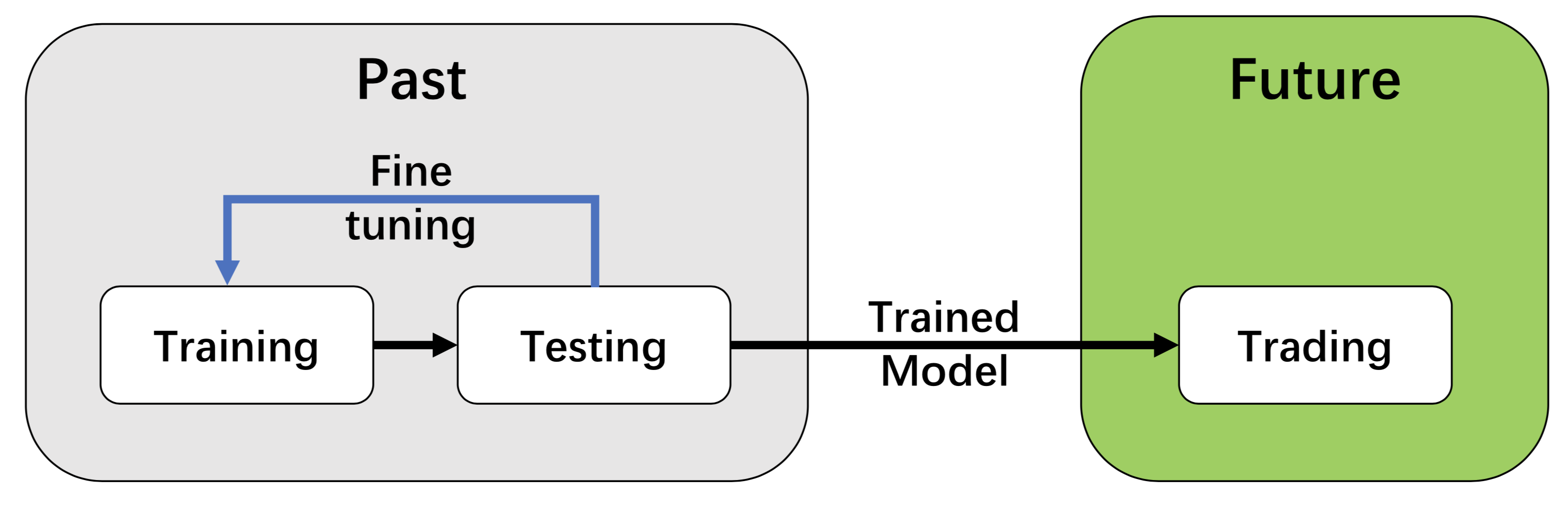
“Training-Testing-Trading” pipeline: simulation for training and connecting real-time APIs for testing/trading, closing the sim-real gap.
Efficient data sampling: accelerate the data sampling process is the key to DRL training! From the ElegantRL project. we know that multi-processing is powerful to reduce the training time (scheduling between CPU + GPU).
Transparency: a virtual env that is invisible to the upper layer
Flexibility and extensibility: Inheritance might be helpful here
Overview
We utilize a layered structure in FinRL-Meta, as shown in the figure above, that consists of three layers: data layer, environment layer, and agent layer. Each layer executes its functions and is independent. Meanwhile, layers interact through end-to-end interfaces to implement the complete workflow of algorithm trading. Moreover, the layer structure allows easy extension of user-defined functions.
FinRL-Meta focuses on the data layer and environment layer for financial reinforcement learning research and benchmarking.
For full-stack deployment and production-oriented trading infrastructure, please see FinRL-X / FinRL-Trading.
DataOps
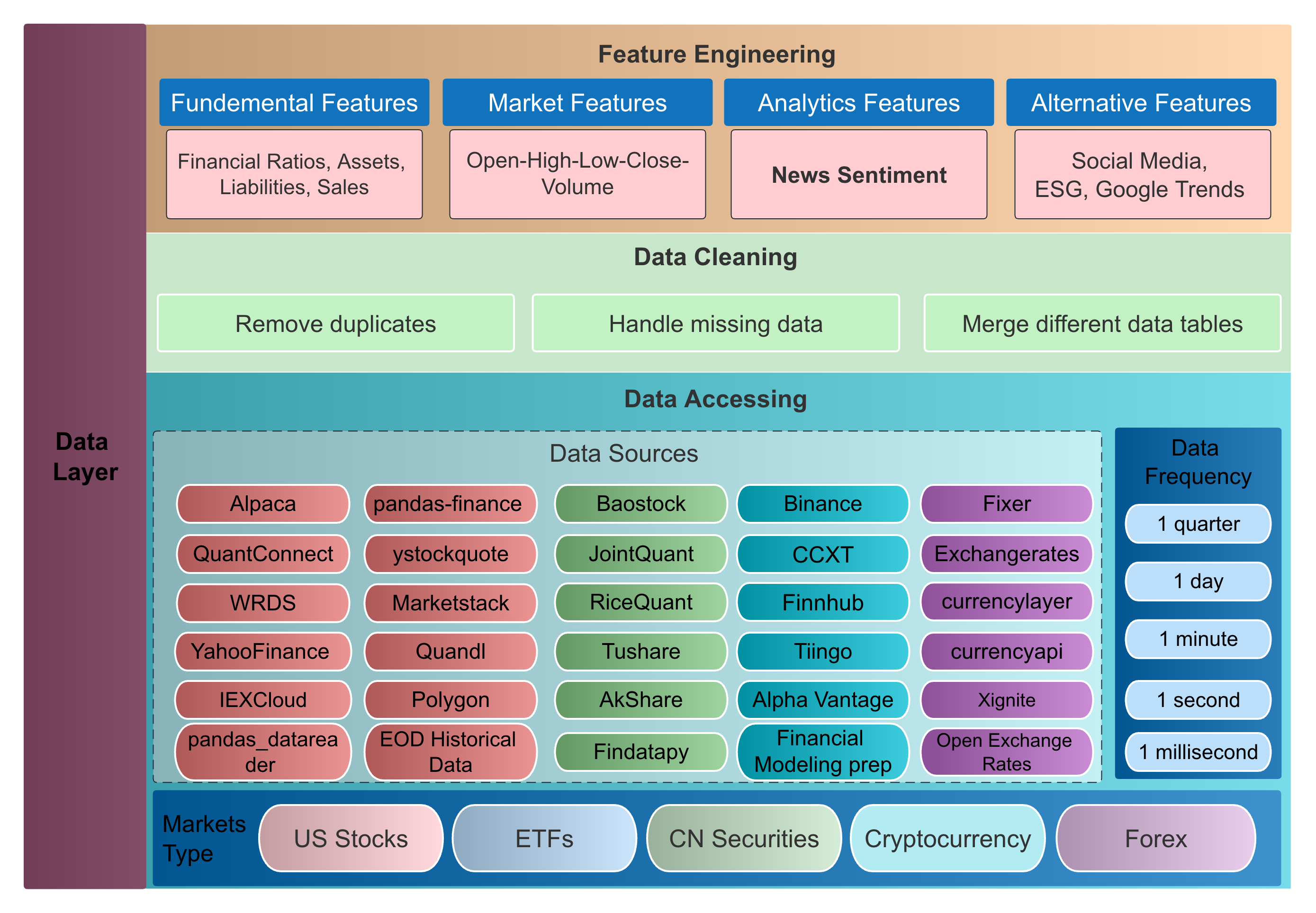
DataOps applies the ideas of lean development and DevOps to the data analytics field. DataOps practices have been developed in companies and organizations to improve the quality and efficiency of data analytics. These implementations consolidate various data sources, unify and automate the pipeline of data analytics, including data accessing, cleaning, analysis, and visualization.
However, the DataOps methodology has not been applied to financial reinforcement learning researches. Most researchers access data, clean data, and extract technical indicators (features) in a case-by-case manner, which involves heavy manual work and may not guarantee the data quality.
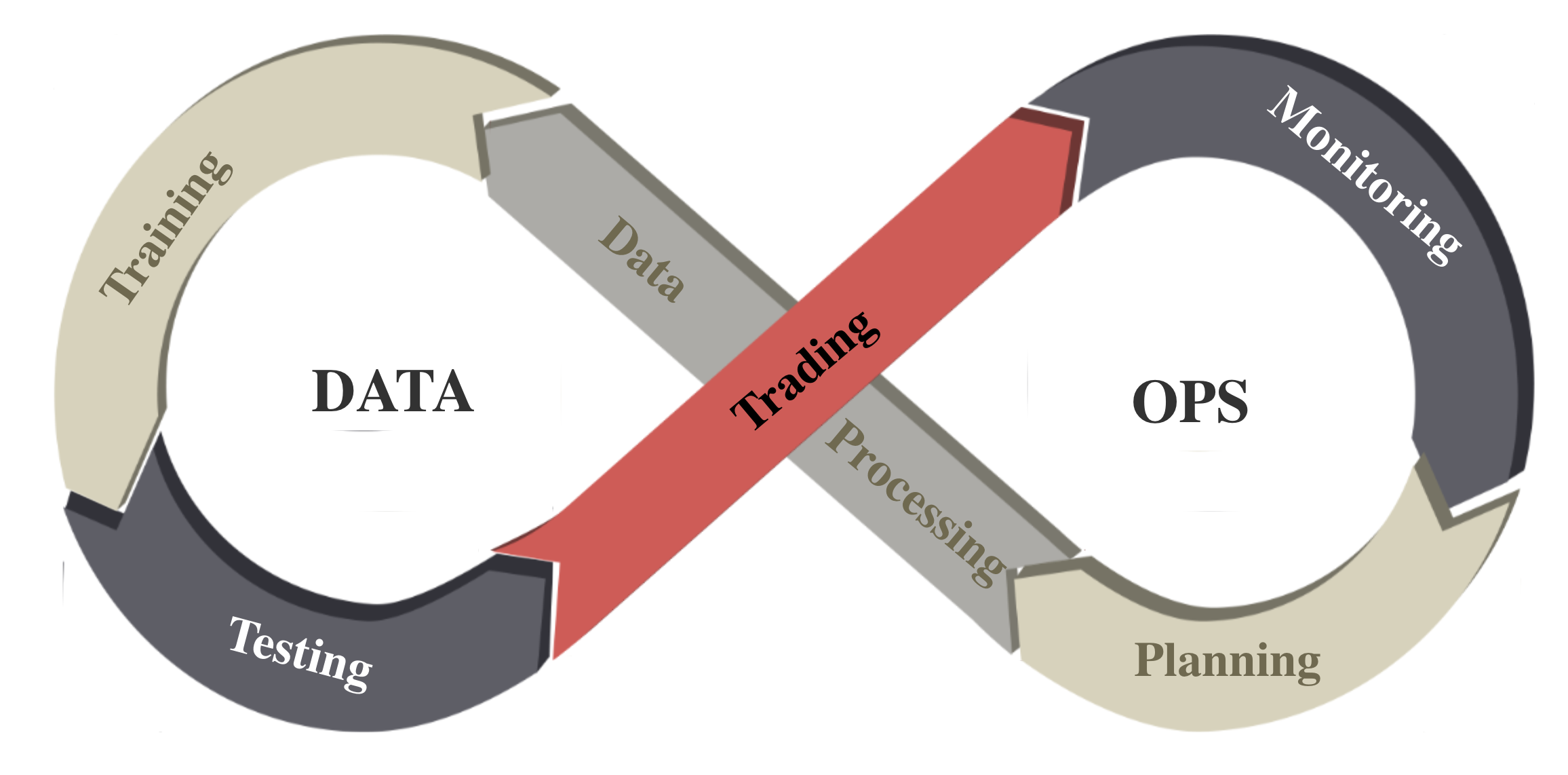
To deal with financial big data (unstructured), we follow the DataOps paradigm and implement an automatic pipeline in the following figure: task planning, data processing, training-testing-trading, and monitoring agents’ performance. Through this pipeline, we continuously produce DRL benchmarks on dynamic market datasets.
Supported Data Sources:
Data Source
Type
Range and Frequency
Request Limits
Raw Data
Preprocessed Data
Akshare
CN Securities, A share
2017-now, 1 day
NA
OHLCV
Prices&Indicators
Alpaca
US Stocks, ETFs
2015-now, 1min
Account-specific
OHLCV
Prices&Indicators
Baostock
CN Securities
1990-12-19-now, 5min
Account-specific
OHLCV
Prices&Indicators
Binance
Cryptocurrency
API-specific, 1s, 1min
API-specific
Tick-level daily aggegrated trades, OHLCV
Prices&Indicators
CCXT
Cryptocurrency
API-specific, 1min
API-specific
OHLCV
Prices&Indicators
IEXCloud
NMS US securities
1970-now, 1 day
100 per second per IP
OHLCV
Prices&Indicators
JoinQuant
CN Securities
2005-now, 1min
3 requests each time
OHLCV
Prices&Indicators
QuantConnect
US Securities
1998-now, 1s
NA
OHLCV
Prices&Indicators
RiceQuant
CN Securities
2005-now, 1ms
Account-specific
OHLCV
Prices&Indicators
Tushare
CN Securities, A share
-now, 1 min
Account-specific
OHLCV
Prices&Indicators
WRDS
US Securities
2003-now, 1ms
5 requests each time
Intraday Trades
Prices&Indicators
YahooFinance
US Securities
Frequency-specific, 1min
2,000/hour
OHLCV
Prices&Indicators
OHLCV: open, high, low, and close prices; volume
adjusted_close: adjusted close price
Technical indicators users can add: 'macd', 'boll_ub', 'boll_lb', 'rsi_30', 'dx_30', 'close_30_sma', 'close_60_sma'. Users also can add their features.
Plug-and-Play (PnP)
In the development pipeline, we separate market environments from the data layer and the agent layer. A DRL agent can be directly plugged into our environments. Different agents/algorithms can be compared by running on the same benchmark environment for fair evaluations.
The following DRL libraries are supported:
ElegantRL: Lightweight, efficient and stable DRL implementation using PyTorch.
Stable-Baselines3: Improved DRL algorithms based on OpenAI Baselines.
RLlib: An open-source DRL library that offers high scalability and unified APIs.
A demonstration notebook for plug-and-play with ElegantRL, Stable Baselines3 and RLlib: Plug and Play with DRL Agents
In addition to research-oriented DRL workflows, FinRL-Meta can serve as the market environment layer for broader ecosystem projects.
For next-generation modular trading infrastructure and production deployment, see FinRL-X / FinRL-Trading.
"Training-Testing-Trading" Pipeline
We employ a training-testing-trading pipeline. First, a DRL agent is trained in a training dataset and fine-tuned (adjusting hyperparameters) in a testing dataset. Then, backtest the agent (on historical dataset), or depoy in a paper/live trading market.
This pipeline address the information leakage problem by separating the training/testing and trading periods.
Such a unified pipeline also allows fair comparisons among different algorithms.
Our Vision
For future work, we plan to build a multi-agent-based market simulator that consists of over ten thousands of agents, namely, a FinRL-Metaverse. First, FinRL-Metaverse aims to build a universe of market environments, like the XLand environment (source) and planet-scale climate forecast (source) by DeepMind. To improve the performance for large-scale markets, we will employ GPU-based massive parallel simulation just as Isaac Gym (source). Moreover, it will be interesting to explore the deep evolutionary RL framework (source) to simulate the markets. Our final goal is to provide insights into complex market phenomena and offer guidance for financial regulations through FinRL-Meta.
Citing FinRL-Meta
Dynamic Datasets and Market Environments for Financial Reinforcement Learning
@article{dynamic_datasets,
    author = {Liu, Xiao-Yang and Xia, Ziyi and Yang, Hongyang and Gao, Jiechao and Zha, Daochen and Zhu, Ming and Wang, Christina Dan and Wang, Zhaoran and Guo, Jian},
    title = {Dynamic Datasets and Market Environments for Financial Reinforcement Learning},
    journal = {Machine Learning - Nature},
    year = {2024}
}
FinRL-Meta: Market Environments and Benchmarks for Data-Driven Financial Reinforcement Learning
@article{finrl_meta_2022,
    author = {Liu, Xiao-Yang and Xia, Ziyi and Rui, Jingyang and Gao, Jiechao and Yang, Hongyang and Zhu, Ming and Wang, Christina Dan and Wang, Zhaoran and Guo, Jian},
    title = {{FinRL-Meta}: Market Environments and Benchmarks for Data-Driven Financial Reinforcement Learning},
    journal = {NeurIPS},
    year = {2022}
}
FinRL-Meta: Data-Driven Deep ReinforcementLearning in Quantitative Finance
@article{finrl_meta_2021,
    author = {Liu, Xiao-Yang and Rui, Jingyang and Gao, Jiechao and Yang, Liuqing and Yang, Hongyang and Wang, Zhaoran and Wang, Christina Dan and Guo Jian},
    title   = {{FinRL-Meta}: Data-Driven Deep ReinforcementLearning in Quantitative Finance},
    journal = {Data-Centric AI Workshop, NeurIPS},
    year    = {2021}
}
For the next-generation production-oriented trading stack in the FinRL ecosystem, please also see FinRL-X / FinRL-Trading.
Collaborators
LICENSE
MIT License
Trademark Disclaimer

FinRL® is a registered trademark.
This license does not grant permission to use the FinRL name, logo, or related trademarks
without prior written consent, except as permitted by applicable trademark law.
For trademark inquiries or permissions, please contact: [email protected]
Disclaimer: Nothing herein is financial advice, and NOT a recommendation to trade real money. Please use common sense and always first consult a professional before trading or investing.
How does AI4Finance-Foundation/FinRL-Meta compare to other AI Tools projects?
AI4Finance-Foundation/FinRL-Meta is tracked by TopGit in the AI Tools category, with 2.0k GitHub stars and written in Python. Browse the AI Tools topic page on TopGit to compare it against similar projects by stars and activity.
How many stars does AI4Finance-Foundation/FinRL-Meta have?
AI4Finance-Foundation/FinRL-Meta has 2.0k GitHub stars — refresh the page for the live number, or check github.com/AI4Finance-Foundation/FinRL-Meta. TopGit mirrors GitHub's count but does not claim minute-by-minute accuracy.
Is AI4Finance-Foundation/FinRL-Meta open source?
Yes — AI4Finance-Foundation/FinRL-Meta ships under the MIT license, which makes its source code freely readable (and, depending on license terms, forkable and reusable). Source: github.com/AI4Finance-Foundation/FinRL-Meta.
What else is in the AI Tools space?
AI4Finance-Foundation/FinRL-Meta is tracked by TopGit under the AI Tools category, alongside 7 GitHub-tagged topics. Trending and Topics pages list peer repositories of comparable stars and language.
What is AI4Finance-Foundation/FinRL-Meta?
AI4Finance-Foundation/FinRL-Meta (AI4Finance-Foundation/FinRL-Meta) is a Python project on GitHub. From the project's own README: FinRL®-Meta: Dynamic datasets and market environments for FinRL.
Where can I see AI4Finance-Foundation/FinRL-Meta in action?
The project maintains a homepage at https://ai4finance.org. The README tab on this page also usually contains screenshots and a quickstart.
Where do I read more about AI4Finance-Foundation/FinRL-Meta?
This TopGit page is a snapshot — the READ ME tab shows the project's own README content (links stripped, images preserved). The GitHub repository at github.com/AI4Finance-Foundation/FinRL-Meta is the definitive source.
Read full README in the tab above.
Still deciding about FinRL-Meta?
One click hands the question to an AI along with this page — see what it says about FinRL-Meta.

 /FinRL-Meta


 We utilize a layered structure in FinRL-Meta, as shown in the figure above, that consists of three layers: data layer, environment layer, and agent layer. Each layer executes its functions and is independent. Meanwhile, layers interact through end-to-end interfaces to implement the complete workflow of algorithm trading. Moreover, the layer structure allows easy extension of user-defined functions.