An AI-powered entry in TopGit's GitHub warehouse: AlexsJones/llmfit, 31.2k stars, AI Tools, Rust. Hundreds of models & providers. One command to find what runs on your hardware.
Snapshot summary built from the project's own GitHub metadata — there's no written TopGit review yet. The page will update automatically when a full review is published.
WHY NO REVIEW YET
TopGit writes full reviews for the most-starred, most-requested repositories. This page is a snapshot until then — see the READ ME tab for the original README in full.
📊 New: benchmark & share — real numbers from your machine, better estimates for everyone. Download a model, serve it, and measure real tok/s on your hardware — then contribute the results back to the project as a PR, straight from the TUI. No gh CLI, no third-party account. Every run is saved locally first, your own measurements replace estimates in the fit table, and each merged submission ships in the next release: anyone on identical hardware gets measured ✓ numbers before they ever run a benchmark. Follow the step-by-step benchmarking guide →
Previously: llmfit 1.0 — the release where the numbers became verifiable →
Hundreds of models & providers. One command to find what runs on your hardware.
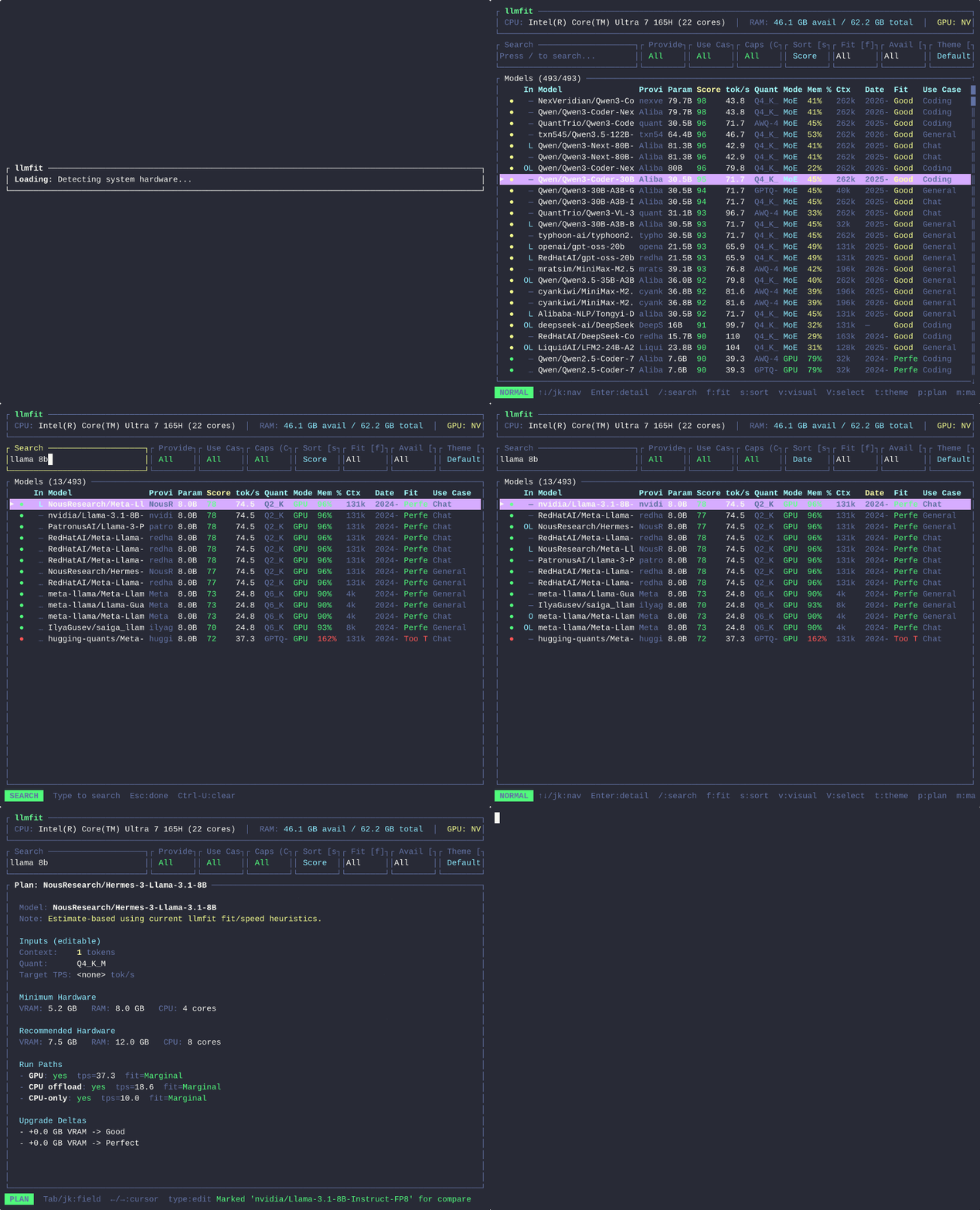
A terminal tool that right-sizes LLM models to your system's RAM, CPU, and GPU. Detects your hardware, scores each model across quality, speed, fit, and context dimensions, and tells you which ones will actually run well on your machine.
Ships with an interactive TUI (default) and a classic CLI mode. Supports multi-GPU setups, MoE architectures, dynamic quantization selection, speed estimation, and local runtime providers (Ollama, llama.cpp, MLX, Docker Model Runner, LM Studio).
Sister projects:
sympozium — managing agents in Kubernetes.
llmserve — a simple TUI for serving local LLM models. Pick a model, pick a backend, serve it.
llama-panel — a native macOS app for managing local llama-server instances.
If Scoop is not installed, follow the Scoop installation guide.
macOS / Linux
Homebrew
Prebuilt binary (recommended, works on all macOS/Linux versions):
brew install AlexsJones/llmfit/llmfit
Or from the homebrew-core formula, which builds from source on macOS versions without a bottle:
brew install llmfit
MacPorts
port install llmfit
Quick install
curl -fsSL https://llmfit.axjns.dev/install.sh | sh
Downloads the latest release binary from GitHub and installs it to /usr/local/bin (or ~/.local/bin if no sudo).
Install to ~/.local/bin without sudo:
curl -fsSL https://llmfit.axjns.dev/install.sh | sh -s -- --local
uv / pip
To install or update llmfit:
uv tool install -U llmfit
To run without installing:
uvx llmfit
You can also install llmfit as a Python package in the normal way with tools such as pip or uv.
Docker / Podman
docker run ghcr.io/alexsjones/llmfit
This prints JSON from llmfit recommend command. The JSON could be further queried with jq.
podman run ghcr.io/alexsjones/llmfit recommend --use-case coding | jq '.models[].name'
To launch the interactive TUI instead, pass the global --tui flag:
docker run --rm -it ghcr.io/alexsjones/llmfit --tui
From source
git clone https://github.com/AlexsJones/llmfit.git
cd llmfit
cargo build --release
# binary is at target/release/llmfit
Usage
llmfit # interactive TUI: your hardware, every model, ranked
The TUI shows your detected specs at the top and every model scored for fit, speed, quality, and context. See the TUI guide for navigation, planning, simulation, downloads, the community leaderboard, and benchmarking.
For scripts, agents, and classic terminal output:
llmfit fit                    # table of all models ranked by fit
llmfit recommend --json       # top picks as JSON (agent/script consumption)
llmfit info "<model>"         # one model: fit analysis, estimate basis, verify commands
llmfit bench                  # measure real tok/s/TTFT against your running provider
llmfit doctor                 # hardware detection report for bug reports
Full reference: CLI & automation.
How it works
llmfit detects your hardware (RAM, CPU, GPU/VRAM, backend), then scores every model in its catalog across four dimensions: memory fit, estimated speed, quality, and context. Speed estimates come from a memory-bandwidth model grounded in runtime sampling and real community measurements — and every estimate ships its inputs, so llmfit info shows exactly what a number assumes and how to verify it on your machine.
Full detail, including the estimation formulas and the model database: How llmfit works.
Contributing
Contributions are welcome, especially new models.
Before submitting a PR
Please run cargo fmt before pushing your changes. Most CI check failures are caused by unformatted code:
cargo fmt
Guides for adding models — locally (no rebuild) or to the built-in catalog: Custom models.
Alternatives
If you're looking for a different approach, check out llm-checker -- a Node.js CLI tool with Ollama integration that can pull and benchmark models directly. It takes a more hands-on approach by actually running models on your hardware via Ollama, rather than estimating from specs. Good if you already have Ollama installed and want to test real-world performance. Note that it doesn't support MoE (Mixture-of-Experts) architectures -- all models are treated as dense, so memory estimates for models like Mixtral or DeepSeek-V3 will reflect total parameter count rather than the smaller active subset.
Code signing
llmfit's Windows release binaries are digitally signed (Authenticode) via SignPath.io, with a free code signing certificate provided by the SignPath Foundation.
Signing happens automatically in the release pipeline: only artifacts built by GitHub Actions from this repository are submitted for signing, and signing requests are approved by the project maintainer (@AlexsJones).
Code signing policy: see the SignPath Foundation code signing policy and terms.
Privacy: this program will not transfer any information to other networked systems unless specifically requested by the user or the person installing or operating it. llmfit only contacts external services when you explicitly use the corresponding feature (e.g. model downloads, runtime provider queries, or the community leaderboard).
No homepage URL was recorded for AlexsJones/llmfit in TopGit's last sync. The README tab above frequently contains screenshots and demo links, or check the repository description on GitHub.
How active is development on AlexsJones/llmfit?
The most recent commit recorded on AlexsJones/llmfit was 11 days ago, based on the GitHub push timestamp. The repository has 1.9k forks — one of the better signals of community interest.
How many stars does AlexsJones/llmfit have?
AlexsJones/llmfit has 31.2k GitHub stars — refresh the page for the live number, or check github.com/AlexsJones/llmfit. TopGit mirrors GitHub's count but does not claim minute-by-minute accuracy.
What language is AlexsJones/llmfit written in?
AlexsJones/llmfit is written primarily in Rust. GitHub's language field is based on the largest share of bytes in the default branch.
What license does AlexsJones/llmfit use?
AlexsJones/llmfit is released under the MIT license. Always verify the LICENSE file directly on GitHub for the authoritative terms — license strings can be edited out of sync with a project's actual stance.
What topics is AlexsJones/llmfit associated with?
GitHub's repository topics for AlexsJones/llmfit: "gguf", "llm", "localai", "mlx", "skill", "unsloth". TopGit's editorial category is AI Tools.
Where do I read more about AlexsJones/llmfit?
This TopGit page is a snapshot — the READ ME tab shows the project's own README content (links stripped, images preserved). The GitHub repository at github.com/AlexsJones/llmfit is the definitive source.
Read full README in the tab above.
Want a second opinion on llmfit?
Ask an AI that can read this page — one click and you get its take on llmfit.
 /llmfit