Snapshot of alibaba/BeeHive: 4.3k★, Objective-C, Mobile. :honeybee: BeeHive is a solution for iOS Application module programs, it absorbed the Spring Framework API service concept to avoid coupling between modules.
Snapshot summary built from the project's own GitHub metadata — there's no written TopGit review yet. The page will update automatically when a full review is published.
WHY NO REVIEW YET
TopGit writes full reviews for the most-starred, most-requested repositories. This page is a snapshot until then — see the READ ME tab for the original README in full.
BeeHive is a modular program of implementation in iOS , it absorbed the Spring Framework API service concept to avoid to directly coupling between modules.
0.1 The basic architecture
We can get to know the architecture of BeeHive from this picture.
0.2 Core concepts
Module: Modules are separated by different function, every module can communicate with other one through their own services.
Service: Services are the interface of the specifically module.
0.3 Achieved characteristics
Plug-in module development of the operating framework
Module implementation and interface calls Separation
manage module life loop, extend the application of system events
0.4 Design
BeeHive bases on Spring Service concept, although you can make and implement specific interfaces decoupling between modules , but can not avoid interface class dependencies.
Why not use invoke and dynamic link library technology for decoupling interface , similar to Apache's DSO way?
Mainly on account of the difficulty and cost of learning to achieve , and dynamic invocation interface parameters can not be able to check phase change problems at compile time , dynamic programming techniques require a higher threshold requirement.
0.5 Project name origin
BeeHive inspired by the honeycomb. Honeycomb is the world's highly modular engineering structures, hexagonal design can bring unlimited expansion possibilities. So we used to do for this project BeeHive named.
1. Module life-cycle event
BeeHive's Each module will provide life-cycle events for the host environment and Each module necessary information exchange to BeeHive, you can observer the change in life run loop.
Events are divided into three types:
System Event
Universal Event
Business Custom Event
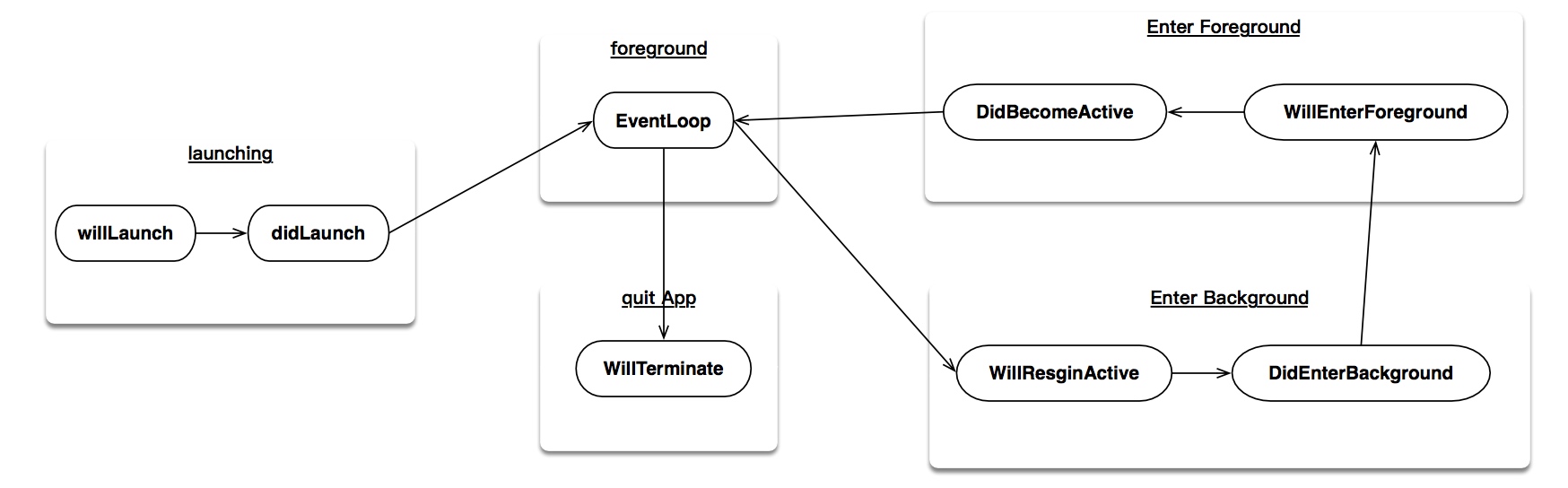
1.1 System Event
System events are usually Application life-cycle events , such as DidBecomeActive, WillEnterBackground etc.
System Event basic workflow is as follows:
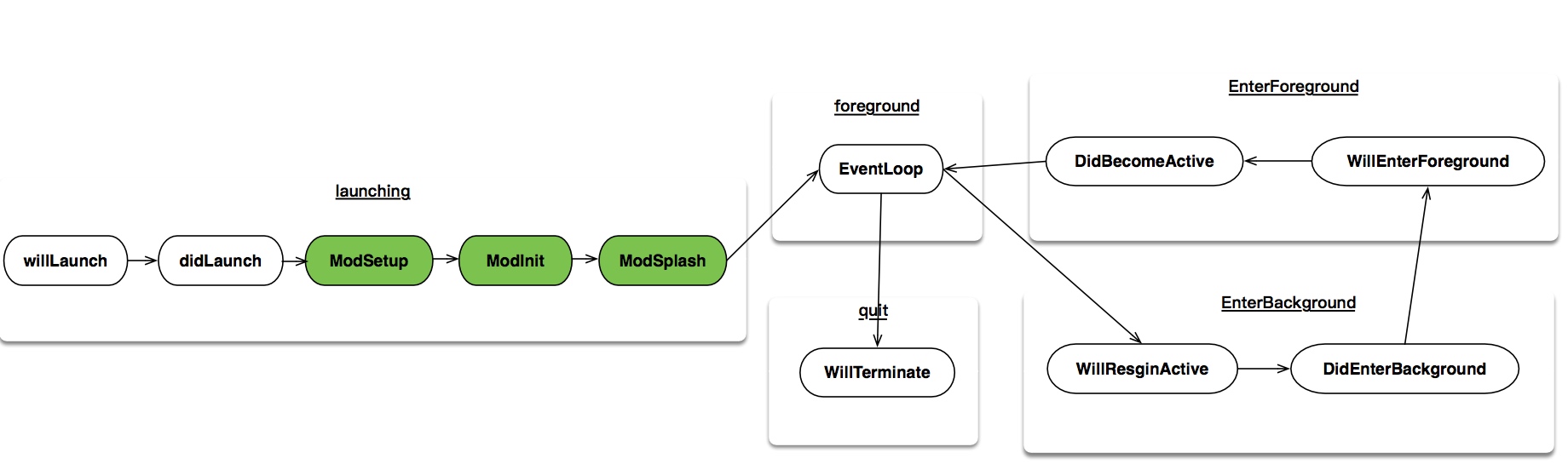
1.2 Universal Event
On the basis of system events on the extended general application events , such modSetup, modInit , etc. , may be used to code each plug-in module initialization settings
Extended common events are as follows :
1.3 Business Custom Event
If you feel the system event , the event is not sufficient to meet the general needs , we will simplify the event packaged into BHAppdelgate, you can extend your own event by inheritance BHAppdelegate, while BHContext Lane modulesByName access each module entry class , to increase the trigger point through.
2. Module registration
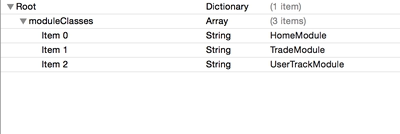
Registration module divided into two types , static registration and dynamic registration
2.1 Static registration
2.2 Dynamic registration
Use BH_EXPORT_MODULE macro module entry in the class implementation declares the class for the
implementation class entry module
If the module is set to export BH_EXPORT_MODULE (YES), it will initialize asynchronous execution module can be optimized before starting after the first screen shows the contents of the start time consuming
3. Programming
BHModuleProtocol provides various modules each module can hook functions , and logic for implementing the plug-in code, you can fine protocol in BHModuleProtocol.h.
3.1 Setting environment variables
By context.env we can judge our application environment state to decide how we configure our application
-(void)modSetup:(BHContext *)context
{
	switch (context.env) {
		case BHEnvironmentDev:
		break;
		case BHEnvironmentProd:
		default:
		break;
	}
}
3.2 Module Init
If the module there is need to start initialization logic can modInit in the preparation of , for example, the module can register an external module interface to access the Service
Event prepared by treating the various business modules can plug-in programming , it has no dependencies between the various business modules , through the interaction between the core and the event module, to achieve a plug-in isolation . But sometimes we need to call each other between modules some collaborative features to completion.
Usually in the form of three types to access service:
by interface(like Spring)
by Export Method(like PHP/ReactNative extension)
by URL Route pattern(like interaction between iPhone apps)
Interface type of service access can take the advantages of compile-time checking is found to change the interface , so that timely correction interface issues . The disadvantage is the need to rely on the interface definition header file by the module increases the more the maintenance interface definition there is a certain amount of work .
#import "BHService.h"

id< HomeServiceProtocol > homeVc = [[BeeHive shareInstance] createService:@protocol(HomeServiceProtocol)];

// use homeVc do invocation
3.5 Singleton or several instance
For some scenes , we visit each declared as service objects , objects can hope to retain some of the state , then we need to declare this service object is a singleton object .
We only need to implement the function declaration in the event service objects
-(BOOL) singleton
{
	return YES;
}
The object was acquired by createService singleton object , if the function returns to achieve the above is NO, createService returns multiple cases
The most recent commit recorded on alibaba/BeeHive was 6.2 years ago, based on the GitHub push timestamp. The repository has 776 forks — one of the better signals of community interest.
How many stars does alibaba/BeeHive have?
alibaba/BeeHive has 4.3k GitHub stars — refresh the page for the live number, or check github.com/alibaba/BeeHive. TopGit mirrors GitHub's count but does not claim minute-by-minute accuracy.
Is alibaba/BeeHive open source?
Yes — alibaba/BeeHive ships under the GPL-2.0 license, which makes its source code freely readable (and, depending on license terms, forkable and reusable). Source: github.com/alibaba/BeeHive.
What else is in the Mobile space?
alibaba/BeeHive is tracked by TopGit under the Mobile category, alongside 11 GitHub-tagged topics. Trending and Topics pages list peer repositories of comparable stars and language.
What is alibaba/BeeHive?
alibaba/BeeHive (alibaba/BeeHive) is a Objective-C project on GitHub. From the project's own README: :honeybee: BeeHive is a solution for iOS Application module programs, it absorbed the Spring Framework API service concept to avoid coupling between modules.
What language is alibaba/BeeHive written in?
alibaba/BeeHive is written primarily in Objective-C. GitHub's language field is based on the largest share of bytes in the default branch.
What license does alibaba/BeeHive use?
alibaba/BeeHive is released under the GPL-2.0 license. Always verify the LICENSE file directly on GitHub for the authoritative terms — license strings can be edited out of sync with a project's actual stance.
Where do I read more about alibaba/BeeHive?
This TopGit page is a snapshot — the READ ME tab shows the project's own README content (links stripped, images preserved). The GitHub repository at github.com/alibaba/BeeHive is the definitive source.
Read full README in the tab above.
Is BeeHive worth your time?
ChatGPT, Claude and Perplexity can all read this page. Ask one of them what it makes of BeeHive.

 /BeeHive