SecLists: Security Wordlists for Pentesters
 /SecLists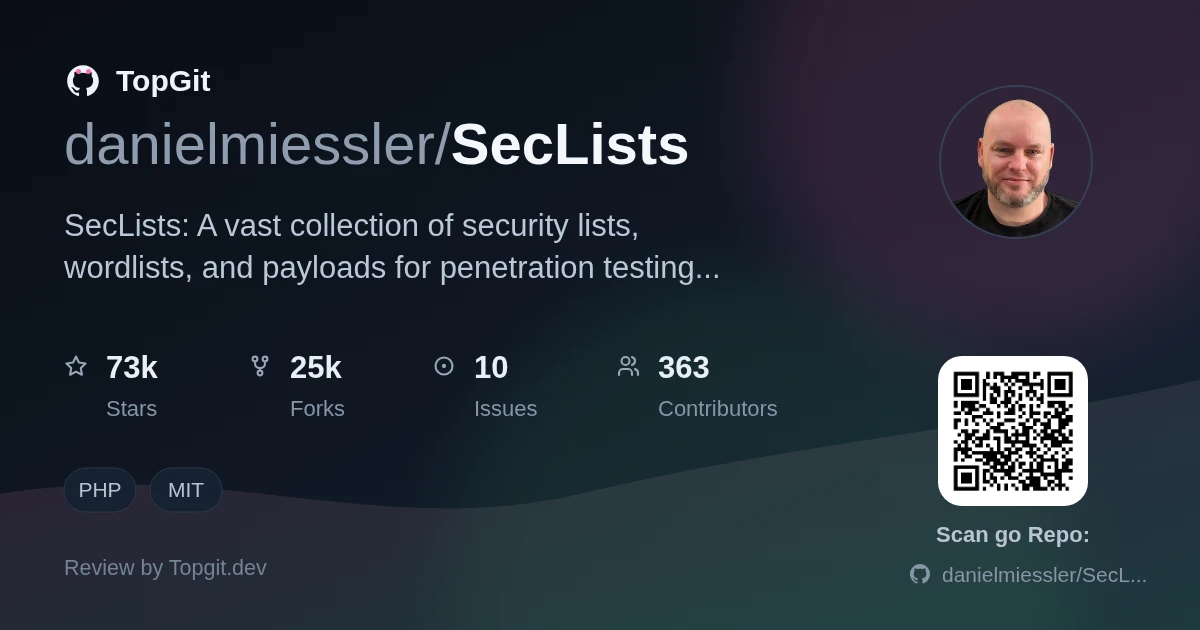
SecLists is a well-established wordlist repository for security testing. Reach for it when you need pre-compiled username, password, or fuzzing data; skip it if you want an active scanner (it's data, not a tool) or highly specialized lists for niche targets.
What is the SecLists Collection?
A curated GitHub repository acting as a security tester's companion, containing organized lists of usernames, passwords, URLs, fuzzing payloads, and web shells for ethical hacking and web application testing.
Comprehensive Types of Lists Included
- ✓Covers multiple list types: usernames, passwords, URLs, sensitive data patterns, fuzzing payloads, web shells, and more.
- ✓Organized by category in subdirectories for fast navigation during engagements.
- ✓Includes a `.bin` directory with built-in wordlist generators and mutators.
- ✓Available via package managers on Kali Linux (`apt -y install seclists`) and BlackArch (`pacman -S seclists`).
- ✓Maintained by a team of known security practitioners including Daniel Miessler, Jason Haddix, Ignacio Portal, and g0tmi1k.
- ✓MIT licensed — freely usable in commercial security assessments.
How Security Testers Utilize SecLists
- •Feeding username and password lists into tools like Hydra or John the Ripper for credential attacks.
- •Piping URL and directory wordlists into ffuf or gobuster for web content discovery.
- •Using fuzzing payloads to test application resilience against injection and malformed input.
- •Referencing web shells and exploit patterns during penetration testing engagements.
- •Generating custom wordlists with the `.bin` tools for specific target scoping.
Important Considerations and Warnings
- △Antivirus software will flag the download as malicious due to web shells and attack payloads — manual whitelisting required on most systems.
- △Storing the repo on a production server creates local file inclusion risk if that system is compromised; keep it on your testing machine only.
- △Data-only resource — you'll still need separate pentesting tools to actually use these lists (e.g., ffuf, Burp Suite, Hydra).
- △Some lists may contain outdated entries; community contributions vary in curation quality.
Other Useful Security Wordlists and Tools
SecLists FAQs
SecLists itself contains no malicious code, but your antivirus will likely flag it due to web shells and attack payloads. Store it on your testing machine, not a production server, to avoid local file inclusion risk if that system is compromised.
MIT License, permitting broad use, modification, and redistribution in both personal and commercial security work.
Yes. The project welcomes contributions — see CONTRIBUTING.md in the repository for guidelines on submitting new lists or improvements.
Daniel Miessler (founder), Jason Haddix, Ignacio Portal (current primary maintainer since 2021), and g0tmi1k oversee the project.
Yes. The repository includes a `.bin` directory with wordlist generators and mutators. External tools like Cook, CeWL, and Genoveva are also recommended in the README for additional generation capabilities.
How to use
Point security tools at the relevant subdirectory and pipe wordlists into scanners, fuzzers, or brute-force utilities. The `.bin` folder contains scripts to generate or mutate lists before use. No server setup or runtime required — the data is consumed directly by your testing tools.
Who should try it — and who should skip
Penetration testers, ethical hackers, and security researchers doing vulnerability assessments or brute force attacks. If you run automated scanners or fuzzers, you'll need these lists as input. Skip if you want an active scanning tool rather than raw data, or if you only test highly specialized targets requiring custom, context-specific wordlists.
Related repositories
Is SecLists worth your time?
ChatGPT, Claude and Perplexity can all read this page. Ask one of them what it makes of SecLists.