Exercises Dataset: 1,324-Entry Fitness Exercise Dataset

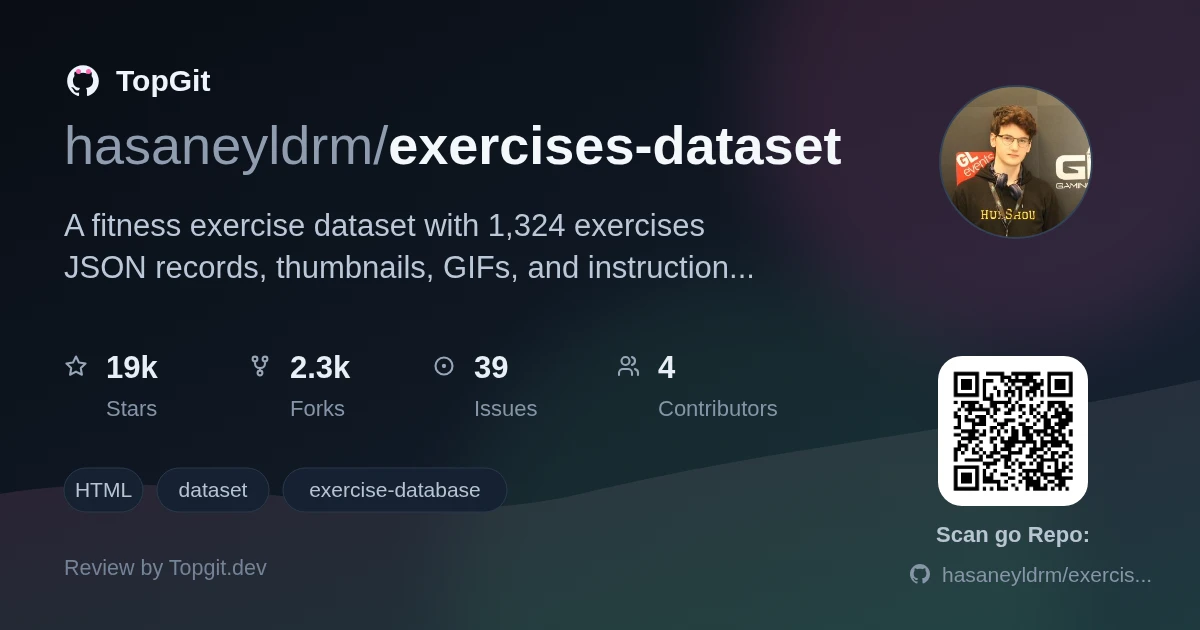
Exercises Dataset is worth pulling into a fitness app if you need real exercise content fast — 1,324 movements tagged by muscle group, equipment, and category, with instructions in 10 languages — instead of writing that content yourself. Skip it if you need exclusive commercial rights to the images and GIFs: those stay under Gym visual's own terms, not the MIT license that covers the JSON and code.
What is the Exercises Dataset?
Exercises Dataset is a GitHub repository of 1,324 fitness exercises, each tagged with category, target muscle, equipment, and muscle-group data, plus an animation GIF, a 180×180 thumbnail, and instructions in 10 languages. It ships as one JSON file with a JSON Schema for validation, plus two static HTML tools — an exercise browser and a setup wizard. It's the exercise layer behind the LogPress workout tracker.
Dataset Contents and Structure
- ✓1,324 exercise records, each with category, body_part, equipment, target, muscle_group, and secondary_muscles fields
- ✓Instructions (and instruction_steps arrays) in 10 languages: English, Spanish, Italian, Turkish, Russian, Chinese, Hindi, Polish, Korean, French
- ✓One 180×180 thumbnail and one animation GIF per exercise, referenced via the image/gif_url paths
- ✓A JSON Schema (Draft 2020-12) file, exercises.schema.json, for validating records
- ✓Body-part breakdown baked into the README: Upper Arms 292, Upper Legs 227, Back 203, down to Neck at just 2
- ✓Equipment breakdown: Body Weight leads with 325 records, ahead of Dumbbell's 294 and Cable's 157
- ✓index.html, a client-side browser with live search, filtering by category/equipment/target, and infinite scroll
- ✓setup.html, which generates CREATE TABLE + INSERT SQL for four databases and API client boilerplate in seven languages
Applications for the Dataset
- •Seeding a workout-tracker or fitness-app backend's exercise table straight from JSON or generated SQL
- •Training or testing exercise-recognition or recommendation models that need labeled category/equipment/muscle data
- •Serving multilingual instructions to a workout app's non-English users without paying a translation vendor
- •Prototyping a gym-app UI against real exercise names, thumbnails, and GIFs instead of placeholder content
- •Health or fitness research needing a labeled exercise taxonomy across body part, equipment, and target muscle
Working with the Data: Code Examples
The dataset lives at data/exercises.json — a flat JSON array of 1,324 objects, no pagination or API calls needed. In Python, json.load() the file and filter with a list comprehension; the README's own example filters ex["category"] == "chest" and gets 163 results, or ex["equipment"] == "body weight" for 325. Pandas users can wrap the same list in pd.DataFrame(data) and call .value_counts() on the category column. Node.js can require() the JSON file directly and .filter()/.reduce() over it. A TypeScript interface for the full record shape — instructions and instruction_steps keyed by 10 language codes — is included in the README for typed access. Multilingual text sits under instructions.<lang> as one string per language, while instruction_steps.<lang> holds the same content pre-split into an array, useful for rendering numbered steps instead of a paragraph. Beyond code, setup.html builds a ready-to-run .sql file with all 1,324 INSERT statements for SQL Server, PostgreSQL, MySQL, or SQLite entirely in-browser, and its "Ask Your LLM" panel outputs a prompt for generating a REST API in Express.js, FastAPI, ASP.NET Core, Spring Boot, Laravel, or Gin.
Important Licensing Details
- △The images and GIFs aren't covered by the MIT license — they're © Gym visual, redistributed "with permission" at 180×180 resolution, and reusing them beyond this repo requires your own license from Gym visual.
- △The GitHub license field itself isn't set; the MIT terms for code and data come from the repo's LICENSE and NOTICE.md files, not the GitHub license badge.
- △No stated collection methodology — the README doesn't say how the underlying exercise data or its 10-language translations were sourced or vetted, so the instructions' accuracy isn't independently verifiable.
- △Every exercise is capped at a 180×180 thumbnail and GIF — fine for a card grid, too small for a full-screen or print asset.
Exploring Other Fitness Datasets
Common Questions
The code, dataset structure, and instruction text in Exercises Dataset are released under the MIT License. The exercise images and GIFs are excluded — they're © Gym visual, redistributed with permission under Gym visual's own Terms & Conditions.
Not under the repo's own license. The README says the images and GIFs are © Gym visual, redistributed here with permission at 180×180 resolution, and reuse is governed by Gym visual's Terms & Conditions — get your own license there before commercial use.
The Exercises Dataset, comprising 1,324 exercise records, presents data for category, body-part, equipment, target, and muscle-group in each, along with a thumbnail and animation GIF.
Instructions are provided in 10 languages: English, Spanish, Italian, Turkish, Russian, Chinese, Hindi, Polish, Korean, and French, both as full text and as a pre-split instruction_steps array per language.
Exercises Dataset includes 325 body-weight exercises, more than any other single equipment category, alongside 294 dumbbell and 154 barbell entries.
Open setup.html in a browser, pick SQL Server, PostgreSQL, MySQL, or SQLite, and it generates a ready-to-run .sql file with CREATE TABLE plus all 1,324 INSERT statements — built client-side, no server needed.
Who should try it — and who should skip
Reach for Exercises Dataset if you're building a workout tracker, fitness content site, or ML prototype and want real exercise names, muscle/equipment tags, and instructions already structured as JSON — setup.html alone saves an afternoon of writing CREATE TABLE and INSERT boilerplate by hand. Skip it if your app needs exercise images at any resolution beyond a 180×180 thumbnail, needs commercial redistribution rights to the media, or needs a documented data-collection methodology for research — none of those are covered here.