On GitHub, hyunwoongko/transformer has picked up 4.7k stars, AI Tools, Python. Transformer: PyTorch Implementation of "Attention Is All You Need"
Snapshot summary built from the project's own GitHub metadata — there's no written TopGit review yet. The page will update automatically when a full review is published.
WHY NO REVIEW YET
TopGit writes full reviews for the most-starred, most-requested repositories. This page is a snapshot until then — see the READ ME tab for the original README in full.
This code was written in 2019, and I was not very familiar with transformer model in that time.
So don't trust this code too much. Currently I am not managing this code well, so please open pull requests if you find bugs in the code and want to fix.
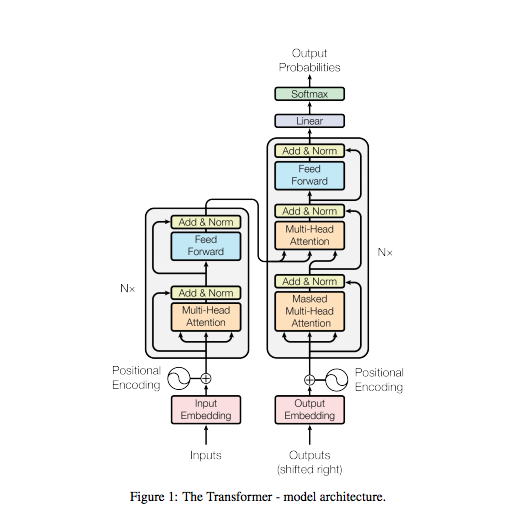
Transformer
My own implementation Transformer model (Attention is All You Need - Google Brain, 2017)
1. Implementations
1.1 Positional Encoding
class PositionalEncoding(nn.Module):
    """
    compute sinusoid encoding.
    """
    def __init__(self, d_model, max_len, device):
        """
        constructor of sinusoid encoding class

        :param d_model: dimension of model
        :param max_len: max sequence length
        :param device: hardware device setting
        """
        super(PositionalEncoding, self).__init__()

        # same size with input matrix (for adding with input matrix)
        self.encoding = torch.zeros(max_len, d_model, device=device)
        self.encoding.requires_grad = False  # we don't need to compute gradient

        pos = torch.arange(0, max_len, device=device)
        pos = pos.float().unsqueeze(dim=1)
        # 1D => 2D unsqueeze to represent word's position

        _2i = torch.arange(0, d_model, step=2, device=device).float()
        # 'i' means index of d_model (e.g. embedding size = 50, 'i' = [0,50])
        # "step=2" means 'i' multiplied with two (same with 2 * i)

        self.encoding[:, 0::2] = torch.sin(pos / (10000 ** (_2i / d_model)))
        self.encoding[:, 1::2] = torch.cos(pos / (10000 ** (_2i / d_model)))
        # compute positional encoding to consider positional information of words

    def forward(self, x):
        # self.encoding
        # [max_len = 512, d_model = 512]

        batch_size, seq_len = x.size()
        # [batch_size = 128, seq_len = 30]

        return self.encoding[:seq_len, :]
        # [seq_len = 30, d_model = 512]
        # it will add with tok_emb : [128, 30, 512]
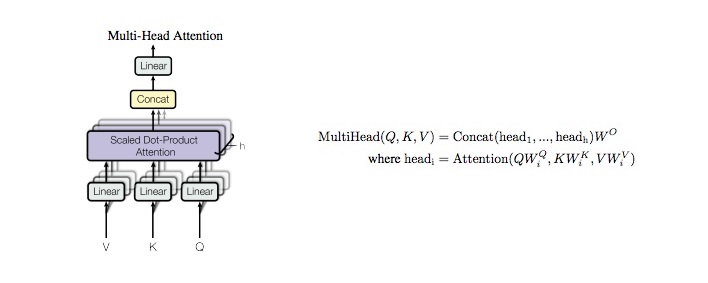
1.2 Multi-Head Attention
class MultiHeadAttention(nn.Module):

    def __init__(self, d_model, n_head):
        super(MultiHeadAttention, self).__init__()
        self.n_head = n_head
        self.attention = ScaleDotProductAttention()
        self.w_q = nn.Linear(d_model, d_model)
        self.w_k = nn.Linear(d_model, d_model)
        self.w_v = nn.Linear(d_model, d_model)
        self.w_concat = nn.Linear(d_model, d_model)

    def forward(self, q, k, v, mask=None):
        # 1. dot product with weight matrices
        q, k, v = self.w_q(q), self.w_k(k), self.w_v(v)

        # 2. split tensor by number of heads
        q, k, v = self.split(q), self.split(k), self.split(v)

        # 3. do scale dot product to compute similarity
        out, attention = self.attention(q, k, v, mask=mask)

        # 4. concat and pass to linear layer
        out = self.concat(out)
        out = self.w_concat(out)

        # 5. visualize attention map
        # TODO : we should implement visualization

        return out

    def split(self, tensor):
        """
        split tensor by number of head

        :param tensor: [batch_size, length, d_model]
        :return: [batch_size, head, length, d_tensor]
        """
        batch_size, length, d_model = tensor.size()

        d_tensor = d_model // self.n_head
        tensor = tensor.view(batch_size, length, self.n_head, d_tensor).transpose(1, 2)
        # it is similar with group convolution (split by number of heads)

        return tensor

    def concat(self, tensor):
        """
        inverse function of self.split(tensor : torch.Tensor)

        :param tensor: [batch_size, head, length, d_tensor]
        :return: [batch_size, length, d_model]
        """
        batch_size, head, length, d_tensor = tensor.size()
        d_model = head * d_tensor

        tensor = tensor.transpose(1, 2).contiguous().view(batch_size, length, d_model)
        return tensor
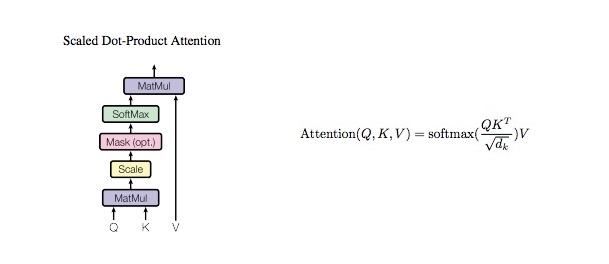
1.3 Scale Dot Product Attention
class ScaleDotProductAttention(nn.Module):
    """
    compute scale dot product attention

    Query : given sentence that we focused on (decoder)
    Key : every sentence to check relationship with Qeury(encoder)
    Value : every sentence same with Key (encoder)
    """

    def __init__(self):
        super(ScaleDotProductAttention, self).__init__()
        self.softmax = nn.Softmax(dim=-1)

    def forward(self, q, k, v, mask=None, e=1e-12):
        # input is 4 dimension tensor
        # [batch_size, head, length, d_tensor]
        batch_size, head, length, d_tensor = k.size()

        # 1. dot product Query with Key^T to compute similarity
        k_t = k.transpose(2, 3)  # transpose
        score = (q @ k_t) / math.sqrt(d_tensor)  # scaled dot product

        # 2. apply masking (opt)
        if mask is not None:
            score = score.masked_fill(mask == 0, -10000)

        # 3. pass them softmax to make [0, 1] range
        score = self.softmax(score)

        # 4. multiply with Value
        v = score @ v

        return v, score
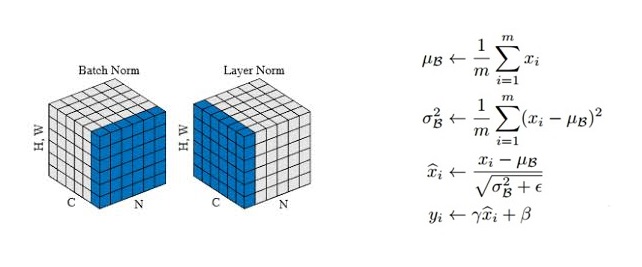
1.4 Layer Norm
class LayerNorm(nn.Module):
    def __init__(self, d_model, eps=1e-12):
        super(LayerNorm, self).__init__()
        self.gamma = nn.Parameter(torch.ones(d_model))
        self.beta = nn.Parameter(torch.zeros(d_model))
        self.eps = eps

    def forward(self, x):
        mean = x.mean(-1, keepdim=True)
        var = x.var(-1, unbiased=False, keepdim=True)
        # '-1' means last dimension.

        out = (x - mean) / torch.sqrt(var + self.eps)
        out = self.gamma * out + self.beta
        return out
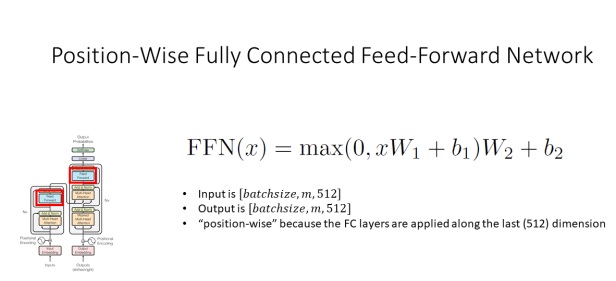
1.5 Positionwise Feed Forward
class PositionwiseFeedForward(nn.Module):

    def __init__(self, d_model, hidden, drop_prob=0.1):
        super(PositionwiseFeedForward, self).__init__()
        self.linear1 = nn.Linear(d_model, hidden)
        self.linear2 = nn.Linear(hidden, d_model)
        self.relu = nn.ReLU()
        self.dropout = nn.Dropout(p=drop_prob)

    def forward(self, x):
        x = self.linear1(x)
        x = self.relu(x)
        x = self.dropout(x)
        x = self.linear2(x)
        return x
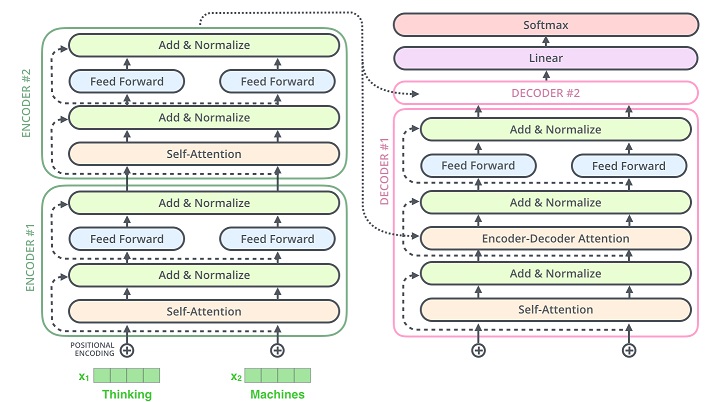
1.6 Encoder & Decoder Structure
class EncoderLayer(nn.Module):

    def __init__(self, d_model, ffn_hidden, n_head, drop_prob):
        super(EncoderLayer, self).__init__()
        self.attention = MultiHeadAttention(d_model=d_model, n_head=n_head)
        self.norm1 = LayerNorm(d_model=d_model)
        self.dropout1 = nn.Dropout(p=drop_prob)

        self.ffn = PositionwiseFeedForward(d_model=d_model, hidden=ffn_hidden, drop_prob=drop_prob)
        self.norm2 = LayerNorm(d_model=d_model)
        self.dropout2 = nn.Dropout(p=drop_prob)

    def forward(self, x, src_mask):
        # 1. compute self attention
        _x = x
        x = self.attention(q=x, k=x, v=x, mask=src_mask)

        # 2. add and norm
        x = self.dropout1(x)
        x = self.norm1(x + _x)

        # 3. positionwise feed forward network
        _x = x
        x = self.ffn(x)

        # 4. add and norm
        x = self.dropout2(x)
        x = self.norm2(x + _x)
        return x
class Encoder(nn.Module):

    def __init__(self, enc_voc_size, max_len, d_model, ffn_hidden, n_head, n_layers, drop_prob, device):
        super().__init__()
        self.emb = TransformerEmbedding(d_model=d_model,
                                        max_len=max_len,
                                        vocab_size=enc_voc_size,
                                        drop_prob=drop_prob,
                                        device=device)

        self.layers = nn.ModuleList([EncoderLayer(d_model=d_model,
                                                  ffn_hidden=ffn_hidden,
                                                  n_head=n_head,
                                                  drop_prob=drop_prob)
                                     for _ in range(n_layers)])

    def forward(self, x, src_mask):
        x = self.emb(x)

        for layer in self.layers:
            x = layer(x, src_mask)

        return x
class DecoderLayer(nn.Module):

    def __init__(self, d_model, ffn_hidden, n_head, drop_prob):
        super(DecoderLayer, self).__init__()
        self.self_attention = MultiHeadAttention(d_model=d_model, n_head=n_head)
        self.norm1 = LayerNorm(d_model=d_model)
        self.dropout1 = nn.Dropout(p=drop_prob)

        self.enc_dec_attention = MultiHeadAttention(d_model=d_model, n_head=n_head)
        self.norm2 = LayerNorm(d_model=d_model)
        self.dropout2 = nn.Dropout(p=drop_prob)

        self.ffn = PositionwiseFeedForward(d_model=d_model, hidden=ffn_hidden, drop_prob=drop_prob)
        self.norm3 = LayerNorm(d_model=d_model)
        self.dropout3 = nn.Dropout(p=drop_prob)

    def forward(self, dec, enc, trg_mask, src_mask):
        # 1. compute self attention
        _x = dec
        x = self.self_attention(q=dec, k=dec, v=dec, mask=trg_mask)

        # 2. add and norm
        x = self.dropout1(x)
        x = self.norm1(x + _x)

        if enc is not None:
            # 3. compute encoder - decoder attention
            _x = x
            x = self.enc_dec_attention(q=x, k=enc, v=enc, mask=src_mask)

            # 4. add and norm
            x = self.dropout2(x)
            x = self.norm2(x + _x)

        # 5. positionwise feed forward network
        _x = x
        x = self.ffn(x)

        # 6. add and norm
        x = self.dropout3(x)
        x = self.norm3(x + _x)
        return x
class Decoder(nn.Module):
    def __init__(self, dec_voc_size, max_len, d_model, ffn_hidden, n_head, n_layers, drop_prob, device):
        super().__init__()
        self.emb = TransformerEmbedding(d_model=d_model,
                                        drop_prob=drop_prob,
                                        max_len=max_len,
                                        vocab_size=dec_voc_size,
                                        device=device)

        self.layers = nn.ModuleList([DecoderLayer(d_model=d_model,
                                                  ffn_hidden=ffn_hidden,
                                                  n_head=n_head,
                                                  drop_prob=drop_prob)
                                     for _ in range(n_layers)])

        self.linear = nn.Linear(d_model, dec_voc_size)

    def forward(self, trg, src, trg_mask, src_mask):
        trg = self.emb(trg)

        for layer in self.layers:
            trg = layer(trg, src, trg_mask, src_mask)

        # pass to LM head
        output = self.linear(trg)
        return output
2. Experiments
I use Multi30K Dataset to train and evaluate model
You can check detail of dataset here
I follow original paper's parameter settings. (below)
2.1 Model Specification
total parameters = 55,207,087
model size = 215.7MB
lr scheduling : ReduceLROnPlateau
2.1.1 configuration
batch_size = 128
max_len = 256
d_model = 512
n_layers = 6
n_heads = 8
ffn_hidden = 2048
drop_prob = 0.1
init_lr = 0.1
factor = 0.9
patience = 10
warmup = 100
adam_eps = 5e-9
epoch = 1000
clip = 1
weight_decay = 5e-4
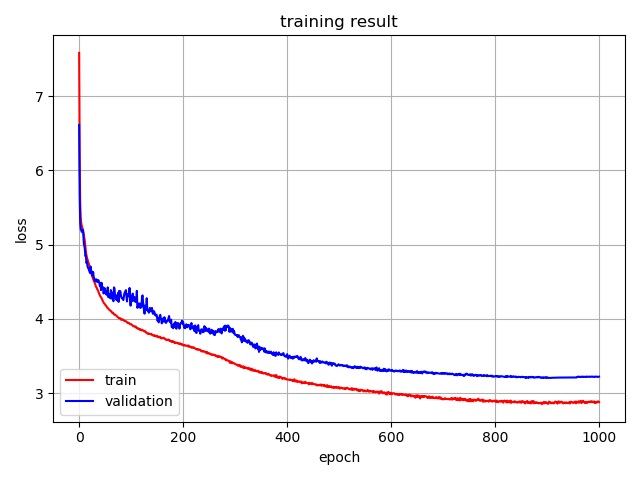
2.2 Training Result
Minimum Training Loss = 2.852672759656864
Minimum Validation Loss = 3.2048025131225586
Model
Dataset
BLEU Score
Original Paper's
WMT14 EN-DE
25.8
My Implementation
Multi30K EN-DE
26.4
3. Reference
Attention is All You Need, 2017 - Google
The Illustrated Transformer - Jay Alammar
Data & Optimization Code Reference - Bentrevett
4. Licence
Copyright 2019 Hyunwoong Ko.

Licensed under the Apache License, Version 2.0 (the "License");
you may not use this file except in compliance with the License.
You may obtain a copy of the License at

http://www.apache.org/licenses/LICENSE-2.0

Unless required by applicable law or agreed to in writing, software
distributed under the License is distributed on an "AS IS" BASIS,
WITHOUT WARRANTIES OR CONDITIONS OF ANY KIND, either express or implied.
See the License for the specific language governing permissions and
limitations under the License.
Does hyunwoongko/transformer have a project website?
No homepage URL was recorded for hyunwoongko/transformer in TopGit's last sync. The README tab above frequently contains screenshots and demo links, or check the repository description on GitHub.
How does hyunwoongko/transformer compare to other AI Tools projects?
hyunwoongko/transformer is tracked by TopGit in the AI Tools category, with 4.7k GitHub stars and written in Python. Browse the AI Tools topic page on TopGit to compare it against similar projects by stars and activity.
How many stars does hyunwoongko/transformer have?
hyunwoongko/transformer has 4.7k GitHub stars — refresh the page for the live number, or check github.com/hyunwoongko/transformer. TopGit mirrors GitHub's count but does not claim minute-by-minute accuracy.
Is hyunwoongko/transformer open source?
TopGit's metadata for hyunwoongko/transformer does not record a license. Most public repositories on GitHub ARE open source, but the exact terms vary — verify by opening the LICENSE file directly.
What else is in the AI Tools space?
hyunwoongko/transformer is tracked by TopGit under the AI Tools category, alongside 4 GitHub-tagged topics. Trending and Topics pages list peer repositories of comparable stars and language.
What is hyunwoongko/transformer?
hyunwoongko/transformer (hyunwoongko/transformer) is a Python project on GitHub. From the project's own README: Transformer: PyTorch Implementation of "Attention Is All You Need"
Where do I read more about hyunwoongko/transformer?
This TopGit page is a snapshot — the READ ME tab shows the project's own README content (links stripped, images preserved). The GitHub repository at github.com/hyunwoongko/transformer is the definitive source.
Read full README in the tab above.
Want a second opinion on transformer?
Ask an AI that can read this page — one click and you get its take on transformer.

 /transformer