Một mục tích hợp AI trong kho dữ liệu GitHub của TopGit: hyunwoongko/transformer, 4.7k sao, nhóm AI Tools, Python. Transformer: PyTorch Implementation of "Attention Is All You Need"
Tóm tắt dựng từ metadata GitHub của chính dự án — chưa có bài review TopGit. Trang sẽ tự động cập nhật khi bài review đầy đủ được xuất bản.
VÌ SAO CHƯA CÓ REVIEW
TopGit viết bài đầy đủ cho repo có nhiều sao nhất và được yêu cầu nhiều nhất. Trang này là snapshot trong thời gian chờ — xem README gốc ở tab READ ME.
This code was written in 2019, and I was not very familiar with transformer model in that time.
So don't trust this code too much. Currently I am not managing this code well, so please open pull requests if you find bugs in the code and want to fix.
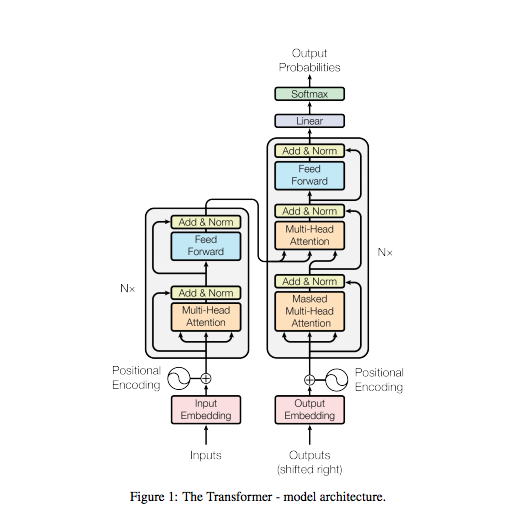
Transformer
My own implementation Transformer model (Attention is All You Need - Google Brain, 2017)
1. Implementations
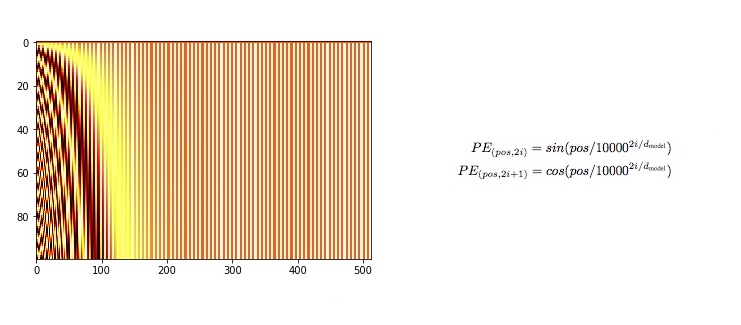
1.1 Positional Encoding
class PositionalEncoding(nn.Module):
    """
    compute sinusoid encoding.
    """
    def __init__(self, d_model, max_len, device):
        """
        constructor of sinusoid encoding class

        :param d_model: dimension of model
        :param max_len: max sequence length
        :param device: hardware device setting
        """
        super(PositionalEncoding, self).__init__()

        # same size with input matrix (for adding with input matrix)
        self.encoding = torch.zeros(max_len, d_model, device=device)
        self.encoding.requires_grad = False  # we don't need to compute gradient

        pos = torch.arange(0, max_len, device=device)
        pos = pos.float().unsqueeze(dim=1)
        # 1D => 2D unsqueeze to represent word's position

        _2i = torch.arange(0, d_model, step=2, device=device).float()
        # 'i' means index of d_model (e.g. embedding size = 50, 'i' = [0,50])
        # "step=2" means 'i' multiplied with two (same with 2 * i)

        self.encoding[:, 0::2] = torch.sin(pos / (10000 ** (_2i / d_model)))
        self.encoding[:, 1::2] = torch.cos(pos / (10000 ** (_2i / d_model)))
        # compute positional encoding to consider positional information of words

    def forward(self, x):
        # self.encoding
        # [max_len = 512, d_model = 512]

        batch_size, seq_len = x.size()
        # [batch_size = 128, seq_len = 30]

        return self.encoding[:seq_len, :]
        # [seq_len = 30, d_model = 512]
        # it will add with tok_emb : [128, 30, 512]
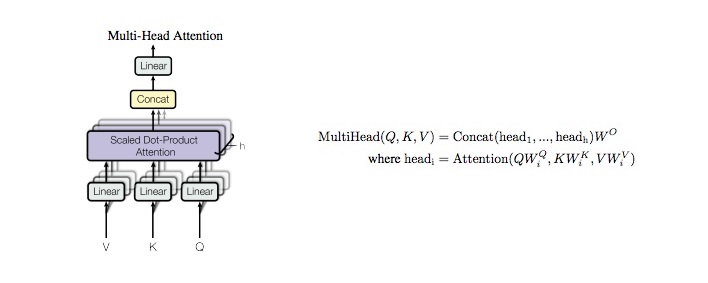
1.2 Multi-Head Attention
class MultiHeadAttention(nn.Module):

    def __init__(self, d_model, n_head):
        super(MultiHeadAttention, self).__init__()
        self.n_head = n_head
        self.attention = ScaleDotProductAttention()
        self.w_q = nn.Linear(d_model, d_model)
        self.w_k = nn.Linear(d_model, d_model)
        self.w_v = nn.Linear(d_model, d_model)
        self.w_concat = nn.Linear(d_model, d_model)

    def forward(self, q, k, v, mask=None):
        # 1. dot product with weight matrices
        q, k, v = self.w_q(q), self.w_k(k), self.w_v(v)

        # 2. split tensor by number of heads
        q, k, v = self.split(q), self.split(k), self.split(v)

        # 3. do scale dot product to compute similarity
        out, attention = self.attention(q, k, v, mask=mask)

        # 4. concat and pass to linear layer
        out = self.concat(out)
        out = self.w_concat(out)

        # 5. visualize attention map
        # TODO : we should implement visualization

        return out

    def split(self, tensor):
        """
        split tensor by number of head

        :param tensor: [batch_size, length, d_model]
        :return: [batch_size, head, length, d_tensor]
        """
        batch_size, length, d_model = tensor.size()

        d_tensor = d_model // self.n_head
        tensor = tensor.view(batch_size, length, self.n_head, d_tensor).transpose(1, 2)
        # it is similar with group convolution (split by number of heads)

        return tensor

    def concat(self, tensor):
        """
        inverse function of self.split(tensor : torch.Tensor)

        :param tensor: [batch_size, head, length, d_tensor]
        :return: [batch_size, length, d_model]
        """
        batch_size, head, length, d_tensor = tensor.size()
        d_model = head * d_tensor

        tensor = tensor.transpose(1, 2).contiguous().view(batch_size, length, d_model)
        return tensor
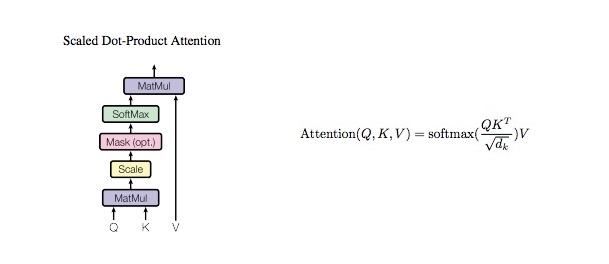
1.3 Scale Dot Product Attention
class ScaleDotProductAttention(nn.Module):
    """
    compute scale dot product attention

    Query : given sentence that we focused on (decoder)
    Key : every sentence to check relationship with Qeury(encoder)
    Value : every sentence same with Key (encoder)
    """

    def __init__(self):
        super(ScaleDotProductAttention, self).__init__()
        self.softmax = nn.Softmax(dim=-1)

    def forward(self, q, k, v, mask=None, e=1e-12):
        # input is 4 dimension tensor
        # [batch_size, head, length, d_tensor]
        batch_size, head, length, d_tensor = k.size()

        # 1. dot product Query with Key^T to compute similarity
        k_t = k.transpose(2, 3)  # transpose
        score = (q @ k_t) / math.sqrt(d_tensor)  # scaled dot product

        # 2. apply masking (opt)
        if mask is not None:
            score = score.masked_fill(mask == 0, -10000)

        # 3. pass them softmax to make [0, 1] range
        score = self.softmax(score)

        # 4. multiply with Value
        v = score @ v

        return v, score
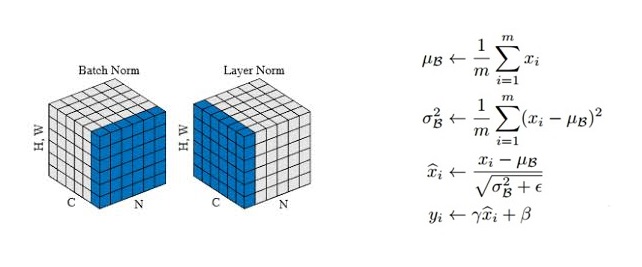
1.4 Layer Norm
class LayerNorm(nn.Module):
    def __init__(self, d_model, eps=1e-12):
        super(LayerNorm, self).__init__()
        self.gamma = nn.Parameter(torch.ones(d_model))
        self.beta = nn.Parameter(torch.zeros(d_model))
        self.eps = eps

    def forward(self, x):
        mean = x.mean(-1, keepdim=True)
        var = x.var(-1, unbiased=False, keepdim=True)
        # '-1' means last dimension.

        out = (x - mean) / torch.sqrt(var + self.eps)
        out = self.gamma * out + self.beta
        return out
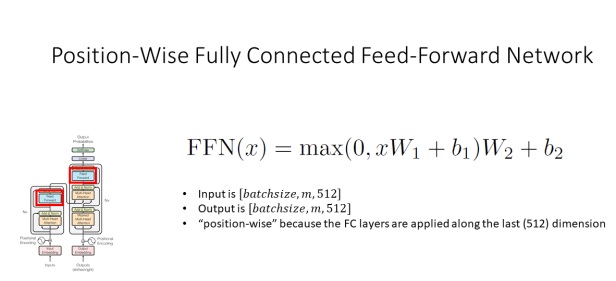
1.5 Positionwise Feed Forward
class PositionwiseFeedForward(nn.Module):

    def __init__(self, d_model, hidden, drop_prob=0.1):
        super(PositionwiseFeedForward, self).__init__()
        self.linear1 = nn.Linear(d_model, hidden)
        self.linear2 = nn.Linear(hidden, d_model)
        self.relu = nn.ReLU()
        self.dropout = nn.Dropout(p=drop_prob)

    def forward(self, x):
        x = self.linear1(x)
        x = self.relu(x)
        x = self.dropout(x)
        x = self.linear2(x)
        return x
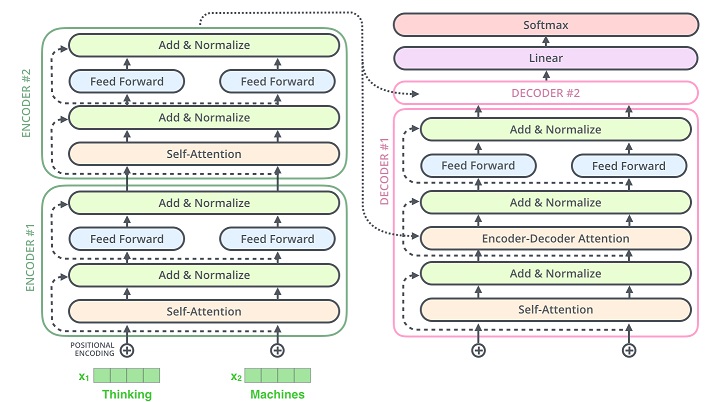
1.6 Encoder & Decoder Structure
class EncoderLayer(nn.Module):

    def __init__(self, d_model, ffn_hidden, n_head, drop_prob):
        super(EncoderLayer, self).__init__()
        self.attention = MultiHeadAttention(d_model=d_model, n_head=n_head)
        self.norm1 = LayerNorm(d_model=d_model)
        self.dropout1 = nn.Dropout(p=drop_prob)

        self.ffn = PositionwiseFeedForward(d_model=d_model, hidden=ffn_hidden, drop_prob=drop_prob)
        self.norm2 = LayerNorm(d_model=d_model)
        self.dropout2 = nn.Dropout(p=drop_prob)

    def forward(self, x, src_mask):
        # 1. compute self attention
        _x = x
        x = self.attention(q=x, k=x, v=x, mask=src_mask)

        # 2. add and norm
        x = self.dropout1(x)
        x = self.norm1(x + _x)

        # 3. positionwise feed forward network
        _x = x
        x = self.ffn(x)

        # 4. add and norm
        x = self.dropout2(x)
        x = self.norm2(x + _x)
        return x
class Encoder(nn.Module):

    def __init__(self, enc_voc_size, max_len, d_model, ffn_hidden, n_head, n_layers, drop_prob, device):
        super().__init__()
        self.emb = TransformerEmbedding(d_model=d_model,
                                        max_len=max_len,
                                        vocab_size=enc_voc_size,
                                        drop_prob=drop_prob,
                                        device=device)

        self.layers = nn.ModuleList([EncoderLayer(d_model=d_model,
                                                  ffn_hidden=ffn_hidden,
                                                  n_head=n_head,
                                                  drop_prob=drop_prob)
                                     for _ in range(n_layers)])

    def forward(self, x, src_mask):
        x = self.emb(x)

        for layer in self.layers:
            x = layer(x, src_mask)

        return x
class DecoderLayer(nn.Module):

    def __init__(self, d_model, ffn_hidden, n_head, drop_prob):
        super(DecoderLayer, self).__init__()
        self.self_attention = MultiHeadAttention(d_model=d_model, n_head=n_head)
        self.norm1 = LayerNorm(d_model=d_model)
        self.dropout1 = nn.Dropout(p=drop_prob)

        self.enc_dec_attention = MultiHeadAttention(d_model=d_model, n_head=n_head)
        self.norm2 = LayerNorm(d_model=d_model)
        self.dropout2 = nn.Dropout(p=drop_prob)

        self.ffn = PositionwiseFeedForward(d_model=d_model, hidden=ffn_hidden, drop_prob=drop_prob)
        self.norm3 = LayerNorm(d_model=d_model)
        self.dropout3 = nn.Dropout(p=drop_prob)

    def forward(self, dec, enc, trg_mask, src_mask):
        # 1. compute self attention
        _x = dec
        x = self.self_attention(q=dec, k=dec, v=dec, mask=trg_mask)

        # 2. add and norm
        x = self.dropout1(x)
        x = self.norm1(x + _x)

        if enc is not None:
            # 3. compute encoder - decoder attention
            _x = x
            x = self.enc_dec_attention(q=x, k=enc, v=enc, mask=src_mask)

            # 4. add and norm
            x = self.dropout2(x)
            x = self.norm2(x + _x)

        # 5. positionwise feed forward network
        _x = x
        x = self.ffn(x)

        # 6. add and norm
        x = self.dropout3(x)
        x = self.norm3(x + _x)
        return x
class Decoder(nn.Module):
    def __init__(self, dec_voc_size, max_len, d_model, ffn_hidden, n_head, n_layers, drop_prob, device):
        super().__init__()
        self.emb = TransformerEmbedding(d_model=d_model,
                                        drop_prob=drop_prob,
                                        max_len=max_len,
                                        vocab_size=dec_voc_size,
                                        device=device)

        self.layers = nn.ModuleList([DecoderLayer(d_model=d_model,
                                                  ffn_hidden=ffn_hidden,
                                                  n_head=n_head,
                                                  drop_prob=drop_prob)
                                     for _ in range(n_layers)])

        self.linear = nn.Linear(d_model, dec_voc_size)

    def forward(self, trg, src, trg_mask, src_mask):
        trg = self.emb(trg)

        for layer in self.layers:
            trg = layer(trg, src, trg_mask, src_mask)

        # pass to LM head
        output = self.linear(trg)
        return output
2. Experiments
I use Multi30K Dataset to train and evaluate model
You can check detail of dataset here
I follow original paper's parameter settings. (below)
2.1 Model Specification
total parameters = 55,207,087
model size = 215.7MB
lr scheduling : ReduceLROnPlateau
2.1.1 configuration
batch_size = 128
max_len = 256
d_model = 512
n_layers = 6
n_heads = 8
ffn_hidden = 2048
drop_prob = 0.1
init_lr = 0.1
factor = 0.9
patience = 10
warmup = 100
adam_eps = 5e-9
epoch = 1000
clip = 1
weight_decay = 5e-4
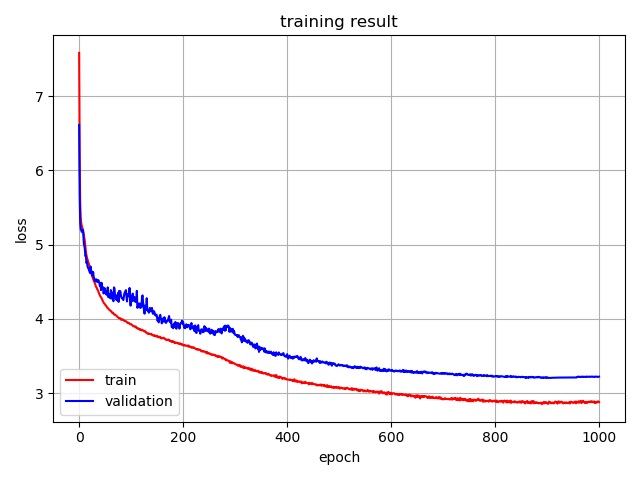
2.2 Training Result
Minimum Training Loss = 2.852672759656864
Minimum Validation Loss = 3.2048025131225586
Model
Dataset
BLEU Score
Original Paper's
WMT14 EN-DE
25.8
My Implementation
Multi30K EN-DE
26.4
3. Reference
Attention is All You Need, 2017 - Google
The Illustrated Transformer - Jay Alammar
Data & Optimization Code Reference - Bentrevett
4. Licence
Copyright 2019 Hyunwoong Ko.

Licensed under the Apache License, Version 2.0 (the "License");
you may not use this file except in compliance with the License.
You may obtain a copy of the License at

http://www.apache.org/licenses/LICENSE-2.0

Unless required by applicable law or agreed to in writing, software
distributed under the License is distributed on an "AS IS" BASIS,
WITHOUT WARRANTIES OR CONDITIONS OF ANY KIND, either express or implied.
See the License for the specific language governing permissions and
limitations under the License.
hyunwoongko/transformer thuộc nhóm AI Tools trên TopGit, cùng 4 topic GitHub. Trang Trending và Topics liệt kê các repo cùng số sao và cùng ngôn ngữ để so sánh.
Đọc thêm về hyunwoongko/transformer ở đâu?
Trang TopGit này là một snapshot — tab "Readme" hiển thị nguyên văn README của repo (đã bỏ link, giữ ảnh). Repo GitHub ở github.com/hyunwoongko/transformer là nguồn chính thức.
hyunwoongko/transformer có bao nhiêu sao?
hyunwoongko/transformer có 4.7k sao GitHub — tải lại trang để xem số mới nhất, hoặc xem trực tiếp github.com/hyunwoongko/transformer. TopGit phản chiếu số sao của GitHub nhưng không cam kết đến từng phút.
hyunwoongko/transformer có phải mã nguồn mở không?
TopGit chưa ghi nhận license cho hyunwoongko/transformer. Phần lớn repo public trên GitHub là mã nguồn mở, nhưng điều khoản khác nhau từng repo — mở file LICENSE để xác nhận.
hyunwoongko/transformer có website riêng không?
TopGit chưa ghi nhận URL trang chủ cho hyunwoongko/transformer. Phần README ở tab phía trên thường có link demo, hoặc xem mô tả GitHub của repo.
hyunwoongko/transformer là gì?
hyunwoongko/transformer (hyunwoongko/transformer) là dự án Python trên GitHub. Theo mô tả gốc: Transformer: PyTorch Implementation of "Attention Is All You Need"
hyunwoongko/transformer so với các dự án AI Tools khác thế nào?
hyunwoongko/transformer được TopGit xếp vào nhóm AI Tools, với 4.7k sao GitHub và viết bằng Python. Xem trang chủ đề AI Tools trên TopGit để so sánh với các dự án tương tự theo số sao và mức độ hoạt động.
Đọc đầy đủ README ở tab phía trên.
Muốn nghe thêm một ý kiến về transformer?
Hỏi một AI đọc được trang này — một cú bấm là có ngay nhận định về transformer.

 /transformer