jundot/omlx
 jundot/omlx
jundot/omlx is tracked by TopGit as an AI tool, with 19.8k stars on GitHub, written primarily in Python. LLM inference server with continuous batching & SSD caching for Apple Silicon — managed from the macOS menu bar
Snapshot summary built from the project's own GitHub metadata — there's no written TopGit review yet. The page will update automatically when a full review is published.
TopGit writes full reviews for the most-starred, most-requested repositories. This page is a snapshot until then — see the READ ME tab for the original README in full.
Snapshot
Top contributors
Show top contributors

oMLX
LLM inference, optimized for your Mac
Continuous batching and tiered KV caching, managed directly from your menu bar.




[email protected] · https://omlx.ai/me
Install · Quickstart · Features · Models · CLI Configuration · Benchmarks · oMLX.ai
English · 中文 · 한국어 · 日本語
Every LLM server I tried made me choose between convenience and control. I wanted to pin everyday models in memory, auto-swap heavier ones on demand, set context limits - and manage it all from a menu bar.
oMLX persists KV cache across a hot in-memory tier and cold SSD tier - even when context changes mid-conversation, all past context stays cached and reusable across requests, making local LLMs practical for real coding work with tools like Claude Code. That's why I built it.
Install
macOS App
Download the .dmg from Releases, drag to Applications, done. The app includes in-app auto-update, so future upgrades are just one click. The macOS app also installs a lightweight ~/.omlx/bin/omlx CLI shim so terminal commands and Apple Shortcuts can control the app-managed server.
Homebrew
brew tap jundot/omlx https://github.com/jundot/omlx
brew install jundot/omlx/omlx

# Upgrade to the latest version
brew update && brew upgrade omlx

# Run as a background service (auto-restarts on crash)
omlx start

# Optional: MCP (Model Context Protocol) support
/opt/homebrew/opt/omlx/libexec/bin/pip install mcp
Optional GLM-5.2 / MiniMax M3 native custom kernels currently require a HEAD build:
brew install jundot/omlx/omlx --HEAD --with-custom-kernel
From Source
git clone https://github.com/jundot/omlx.git
cd omlx
pip install -e .          # Core only
pip install -e ".[mcp]"   # With MCP (Model Context Protocol) support

# GLM-5.2 / MiniMax M3 / Qwen3.5 native custom kernels (strongly recommended
# if you serve those families -- see note below)
OMLX_WITH_CUSTOM_KERNEL=1 pip install -e .
Requires macOS 15.0+ (Sequoia), Python 3.11–3.13, and Apple Silicon (M1/M2/M3/M4).
Note on native custom kernels: a plain
pip install -e .does NOT build them, and the affected model families then silently fall back to much slower generic paths -- for GLM-5.2 the fused DSA prefill is roughly 30x faster with the kernels (measured 845 vs ~29 tok/s on an M3 Ultra), and the fallback also uses more memory (#2137). Building them requires the Metal toolchain, which Command Line Tools alone do not provide (xcrun: error: unable to find utility "metal"): install full Xcode, or use the official DMG which ships the kernels precompiled. Homebrew can build them withbrew install jundot/omlx/omlx --HEAD --with-custom-kernel, but that build also needs full Xcode. To verify your install:python -c "from omlx.custom_kernels import native_kernel_status; print(native_kernel_status())"
Quickstart
macOS App
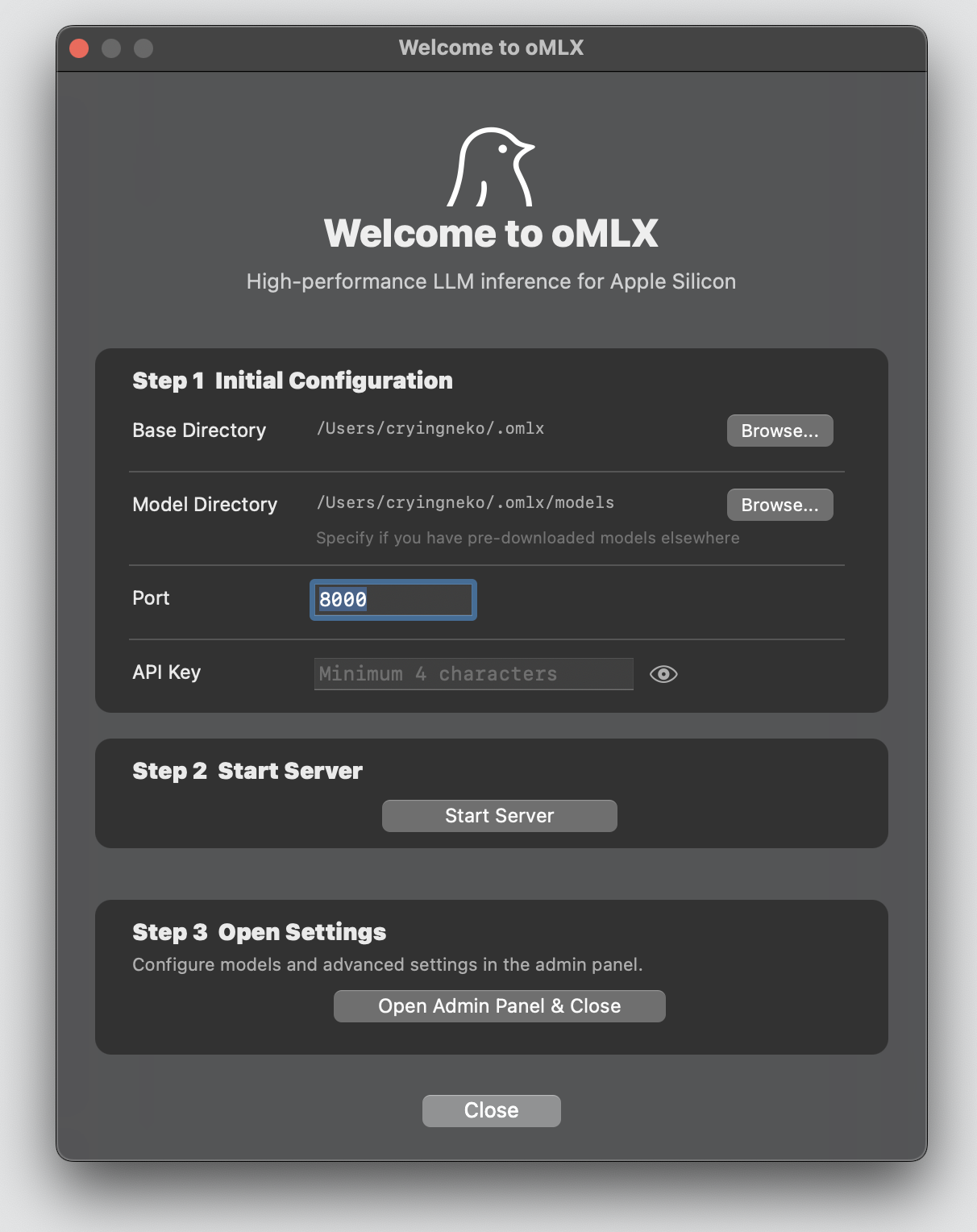
Launch oMLX from your Applications folder. The Welcome screen guides you through three steps - model directory, server start, and first model download. That's it. To connect OpenClaw, OpenCode, Codex, Hermes Agent, or Copilot, see Integrations.
CLI
# Managed background server (macOS app or Homebrew install)
omlx start
omlx stop
omlx restart

# Foreground server attached to this terminal
omlx serve --model-dir ~/models
The server discovers LLMs, VLMs, embedding models, and rerankers from subdirectories automatically. Any OpenAI-compatible client can connect to http://localhost:8000/v1. A built-in chat UI is also available at http://localhost:8000/admin/chat.
Homebrew Service
If you installed via Homebrew, you can run oMLX as a managed background service:
omlx start                    # Start via brew services
omlx stop                     # Stop
omlx restart                  # Restart

brew services start omlx    # Start (auto-restarts on crash)
brew services stop omlx     # Stop
brew services restart omlx  # Restart
brew services info omlx     # Check status
The service runs omlx serve with zero-config defaults (~/.omlx/models, port 8000). omlx start, omlx stop, and omlx restart are the portable lifecycle commands; Homebrew installs delegate them to brew services. To customize, either set environment variables (OMLX_MODEL_DIR, OMLX_PORT, etc.) or run omlx serve --model-dir /your/path once to persist settings to ~/.omlx/settings.json.
Logs are written to two locations:
- Service log:
$(brew --prefix)/var/log/omlx.log(stdout/stderr) - Server log:
~/.omlx/logs/server.log(structured application log)
Features
Supports text LLMs, vision-language models (VLM), OCR models, embeddings, and rerankers on Apple Silicon.
Admin Dashboard
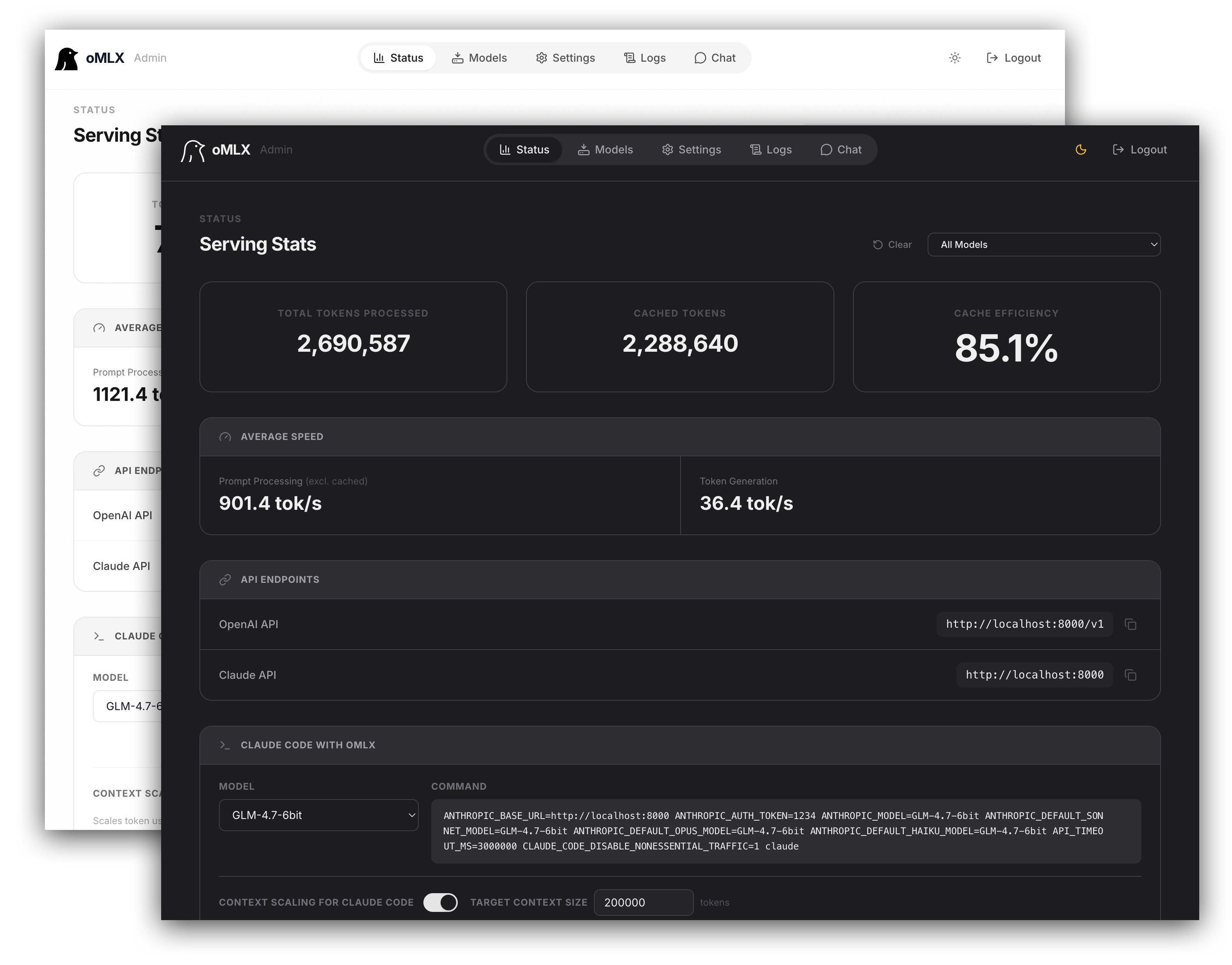
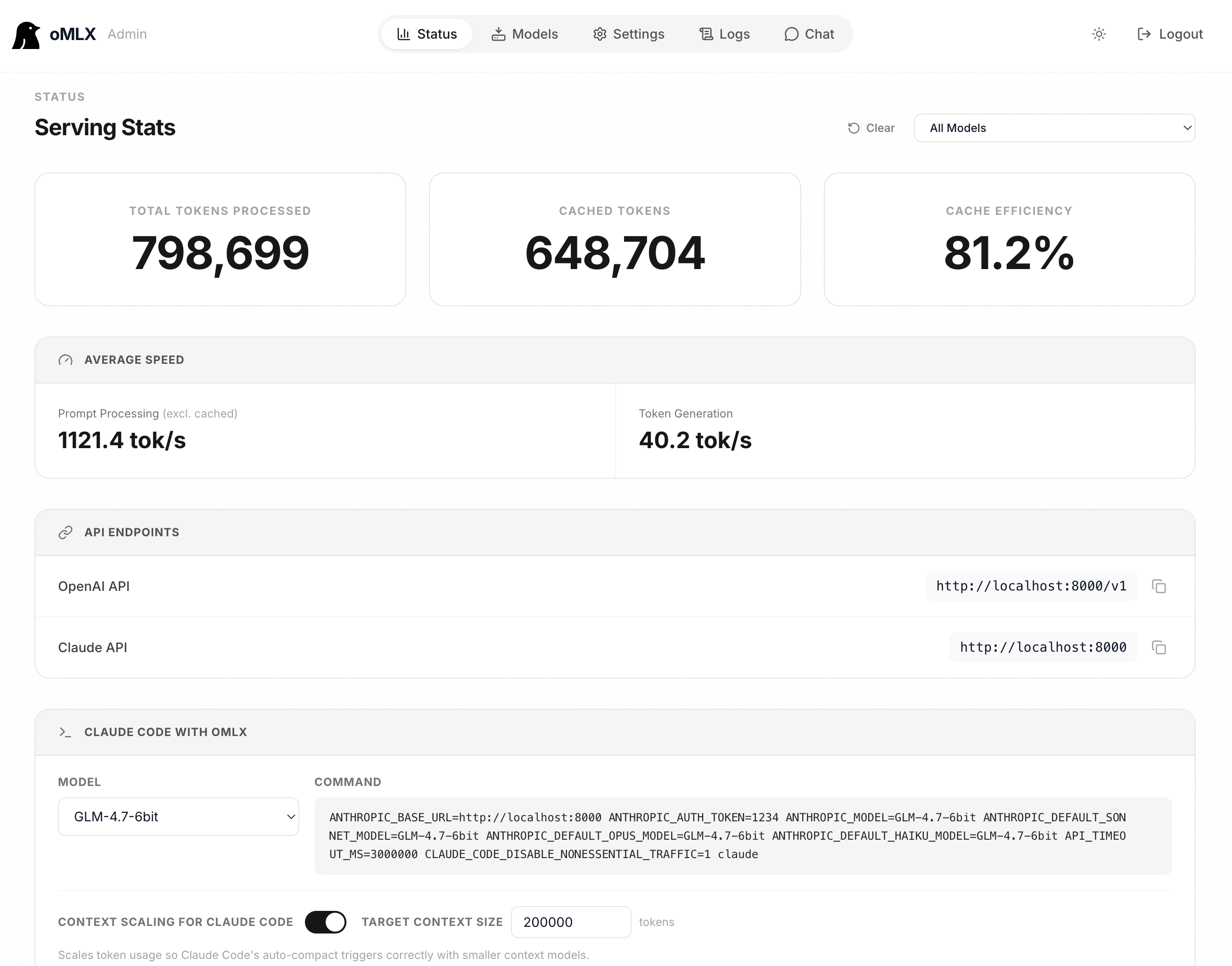
Web UI at /admin for real-time monitoring, model management, chat, benchmark, and per-model settings. Supports English, Korean, Japanese, Chinese, French, Russian, Spanish, and Brazilian Portuguese. All CDN dependencies are vendored for fully offline operation.
Experimental Multi-Mac Inference
Source builds can split one downloaded language model across unequal-memory Macs using MLX pipeline ranks over Ring or Thunderbolt RDMA/JACCL. The Cluster dashboard handles read-only peer discovery, strict SSH/runtime verification, byte-aware unequal shard planning, measured compute/link rebalancing, headroom-aware execution tuning, activation, and a live shard/performance map on both Macs. Interactive, balanced, and throughput profiles expose coalesced batching, prompt-cache affinity, rotating-KV limits, Ring connection tuning, and a capability-gated experimental token-only output path. See Distributed inference across Macs for setup, security boundaries, current limitations, and the physical-hardware validation checklist.
Vision-Language Models
Run VLMs with the same continuous batching and tiered KV cache stack as text LLMs. Supports multi-image chat, base64/URL/file image inputs, and tool calling with vision context. OCR models (DeepSeek-OCR, DOTS-OCR, GLM-OCR) are auto-detected with optimized prompts.
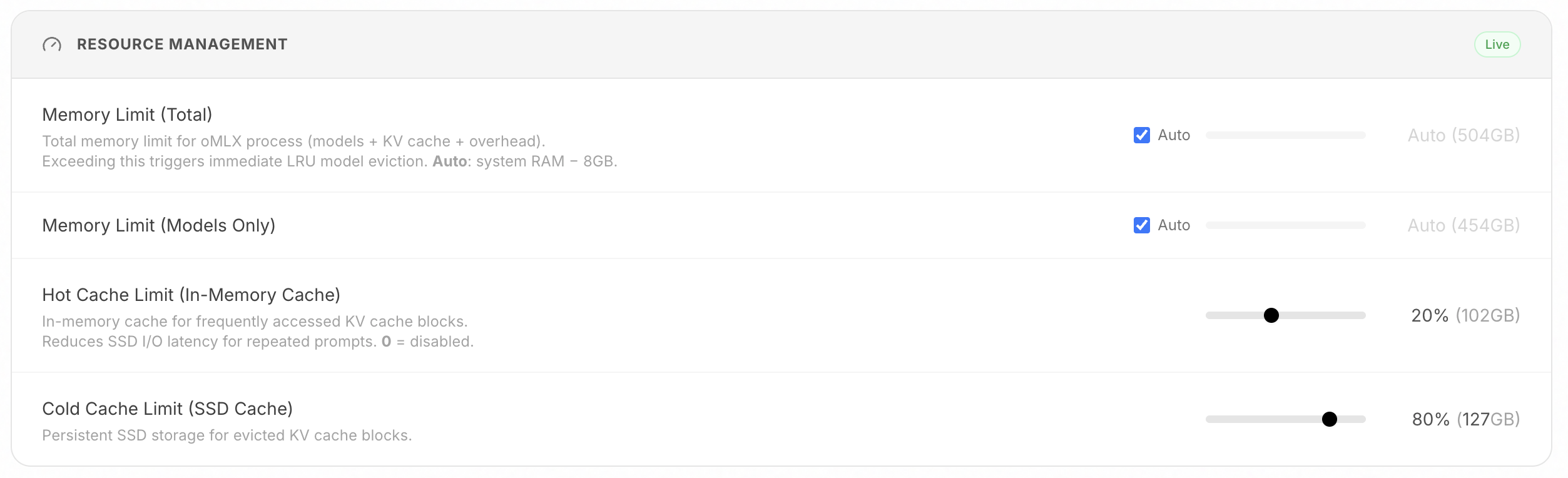
Tiered KV Cache (Hot + Cold)
Block-based KV cache management inspired by vLLM, with prefix sharing and Copy-on-Write. The cache operates across two tiers:
- Hot tier (RAM): Frequently accessed blocks stay in memory for fast access.
- Cold tier (SSD): When the hot cache fills up, blocks are offloaded to SSD in safetensors format. On the next request with a matching prefix, they're restored from disk instead of recomputed from scratch - even after a server restart.
Continuous Batching
Handles concurrent requests through mlx-lm's BatchGenerator. Max concurrent requests is configurable via CLI or admin panel.
Claude Code Optimization
Context scaling support for running smaller context models with Claude Code. Scales reported token counts so that auto-compact triggers at the right timing, and SSE keep-alive prevents read timeouts during long prefill.
Multi-Model Serving
Load LLMs, VLMs, embedding models, and rerankers within the same server. Models are managed through a combination of automatic and manual controls:
- LRU eviction: Least-recently-used models are evicted automatically when memory runs low.
- Manual load/unload: Interactive status badges in the admin panel let you load or unload models on demand.
- Model pinning: Pin frequently used models to keep them always loaded.
- Per-model TTL: Set an idle timeout per model to auto-unload after a period of inactivity.
- Process memory enforcement: Total memory limit (default: system RAM - 8GB) prevents system-wide OOM.
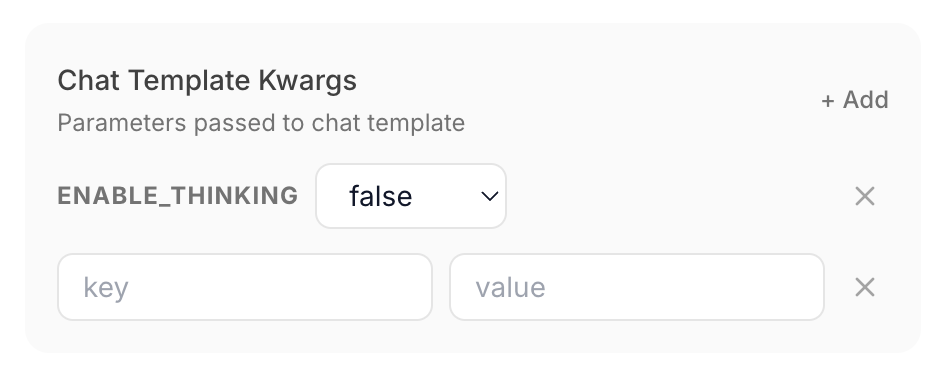
Per-Model Settings
Configure sampling parameters, chat template kwargs, TTL, model alias, model type override, and more per model directly from the admin panel. Changes apply immediately without server restart.
- Model alias: set a custom API-visible name.
/v1/modelsreturns the alias, and requests accept both the alias and directory name. - Model type override: manually set a model as LLM or VLM regardless of auto-detection.
- Profiles: save named bundles of per-model settings and switch between them from the admin panel. A profile can optionally be exposed as its own model:
/v1/modelsthen also lists<model>:<profile>(e.g.qwen3-8b:thinking), which serves on the same engine as the base model with the profile's settings overlaid per request — no extra memory, no reload. When the base model has an alias, the exposed ID is advertised as<alias>:<profile>; the directory-name form keeps working, just like for the base model.
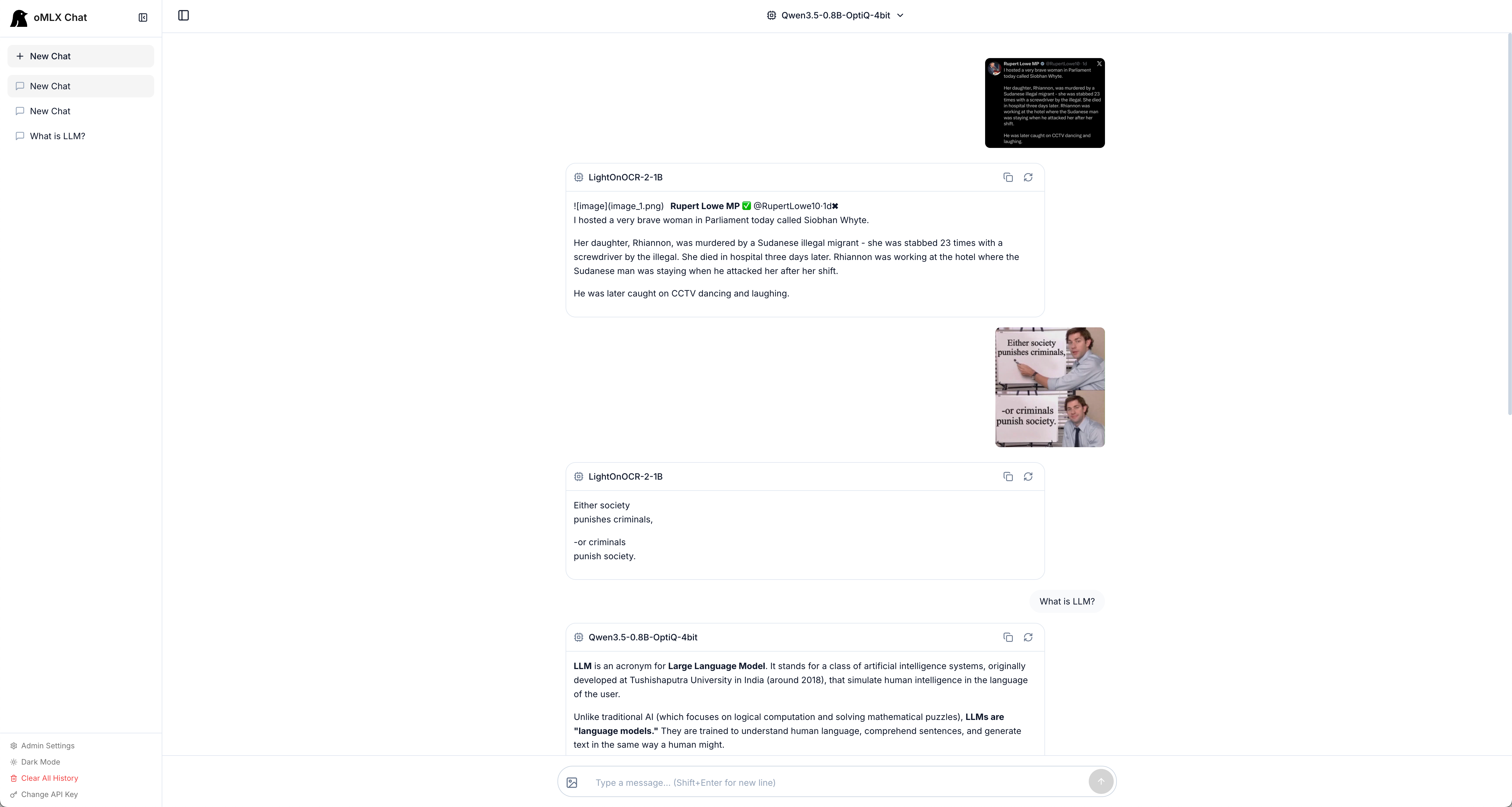
Built-in Chat
Chat directly with any loaded model from the admin panel. Supports conversation history, model switching, dark mode, reasoning model output, and image upload for VLM/OCR models.
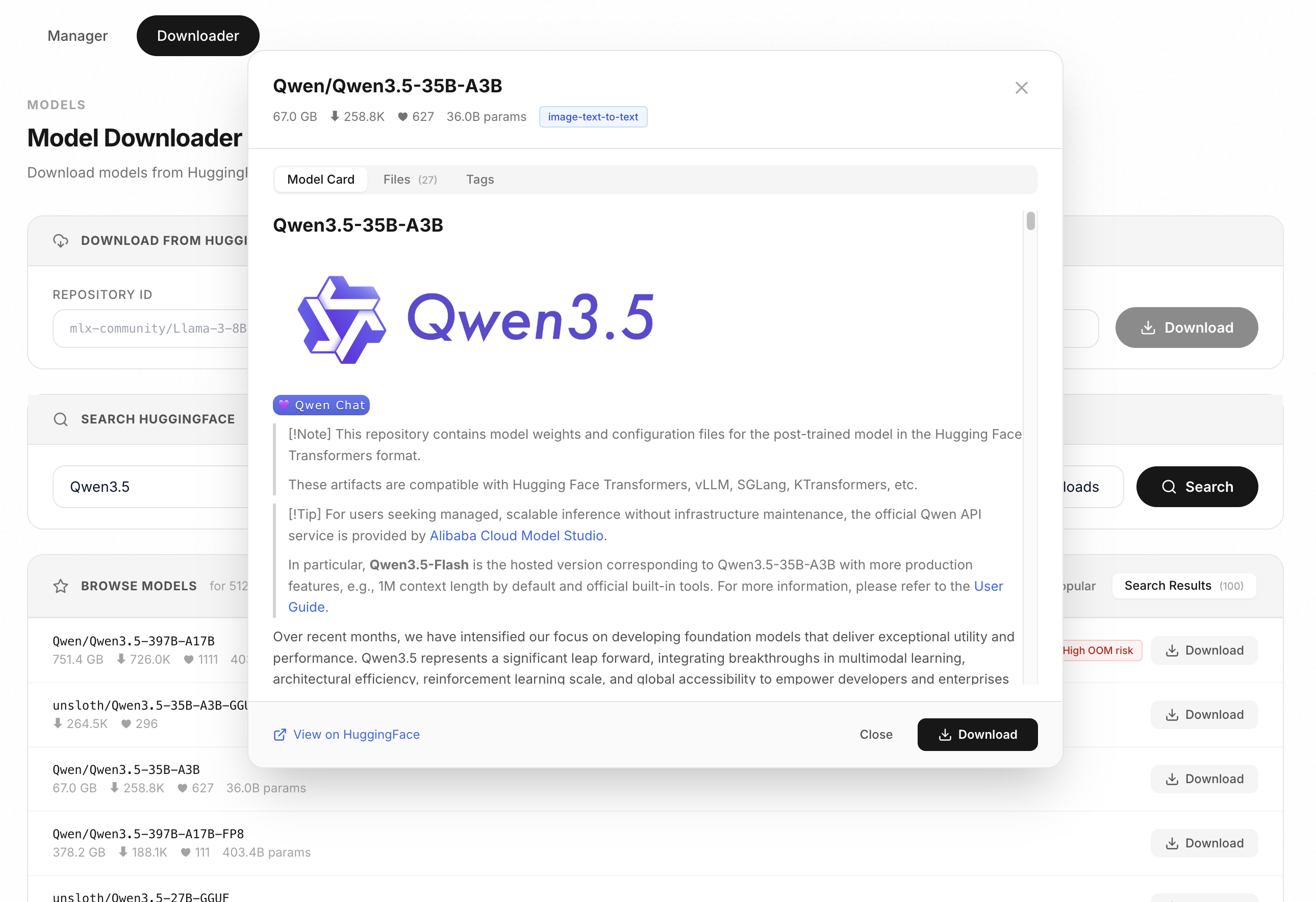
Model Downloader
Search and download MLX models from HuggingFace directly in the admin dashboard. Browse model cards, check file sizes, and download with one click.
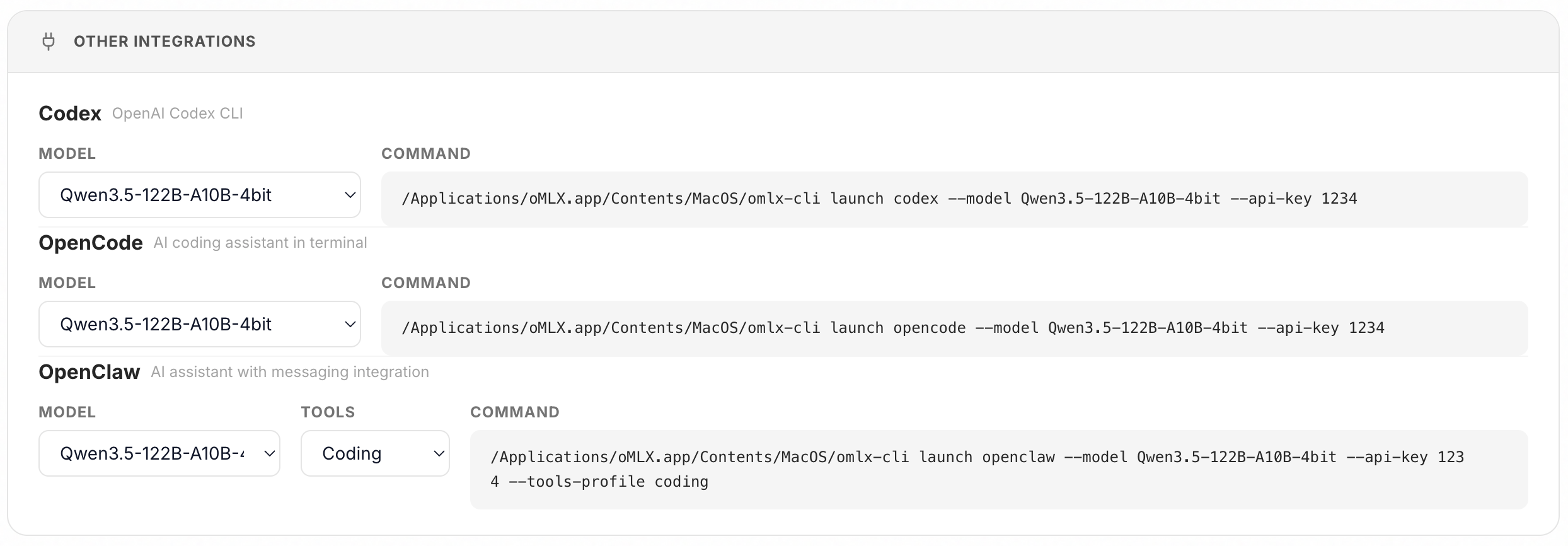
Integrations
Set up OpenClaw, OpenCode, Codex, Hermes Agent, Copilot, and Pi directly from the admin dashboard with a single click. No manual config editing required.
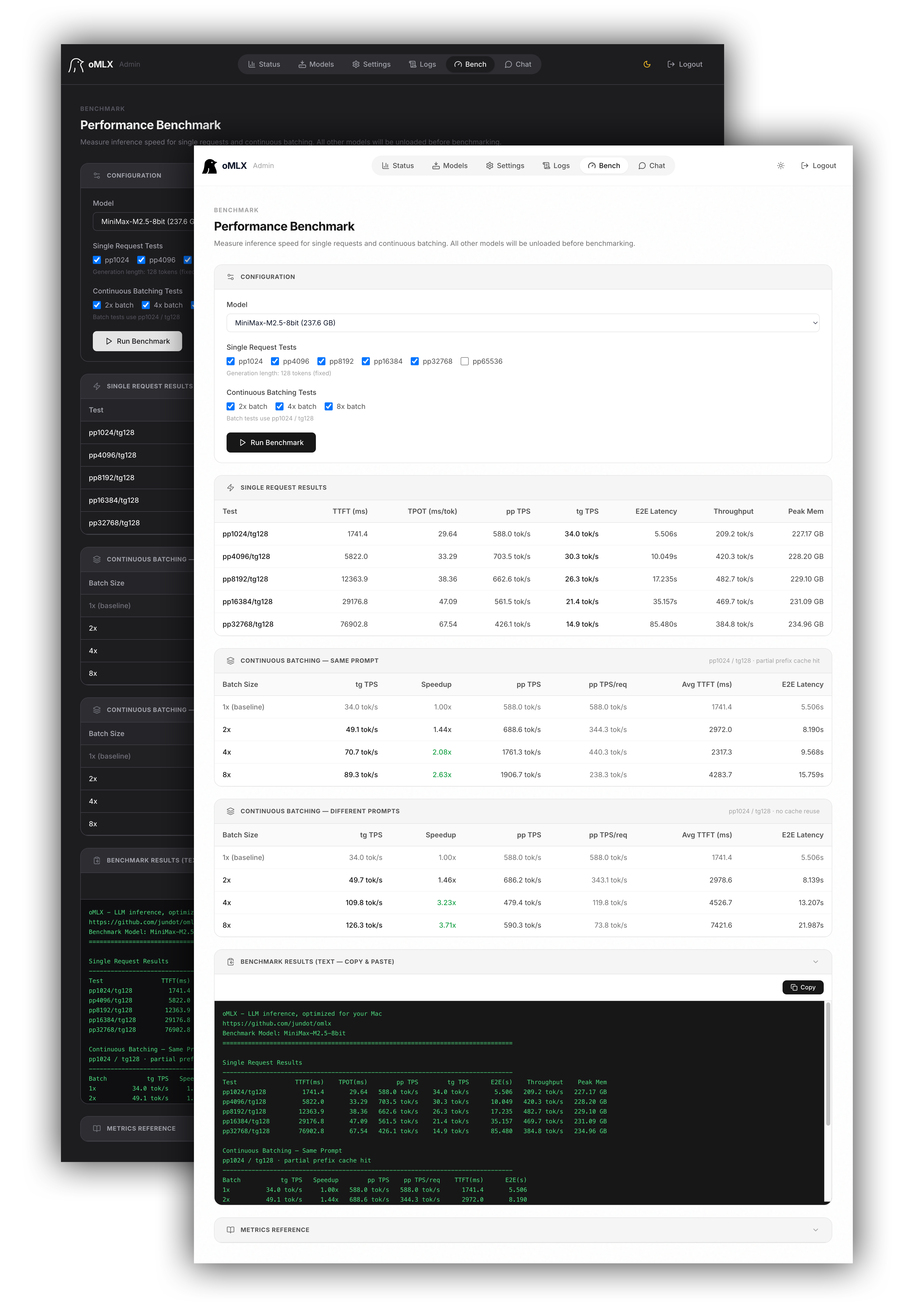
Performance Benchmark
One-click benchmarking from the admin panel. Measures prefill (PP) and text generation (TG) tokens per second, with partial prefix cache hit testing for realistic performance numbers.
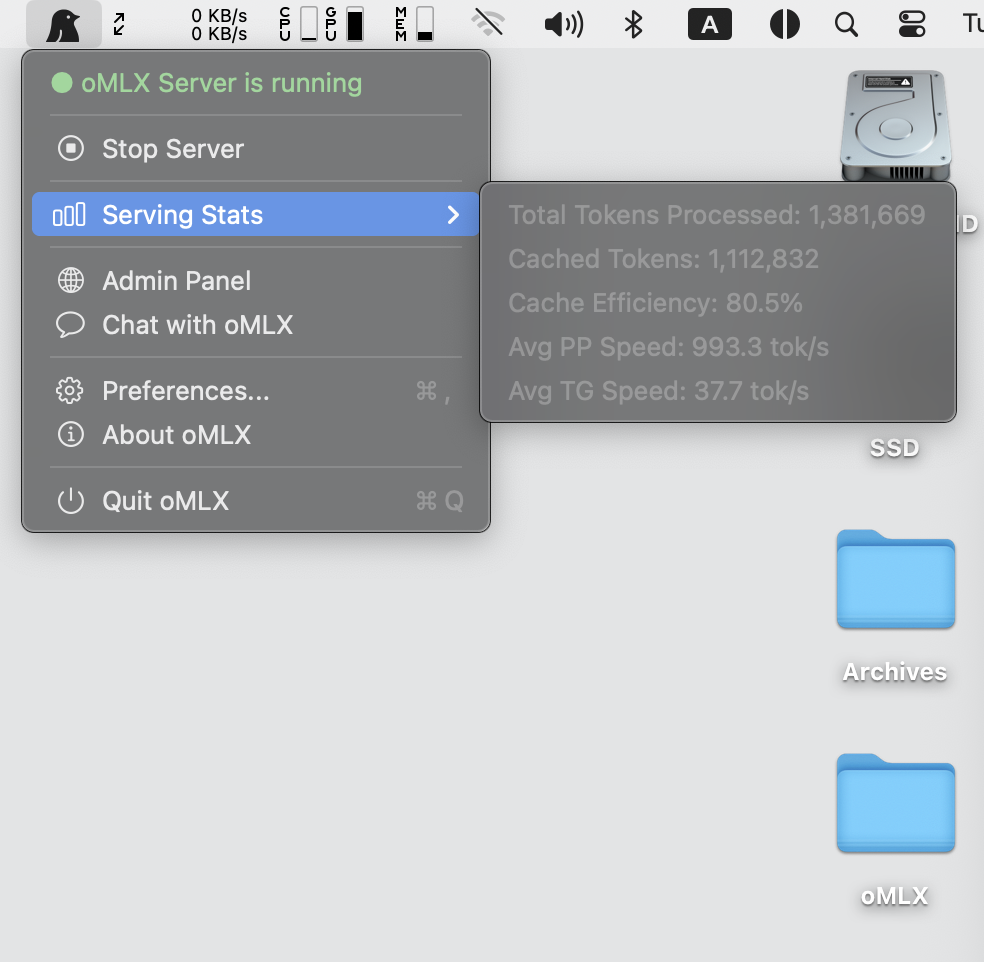
macOS Menubar App
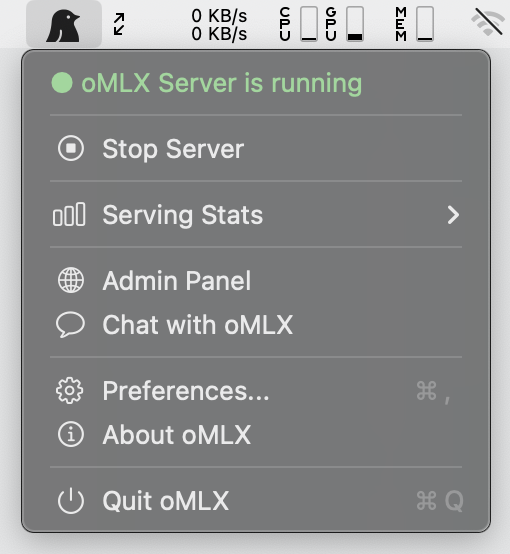
Native Swift / SwiftUI menubar app (not Electron). Start, stop, and monitor the server without opening a terminal. Includes persistent serving stats (survives restarts), auto-restart on crash, and built-in auto-update.
API Compatibility
Drop-in replacement for OpenAI and Anthropic APIs. Supports streaming usage stats (stream_options.include_usage), Anthropic adaptive thinking, and vision inputs (base64, URL).
| Endpoint | Description |
|---|---|
POST /v1/chat/completions | Chat completions (streaming) |
POST /v1/completions | Text completions (streaming) |
POST /v1/messages | Anthropic Messages API |
POST /v1/embeddings | Text embeddings |
POST /v1/rerank | Document reranking |
GET /v1/models | List available models |
Tool Calling & Structured Output
Supports all function calling formats available in mlx-lm, JSON schema validation, and MCP tool integration. Tool calling requires the model's chat template to support the tools parameter. The following model families are auto-detected via mlx-lm's built-in tool parsers:
| Model Family | Format |
|---|---|
| Llama, Qwen, DeepSeek, etc. | JSON <tool_call> |
| Qwen3.5 Series | XML <function=...> |
| Gemma | <start_function_call> |
| GLM (4.7, 5) | <arg_key>/<arg_value> XML |
| MiniMax | Namespaced <minimax:tool_call> |
| Mistral | [TOOL_CALLS] |
| Kimi K2 | <|tool_calls_section_begin|> |
| Longcat | <longcat_tool_call> |
Models not listed above may still work if their chat template accepts tools and their output uses a recognized <tool_call> XML format. For tool-enabled streaming, assistant text is emitted incrementally while known tool-call control markup is suppressed from visible content; structured tool calls are emitted after parsing the completed turn.
Models
Point --model-dir at a directory containing MLX-format model subdirectories. Two-level organization folders (e.g., mlx-community/model-name/) are also supported.
~/models/
├── Step-3.5-Flash-8bit/
├── Qwen3-Coder-Next-8bit/
├── gpt-oss-120b-MXFP4-Q8/
├── Qwen3.5-122B-A10B-4bit/
└── bge-m3/
Models are auto-detected by type. You can also download models directly from the admin dashboard.
| Type | Models |
|---|---|
| LLM | Any model supported by mlx-lm |
| VLM | Qwen3.5 Series, GLM-4V, Pixtral, and other mlx-vlm models |
| OCR | DeepSeek-OCR, DOTS-OCR, GLM-OCR |
| Embedding | BERT, BGE-M3, ModernBERT |
| Reranker | ModernBERT, XLM-RoBERTa |
CLI Configuration
# Managed background server (macOS app or Homebrew install)
omlx start
omlx stop
omlx restart

# Start with default settings (memory guard tier = balanced, manage via admin UI)
omlx serve --model-dir ~/models

# Choose a memory guard tier at startup
omlx serve --model-dir ~/models --memory-guard safe

# Set a custom memory guard ceiling in GB
omlx serve --model-dir ~/models --memory-guard-gb 48

# Enable SSD cache for KV blocks
omlx serve --model-dir ~/models --paged-ssd-cache-dir ~/.omlx/cache

# Set in-memory hot cache size
omlx serve --model-dir ~/models --hot-cache-max-size 20%

# Adjust max concurrent requests (default: 8)
omlx serve --model-dir ~/models --max-concurrent-requests 16

# With MCP tools
omlx serve --model-dir ~/models --mcp-config mcp.json

# HuggingFace mirror endpoint (for restricted regions)
omlx serve --model-dir ~/models --hf-endpoint https://hf-mirror.com

# API key authentication
omlx serve --model-dir ~/models --api-key your-secret-key
# Localhost-only: skip verification via admin panel global settings
All settings can also be configured from the web admin panel at /admin. Settings are persisted to ~/.omlx/settings.json, and CLI flags take precedence.
Architecture
FastAPI Server (OpenAI / Anthropic API)
    │
    ├── EnginePool (multi-model, LRU eviction, TTL, manual load/unload)
    │   ├── BatchedEngine (LLMs, continuous batching)
    │   ├── VLMEngine (vision-language models)
    │   ├── EmbeddingEngine
    │   └── RerankerEngine
    │
    ├── ProcessMemoryEnforcer (total memory limit, TTL checks)
    │
    ├── Scheduler (FCFS, configurable concurrency)
    │   └── mlx-lm BatchGenerator
    │
    └── Cache Stack
        ├── PagedCacheManager (GPU, block-based, CoW, prefix sharing)
        ├── Hot Cache (in-memory tier, write-back)
        └── PagedSSDCacheManager (SSD cold tier, safetensors format)
Development
CLI Server
git clone https://github.com/jundot/omlx.git
cd omlx
pip install -e ".[dev]"
pytest -m "not slow"
macOS App
The native SwiftUI app lives at apps/omlx-mac/. Requires Xcode 26.5+ and Python 3.11+. venvstacks is declared as a dev dependency so pip install -e ".[dev]" (or uv sync --dev) brings the pinned version in. The build script also falls back to uvx venvstacks or pipx run venvstacks if you prefer a host-global tool runner.
# Stage a runnable oMLX.app (xcodebuild + venvstacks Python layers + ad-hoc sign)
apps/omlx-mac/Scripts/build.sh release

# Result lands at apps/omlx-mac/build/Stage/oMLX.app
open apps/omlx-mac/build/Stage/oMLX.app

# Force a fresh venvstacks rebuild (otherwise it's cached by fingerprint)
apps/omlx-mac/Scripts/build.sh release --rebuild-donor

# Stage with optional GLM-5.2 / MiniMax M3 native custom kernels
apps/omlx-mac/Scripts/build.sh release --with-custom-kernel
First cold build takes 10–20 minutes (venvstacks Python layer assembly). Subsequent builds reuse the cached packaging/_export/ and finish in about 4 minutes. See packaging/README.md for the layer configuration and apps/omlx-mac/ for the Swift sources.
Contributing
Contributions are welcome! See Contributing Guide for details.
- Bug fixes and improvements
- Performance optimizations
- Documentation improvements
License
Apache 2.0
Acknowledgments
- MLX and mlx-lm by Apple
- mlx-vlm - Vision-language model inference on Apple Silicon
- vllm-mlx - oMLX started from vllm-mlx v0.1.0 and evolved significantly with multi-model serving, tiered KV caching, VLM with full paged cache support, an admin panel, and a macOS menu bar app
- venvstacks - Portable Python environment layering for the macOS app bundle
- mlx-embeddings - Embedding model support for Apple Silicon
- dflash-mlx - Block diffusion speculative decoding on Apple Silicon
- MTPLX - Lightning MTP's verify-shape Metal kernels are powered by MTPLX by Youssof Altoukhi, which also inspired the depth-k pipeline
- mlx-serve - The fused GDN verify prework kernel is adapted from mlx-serve's port of the mlxfast-challenge qwen35_packed_gdn_prework kernel
- SiliconScope - The menu bar statistics take their design and rendering approach from SiliconScope by Kennt Kim, which also inspired the energy-efficient re-render gating
Related repositories
AutoGPT is an open-source platform designed for building, deploying, and running AI agents that can carry out complete workflows. Users can define tasks in plain English or use a visual builder to shape each step. The project offers two primary paths: a managed, hosted AutoGPT Platform that handles infrastructure and model access for a fee, and a self-hosting option that is free but requires users to provide their own infrastructure and model API keys. Agents can run on demand, on schedules, or from triggers, connecting to over 45 platforms and hundreds of AI models. It's presented as a tool to automate various functions, from executive operations and sales research to marketing campaign drafts and incident triage in engineering.
Firecrawl is an API and set of SDKs for turning any URL into Markdown, structured JSON, or a screenshot, handling JS rendering and proxy rotation itself. It's built for feeding AI agents and LLM pipelines clean web data, with dedicated search, crawl, map, and agent endpoints, an MCP server, and SDKs for nine languages.
prompts.chat is an open-source library of prompts written for AI chat assistants, first released in December 2022 under the name Awesome ChatGPT Prompts. The GitHub project has since grown and now distributes prompts through a website, a CSV file, a Markdown file, and a Hugging Face dataset, alongside a self-hosting option, a CLI, an MCP server, and a Claude Code plugin.
prompts.chat is the largest open-source prompt library for AI, formerly called Awesome ChatGPT Prompts. It hosts curated prompts in CSV and Markdown, available as a public website, Hugging Face dataset, or self-hosted instance. The project supports multiple LLM providers including ChatGPT, Claude, Gemini, Llama, and Mistral. Self-hosting uses a Next.js setup wizard that configures authentication via GitHub, Google, or Azure AD, with PostgreSQL as the recommended database. CLI access, an MCP server, and a Claude Code plugin extend its reach into developer workflows. The codebase is MIT-licensed while prompt data falls under CC0. Its 166k GitHub stars make it an AI resource on the platform with 166k GitHub stars, and it has been cited by Harvard, Columbia, and Forbes.
Quick answers
How active is development on jundot/omlx?
The most recent commit recorded on jundot/omlx was 5 days ago, based on the GitHub push timestamp. The repository has 1.7k forks — one of the better signals of community interest.
How many stars does jundot/omlx have?
jundot/omlx has 19.8k GitHub stars — refresh the page for the live number, or check github.com/jundot/omlx. TopGit mirrors GitHub's count but does not claim minute-by-minute accuracy.
What else is in the AI Tools space?
jundot/omlx is tracked by TopGit under the AI Tools category, alongside 6 GitHub-tagged topics. Trending and Topics pages list peer repositories of comparable stars and language.
What language is jundot/omlx written in?
jundot/omlx is written primarily in Python. GitHub's language field is based on the largest share of bytes in the default branch.
What topics is jundot/omlx associated with?
GitHub's repository topics for jundot/omlx: "apple-silicon", "inference-server", "llm", "macos", "mlx", "openai-api". TopGit's editorial category is AI Tools.
Where do I read more about jundot/omlx?
This TopGit page is a snapshot — the READ ME tab shows the project's own README content (links stripped, images preserved). The GitHub repository at github.com/jundot/omlx is the definitive source.
Why is jundot/omlx categorized under AI Tools?
TopGit places jundot/omlx in the AI Tools category based on its GitHub topics and description (tagged: "apple-silicon", "inference-server", "llm"). Categories are assigned from real repository metadata, not editorial guesswork.
Read full README in the tab above.
Is omlx worth your time?
ChatGPT, Claude and Perplexity can all read this page. Ask one of them what it makes of omlx.