leoxiaobin/deep-high-resolution-net.pytorch is an AI-powered project on GitHub with 4.5k stars, written primarily in Cuda. The project is an official implementation of our CVPR2019 paper "Deep High-Resolution Representation Learning for Human Pose Estimation"
Snapshot summary built from the project's own GitHub metadata — there's no written TopGit review yet. The page will update automatically when a full review is published.
WHY NO REVIEW YET
TopGit writes full reviews for the most-starred, most-requested repositories. This page is a snapshot until then — see the READ ME tab for the original README in full.
Deep High-Resolution Representation Learning for Human Pose Estimation (CVPR 2019)
News
[2021/04/12] Welcome to check out our recent work on bottom-up pose estimation (CVPR 2021) HRNet-DEKR!
[2020/07/05] A very nice blog from Towards Data Science introducing HRNet and HigherHRNet for human pose estimation.
[2020/03/13] A longer version is accepted by TPAMI: Deep High-Resolution Representation Learning for Visual Recognition. It includes more HRNet applications, and the codes are available: semantic segmentation, objection detection, facial landmark detection, and image classification.
[2020/02/01] We have added demo code for HRNet. Thanks Alex Simes.
Visualization code for showing the pose estimation results. Thanks Depu!
[2019/08/27] HigherHRNet is now on ArXiv, which is a bottom-up approach for human pose estimation powerd by HRNet. We will also release code and models at Higher-HRNet-Human-Pose-Estimation, stay tuned!
Our new work High-Resolution Representations for Labeling Pixels and Regions is available at HRNet. Our HRNet has been applied to a wide range of vision tasks, such as image classification, objection detection, semantic segmentation and facial landmark.
Introduction
This is an official pytorch implementation of Deep High-Resolution Representation Learning for Human Pose Estimation.
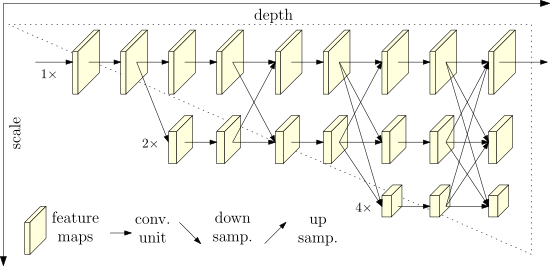
In this work, we are interested in the human pose estimation problem with a focus on learning reliable high-resolution representations. Most existing methods recover high-resolution representations from low-resolution representations produced by a high-to-low resolution network. Instead, our proposed network maintains high-resolution representations through the whole process.
We start from a high-resolution subnetwork as the first stage, gradually add high-to-low resolution subnetworks one by one to form more stages, and connect the mutli-resolution subnetworks in parallel. We conduct repeated multi-scale fusions such that each of the high-to-low resolution representations receives information from other parallel representations over and over, leading to rich high-resolution representations. As a result, the predicted keypoint heatmap is potentially more accurate and spatially more precise. We empirically demonstrate the effectiveness of our network through the superior pose estimation results over two benchmark datasets: the COCO keypoint detection dataset and the MPII Human Pose dataset.
pose_resnet_[50,101,152] is our previous work of Simple Baselines for Human Pose Estimation and Tracking
Results on COCO val2017 with detector having human AP of 56.4 on COCO val2017 dataset
Arch
Input size
#Params
GFLOPs
AP
Ap .5
AP .75
AP (M)
AP (L)
AR
AR .5
AR .75
AR (M)
AR (L)
pose_resnet_50
256x192
34.0M
8.9
0.704
0.886
0.783
0.671
0.772
0.763
0.929
0.834
0.721
0.824
pose_resnet_50
384x288
34.0M
20.0
0.722
0.893
0.789
0.681
0.797
0.776
0.932
0.838
0.728
0.846
pose_resnet_101
256x192
53.0M
12.4
0.714
0.893
0.793
0.681
0.781
0.771
0.934
0.840
0.730
0.832
pose_resnet_101
384x288
53.0M
27.9
0.736
0.896
0.803
0.699
0.811
0.791
0.936
0.851
0.745
0.858
pose_resnet_152
256x192
68.6M
15.7
0.720
0.893
0.798
0.687
0.789
0.778
0.934
0.846
0.736
0.839
pose_resnet_152
384x288
68.6M
35.3
0.743
0.896
0.811
0.705
0.816
0.797
0.937
0.858
0.751
0.863
pose_hrnet_w32
256x192
28.5M
7.1
0.744
0.905
0.819
0.708
0.810
0.798
0.942
0.865
0.757
0.858
pose_hrnet_w32
384x288
28.5M
16.0
0.758
0.906
0.825
0.720
0.827
0.809
0.943
0.869
0.767
0.871
pose_hrnet_w48
256x192
63.6M
14.6
0.751
0.906
0.822
0.715
0.818
0.804
0.943
0.867
0.762
0.864
pose_hrnet_w48
384x288
63.6M
32.9
0.763
0.908
0.829
0.723
0.834
0.812
0.942
0.871
0.767
0.876
Note:
Flip test is used.
Person detector has person AP of 56.4 on COCO val2017 dataset.
pose_resnet_[50,101,152] is our previous work of Simple Baselines for Human Pose Estimation and Tracking.
GFLOPs is for convolution and linear layers only.
Results on COCO test-dev2017 with detector having human AP of 60.9 on COCO test-dev2017 dataset
Arch
Input size
#Params
GFLOPs
AP
Ap .5
AP .75
AP (M)
AP (L)
AR
AR .5
AR .75
AR (M)
AR (L)
pose_resnet_152
384x288
68.6M
35.3
0.737
0.919
0.828
0.713
0.800
0.790
0.952
0.856
0.748
0.849
pose_hrnet_w48
384x288
63.6M
32.9
0.755
0.925
0.833
0.719
0.815
0.805
0.957
0.874
0.763
0.863
pose_hrnet_w48*
384x288
63.6M
32.9
0.770
0.927
0.845
0.734
0.831
0.820
0.960
0.886
0.778
0.877
Note:
Flip test is used.
Person detector has person AP of 60.9 on COCO test-dev2017 dataset.
pose_resnet_152 is our previous work of Simple Baselines for Human Pose Estimation and Tracking.
GFLOPs is for convolution and linear layers only.
pose_hrnet_w48* means using additional data from AI challenger for training.
Environment
The code is developed using python 3.6 on Ubuntu 16.04. NVIDIA GPUs are needed. The code is developed and tested using 4 NVIDIA P100 GPU cards. Other platforms or GPU cards are not fully tested.
Quick start
Installation
Install pytorch >= v1.0.0 following official instruction.
Note that if you use pytorch's version < v1.0.0, you should following the instruction at https://github.com/Microsoft/human-pose-estimation.pytorch to disable cudnn's implementations of BatchNorm layer. We encourage you to use higher pytorch's version(>=v1.0.0)
Clone this repo, and we'll call the directory that you cloned as ${POSE_ROOT}.
Install dependencies:
pip install -r requirements.txt
Make libs:
cd ${POSE_ROOT}/lib
make
Install COCOAPI:
# COCOAPI=/path/to/clone/cocoapi
git clone https://github.com/cocodataset/cocoapi.git $COCOAPI
cd $COCOAPI/PythonAPI
# Install into global site-packages
make install
# Alternatively, if you do not have permissions or prefer
# not to install the COCO API into global site-packages
python3 setup.py install --user
Note that instructions like # COCOAPI=/path/to/install/cocoapi indicate that you should pick a path where you'd like to have the software cloned and then set an environment variable (COCOAPI in this case) accordingly.
Init output(training model output directory) and log(tensorboard log directory) directory:
For MPII data, please download from MPII Human Pose Dataset. The original annotation files are in matlab format. We have converted them into json format, you also need to download them from OneDrive or GoogleDrive.
Extract them under {POSE_ROOT}/data, and make them look like this:
For COCO data, please download from COCO download, 2017 Train/Val is needed for COCO keypoints training and validation. We also provide person detection result of COCO val2017 and test-dev2017 to reproduce our multi-person pose estimation results. Please download from OneDrive or GoogleDrive.
Download and extract them under {POSE_ROOT}/data, and make them look like this:
Many other dense prediction tasks, such as segmentation, face alignment and object detection, etc. have been benefited by HRNet. More information can be found at High-Resolution Networks.
Other implementation
mmpose
ModelScope (中文)
timm
Citation
If you use our code or models in your research, please cite with:
@inproceedings{sun2019deep,
  title={Deep High-Resolution Representation Learning for Human Pose Estimation},
  author={Sun, Ke and Xiao, Bin and Liu, Dong and Wang, Jingdong},
  booktitle={CVPR},
  year={2019}
}

@inproceedings{xiao2018simple,
    author={Xiao, Bin and Wu, Haiping and Wei, Yichen},
    title={Simple Baselines for Human Pose Estimation and Tracking},
    booktitle = {European Conference on Computer Vision (ECCV)},
    year = {2018}
}

@article{WangSCJDZLMTWLX19,
  title={Deep High-Resolution Representation Learning for Visual Recognition},
  author={Jingdong Wang and Ke Sun and Tianheng Cheng and
          Borui Jiang and Chaorui Deng and Yang Zhao and Dong Liu and Yadong Mu and
          Mingkui Tan and Xinggang Wang and Wenyu Liu and Bin Xiao},
  journal   = {TPAMI}
  year={2019}
}
How active is development on leoxiaobin/deep-high-resolution-net.pytorch?
The most recent commit recorded on leoxiaobin/deep-high-resolution-net.pytorch was 2.2 years ago, based on the GitHub push timestamp. The repository has 918 forks — one of the better signals of community interest.
How does leoxiaobin/deep-high-resolution-net.pytorch compare to other AI Tools projects?
leoxiaobin/deep-high-resolution-net.pytorch is tracked by TopGit in the AI Tools category, with 4.5k GitHub stars and written in Cuda. Browse the AI Tools topic page on TopGit to compare it against similar projects by stars and activity.
How many stars does leoxiaobin/deep-high-resolution-net.pytorch have?
leoxiaobin/deep-high-resolution-net.pytorch has 4.5k GitHub stars — refresh the page for the live number, or check github.com/leoxiaobin/deep-high-resolution-net.pytorch. TopGit mirrors GitHub's count but does not claim minute-by-minute accuracy.
What is leoxiaobin/deep-high-resolution-net.pytorch?
leoxiaobin/deep-high-resolution-net.pytorch (leoxiaobin/deep-high-resolution-net.pytorch) is a Cuda project on GitHub. From the project's own README: The project is an official implementation of our CVPR2019 paper "Deep High-Resolution Representation Learning for Human Pose Estimation"
What language is leoxiaobin/deep-high-resolution-net.pytorch written in?
leoxiaobin/deep-high-resolution-net.pytorch is written primarily in Cuda. GitHub's language field is based on the largest share of bytes in the default branch.
What topics is leoxiaobin/deep-high-resolution-net.pytorch associated with?
GitHub's repository topics for leoxiaobin/deep-high-resolution-net.pytorch: "coco-keypoints-detection", "deep-high-resolution-net", "deep-learning", "high-resolution-net", "human-pose-estimation", "mpii", "mpii-dataset", "mscoco-keypoint". TopGit's editorial category is AI Tools.
Why is leoxiaobin/deep-high-resolution-net.pytorch categorized under AI Tools?
TopGit places leoxiaobin/deep-high-resolution-net.pytorch in the AI Tools category based on its GitHub topics and description (tagged: "coco-keypoints-detection", "deep-high-resolution-net", "deep-learning"). Categories are assigned from real repository metadata, not editorial guesswork.
Read full README in the tab above.
Still deciding about deep-high-resolution-net.pytorch?
One click hands the question to an AI along with this page — see what it says about deep-high-resolution-net.pytorch.

 /deep-high-resolution-net.pytorch