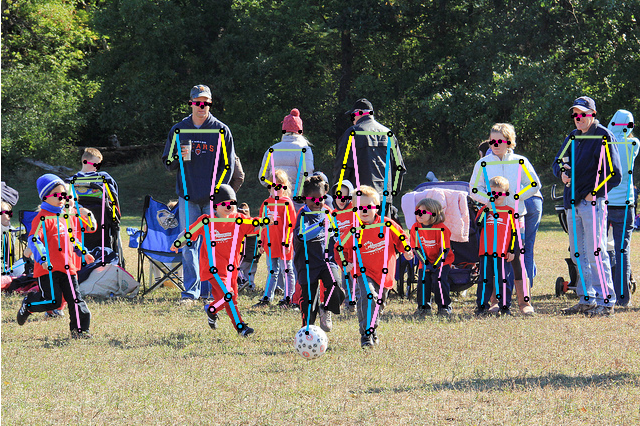
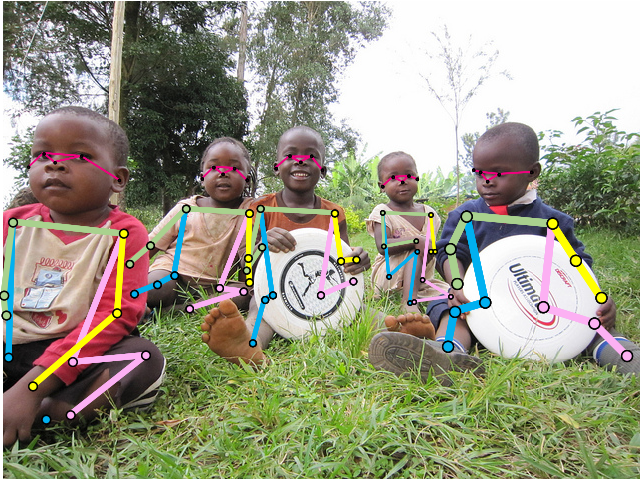
Snapshot của leoxiaobin/deep-high-resolution-net.pytorch: 4.5k★ · Cuda · AI Tools. The project is an official implementation of our CVPR2019 paper "Deep High-Resolution Representation Learning for Human Pose Estimation"
Tóm tắt dựng từ metadata GitHub của chính dự án — chưa có bài review TopGit. Trang sẽ tự động cập nhật khi bài review đầy đủ được xuất bản.
VÌ SAO CHƯA CÓ REVIEW
TopGit viết bài đầy đủ cho repo có nhiều sao nhất và được yêu cầu nhiều nhất. Trang này là snapshot trong thời gian chờ — xem README gốc ở tab READ ME.
Deep High-Resolution Representation Learning for Human Pose Estimation (CVPR 2019)
News
[2021/04/12] Welcome to check out our recent work on bottom-up pose estimation (CVPR 2021) HRNet-DEKR!
[2020/07/05] A very nice blog from Towards Data Science introducing HRNet and HigherHRNet for human pose estimation.
[2020/03/13] A longer version is accepted by TPAMI: Deep High-Resolution Representation Learning for Visual Recognition. It includes more HRNet applications, and the codes are available: semantic segmentation, objection detection, facial landmark detection, and image classification.
[2020/02/01] We have added demo code for HRNet. Thanks Alex Simes.
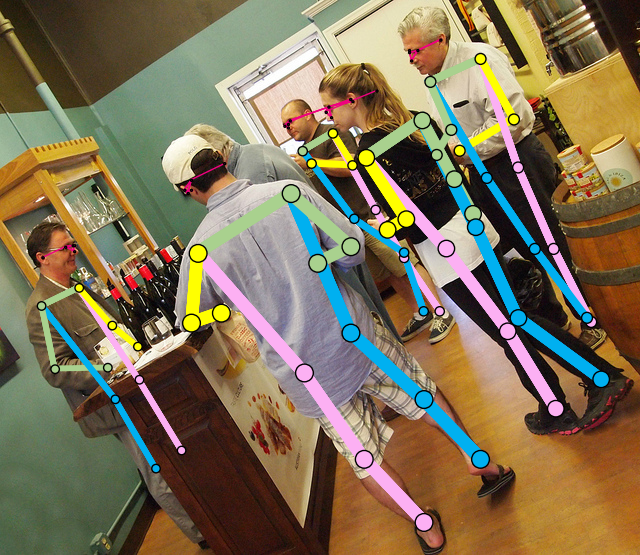
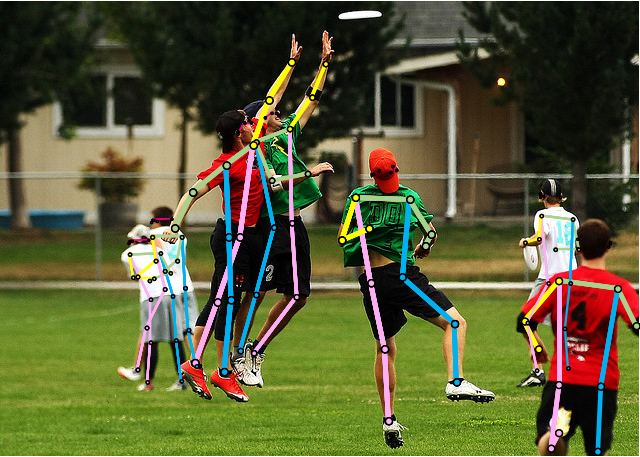
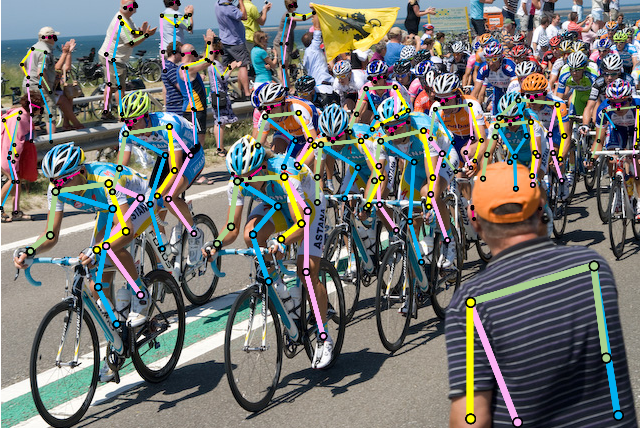
Visualization code for showing the pose estimation results. Thanks Depu!
[2019/08/27] HigherHRNet is now on ArXiv, which is a bottom-up approach for human pose estimation powerd by HRNet. We will also release code and models at Higher-HRNet-Human-Pose-Estimation, stay tuned!
Our new work High-Resolution Representations for Labeling Pixels and Regions is available at HRNet. Our HRNet has been applied to a wide range of vision tasks, such as image classification, objection detection, semantic segmentation and facial landmark.
Introduction
This is an official pytorch implementation of Deep High-Resolution Representation Learning for Human Pose Estimation.
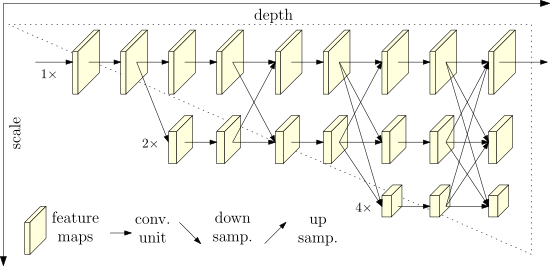
In this work, we are interested in the human pose estimation problem with a focus on learning reliable high-resolution representations. Most existing methods recover high-resolution representations from low-resolution representations produced by a high-to-low resolution network. Instead, our proposed network maintains high-resolution representations through the whole process.
We start from a high-resolution subnetwork as the first stage, gradually add high-to-low resolution subnetworks one by one to form more stages, and connect the mutli-resolution subnetworks in parallel. We conduct repeated multi-scale fusions such that each of the high-to-low resolution representations receives information from other parallel representations over and over, leading to rich high-resolution representations. As a result, the predicted keypoint heatmap is potentially more accurate and spatially more precise. We empirically demonstrate the effectiveness of our network through the superior pose estimation results over two benchmark datasets: the COCO keypoint detection dataset and the MPII Human Pose dataset.
pose_resnet_[50,101,152] is our previous work of Simple Baselines for Human Pose Estimation and Tracking
Results on COCO val2017 with detector having human AP of 56.4 on COCO val2017 dataset
Arch
Input size
#Params
GFLOPs
AP
Ap .5
AP .75
AP (M)
AP (L)
AR
AR .5
AR .75
AR (M)
AR (L)
pose_resnet_50
256x192
34.0M
8.9
0.704
0.886
0.783
0.671
0.772
0.763
0.929
0.834
0.721
0.824
pose_resnet_50
384x288
34.0M
20.0
0.722
0.893
0.789
0.681
0.797
0.776
0.932
0.838
0.728
0.846
pose_resnet_101
256x192
53.0M
12.4
0.714
0.893
0.793
0.681
0.781
0.771
0.934
0.840
0.730
0.832
pose_resnet_101
384x288
53.0M
27.9
0.736
0.896
0.803
0.699
0.811
0.791
0.936
0.851
0.745
0.858
pose_resnet_152
256x192
68.6M
15.7
0.720
0.893
0.798
0.687
0.789
0.778
0.934
0.846
0.736
0.839
pose_resnet_152
384x288
68.6M
35.3
0.743
0.896
0.811
0.705
0.816
0.797
0.937
0.858
0.751
0.863
pose_hrnet_w32
256x192
28.5M
7.1
0.744
0.905
0.819
0.708
0.810
0.798
0.942
0.865
0.757
0.858
pose_hrnet_w32
384x288
28.5M
16.0
0.758
0.906
0.825
0.720
0.827
0.809
0.943
0.869
0.767
0.871
pose_hrnet_w48
256x192
63.6M
14.6
0.751
0.906
0.822
0.715
0.818
0.804
0.943
0.867
0.762
0.864
pose_hrnet_w48
384x288
63.6M
32.9
0.763
0.908
0.829
0.723
0.834
0.812
0.942
0.871
0.767
0.876
Note:
Flip test is used.
Person detector has person AP of 56.4 on COCO val2017 dataset.
pose_resnet_[50,101,152] is our previous work of Simple Baselines for Human Pose Estimation and Tracking.
GFLOPs is for convolution and linear layers only.
Results on COCO test-dev2017 with detector having human AP of 60.9 on COCO test-dev2017 dataset
Arch
Input size
#Params
GFLOPs
AP
Ap .5
AP .75
AP (M)
AP (L)
AR
AR .5
AR .75
AR (M)
AR (L)
pose_resnet_152
384x288
68.6M
35.3
0.737
0.919
0.828
0.713
0.800
0.790
0.952
0.856
0.748
0.849
pose_hrnet_w48
384x288
63.6M
32.9
0.755
0.925
0.833
0.719
0.815
0.805
0.957
0.874
0.763
0.863
pose_hrnet_w48*
384x288
63.6M
32.9
0.770
0.927
0.845
0.734
0.831
0.820
0.960
0.886
0.778
0.877
Note:
Flip test is used.
Person detector has person AP of 60.9 on COCO test-dev2017 dataset.
pose_resnet_152 is our previous work of Simple Baselines for Human Pose Estimation and Tracking.
GFLOPs is for convolution and linear layers only.
pose_hrnet_w48* means using additional data from AI challenger for training.
Environment
The code is developed using python 3.6 on Ubuntu 16.04. NVIDIA GPUs are needed. The code is developed and tested using 4 NVIDIA P100 GPU cards. Other platforms or GPU cards are not fully tested.
Quick start
Installation
Install pytorch >= v1.0.0 following official instruction.
Note that if you use pytorch's version < v1.0.0, you should following the instruction at https://github.com/Microsoft/human-pose-estimation.pytorch to disable cudnn's implementations of BatchNorm layer. We encourage you to use higher pytorch's version(>=v1.0.0)
Clone this repo, and we'll call the directory that you cloned as ${POSE_ROOT}.
Install dependencies:
pip install -r requirements.txt
Make libs:
cd ${POSE_ROOT}/lib
make
Install COCOAPI:
# COCOAPI=/path/to/clone/cocoapi
git clone https://github.com/cocodataset/cocoapi.git $COCOAPI
cd $COCOAPI/PythonAPI
# Install into global site-packages
make install
# Alternatively, if you do not have permissions or prefer
# not to install the COCO API into global site-packages
python3 setup.py install --user
Note that instructions like # COCOAPI=/path/to/install/cocoapi indicate that you should pick a path where you'd like to have the software cloned and then set an environment variable (COCOAPI in this case) accordingly.
Init output(training model output directory) and log(tensorboard log directory) directory:
For MPII data, please download from MPII Human Pose Dataset. The original annotation files are in matlab format. We have converted them into json format, you also need to download them from OneDrive or GoogleDrive.
Extract them under {POSE_ROOT}/data, and make them look like this:
For COCO data, please download from COCO download, 2017 Train/Val is needed for COCO keypoints training and validation. We also provide person detection result of COCO val2017 and test-dev2017 to reproduce our multi-person pose estimation results. Please download from OneDrive or GoogleDrive.
Download and extract them under {POSE_ROOT}/data, and make them look like this:
Many other dense prediction tasks, such as segmentation, face alignment and object detection, etc. have been benefited by HRNet. More information can be found at High-Resolution Networks.
Other implementation
mmpose
ModelScope (中文)
timm
Citation
If you use our code or models in your research, please cite with:
@inproceedings{sun2019deep,
  title={Deep High-Resolution Representation Learning for Human Pose Estimation},
  author={Sun, Ke and Xiao, Bin and Liu, Dong and Wang, Jingdong},
  booktitle={CVPR},
  year={2019}
}

@inproceedings{xiao2018simple,
    author={Xiao, Bin and Wu, Haiping and Wei, Yichen},
    title={Simple Baselines for Human Pose Estimation and Tracking},
    booktitle = {European Conference on Computer Vision (ECCV)},
    year = {2018}
}

@article{WangSCJDZLMTWLX19,
  title={Deep High-Resolution Representation Learning for Visual Recognition},
  author={Jingdong Wang and Ke Sun and Tianheng Cheng and
          Borui Jiang and Chaorui Deng and Yang Zhao and Dong Liu and Yadong Mu and
          Mingkui Tan and Xinggang Wang and Wenyu Liu and Bin Xiao},
  journal   = {TPAMI}
  year={2019}
}
leoxiaobin/deep-high-resolution-net.pytorch có bao nhiêu sao?
leoxiaobin/deep-high-resolution-net.pytorch có 4.5k sao GitHub — tải lại trang để xem số mới nhất, hoặc xem trực tiếp github.com/leoxiaobin/deep-high-resolution-net.pytorch. TopGit phản chiếu số sao của GitHub nhưng không cam kết đến từng phút.
leoxiaobin/deep-high-resolution-net.pytorch có những chủ đề gì?
GitHub topics của leoxiaobin/deep-high-resolution-net.pytorch: "coco-keypoints-detection", "deep-high-resolution-net", "deep-learning", "high-resolution-net", "human-pose-estimation", "mpii", "mpii-dataset", "mscoco-keypoint". TopGit xếp repo vào nhóm AI Tools.
leoxiaobin/deep-high-resolution-net.pytorch còn đang phát triển không?
Commit gần nhất trên leoxiaobin/deep-high-resolution-net.pytorch là 2.2 năm trước (theo timestamp GitHub). Repo có 918 fork — một chỉ báo về mức độ quan tâm của cộng đồng.
leoxiaobin/deep-high-resolution-net.pytorch là gì?
leoxiaobin/deep-high-resolution-net.pytorch (leoxiaobin/deep-high-resolution-net.pytorch) là dự án Cuda trên GitHub. Theo mô tả gốc: The project is an official implementation of our CVPR2019 paper "Deep High-Resolution Representation Learning for Human Pose Estimation"
leoxiaobin/deep-high-resolution-net.pytorch so với các dự án AI Tools khác thế nào?
leoxiaobin/deep-high-resolution-net.pytorch được TopGit xếp vào nhóm AI Tools, với 4.5k sao GitHub và viết bằng Cuda. Xem trang chủ đề AI Tools trên TopGit để so sánh với các dự án tương tự theo số sao và mức độ hoạt động.
leoxiaobin/deep-high-resolution-net.pytorch viết bằng ngôn ngữ gì?
leoxiaobin/deep-high-resolution-net.pytorch chủ yếu viết bằng Cuda. Trường "language" của GitHub dựa trên phần lớn byte ở nhánh mặc định.
Vì sao leoxiaobin/deep-high-resolution-net.pytorch được xếp vào nhóm AI Tools?
TopGit xếp leoxiaobin/deep-high-resolution-net.pytorch vào nhóm AI Tools dựa trên GitHub topics và mô tả của repo (gắn thẻ: "coco-keypoints-detection", "deep-high-resolution-net", "deep-learning"). Việc phân loại dựa trên metadata thật của repo, không phải đoán theo cảm tính biên tập.
Đọc đầy đủ README ở tab phía trên.
deep-high-resolution-net.pytorch có đáng để bạn bỏ thời gian?
ChatGPT, Claude và Perplexity đều đọc được trang này. Hỏi thử xem họ nghĩ gì về deep-high-resolution-net.pytorch.

 /deep-high-resolution-net.pytorch