
microsoft/UFO

microsoft/UFO is a Python project with 10.2k stars in the AI Tools space. UFO³: Weaving the Digital Agent Galaxy
Snapshot summary built from the project's own GitHub metadata — there's no written TopGit review yet. The page will update automatically when a full review is published.
TopGit writes full reviews for the most-starred, most-requested repositories. This page is a snapshot until then — see the READ ME tab for the original README in full.
Snapshot
Top contributors
Show top contributors
UFO³  : Weaving the Digital Agent Galaxy
From Single Device Agent to Multi-Device Galaxy
📖 Language / 语言: English | 中文






📚 Quick Links: 🌌 UFO³ README • 🖥️ UFO² README • 📖 Full Documentation
🎯 Choose Your Path
|
|
 UFO² Desktop AgentOS
🎬 See UFO³ Galaxy in Action
Watch how UFO³ Galaxy orchestrates complex workflows across multiple devices:
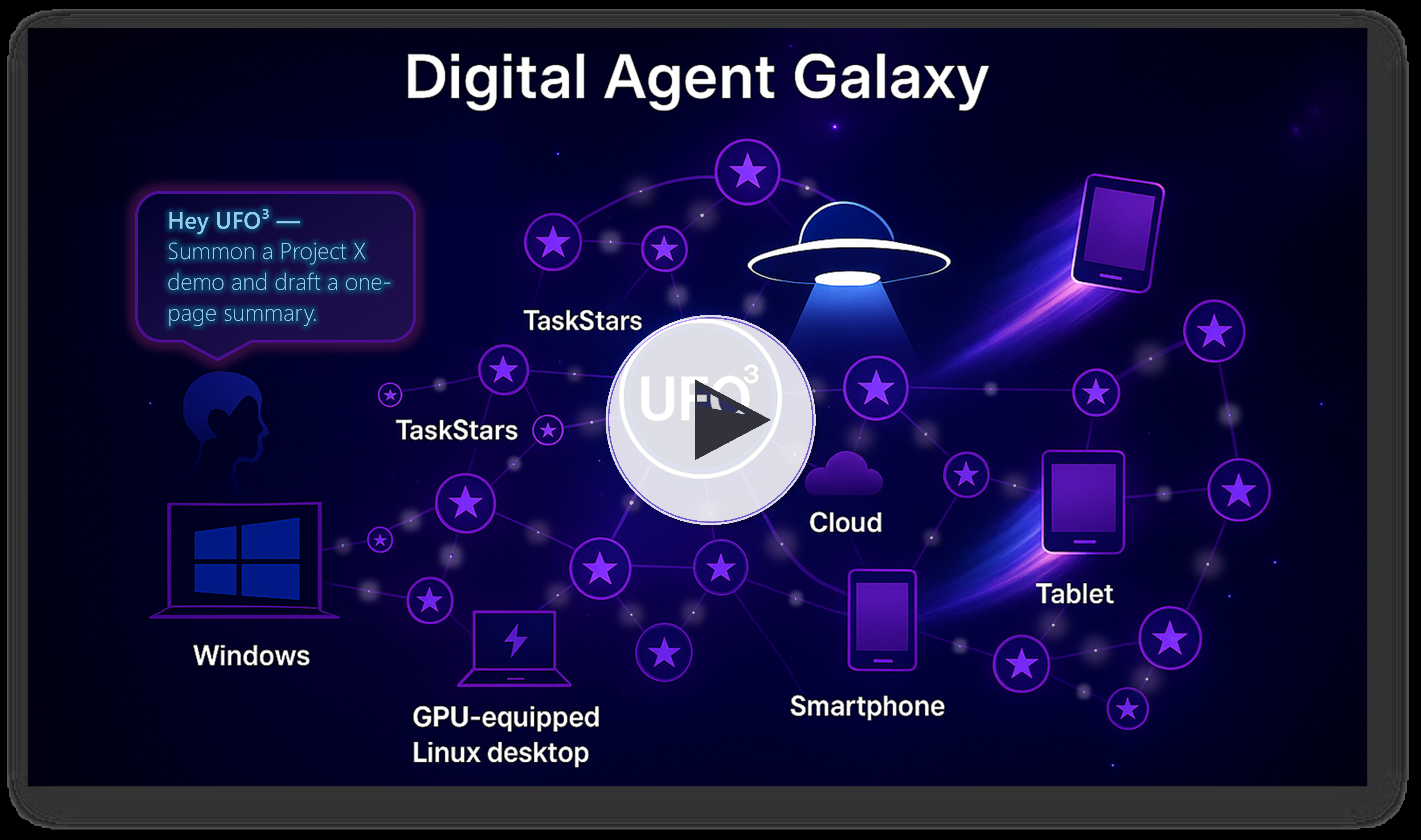
🎥 Click to watch: Cross-device task orchestration with UFO³ Galaxy
🌟 What's New in UFO³?
Evolution Timeline
%%{init: {'theme':'base', 'themeVariables': { 'primaryColor':'#E8F4F8','primaryTextColor':'#1A1A1A','primaryBorderColor':'#7CB9E8','lineColor':'#A8D5E2','secondaryColor':'#B8E6F0','tertiaryColor':'#D4F1F4','fontSize':'16px','fontFamily':'Segoe UI, Arial, sans-serif'}}}%%
graph LR
    A["<b>🎈 UFO</b><br/><span style='font-size:14px'>February 2024</span><br/><span style='font-size:13px; color:#666'><i>GUI Agent for Windows</i></span>"]
    B["<b>🖥️ UFO²</b><br/><span style='font-size:14px'>April 2025</span><br/><span style='font-size:13px; color:#666'><i>Desktop AgentOS</i></span>"]
    C["<b>🌌 UFO³ Galaxy</b><br/><span style='font-size:14px'>November 2025</span><br/><span style='font-size:13px; color:#666'><i>Multi-Device Orchestration</i></span>"]

    A -->|Evolve| B
    B -->|Scale| C

    style A fill:#E8F4F8,stroke:#7CB9E8,stroke-width:2.5px,color:#1A1A1A,rx:15,ry:15
    style B fill:#C5E8F5,stroke:#5BA8D0,stroke-width:2.5px,color:#1A1A1A,rx:15,ry:15
    style C fill:#A4DBF0,stroke:#3D96BE,stroke-width:2.5px,color:#1A1A1A,rx:15,ry:15
🚀 UFO³ = Galaxy (Multi-Device Orchestration) + UFO² (Device Agent)
UFO³ introduces Galaxy, a revolutionary multi-device orchestration framework that coordinates intelligent agents across heterogeneous platforms. Built on five tightly integrated design principles:
-
🌟 Declarative Decomposition into Dynamic DAG - Requests decomposed into structured DAG with TaskStars and dependencies for automated scheduling and runtime rewriting
-
🔄 Continuous Result-Driven Graph Evolution - Living constellation that adapts to execution feedback through controlled rewrites and dynamic adjustments
-
⚡ Heterogeneous, Asynchronous & Safe Orchestration - Capability-based device matching with async execution, safe locking, and formally verified correctness
-
🔌 Unified Agent Interaction Protocol (AIP) - WebSocket-based secure coordination layer with fault tolerance and automatic reconnection
-
🛠️ Template-Driven MCP-Empowered Device Agents - Lightweight toolkit for rapid agent development with MCP integration for tool augmentation
| Aspect | UFO² | UFO³ Galaxy |
|---|---|---|
| Architecture | Single Windows Agent | Multi-Device Orchestration |
| Task Model | Sequential ReAct Loop | DAG-based Constellation Workflows |
| Scope | Single device, multi-app | Multi-device, cross-platform |
| Coordination | HostAgent + AppAgents | ConstellationAgent + TaskOrchestrator |
| Device Support | Windows Desktop | Windows, Linux, Android (more coming) |
| Task Planning | Application-level | Device-level with dependencies |
| Execution | Sequential | Parallel DAG execution |
| Device Agent Role | Standalone | Can serve as Galaxy device agent |
| Complexity | Simple to Moderate | Simple to Very Complex |
| Learning Curve | Low | Moderate |
| Cross-Device Collaboration | ❌ Not Supported | ✅ Core Feature |
| Setup Difficulty | ✅ Easy | ⚠️ Moderate |
| Status | ✅ LTS (Long-Term Support) | ⚡ Active Development |
🎓 Migration Path
For UFO² Users:
- ✅ Keep using UFO² – Fully supported, actively maintained
- 🔄 Gradual adoption – Galaxy can use UFO² as Windows device agent
- 📈 Scale up – Move to Galaxy when you need multi-device capabilities
- 📚 Learning resources – Migration Guide
✨ Capabilities at a Glance
🌌 Galaxy Framework – What's Different?
🌟 Constellation PlanningBenefits:
|
🎯 Device AssignmentSmart Matching:
|
📊 OrchestrationOrchestration:
|
🪟 UFO² Desktop AgentOS – Core Strengths
UFO² serves dual roles: standalone Windows automation and Galaxy device agent for Windows platforms.
| Feature | Description | Documentation |
|---|---|---|
| Deep OS Integration | Windows UIA, Win32, WinCOM native control | Learn More |
| Hybrid Actions | GUI clicks + API calls for optimal performance | Learn More |
| Speculative Multi-Action | Batch predictions → 51% fewer LLM calls | Learn More |
| Visual + UIA Detection | Hybrid control detection for robustness | Learn More |
| Knowledge Substrate | RAG with docs, demos, execution traces | Learn More |
| Device Agent Role | Can serve as Windows executor in Galaxy orchestration | Learn More |
As Galaxy Device Agent:
- Receives tasks from ConstellationAgent via Galaxy orchestration layer
- Executes Windows-specific operations using proven UFO² capabilities
- Reports status and results back to TaskOrchestrator
- Participates in cross-device workflows seamlessly
🚀 Quick Start Guide
Choose your path and follow the detailed setup guide:
🌌 Galaxy Quick StartFor cross-device orchestration 📖 Complete Guide:
|
🪟 UFO² Quick StartFor Windows automation 📖 Complete Guide:
|
📋 Common Configuration
Both frameworks require LLM API configuration. Choose your provider:
OpenAI Configuration
For Galaxy (config/galaxy/agent.yaml):
CONSTELLATION_AGENT:
  REASONING_MODEL: false
  API_TYPE: "openai"
  API_BASE: "https://api.openai.com/v1/chat/completions"
  API_KEY: "sk-your-key-here"
  API_MODEL: "gpt-4o"
For UFO² (config/ufo/agents.yaml):
VISUAL_MODE: True
API_TYPE: "openai"
API_BASE: "https://api.openai.com/v1/chat/completions"
API_KEY: "sk-your-key-here"
API_MODEL: "gpt-4o"
Azure OpenAI Configuration
For Galaxy (config/galaxy/agent.yaml):
CONSTELLATION_AGENT:
  REASONING_MODEL: false
  API_TYPE: "aoai"
  API_BASE: "https://YOUR-RESOURCE.openai.azure.com"
  API_KEY: "your-azure-key"
  API_MODEL: "gpt-4o"
  API_DEPLOYMENT_ID: "your-deployment-id"
For UFO² (config/ufo/agents.yaml):
VISUAL_MODE: True
API_TYPE: "aoai"
API_BASE: "https://YOUR-RESOURCE.openai.azure.com"
API_KEY: "your-azure-key"
API_MODEL: "gpt-4o"
API_DEPLOYMENT_ID: "your-deployment-id"
💡 More LLM Options: See Model Configuration Guide for Qwen, Gemini, Claude, and more.
📚 Documentation Structure
🌌 Galaxy Documentation
📖 Technical Documentation:
|
🪟 UFO² Documentation
📖 Online Docs:
|
📢 Latest Updates
2025-11 – UFO³ Galaxy Framework Released 🌌
Major Research Breakthrough: Multi-Device Orchestration System
- 🌟 Declarative DAG Decomposition: TaskConstellation structure for workflow logic and dependencies
- 🔄 Dynamic Graph Evolution: Living constellation that adapts through controlled rewrites
- 🎯 Heterogeneous Orchestration: Safe, asynchronous execution with capability-based device matching
- 🔌 Unified AIP Protocol: WebSocket-based secure agent coordination with fault tolerance
- 🛠️ MCP-Empowered Agent Framework: Template-driven toolkit for rapid device agent development
- 📄 Research Paper: UFO³: Weaving the Digital Agent Galaxy
Key Features:
- First multi-device orchestration framework for GUI agents
- Result-driven adaptive execution instead of rigid workflows
- Model Context Protocol (MCP) integration for tool augmentation
- Formally verified correctness and concurrency safety guarantees
2025-04 – UFO² v2.0.0
- 📅 UFO² Desktop AgentOS released
- 🏗️ Enhanced architecture with AgentOS concept
- 📄 Technical Report published
- ✅ Entered Long-Term Support (LTS) status
2024-02 – Original UFO
- 🎈 First UFO release - UI-Focused agent for Windows
- 📄 Original Paper
- 🌍 Wide media coverage and adoption
📚 Citation
If you use UFO³ Galaxy or UFO² in your research, please cite the relevant papers:
UFO³ Galaxy Framework (2025)
@article{zhang2025ufo3,
  title={UFO$^3$: Weaving the Digital Agent Galaxy},
  author = {Zhang, Chaoyun and Li, Liqun and Huang, He and Ni, Chiming and Qiao, Bo and Qin, Si and Kang, Yu and Ma, Minghua and Lin, Qingwei and Rajmohan, Saravan and Zhang, Dongmei},
  journal = {arXiv preprint arXiv:2511.11332},
  year    = {2025},
}
UFO² Desktop AgentOS (2025)
@article{zhang2025ufo2,
  title   = {{UFO2: The Desktop AgentOS}},
  author  = {Zhang, Chaoyun and Huang, He and Ni, Chiming and Mu, Jian and Qin, Si and He, Shilin and Wang, Lu and Yang, Fangkai and Zhao, Pu and Du, Chao and Li, Liqun and Kang, Yu and Jiang, Zhao and Zheng, Suzhen and Wang, Rujia and Qian, Jiaxu and Ma, Minghua and Lou, Jian-Guang and Lin, Qingwei and Rajmohan, Saravan and Zhang, Dongmei},
  journal = {arXiv preprint arXiv:2504.14603},
  year    = {2025}
}
Original UFO (2024)
@article{zhang2024ufo,
  title   = {{UFO: A UI-Focused Agent for Windows OS Interaction}},
  author  = {Zhang, Chaoyun and Li, Liqun and He, Shilin and Zhang, Xu and Qiao, Bo and Qin, Si and Ma, Minghua and Kang, Yu and Lin, Qingwei and Rajmohan, Saravan and Zhang, Dongmei and Zhang, Qi},
  journal = {arXiv preprint arXiv:2402.07939},
  year    = {2024}
}
🌐 Media & Community
Media Coverage:
- 微软正式开源UFO²,Windows桌面迈入「AgentOS 时代」
- Microsoft's UFO: Smarter Windows Experience
- 下一代Windows系统曝光
- More coverage →
Community:
- 💬 GitHub Discussions
- 🐛 Issue Tracker
- 📧 Email: [email protected]
- 📺 YouTube Channel
🎨 Related Projects & Research
Microsoft Research:
- TaskWeaver – Code-first LLM agent framework for data analytics and task automation
GUI Agent Research:
- LLM-Brained GUI Agents Survey – Comprehensive survey of GUI automation agents
- Interactive Survey Site – Explore latest GUI agent research and developments
Multi-Agent Systems:
- UFO³ Galaxy represents a novel approach to multi-device orchestration, introducing the Constellation framework for coordinating heterogeneous agents across platforms
- Builds on multi-agent coordination research while addressing unique challenges of cross-device GUI automation
Benchmarks:
- Windows Agent Arena (WAA) – Evaluation benchmark for Windows automation agents
- OSWorld – Cross-application task evaluation suite
💡 FAQ
🤔 Should I use Galaxy or UFO²?
Start with UFO² if:
- You only need Windows automation
- You want quick setup and learning
- Tasks are relatively simple
Choose Galaxy if:
- You need cross-device coordination
- Tasks are complex and multi-step
- You want advanced orchestration
- You're comfortable with active development
Hybrid approach if:
- You want best of both worlds
- Some tasks are simple (UFO²), some complex (Galaxy)
- You're gradually migrating
⚠️ Will UFO² be deprecated?
No! UFO² has entered Long-Term Support (LTS) status:
- ✅ Actively maintained
- ✅ Bug fixes and security updates
- ✅ Performance improvements
- ✅ Full community support
- ✅ No plans for deprecation
UFO² is the stable, proven solution for Windows automation.
🔄 How do I migrate from UFO² to Galaxy?
Migration is gradual and optional:
- Phase 1: Learn – Understand Galaxy concepts
- Phase 2: Experiment – Try Galaxy with non-critical tasks
- Phase 3: Hybrid – Use both frameworks
- Phase 4: Migrate – Gradually move complex tasks to Galaxy
No forced migration! Continue using UFO² as long as it meets your needs.
See Migration Guide for details.
🎯 Can Galaxy do everything UFO² does?
Functionally: Yes. Galaxy can use UFO² as a Windows device agent.
Practically: It depends.
- For simple Windows tasks: UFO² standalone is easier and more streamlined
- For complex workflows: Galaxy orchestrates UFO² with other device agents
Recommendation: Use the right tool for the job. UFO² can work standalone or as Galaxy's Windows device agent.
📊 How mature is Galaxy?
Status: Active Development 🚧
Stable:
- ✅ Core architecture
- ✅ DAG orchestration
- ✅ Basic multi-device support
- ✅ Event system
In Development:
- 🔨 Advanced device types
- 🔨 Enhanced monitoring
- 🔨 Performance optimization
- 🔨 Extended documentation
Recommendation: Great for experimentation and non-critical workflows.
🔧 Can I extend or customize?
Both frameworks are highly extensible:
UFO²:
- Custom actions and automators
- Custom knowledge sources (RAG)
- Custom control detectors
- Custom evaluation metrics
Galaxy:
- Custom agents
- Custom device types
- Custom orchestration strategies
- Custom visualization components
See respective documentation for extension guides.
🤝 How can I contribute?
We welcome contributions to both UFO² and Galaxy!
Ways to contribute:
- 🐛 Report bugs and issues
- 💡 Suggest features and improvements
- 📝 Improve documentation
- 🧪 Add tests and examples
- 🔧 Submit pull requests
See CONTRIBUTING.md for guidelines.
⚠️ Disclaimer & License
Disclaimer: By using this software, you acknowledge and agree to the terms in DISCLAIMER.md.
License: This project is licensed under the MIT License.
Trademarks: Use of Microsoft trademarks follows Microsoft's Trademark Guidelines.
🚀 Ready to Get Started?
🌌 Explore GalaxyMulti-Device Orchestration |
🪟 Try UFO²Windows Desktop Agent |


© Microsoft 2025 | UFO³ is an open-source research project
⭐ Star us on GitHub | 🤝 Contribute | 📖 Read the docs | 💬 Join discussions
From Single Agent to Digital Galaxy
UFO³ - Weaving the Future of Intelligent Automation
Related repositories
Dify is an open-source LLM app platform that packages a visual workflow/agent builder, RAG pipeline, model provider management, and app-level APIs into one self-hostable (or cloud) stack, aimed at teams who want to skip stitching those pieces together themselves.
The TradingAgents LLM framework splits a trading decision across specialized agents — four analysts, bullish and bearish researchers, a trader, and a risk/portfolio manager — built on LangGraph, with the README explicitly framing it as a research tool rather than investment advice.
Firecrawl is an API and set of SDKs for turning any URL into Markdown, structured JSON, or a screenshot, handling JS rendering and proxy rotation itself. It's built for feeding AI agents and LLM pipelines clean web data, with dedicated search, crawl, map, and agent endpoints, an MCP server, and SDKs for nine languages.
AutoGPT is an open-source platform designed for building, deploying, and running AI agents that can carry out complete workflows. Users can define tasks in plain English or use a visual builder to shape each step. The project offers two primary paths: a managed, hosted AutoGPT Platform that handles infrastructure and model access for a fee, and a self-hosting option that is free but requires users to provide their own infrastructure and model API keys. Agents can run on demand, on schedules, or from triggers, connecting to over 45 platforms and hundreds of AI models. It's presented as a tool to automate various functions, from executive operations and sales research to marketing campaign drafts and incident triage in engineering.
Quick answers
How active is development on microsoft/UFO?
The most recent commit recorded on microsoft/UFO was 4 months ago, based on the GitHub push timestamp. The repository has 1.1k forks — one of the better signals of community interest.
How many stars does microsoft/UFO have?
microsoft/UFO has 10.2k GitHub stars — refresh the page for the live number, or check github.com/microsoft/UFO. TopGit mirrors GitHub's count but does not claim minute-by-minute accuracy.
Is microsoft/UFO open source?
Yes — microsoft/UFO ships under the MIT license, which makes its source code freely readable (and, depending on license terms, forkable and reusable). Source: github.com/microsoft/UFO.
What else is in the AI Tools space?
microsoft/UFO is tracked by TopGit under the AI Tools category, alongside 6 GitHub-tagged topics. Trending and Topics pages list peer repositories of comparable stars and language.
What topics is microsoft/UFO associated with?
GitHub's repository topics for microsoft/UFO: "agent", "automation", "copilot", "gui", "llm", "windows". TopGit's editorial category is AI Tools.
Where can I see microsoft/UFO in action?
The project maintains a homepage at https://microsoft.github.io/UFO/. The README tab on this page also usually contains screenshots and a quickstart.
Where do I read more about microsoft/UFO?
This TopGit page is a snapshot — the READ ME tab shows the project's own README content (links stripped, images preserved). The GitHub repository at github.com/microsoft/UFO is the definitive source.
Read full README in the tab above.
Is UFO worth your time?
ChatGPT, Claude and Perplexity can all read this page. Ask one of them what it makes of UFO.