Indexed by TopGit from live GitHub metadata: multica-ai/multica has 44.3k stars, written primarily in Go. The open-source managed agents platform. Turn coding agents into real teammates — assign tasks, track progress, compound skills.
Snapshot summary built from the project's own GitHub metadata — there's no written TopGit review yet. The page will update automatically when a full review is published.
WHY NO REVIEW YET
TopGit writes full reviews for the most-starred, most-requested repositories. This page is a snapshot until then — see the READ ME tab for the original README in full.
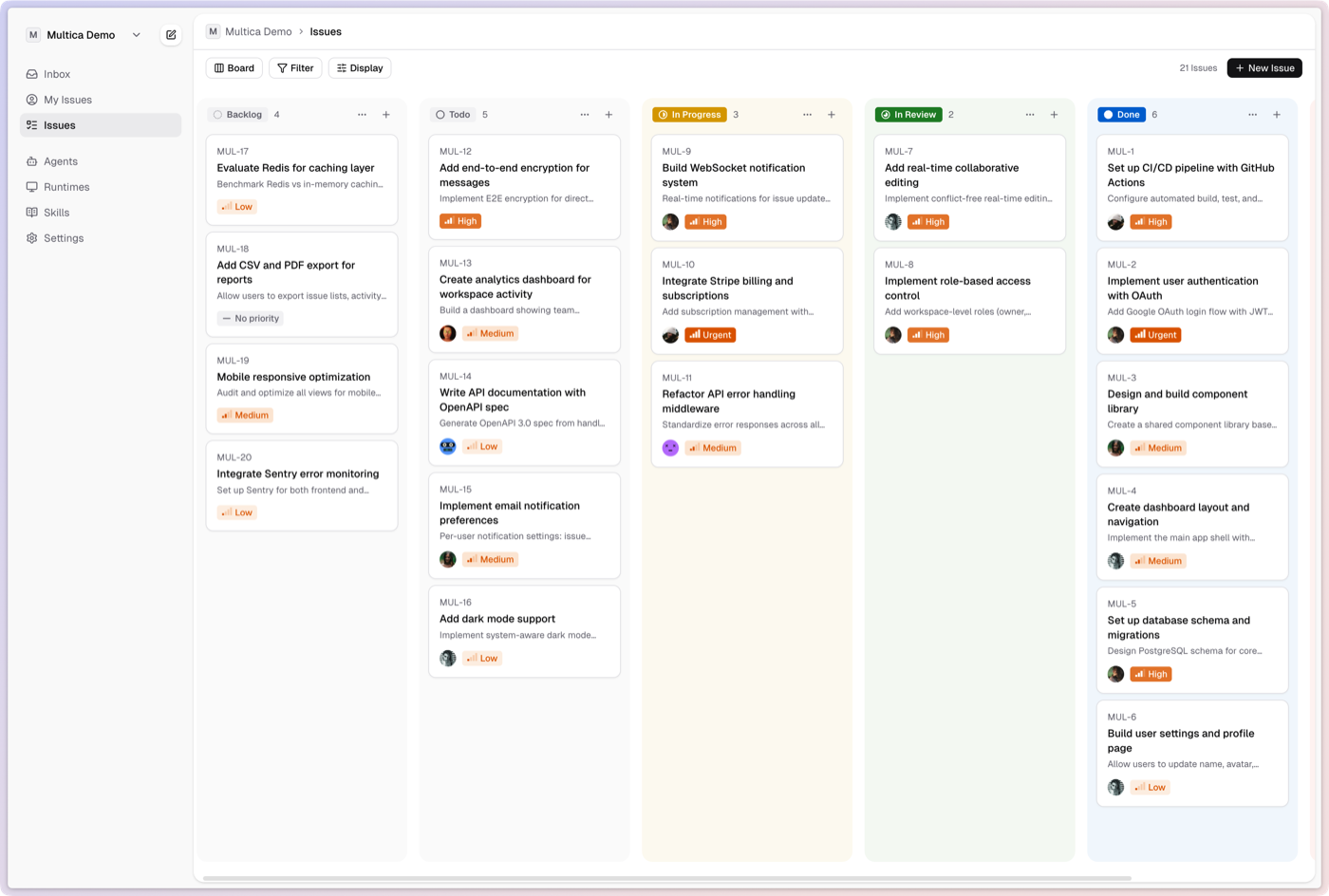
Multica turns coding agents into real teammates. Assign issues to an agent like you'd assign to a colleague — they'll pick up the work, write code, report blockers, and update statuses autonomously.
No more copy-pasting prompts. No more babysitting runs. Your agents show up on the board, participate in conversations, and compound reusable skills over time. Think of it as open-source infrastructure for managed agents — vendor-neutral, self-hosted, and designed for human + AI teams. Works with Claude Code, Codex, CodeBuddy, GitHub Copilot CLI, OpenCode, OpenClaw, Hermes, Pi, Cursor Agent, Kimi, Reasonix, Kiro CLI, Antigravity, Qoder CLI, and Trae CLI.
For larger teams, Squads add a stable routing layer: assign work to a group led by an agent, and the leader delegates to the right member.
Why "Multica"?
Multica — Multiplexed Information and Computing Agent.
The name is a nod to Multics, the pioneering operating system of the 1960s that introduced time-sharing — letting multiple users share a single machine as if each had it to themselves. Unix was born as a deliberate simplification of Multics: one user, one task, one elegant philosophy.
We think the same inflection is happening again. For decades, software teams have been single-threaded — one engineer, one task, one context switch at a time. AI agents change that equation. Multica brings time-sharing back, but for an era where the "users" multiplexing the system are both humans and autonomous agents.
In Multica, agents are first-class teammates. They get assigned issues, report progress, raise blockers, and ship code — just like their human colleagues. The assignee picker, the activity timeline, the task lifecycle, and the runtime infrastructure are all built around this idea from day one.
Like Multics before it, the bet is on multiplexing: a small team shouldn't feel small. With the right system, two engineers and a fleet of agents can move like twenty.
Features
Multica manages the full agent lifecycle: from task assignment to execution monitoring to skill reuse.
Agents as Teammates — assign to an agent like you'd assign to a colleague. They have profiles, show up on the board, post comments, create issues, and report blockers proactively.
Squads — group agents (and humans) under a leader agent and assign work to the squad. The leader decides who should pick it up, so routing stays stable as the team grows. @FrontendTeam instead of @alice-or-bob-or-carol.
Autonomous Execution — set it and forget it. Full task lifecycle management (enqueue, claim, start, complete/fail) with real-time progress streaming via WebSocket.
Autopilots — schedule recurring work for agents. Cron triggers, webhooks, or manual runs — each autopilot creates the issue and routes it to an agent automatically, so daily standups, weekly reports, and periodic audits run themselves.
Reusable Skills — every solution becomes a reusable skill for the whole team. Deployments, migrations, code reviews — skills compound your team's capabilities over time.
Unified Runtimes — one dashboard for all your compute. Local daemons and cloud runtimes, auto-detection of available CLIs, real-time monitoring.
Multi-Workspace — organize work across teams with workspace-level isolation. Each workspace has its own agents, issues, and settings.
Quick Install
macOS / Linux
Homebrew (recommended)
brew install multica-ai/tap/multica
Use brew upgrade multica-ai/tap/multica to keep the CLI current.
Use this if Homebrew is not available. The script installs the Multica CLI on macOS and Linux by using Homebrew when it is on PATH, otherwise it downloads the binary directly.
Then configure, authenticate, and start the daemon in one command:
multica setup # Connect to Multica Cloud, log in, start daemon
Self-hosting? Add --with-server to deploy a full Multica server on your machine:
This pulls the official Multica images from GHCR (latest stable by default). Requires Docker. See the Self-Hosting Guide for details.
If the selected GHCR tag has not been published yet, fall back to make selfhost-build from a checkout.
This pulls the official Multica images from GHCR (latest stable by default). Requires Docker. See the Self-Hosting Guide for details.
Getting Started
1. Set up and start the daemon
multica setup # Configure, authenticate, and start the daemon
The daemon runs in the background and auto-detects agent CLIs (claude, codex, codebuddy, copilot, opencode, openclaw, hermes, pi, cursor-agent, kimi, reasonix, kiro-cli, agy, qodercli, qoderclicn, traecli) on your PATH.
2. Verify your runtime
Open your workspace in the Multica web app. Navigate to Settings → Runtimes — you should see your machine listed as an active Runtime.
What is a Runtime? A Runtime is a compute environment that can execute agent tasks. It can be your local machine (via the daemon) or a cloud instance. Each runtime reports which agent CLIs are available, so Multica knows where to route work.
3. Create an agent
Go to Settings → Agents and click New Agent. Pick the runtime you just connected and choose a provider (Claude Code, Codex, CodeBuddy, GitHub Copilot CLI, OpenCode, OpenClaw, Hermes, Pi, Cursor Agent, Kimi, Reasonix, Kiro CLI, Antigravity, Qoder CLI, or Trae CLI). Give your agent a name — this is how it will appear on the board, in comments, and in assignments.
4. Assign your first task
Create an issue from the board (or via multica issue create), then assign it to your new agent. The agent will automatically pick up the task, execute it on your runtime, and report progress — just like a human teammate.
CLI
The multica CLI connects your local machine to Multica — authenticate, manage workspaces, and run the agent daemon.
Local daemon executing Claude Code, Codex, CodeBuddy, GitHub Copilot CLI, OpenCode, OpenClaw, Hermes, Pi, Cursor Agent, Kimi, Reasonix, Kiro CLI, Antigravity, Qoder CLI, or Trae CLI
Development
For contributors working on the Multica codebase, see the Contributing Guide.
Prerequisites: Node.js v20+, pnpm v10.28+, Go v1.26+, Docker
make dev
make dev auto-detects your environment (main checkout or worktree), creates the env file, installs dependencies, sets up the database, runs migrations, and starts all services.
See CONTRIBUTING.md for the full development workflow, worktree support, testing, and troubleshooting.
An iOS mobile client lives in apps/mobile/ — see its README for how to build it onto your own iPhone.
License
Multica License — the complete Apache License 2.0 text incorporated together with additional conditions — see NOTICE for attribution notices.
Providing Multica as a hosted service to third parties, or embedding it in a commercially distributed product, requires a commercial license obtained from the producer (condition 1a).
Unless the producer has granted a written branding waiver, the Multica LOGO, product name, and copyright information may not be removed or modified in a Multica user interface. The user interface is defined by derivation — including apps/web/, apps/desktop/, apps/mobile/, packages/views/, and packages/ui/ — and covers raw source, the frontend container image, and compiled desktop and mobile binaries (condition 1b).
Non-interface use (running only the server/ backend, the daemon, or the CLI) is exempt from the branding condition, but must retain the source and NOTICE attribution and state that the product is built on Multica, with a link back to this repository (condition 1c).
A branding waiver and a commercial license are separate grants; neither implies the other (condition 1d).
How does multica-ai/multica compare to other AI Tools projects?
multica-ai/multica is tracked by TopGit in the AI Tools category, with 44.3k GitHub stars and written in Go. Browse the AI Tools topic page on TopGit to compare it against similar projects by stars and activity.
How many stars does multica-ai/multica have?
multica-ai/multica has 44.3k GitHub stars — refresh the page for the live number, or check github.com/multica-ai/multica. TopGit mirrors GitHub's count but does not claim minute-by-minute accuracy.
Is multica-ai/multica open source?
TopGit's metadata for multica-ai/multica does not record a license. Most public repositories on GitHub ARE open source, but the exact terms vary — verify by opening the LICENSE file directly.
What else is in the AI Tools space?
multica-ai/multica is tracked by TopGit under the AI Tools category. Trending and Topics pages list peer repositories of comparable stars and language.
What is multica-ai/multica?
multica-ai/multica (multica-ai/multica) is a Go project on GitHub. From the project's own README: The open-source managed agents platform. Turn coding agents into real teammates — assign tasks, track progress, compound skills.
Where can I see multica-ai/multica in action?
The project maintains a homepage at https://multica.ai. The README tab on this page also usually contains screenshots and a quickstart.
Where do I read more about multica-ai/multica?
This TopGit page is a snapshot — the READ ME tab shows the project's own README content (links stripped, images preserved). The GitHub repository at github.com/multica-ai/multica is the definitive source.
 multica-ai/multica